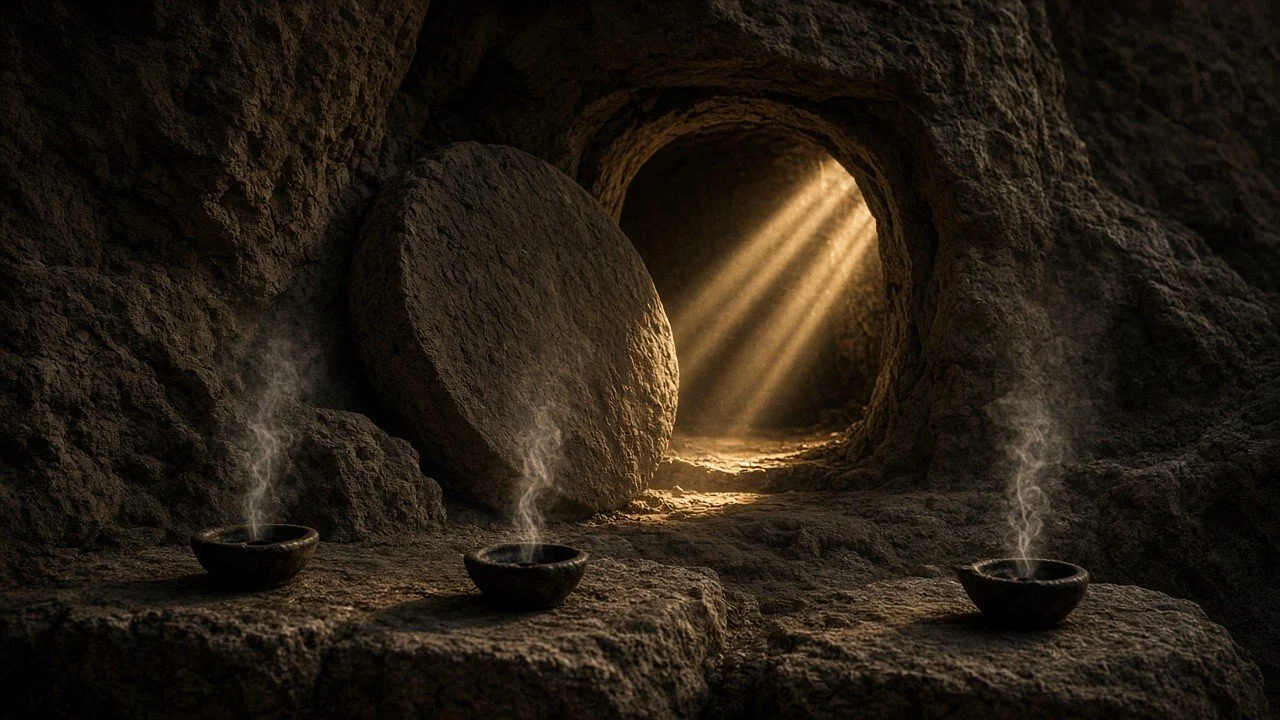
From the third day to Peter's three denials, why the number three keeps appearing in Jesus' life and the Bible, and what's text, tradition or myth.
Count The Threes In The Gospels And A Pattern Starts Staring Back At You
Peter denies Jesus three times. Jesus prays three times in Gethsemane. Three crosses stand at Golgotha. The darkness lasts three hours, and the charge over the cross is written in three languages. Then comes the line Christians have repeated for nearly two thousand years: raised "on the third day".
Once you notice it, the number three seems to be everywhere in the story of Jesus, and in the Hebrew Bible he read. Is it a hidden code? Is it coincidence? Or is it something more ordinary and, in some ways, more interesting: the way ancient Jewish writers told time, structured stories and made a point stick?
Every case below is checked against the text. It also separates four things that often get blurred together: what the Bible actually says, what later Christian tradition added, what scholars think is going on, and what belongs to numerology. Quotations are from the New Revised Standard Version Updated Edition (NRSVUE) unless marked otherwise.
The Third Day: The Three That Matters Most
The most important three in the New Testament is also the oldest. Writing to the church in Corinth in the mid-first century, Paul passes on what he calls a tradition "of first importance": that Christ died, "was buried and that he was raised on the third day in accordance with the scriptures" (1 Corinthians 15:3–4).
The Gospels phrase the timing in more than one way. In Mark, Jesus teaches that the Son of Man will be killed "and after three days rise again" (Mark 8:31). In Matthew's version of the same prediction, he will "on the third day be raised" (Matthew 16:21). On the road to Emmaus, a disciple sighs, "it is now the third day since these things took place" (Luke 24:21).
A modern reader counting hours finds a problem. If Jesus died on a Friday afternoon and the tomb was found empty early on Sunday, that is nowhere near 72 hours. The usual scholarly explanation is inclusive reckoning: in the ancient world, any part of a day could be counted as a day. Friday is day one, Saturday is day two, and Sunday is the third day.
The Hebrew Bible shows the idiom at work:
Esther: Esther asks her people to fast "for three days, night or day" (Esther 4:16), then goes to the king "on the third day" (Esther 5:1).
Rehoboam: The king tells the people to come back "after three days" (2 Chronicles 10:5). They return "on the third day, as the king had directed" (2 Chronicles 10:12).
The rabbis: A later rabbinic saying, preserved in the Jerusalem Talmud and attributed to Rabbi Eleazar ben Azariah, puts the principle neatly: a day and a night make one unit of time, and part of that unit counts as the whole.
So "after three days", "on the third day" and "three days and three nights" can all describe the same short span. That does not settle every debate. Some Christian groups argue for a Wednesday or Thursday crucifixion to get a literal 72 hours. But the idiom is the mainstream reading.
Jonah, Hosea And The Scriptures Behind "Three Days"
Paul says "in accordance with the scriptures", but he does not say which ones. Two passages are the usual candidates.
The first is Jonah. "Jonah was in the belly of the fish three days and three nights" (Jonah 1:17; 2:1 in Hebrew Bibles). In Matthew, Jesus applies it directly: "For just as Jonah was three days and three nights in the belly of the sea monster, so for three days and three nights the Son of Man will be in the heart of the earth" (Matthew 12:40).
The second is Hosea: "After two days he will revive us; on the third day he will raise us up, that we may live before him" (Hosea 6:2). In context, Hosea is talking about the nation of Israel being restored after judgement, not about an individual rising from a grave. Early Christians read it as foreshadowing; many historians read it as a text that was later reapplied. Both points are worth holding together.
The third day was already a loaded moment in Israel's story:
Abraham sees Mount Moriah, where he is to sacrifice Isaac, "on the third day" (Genesis 22:4).
Sinai: God tells Moses to have the people "prepare for the third day, because on the third day the Lord will come down upon Mount Sinai" (Exodus 19:11).
Cana: John even opens Jesus' first sign with the words "On the third day there was a wedding in Cana" (John 2:1).
In other words, the third day often marks the moment when God acts, a turning point after waiting.
Peter's Three Denials And Three Restorations
The most human three in the Gospels belongs to Peter. At the Last Supper, Jesus warns him: "Truly I tell you, this very night, before the cock crows, you will deny me three times" (Matthew 26:34). Mark adds a twist: "before the cock crows twice" (Mark 14:30). It happens exactly as predicted. Peter remembers the words, "and he broke down and wept" (Mark 14:72).
John's Gospel then gives the scene its echo. After the resurrection, by a charcoal fire on the shore of Galilee, Jesus asks Peter three times whether he loves him. "He said to him the third time, 'Simon son of John, do you love me?' Peter felt hurt because he said to him the third time, 'Do you love me?'" (John 21:17).
John does not spell out the link, but readers have made it since the early church: three denials, then three affirmations. Scholars who study biblical triads point out that a third repetition often does two jobs at once. It makes something final, and it sets up what comes next. Here the restoration is complete, and Jesus immediately goes on to describe Peter's future, and his death.
Three Temptations In The Wilderness
After his baptism, Jesus goes into the wilderness and is tempted. Mark mentions it in two verses (Mark 1:12–13) with no details. Matthew and Luke both give three specific tests (Matthew 4:1–11; Luke 4:1–13):
Bread: Turn stones into bread.
The Temple: Throw yourself down from the Temple and let angels catch you.
The kingdoms: Worship the devil in exchange for all the kingdoms of the world.
Matthew and Luke put the second and third in a different order, which is a small reminder that the Gospel writers arranged their material rather than taking dictation. Each time, Jesus answers with a line from Deuteronomy. Many readers see a deliberate contrast with Israel's testing in the wilderness. Here, where Israel stumbled, Jesus does not.
Three Gifts, But Not Three Kings
This is the one that surprises people. Matthew never says how many Magi there were. The text says they "offered him gifts of gold, frankincense, and myrrh" (Matthew 2:11). Three gifts, an unstated number of visitors.
Western tradition settled on three wise men, probably because of the three gifts. Eastern tradition at times numbered the Magi at twelve. The idea that they were kings appears by about the third century, and the familiar names, later standardised as Caspar (or Gaspar), Melchior and Balthasar, show up around the eighth century.
So the three gifts are biblical. The three kings are tradition. For more on how a sacred story gathers detail over the centuries, see our guide to the history of Good Friday and Easter.
Peter, James And John: The Inner Three
Jesus has twelve disciples, but the Gospels repeatedly single out three. "Six days later, Jesus took with him Peter and James and John and led them up a high mountain apart, by themselves. And he was transfigured before them" (Mark 9:2).
The same three are the only ones allowed into the room when Jesus raises Jairus's daughter (Mark 5:37). They are also taken further into Gethsemane than the others (Mark 14:33). They witness both his glory and his anguish.
Gethsemane: Praying Three Times
In the garden, Jesus prays that the cup might pass from him, and returns to find his disciples asleep. It happens again. Then: "So leaving them again, he went away and prayed for the third time, saying the same words" (Matthew 26:44). Mark has him come back "a third time" before the arrest (Mark 14:41).
Paul uses the same pattern for his own unanswered prayer: "Three times I appealed to the Lord about this, that it would leave me" (2 Corinthians 12:8). In both cases, asking three times reads less like a magic formula than a way of saying: he asked fully, and the answer was still no.
Golgotha: Three Crosses, Three Hours, Three Languages
The crucifixion scene is full of threes, though each comes from a different Gospel detail.
Three crosses: Jesus is crucified "with the criminals, one on his right and one on his left" (Luke 23:33).
Three hours of darkness: "When it was noon, darkness came over the whole land until three in the afternoon" (Mark 15:33). In the Greek, and in older translations, this runs from the sixth hour to the ninth.
Three languages: Pilate's inscription, "Jesus of Nazareth, the King of the Jews", was "written in Hebrew, in Latin, and in Greek" (John 19:19–20). Those were the languages of the local population, Roman power and the wider eastern Mediterranean. The NRSVUE notes that "Hebrew" here may mean Aramaic.
Christian interpreters have long read the three languages as a sign that the message was meant for the whole world. That is interpretation, not something John states.
The "Three-Year Ministry": Tradition, Not Text
Ask almost anyone and they will tell you Jesus' ministry lasted three years. No verse says so. Luke states only that Jesus "was about thirty years old when he began his work" (Luke 3:23).
The three-year figure comes from John's Gospel, which mentions three separate Passovers during Jesus' ministry (John 2:13; 6:4; 11:55). Counting from one to the next gives a ministry of at least two years, which tradition rounds to about three.
The other three Gospels mention only one Passover, the one at which Jesus dies. Some historians therefore argue for a much shorter public career. The historian E. P. Sanders suggests it lasted "perhaps less than one year". The honest answer is that the three-year ministry is an inference from John, not a stated fact. For how scholars weigh these questions, see our look at the evidence for the historical Jesus.
Threes In The Hebrew Bible
The pattern did not start with Jesus. The Hebrew Bible is full of triads:
Abraham's three visitors: "He looked up and saw three men standing near him" (Genesis 18:2). Christian artists later read the scene as a hint of the Trinity, though the text itself makes no such claim.
Daniel's three friends: Shadrach, Meshach and Abednego are thrown into the furnace. The king sees "four men unbound, walking in the middle of the fire" (Daniel 3:25).
The Aaronic blessing: It has three lines: "The Lord bless you and keep you; the Lord make his face to shine upon you and be gracious to you; the Lord lift up his countenance upon you and give you peace" (Numbers 6:24–26).
"Holy, holy, holy": The seraphim cry, "Holy, holy, holy is the Lord of hosts" (Isaiah 6:3). The threefold cry returns in Revelation 4:8.
Narrative rhythm: Samuel is called three times before he understands (1 Samuel 3:8). Elijah has the altar drenched three times before the fire falls (1 Kings 18:34).
Proverbs: "A threefold cord is not quickly broken" (Ecclesiastes 4:12).
Writing in a Jewish scholarly journal, one author notes that "threes abound" in Jewish life, from the three patriarchs to the three daily prayers and the three pilgrimage festivals.
The Trinity: A Later Doctrine, Not A Word In The Bible
Many people assume the threes all point to the Trinity. Here the evidence needs care. Neither the word "Trinity" nor the fully worked-out doctrine appears in the New Testament.
What the New Testament does contain are threefold formulas that later theologians built on. Jesus sends his disciples out "baptizing them in the name of the Father and of the Son and of the Holy Spirit" (Matthew 28:19). Paul closes a letter with "The grace of the Lord Jesus Christ, the love of God, and the communion of the Holy Spirit be with all of you" (2 Corinthians 13:13).
The doctrine of one God in three persons developed over several centuries of argument. It was shaped at the Council of Nicaea in 325 and took its classic form by the end of the fourth century. If you want to know how it sits beside Jewish and Muslim belief in one God, our explainer on the Abrahamic religions sets out the differences.
The King James Version's best-known Trinity verse has its own twist. 1 John 5:7 reads: "For there are three that bear record in heaven, the Father, the Word, and the Holy Ghost: and these three are one" (KJV). Textual scholars agree that these words, known as the Johannine Comma, are a later Latin addition. They are absent from the early Greek manuscripts. Modern translations, including the NRSVUE, leave them out.
So Why Three? What The Evidence Supports
There is no single reason. The most defensible explanations are fairly down to earth.
Time-telling: "The third day" was a natural Hebrew way to describe a short interval and the turning point that follows it.
Storytelling: Folklorists and biblical scholars alike recognise the "rule of three". The first two occurrences establish a pattern, and the third delivers the payoff. It works in jokes and fairy tales for the same reason.
Memory: For a culture that passed on teaching orally, triads are easy to remember. Faith, hope and love (1 Corinthians 13:13) is easy to recite.
Emphasis and completeness: A threefold action signals that something has been done fully: three denials, three prayers, three questions.
Theology, after the fact: Later Christians, reading back through the Bible with the Trinity in mind, found threes that had not originally been written as Trinitarian. That is a legitimate devotional reading, but it is not the same as the original meaning.
A Word Of Caution About Numerology
Look hard enough at any long text and numbers start forming patterns. The Bible also contains plenty of sevens, twelves and forties, and plenty of threes that carry no special weight at all.
Biblical scholars generally warn against treating numbers as a secret code. In many passages a number simply means the number. Where symbolism is intended, the context, not a chart of "meanings", should decide.
That caution matters, because the real story is more striking than any code. Some of the most familiar threes, such as the three kings and the three-year ministry, turn out to be tradition. The ones that are genuinely in the text, such as the third day, Peter's denials and Gethsemane, show ancient writers using a familiar pattern with real skill. That is part of why religions so often repeat the same story shapes.
Frequently Asked Questions
Was Jesus Really In The Tomb For Three Days?
By ancient inclusive reckoning, yes. Part of Friday, all of Saturday and part of Sunday count as three days. By modern hour-counting, it was closer to a day and a half. Most scholars read the Gospel phrases as an idiom, not a stopwatch.
Does The Bible Say There Were Three Wise Men?
No. Matthew 2:11 lists three gifts but does not give the number of Magi. The number three, their royal status and their names all come from later tradition.
Is The Word "Trinity" In The Bible?
No. The New Testament contains threefold formulas, such as Matthew 28:19 and 2 Corinthians 13:13, which later theologians developed into the doctrine of the Trinity over the following centuries.
Did Jesus' Ministry Last Three Years?
The Bible does not say. The figure is inferred from the three Passovers in John's Gospel. Matthew, Mark and Luke describe what could be a much shorter ministry.
Is The Number Three "Holy" In The Bible?
The Bible never declares any number holy. Three often marks completeness, emphasis or a turning point, but whether it carries symbolic meaning depends on the passage.
Sources
Bible Gateway: New Revised Standard Version Updated Edition (NRSVUE)
Journal of the Evangelical Theological Society: "On the Third Day"
Tyndale Bulletin: Heptadic Verbal Patterns in the Solomon Narrative
