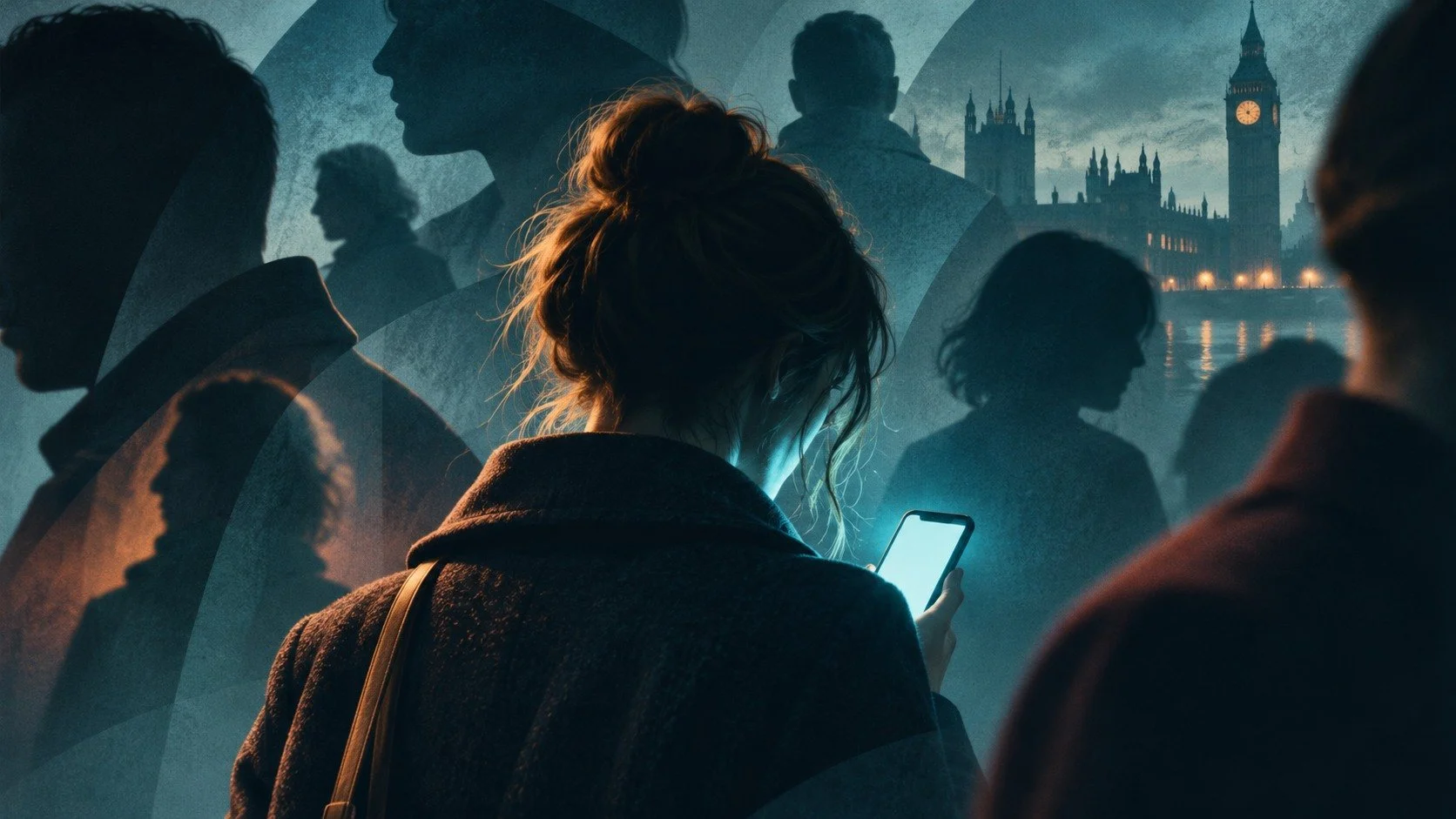
Understand Hunting Alice Bell true story in the context of Being Maxine Carr.
What Happens When Strangers Decide They Know Your Real Name?
Alice Bell is fictional. The frightening thing that happens to the women accused of being her has a real precedent. David Baddiel traces the idea for Channel 4’s six-part thriller to a documentary called Being Maxine Carr. It featured women who had been targeted because other people wrongly believed they were Carr, living under a new identity. What stayed with Baddiel was the predicament of someone being asked to disprove a story that strangers had already decided was true.
Hunting Alice Bell, created by Baddiel with Peter Bradshaw, begins with that predicament and invents its own mystery. Alex Roach plays Fran, whose family comes under pressure when she is accused of being the former lover of a serial killer. Simon Pegg plays the fictional Dr Jason Nash. Knowing the background will help explain why several women come under suspicion. The identity at the centre of the television mystery stays under wraps here.
What Did the Documentary Contribute?
Maxine Carr was convicted of conspiring to pervert the course of justice after giving a false alibi to Ian Huntley, the man convicted of murdering Holly Wells and Jessica Chapman in Soham. After Carr’s release she received protection for her new identity. Concealing that information served an identifiable purpose. It also created a circumstance in which somebody claiming to have recognised her could be extremely difficult for a neighbour or a reader to check.
Being Maxine Carr examined the experiences of four women caught in that situation. Baddiel says a couple of scenes in the drama draw on things he saw in the documentary. That is a reasonably precise account of the debt the fiction owes to it. It gives no grounds for treating one of the programme’s invented women as a disguised portrait of one of those people, or for assigning the fictional killer’s conduct to anyone in the real case.
Imagine the difference between two accusations. If a stranger says you were in a particular shop at noon yesterday, your whereabouts at noon might settle it. If the accusation is that your entire adult identity has been manufactured, presenting evidence of that identity may simply excite the people who believe in the cover-up. A driving licence with the name you use is exactly what they imagine a person living under another name would possess. The story can swallow any answer you give.
Who Are the Women at the Centre of the Story?
Fran discovers that other women have also attracted suspicion. The ensemble includes Amanda Abbington as Julie, Emily Barber as Vanessa, Toni O’Rourke as Ros and Christina Bennington as Charlotte. Bringing several possible targets into the story makes a point that a thriller about one hunted individual might miss. Several communities can become absolutely certain of mutually incompatible identifications.
A viewer following five characters can see the absurdity more easily than a neighbour hearing about just one. Within a single group, the evidence may seem to be accumulating. One person repeats a name, another supplies a photograph and a third reports that the story has reached another town. Follow the chain back and the appearance of three sources can collapse into one unverified allegation.
The drama adds a further complication. A person wrongly accused of something dreadful need not be wholly candid about the rest of their life. Having a secret is an ordinary human condition. A whodunnit trains its audience to interpret concealment as a clue. Here the audience has to make room for the possibility that somebody might hide a private matter for perfectly intelligible reasons, especially once strangers have begun examining everything they do.
Why Give the Online Investigator an Audience?
Baddiel has described the importance of the character who calls himself True Crime Buster. A person trying to find something out in private can quietly change their mind. A self-appointed investigator who has built a public identity around finding the truth has more to lose. Admitting a mistake can mean disappointing followers whose attention has become part of the reward for investigating.
This gives a rumour two lives. In the first it is a claim about the target. In the second it is evidence of the person making the claim being bold enough to say what others supposedly fear to say. A correction has to compete with both. The people who circulated the original post can find a reason to defend it even after its factual basis has weakened.
The writers also make this a domestic story. Fran’s family have to live in the gap between knowing a person intimately and being able to prove things about her to outsiders. A partner or child cannot stop people looking by offering a better account of the woman they know. Even an expression of loyalty can be recast as evidence that she has deceived the people closest to her.
Why Did the Idea Become a Six-Part Series?
Baddiel and Bradshaw originally wrote a film that did not get made. Developing it for television meant finding enough distinct human consequences to sustain six episodes. Polly Buckle and Kate Verghese joined the writing team. Paul Walker directed throughout. The extended format gives the writers space to show a rumour reaching different households and changing as it travels.
It also changes the audience’s position. In a short film we might meet an accuser, discover the mistake and leave with our own judgement comfortably intact. A serial invites us to suspect different people over time. Each cliffhanger creates an opportunity to make exactly the kind of confident inference we would condemn in someone sharing photographs of a stranger. The difference is that viewers are playing within a fiction whose participants have agreed to be looked at.
Why Does the Title Put the Viewer on the Side of the Hunt?
Even before the opening scene, the verb in Hunting Alice Bell suggests an objective the viewer might share. A conventional mystery rewards the person who looks most carefully, spots a contradiction or distrusts the plausible explanation. Here those same habits can look intrusive and dangerous when exercised by a crowd. The title gives the audience a reason to be curious, then leaves it to decide how comfortable it feels about the company it is keeping.
The real documentary and the fictional series offer quite different answers to that discomfort. In the documentary a misidentified woman has a life outside the camera, and a false allegation can follow her when the credits finish. In the thriller an invented detail can safely be treated as a clue planted by a writer. Remembering which world a clue belongs to is a small but important part of watching a drama drawn from real experiences.
When Does Hunting Alice Bell Start?
The Channel 4 premiere is scheduled for Wednesday 11 November 2026 at 9pm. It is a psychological thriller with elements of family drama and social satire. Viewers looking for an account of the Soham investigation will find a different subject here. Its creative starting point comes later in the real chronology, with what happened when ordinary women found strangers comparing their faces and histories to somebody else’s.
The question the drama brings home is more unsettling than whether you could identify a criminal. If five neighbours in five different places all feel sure they have recognised the same woman, how would any one of them discover that their certainty has carried them further than their evidence?
Sources
Hunting Alice Bell Press Pack | Channel 4 — Official credits, release details and character names.
Q&A with David Baddiel, Co-Creator, Co-Writer and Executive Producer | Channel 4 — Baddiel explains the documentary influence and the writing process.
Channel 4 announces psychological thriller Hunting Alice Bell from Clapperboard Studios | Channel 4 — The original commissioning announcement describes the fictional premise.
Next Reads
Why Eyewitnesses Get Things Wrong: Memory, Confidence And Misidentification — Explore why sincere recognition can be mistaken.
Can a Celebrity Stop a Newspaper Publishing Allegations? How Privacy Injunctions Work in England and Wales — See how privacy and publication are weighed in a real legal setting.
How AI Actually Learns: Training Data, Predictions And Hallucinations — Understand how patterns can be mistaken for certainty.
