Understand Haymitch Games tape explained in the context of Catching Fire.
What Could Katniss Possibly Miss When the Capitol Shows Her the Winning Blow?
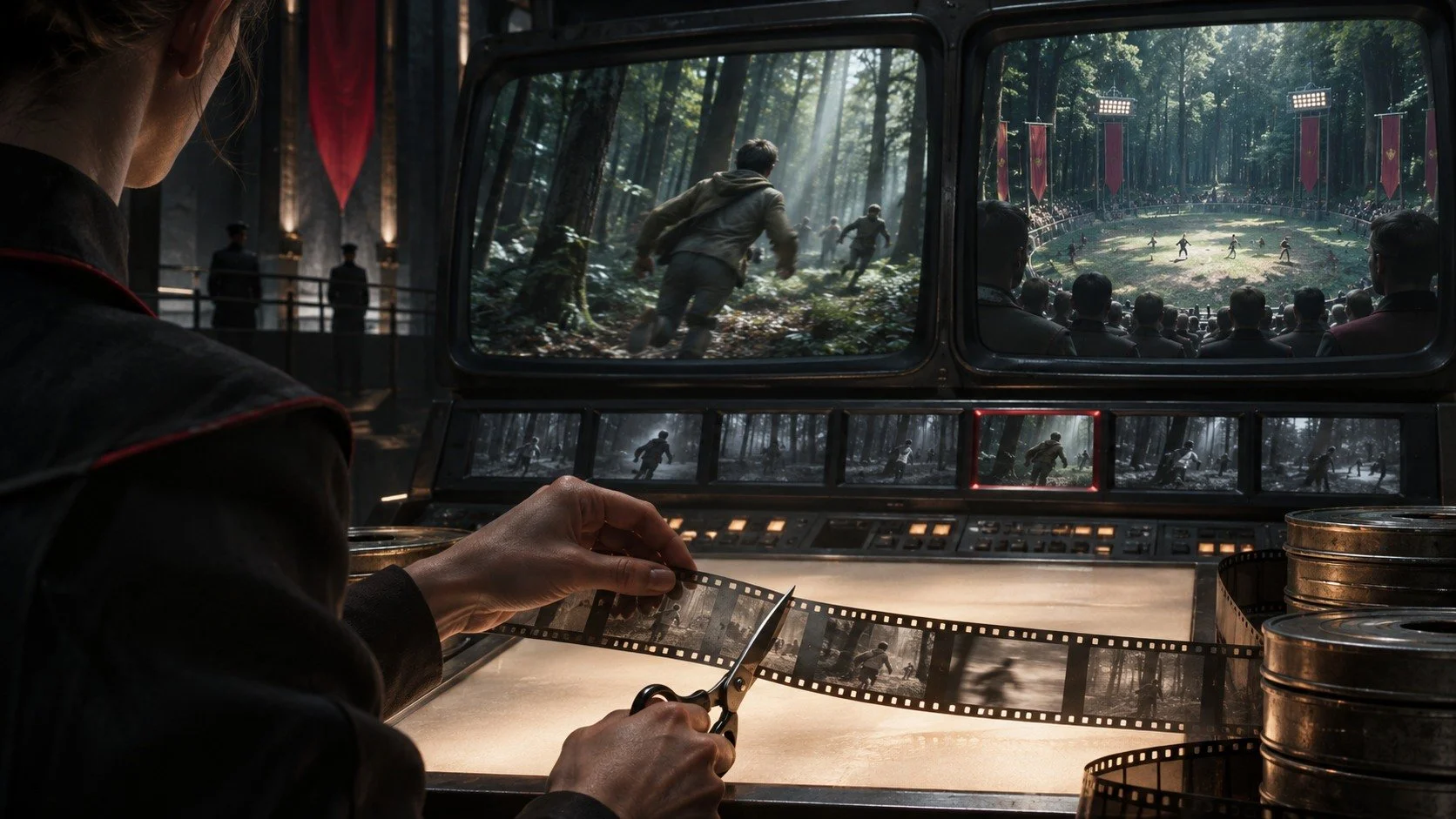
In Catching Fire, Katniss and Peeta watch a recording of the Games Haymitch won. They see a young District 12 tribute explore the edge of the arena, discover what its force field does to objects thrown at it, and turn the discovery against his final opponent. They understand something that a less experienced viewer might miss. A boy has made the Capitol’s own equipment kill on his behalf. What they cannot reconstruct is the larger rebellion the recording has been made to hide.
Major book spoilers follow for Catching Fire and Sunrise on the Reaping, including the fates of tributes and the result of the Second Quarter Quell. This comparison concerns Suzanne Collins’s novels. It does not assume the forthcoming film retains every detail of the prequel or that viewers of the earlier film saw the tape scene from the book.
Who Is Offering Katniss the Evidence?
Katniss and Peeta are preparing for an arena populated by previous victors. They need to understand how competitors think, which skills they have and how they behaved under pressure. An old broadcast looks like useful intelligence. The pictures include genuine events, and the two viewers have the rare advantage of knowing from inside an arena what a gesture or change of terrain can mean.
The weakness in their method is access. They can study a recording because somebody decided which images to preserve and distribute. The surviving version need not show everything different cameras captured, still less everything competitors understood about their own actions. A violent outcome can be accurately recorded while the sequence of choices that produced it is removed.
Collins builds an unusually fair trap for the reader. People who read Catching Fire years before the prequel had much the same information as Katniss. They could speculate about Haymitch’s past but could not consult the book that would eventually be written from his perspective. The later novel gives readers an experience unavailable to Katniss on the sofa. They can put the official record beside a participant’s account and examine the gap.
The First Edit Happens Before Anyone Enters the Arena
The machinery of the reaping requires the audience to accept that the people introduced as tributes are the people selected by the prescribed public ritual. In the prequel that process breaks down in District 12. Woodbine Chance is selected, tries to escape and is killed. Haymitch is drawn into his place. The state can present a neat list of entrants only after a messier, more violent selection has already taken place.
Watch what that changes about Haymitch’s story. A boy randomly selected under the rules could still hate the Capitol, but a boy who knows how easily the officials can alter the outcome has first-hand knowledge of their investment in appearances. From the beginning there are two events: the one the ceremony is supposed to record and the one that actually puts Haymitch on the train.
Louella McCoy makes the difference more disturbing. She is a girl Haymitch knows. When she dies during the parade in the Capitol, the authorities arrange a substitute, the girl he calls Lou Lou. Someone who knew Louella can see the difference. A viewer in another district, introduced to the tributes through a broadcast, has hardly any means of doing so. The idea of a single, complete official record fails before the arena doors open.
The state does not have to persuade Haymitch that his friend is alive. It needs the great majority of viewers, who never knew her, to accept that the girl on the screen is the person named in the programme. That distinction helps explain the particular cruelty of making him participate. A witness to the substitution is made to stand beside the substitute and lend the arrangement his credibility.
The Second Edit Changes What Teamwork Means
A highlights recording can show tributes moving together. It can leave out the terms on which they agreed to help one another. In Sunrise on the Reaping, the Newcomers’ alliance and Ampert’s involvement give collective action a political significance beyond sheltering together until the Career tributes have been defeated. Kids who are supposed to be rivals can choose goals the organisers never offered them.
A contest designed to end with one survivor gives official editors a ready explanation for almost any alliance. People cooperate to improve their prospects. When only one of them lives, an editor can tell the whole story backwards from that result. Earlier acts of generosity become tactical bargains. Any person who helped the eventual winner can be fitted into a narrative about that winner’s remarkable individual qualities.
The reader of the prequel has access to plans directed against the arena itself. Haymitch’s part in attempts to damage its infrastructure matters because it identifies another possible object of violence. The children have been supplied with enemies in the form of other children. They begin to distinguish the people attacking them at close range from the people who designed the conditions in which those attacks make sense.
For Katniss, that knowledge would have had immediate practical value. She is facing another Quell in which alliances and the boundary of an arena will matter enormously. The tape lets her recognise Haymitch’s intelligence while withholding a kind of organisational history. A future rebel can learn how one exceptional person survived. It is much harder for her to learn how people before her tried to act together.
Why Does Maysilee Matter Beyond Her Death?
Catching Fire establishes that Maysilee Donner allies herself with Haymitch. They part, and when she is mortally wounded by the pink birds, he returns to her. The footage preserves a gesture of companionship that unsettles any simple account of a young man surviving through sheer indifference. Katniss also has personal reasons to attend to a girl connected to her mother’s generation and the history of the mockingjay pin.
Sunrise gives Maysilee time to be difficult. She can argue, make judgements, act decisively and surprise Haymitch. The reader encounters those qualities before knowing exactly how a given argument will affect their alliance. That freedom from hindsight is part of the difference between living through the Games and watching a compressed record of them.
A memorial image of a dying girl and a boy who stays with her can be moving and still tell us very little about who the girl was when she could answer back. A state does not always need to remove evidence of affection. It can preserve affection in its least politically troublesome form, as an emotion experienced too late to organise around. The prequel returns to Maysilee the stretch of life in which her opinions and choices can still change somebody else’s.
The Third Edit Leaves the Force Field in Plain Sight
The axe is the hardest part of Haymitch’s victory to disguise. The last opponent throws it. Haymitch drops beneath it. The boundary sends it back and the blow kills the person who threw it. The apparatus built to contain the tributes has a material property the designers cannot suspend merely because one tribute has understood it.
Katniss draws a perceptive conclusion from that sequence. The Capitol dislikes being made to look foolish, and Haymitch found a way to use its own arena. Her interpretation is a reasonable reading of genuine evidence. The prequel deepens the event by showing the extent to which the arena’s weaknesses and the possibility of interfering with the Games have occupied Haymitch and others. The spectacular result is visible. Much of its political context is missing.
This is a stronger construction than a revelation that the cameras filmed an entirely different death. If the earlier scene were a wholesale fabrication, revisiting Catching Fire would amount to discarding it. Instead the audience can return to the same axe, the same boundary and the same winner and find a different meaning in them. An image that seemed to explain the victor now demonstrates the limits of what could be known about him.
The edit also protects a comforting story for the Capitol’s audience. A clever competitor exploiting a quirk of the playing field is still a competitor. His ingenuity may even make the Games seem more exciting. A group of children trying to interrupt the contest raises a question entertainment cannot answer so comfortably. Why should anyone play at all? Leave in the cleverness, take away the organisation, and a dangerous account can become a memorable episode of sport.
Why Can't Haymitch Simply Tell Her?
Readers have sometimes treated adult Haymitch as an inconveniently secretive mentor who could make life easier by explaining himself. A young survivor returning to District 12 has good reason to learn a different lesson. Winning has not put the people he loves beyond the Capitol’s reach. What happens to his family and to Lenore Dove makes clear how easily consequences can travel outside the arena.
Telling a younger tribute about collective resistance would also be different from telling a personal anecdote. It would potentially implicate people, expose methods and encourage action whose costs the speaker understands intimately. Silence can be self-protection, protection of somebody else, grief, distrust or a failure to find a bearable way of remembering. The books allow several motives to occupy the same pause.
Catching Fire is told through Katniss. She has no right of entry into Haymitch’s memories merely because we as readers want her to have it. The later novel grants that access by changing the teller and the time. It does not retrospectively grant it to everyone who was once in a room with him.
Why Make the Tape Part of Another Training Programme?
Katniss watches Haymitch’s Games because she may have to face other victors. She is doing what a sensible competitor would do, looking for habits that can be turned into a tactical advantage. That setting shapes the questions she thinks to ask. How did he survive? Which mistake cost his opponent her life? Where was the danger at the edge of the map? An archive assembled by the Capitol has found an audience under pressure to use it on the Capitol’s terms.
The prequel changes the exercise. Ask who was absent from the edited sequence, who had the opportunity to speak to whom, or what a tribute might have hoped to achieve besides living to the end. The pictures yield fewer answers, but their silences become intelligible. A camera placed to catch a spectacular death might have recorded very little of the conversation that gave the dead person a reason to be there.
There is an irony in the survival of the force-field trick. By preserving it, the state also preserves a practical demonstration that its spectacular world has an edge. The authorities can control the programme’s framing more readily than they can control every inference a future viewer will draw from it. Katniss reads against the edit when she interprets Haymitch’s victory as a challenge to the organisers. She cannot see the whole challenge, but she has found the loose thread the official story failed to cut.
A reader coming back to the scene after Sunrise may have the urge to correct her. She deserves more credit than that. To identify one act of resistance in footage curated by the people who suppressed a wider one is already an achievement. The purpose of the second account is to enlarge that insight, not to make the first reader of the archive look foolish.
What Does the Reader Become Responsible For?
Collins has linked the prequel to questions about propaganda and the ways populations submit to power. One of her more uncomfortable decisions is to make the old footage genuinely interesting. Katniss watches carefully. So do we. Neither ignorance nor laziness explains the initial misunderstanding. An intelligent audience can interpret every available clue competently and still be wrong about the shape of the event if somebody else chose all the clues.
That insight has an ordinary test outside Panem. When watching a short clip, try to identify which conclusions are contained in the pictures and which depend on believing the clip begins and ends in the right places. A person can be seen striking a blow. A clip alone may leave open what preceded it, who selected it and whether another angle contains information essential to understanding it.
The reward for reading the two novels together is a change in where the eye settles. On first encounter the force field holds our attention because it explains how Haymitch won. On a second visit, the more striking thing is the space around him where other people’s plans ought to be. The Capitol allowed Panem to remember the victor. It did its best to make sure nobody watching could inherit the rebellion.
Sources
Suzanne Collins - SUNRISE ON THE REAPING SCHOLASTIC INTERVIEW — Collins discusses propaganda, resistance and the alliance.
CATCHING FIRE — The publisher’s reading guide connects the novels and their treatment of Haymitch.
What Sunrise on the Reaping Means for the World of the Hunger Games — Critical discussion of the prequel’s ending and the meaning of the broadcast.
Next Reads
Sunrise On The Reaping Explained Haymitch The Quarter Quell And The Ending — Read the full plot and ending of Haymitch’s story.
Why Was Katniss’s Name In The Reaping 20 Times The Hunger Games Lottery Explained — Explore how the reaping system shapes Katniss’s odds.
What Is A Quarter Quell All Three Hunger Games Twists Explained — See all three Quarter Quell rule changes in context.
