The Ramayana Explained Before You See the Film
Why Would a Prince Give Up a Kingdom That Already Wants Him?
The most revealing decision in the Ramayana comes before the abduction, the search across the sea or the war for Lanka. On the eve of becoming king, Rama accepts that he must leave home for fourteen years. His father wants him to rule. The people of Ayodhya want him to rule. Even the brother who stands to benefit wants him to rule. The obstacle is a promise, and Rama believes a kingdom gained by breaking it would cost too much.
That dilemma is a good way into an epic whose characters can otherwise arrive in an intimidating procession of unfamiliar names. A first-time reader needs four bearings. Rama is the exiled prince. Sita is his wife, who chooses to go with him. Ravana is the ruler who abducts her. Hanuman is the ally whose journey makes it possible for husband and wife to learn what has happened to one another. Their story asks how people decide what they owe a parent, a partner, a ruler or a stranger when those obligations pull them in different directions.
The 2026 film stars Ranbir Kapoor as Rama, Sai Pallavi as Sita and Yash as Ravana. It opens a two-part adaptation. This guide introduces the wider epic. From the section on the golden deer onwards, it discusses major events in the traditional story. The ending of a particular film is a separate matter.
Which Ramayana Are People Talking About?
The Sanskrit epic traditionally attributed to Valmiki is an influential starting point. The name Ramayana refers to Rama’s journey, a journey that has also taken the story across languages, religious traditions and forms of performance. A person can encounter it first in a temple, a television serial, a children’s book, a dance drama or a family’s festival celebrations. All can be encounters with a living tradition.
A useful comparison is between reading a score and attending a performance. The written text lets us follow the sequence and examine an individual speech. A performer must decide how long a silence lasts, where the audience’s sympathy settles and what the face of the listener reveals. In a tradition with many texts as well as many performances, those decisions go further. A retelling can rearrange events, change the emphasis of a relationship or let someone usually seen from a distance speak for herself.
That matters particularly for Sita. Summaries often give her just one verb in the passive voice: she is abducted. Read the earlier argument about exile and a different person emerges. She knows what Rama proposes to do. She disputes his authority to decide on her behalf what her life beside him should mean. By the time Ravana takes her away, the audience already knows what a choice freely made by Sita looks like.
Why Does Rama Leave Ayodhya?
King Dasharatha plans to install his son Rama as heir. An earlier undertaking now comes due. Kaikeyi, one of the king’s wives, invokes two boons. She wants her own son Bharata installed and Rama sent into exile. The king’s past generosity has given someone else the power to determine his family’s future.
Rama could plausibly argue that a ruler has responsibilities to his subjects as well as to his word. He might appeal to popular support or insist that an undertaking made before the present crisis cannot bind the kingdom indefinitely. Instead he treats his father’s honour as something his own conduct can preserve. He leaves. His brother Lakshmana goes with him, as does Sita.
This is one way to understand dharma, a word often translated as duty, righteousness or the right ordering of life. The plot supplies the difficulty that a short English definition leaves out. A good son, a good husband and a good future sovereign inhabit the same person. What one role requires may inflict a cost on somebody entitled to the protection of another.
Bharata supplies an answer of his own. He goes to Rama and asks him to return. When Rama holds to the term of exile, Bharata takes Rama’s sandals back as the sign of the absent ruler’s authority. In an ordinary succession story an empty throne is an invitation to seize power. Here two brothers compete to give it away. The sandals make that extraordinary arrangement intelligible even to someone watching a performance in a language they barely understand.
What Changes in the Forest?
At court, kinship and ceremony tell strangers where everyone stands. In the forest the exiles must judge those they meet with fewer protections. They encounter ascetics and powerful beings whose abilities, disguises and loyalties challenge appearances. Actions taken to protect one person can expose another. Earlier decisions accumulate consequences long after the people who made them think the episode has ended.
Ravana’s sister Shurpanakha encounters the brothers, and Lakshmana mutilates her. This violent episode matters to the chain of events that follows. Reducing everything that happens to a clean contest between virtue and evil leaves out the injury and retaliation through which the danger reaches the household. An adaptation’s handling of Shurpanakha can tell you a great deal about whose suffering it expects its audience to notice.
Why Does a Golden Deer Matter?
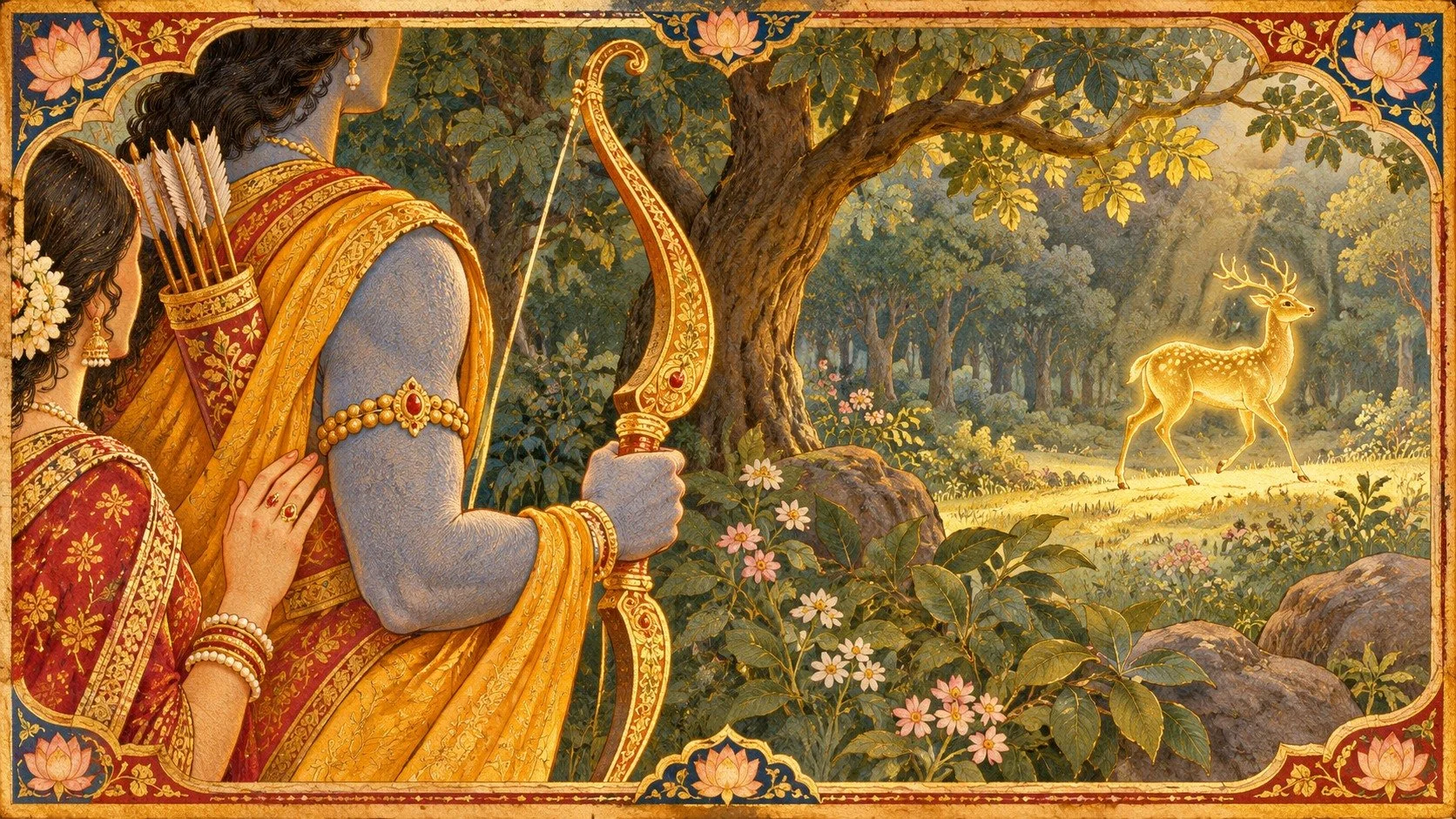
The creature Sita sees near the forest dwelling appears extraordinary enough to draw Rama away. It is Maricha in disguise, assisting Ravana. The deception works because the apparently simple problem of catching a beautiful animal sets each member of the household a different task. Someone will pursue it. Someone should stay behind. A cry that sounds like Rama in distress then makes remaining behind feel like a betrayal.
The audience can understand the trap while still seeing why each decision is reasonable to the person who must make it. That is a richer source of suspense than wondering whether the glittering creature is genuine. By the time Ravana approaches Sita in disguise, the defences of the household have been pulled apart through its members’ concern for one another.
The famous protective line drawn by Lakshmana belongs to particular tellings. People who grew up hearing about the line may remember it as the central detail of the scene. Someone reading another version may search for it in vain. Its presence shifts the moral emphasis towards a boundary and the consequences of crossing it. Its absence leaves more weight on deception, hospitality and the impossible business of knowing whom to trust.
Who Is Ravana?
Ravana rules Lanka. He possesses learning, power and an extraordinary capacity to command. In many depictions he has ten heads, a visual attribute immediately legible across painting, sculpture and theatre. An audience can see at once that the household in the forest faces a sovereign with resources on a scale an individual traveller cannot match.
His abduction of Sita establishes the limit of those resources. Ravana can carry her away and surround her with the wealth of his capital. He cannot make her accept him. In the episodes set in Lanka, Sita’s sustained refusal gives her a form of action quite different from the movement of armies and messengers outside. Accepting that distinction makes her part of the unfolding drama throughout captivity.
The great bird Jatayu tries to prevent the abduction. He cannot defeat Ravana, yet the attempt matters. It leaves someone able to bear witness to what happened. Throughout the epic a supposedly lesser achievement, delivering news, preserving a token or returning to tell the truth, makes the next great deed possible.
Why Is Hanuman So Important?
Rama’s alliance with Sugriva brings him into contact with Hanuman, one of the epic’s most beloved figures. Hanuman has the strength to cross the sea to Lanka. His assignment also calls for discretion. A powerful stranger appearing without warning to someone held captive might cause fear or look like another of Ravana’s tricks.
The solution is a token. Hanuman brings Rama’s ring. It turns an improbable account of a successful journey into news Sita has grounds to believe. She in turn gives him a jewel to carry back. Two people separated by water, an enemy army and the possibility of deception now have reason to believe one another alive. The objects change what each can rationally hope for.
This helps explain why Hanuman’s devotion means so much in religious practice. Strength alone could bring him to the right island. To serve well he must also understand what another person needs from him when he gets there. In a story crowded with kings and commands, the messenger exercises some of the most delicate judgement of all.
What Is the War for Lanka About?
To recover Sita, the alliance must solve a geographical problem before it can solve a military one. Hanuman can make the crossing alone. An army needs a passage. The bridge to Lanka gives a material shape to the change in the story. What had depended on one traveller’s extraordinary ability can now be undertaken collectively.
Ravana’s brother Vibhishana adds a political difficulty. Loyalty to a relative and loyalty to justice have come apart. He sides with Rama. Put that choice beside Bharata’s refusal to profit from Rama’s exile. Both men must decide what it means to be a good brother. They reach outwardly opposite decisions because their brothers have asked very different things of them.
Rama’s victory defeats the power that took Sita. Their reunion raises harder questions about public honour, trust and the expectations placed on a woman returning from captivity. The fire ordeal is among the tradition’s most debated episodes. Some tellings also follow the pain of a later separation. It matters which version someone is describing when they speak of the Ramayana’s happy ending.
Why Is Rama Worshipped as Well as Read About?
For many Hindus Rama is an avatar of Vishnu. A discussion of his actions can therefore be a religious act as well as an encounter with a literary character. People may return to a familiar episode to consider exemplary conduct, to express devotion or to argue seriously about a decision they find painful. Knowing how a plot ends does little to diminish those purposes.
This is a significant difference between the experience of a newcomer attending the film and that of someone who has grown up with the story. One person may be wondering whether a disguised visitor is dangerous. Another is waiting to see how the director will stage a moment they already know almost gesture by gesture. Suspense for the second viewer can lie in interpretation. Who gets the close-up? Does the camera dwell on the person speaking or the person obliged to obey?
Sita, too, has a religious identity and a devotional life extending far beyond her role in a husband’s biography. The tradition associates her with Lakshmi. Her association with the earth is important from the beginning: in a widely told account King Janaka discovers her while ploughing. An introduction concerned only with who marries whom misses that striking origin. A child found in a furrow grows up in a royal household. She can belong intimately to a human family and retain a relationship to the earth that royal authority cannot exhaust.
Is Lakshmana Simply Rama’s Sidekick?
Lakshmana leaves a secure place at court for a life organised around the safety of others. A prince who does that assumes practical responsibilities. Somebody must provide shelter, stay alert to danger and make difficult decisions when Rama goes beyond sight. The episode of the cry in the forest is so effective because it puts two of Lakshmana’s duties in direct conflict. He cannot personally protect Sita and go to Rama’s aid at the same time.
His predicament has a counterpart in Bharata’s. One brother honours Rama by accompanying him. Another has to honour him from home. Remaining in a palace ordinarily looks like the comfortable option. In this case it means living with the knowledge that a political advantage has been secured in one’s name and finding a way to govern without endorsing the conduct that produced it. Across these different relationships, the story allows similar loyalties to take different forms.
Why Does the Epic Travel So Well Between Art Forms?
A storyteller can move from the palace to the forest in a sentence. A painter can place several episodes within a single field of view, letting a reader follow a character’s movement across an image. A stage performance must decide how a human body will suggest a leap across the sea. A film can use visual effects to make that leap physically convincing, then find that the harder task is making the audience care what its messenger says once he lands.
One productive way to watch an adaptation is to follow a single object across changes of medium. A storyteller can linger on a ring before identifying its owner. A painter may enlarge the gesture of giving it. A director can cut to Sita’s recognition before giving the audience a clear view of it. The basic event survives, while its emotional centre moves from the marvellous journey to the person receiving an almost impossibly welcome piece of news.
For viewers who want to read further afterwards, choose an edition that tells you which text or tradition it follows and whether it is abridged. A short narrative can be an excellent introduction, but it may give little room to the conversations that made a decision difficult. Having met the main figures, try reading one of those conversations slowly. Rama and Sita arguing about exile can reveal as much about their world as the eventual march of an army.
For a second reading, reverse the usual emphasis on heroes and opponents. Follow the passage of information instead. Who first knows that a promise has been made? Who knows where Sita has gone? Which witnesses survive, who believes them, and what could possibly convince the person waiting at home? The answers reveal an epic unusually attentive to the fallibility of sight and the value of a trustworthy messenger. Even victory depends upon somebody bringing the right news to the right person.
What Should a First-Time Viewer Watch For?
Watch who gets to make a promise and who has to carry it out. Dasharatha gives his word and Rama loses his home. Rama commits himself to exile and Sita claims the right to decide what it means for her. Hanuman promises to take news across the sea and his success changes what two other people believe about the future. The same pattern that first tears a family apart can, in different hands, help bring it back together.
One final detail is worth carrying into the cinema. The most convincing evidence of love in the epic often fits in a hand. A pair of sandals can stand for a kingdom held in trust. A ring can tell a captive that the person she loves is searching for her. Long before a film can put armies on a screen, the story has taught its audience how much can depend on recognising a small, familiar object.
Sources
The Journey Begins. Ramayana: Part One Arrives Worldwide. | Prime Focus Studios — The studio identifies the cast and the two-part adaptation.
Ramayana, The Epic of Rama, Prince of India — A literary rendering of the epic for comparison with the film.
Epic India — The museum places Ramayana episodes in their visual traditions.
Next Reads
The odyssey summary homers homecoming epic and the price of return — Compare another epic of exile and homecoming.
The Iliad Summary: Homer’s Epic of Rage, Glory, and War — Explore the family obligations behind another epic war.
The Abrahamic Religions Explained: How One Ancient Idea of God Changed the World — Consider how traditions preserve and interpret sacred stories.
