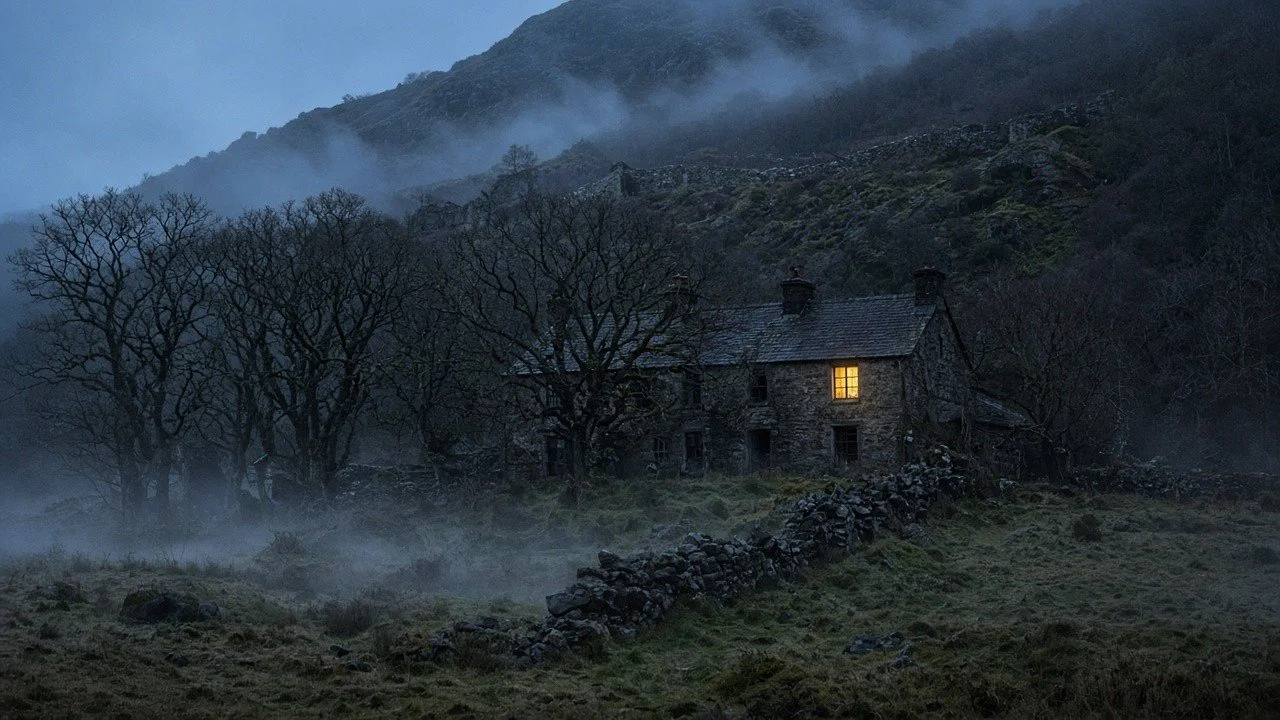
Bill and Liz Rich said their ordeal began at Heol Fanog, a remote Brecon Beacons farmhouse, in 1989,
A Family Moved Into A Remote Welsh Farmhouse In 1989, And What They Say Happened Next Earned It The Name Britain's Most Exorcised Home
The BBC's new drama The Witch Farm opens in the summer of 1989, with a young couple driving out of London towards a remote farmhouse in the foothills of the Brecon Beacons. They want a fresh start. On the very first night, Liz hears footsteps on the landing.
It is a ghost story, but it is not invented from scratch. The four-part series is based on the real experiences described by Bill and Liz Rich, who lived at a farmhouse called Heol Fanog for several years from 1989 and said they were tormented by footsteps, smells, apparitions and worse. Their case has been called "the Welsh Amityville", and the writer Danny Robins, who investigated it for a BBC Radio 4 podcast in 2022, has described it as a house that saw more exorcisms than any other in British history.
So is The Witch Farm a true story? The honest answer is that the people, the place and the accounts are real, but whether anything paranormal happened is exactly what has never been settled. This guide separates what is documented from what is claimed, and sets out what the BBC says it has changed.
The Witch Farm: Cast, Writer And Release Date
The Witch Farm is a four-part drama, each episode around an hour long, written and created by Danny Robins, the presenter behind the BBC's Uncanny, the podcast The Battersea Poltergeist and the stage play 2:22 – A Ghost Story. It is directed by Stacey Gregg, whose credits include Bad Sisters, and made by Mammoth Screen for BBC One in a co-commission with BBC Cymru Wales.
Gabrielle Creevy, from Port Talbot, plays Liz Rich, and Michael Socha plays Bill Rich. Lewin Lloyd plays Jonathan, Bill's teenage son. The cast also includes Sian Gibson, Robert Pugh, Jeremy Swift, Edward Holcroft, Suzanne Packer and Roger Evans.
The first two episodes arrive on BBC iPlayer at 6am on Sunday 22 November 2026, and air on BBC One and BBC One Wales at 9pm on Sunday 22 and Monday 23 November. Episodes three and four follow on iPlayer at 6am on Sunday 29 November, and on BBC One at 9pm on 29 and 30 November.
Who Were Bill And Liz Rich?
According to Robins's account of the case, Bill Rich was an artist from England and Liz was Welsh. When they moved to Heol Fanog in May 1989, Liz was pregnant with their first child, and Bill's son from his first marriage, Laurence, came with them.
The house was not a crumbling ruin. It was an old stone property converted from an even older barn, set behind a bank of trees about half a mile from the nearest neighbour. The name, Robins has said, means "Road to the Peaks". The Riches rented it.
Both had been through a hard few years before the move. The researcher Mark Fox, drawing on the book Testimony by Mark Chadbourn, has written that Bill's marriage of 16 years had recently ended and that Liz had struggled for years with her health before training as a herbalist, which is how she met Bill. Heol Fanog was meant to be a new beginning. They spent their first summer renovating the house and garden.
What The Family Said Happened
The accounts that follow are the family's, as given to Chadbourn for Testimony, to Robins for the podcast and to other interviewers. They are claims, not established facts.
As winter approached, Liz said, she began hearing loud, heavy footsteps running through the house and down the stairs. "The footsteps were frequent but the strange thing was, they never reached the bottom of the stairs," she told the BBC in 2022. Doors slammed. The family described sudden hot and cold spots, and smells of sulphur and incense that came and went.
Then there was the electricity. The family said the meter spun wildly at the moments when the activity was most intense, and that their first bill was £750 for three months, which Robins put at almost £2,000 in 2022 money. An official from the electricity board, according to the family, could not explain why so much power was being used or why it came in bursts.
Over the following years, the claims escalated. The family described the deaths of animals, apparitions including an old woman and a dark, hooded figure, physical injuries and what they believed was the possession of Bill's son. Liz later described seeing "this black silhouette of a seven-foot man walking just on the inside of the kitchen door". In Chadbourn's telling, as summarised by later writers, Laurence's behaviour changed sharply after the haunting began, and the couple, convinced something had taken hold of him, sent him to boarding school. He later returned as a settled adult.
"Exorcism After Exorcism"
The Riches went looking for help, and they found a lot of it. "I thought perhaps, when this sort of thing happens you get a priest, so I went to Brecon Cathedral," Liz said. A priest came, walked through the house speaking Latin and sprinkling holy water, and for a while the activity stopped. "But then it came back even stronger. We had exorcism after exorcism."
Over the years, the house was visited by priests, spiritualists, dowsers, a Baptist minister named David Holmwood, members of the Society for Psychical Research and the exorcist Eddie Burks. According to Chadbourn's book, Burks said he identified a "pre-Christian" presence on the land, and it was his visit, rather than the clergy's, that the Riches credited with finally ending the haunting. The family's ordeal lasted around six to seven years, depending on whose account you follow.
Along the way, the house acquired a dark mythology. Robins has spoken of local rumours of witchcraft, Celtic ritual, ley lines and murder in the area, and the nearby ruins of an old manor house. He has also stressed that he needed "to sort myth from fact". Some of the most lurid stories attached to Heol Fanog appear to come from places miles away, or only from the people who investigated the haunting.
What Sceptics Point To
Not everyone who lived at Heol Fanog had the same experience, and that is the most important thing to know before watching.
Mark Fox notes that Testimony itself contains a striking number of people who found nothing wrong with the house. The owner said they had never heard of anything unusual. A local builder said "it just seemed like a normal house to me". Bridget Buscombe, who lived there for several years before the Riches, said: "I loved that house and felt very happy there." After the podcast was released, the people then living at Heol Fanog, who said they had been there for 25 years, contacted Robins to say the electricity drains had not recurred and that the only mystery about the farm was the "gentle mystery of nature".
There are rational explanations on the table too. Robins has said the investigation considered whether the family could have been affected by "some form of intoxication from the house's oil heater", and whether the isolation itself might have worked on their nerves. "If you're a sceptic, you could say 'does the isolation play a part in this remote location, does it play on their imagination?'" he said.
Fox's own reading is that the place and the people both mattered: a family under strain arriving at a house where, he argues, a few odd things had been noticed before. Even the happy former resident, Buscombe, told Chadbourn of one night she could not explain, when an old spinning wheel in her bedroom began turning on its own.
Liz Rich herself has suggested something similar. Asked by Robins at the end of the podcast why it happened to them, she said: "It's like making a cocktail, I guess. You've got to have certain ingredients for it to work right. And I guess Bill and I were the missing ingredients."
From Testimony To Radio 4 To BBC One
The case has been told several times. Chadbourn, a novelist and former journalist, wrote Testimony, and appeared in the Channel 4 docudrama True Horror, which dramatised the case as "Hellfire Farm". That programme left a great deal out. Its executive producer, Joel Wilson, said: "So much happened in that story that inevitably we left some stuff out." It ended the story with the minister's visit, not Burks's.
Robins's eight-part Radio 4 podcast The Witch Farm ran from October to December 2022, with Chadbourn as a consultant. It mixed dramatised reconstructions, starring Joseph Fiennes and Alexandra Roach, with interviews with Liz Rich and other witnesses, and studio experts arguing for and against a paranormal explanation.
What The BBC Has Changed
The BBC has been clear that this is not a documentary. When it announced the series, it said the drama was inspired by the real events, theories and first-hand accounts explored in the podcast, but that "some characters, elements and chronologies have been created or changed for dramatic purposes".
Some changes are already visible from the BBC's own material:
Laurence becomes Jonathan. Bill's real son was called Laurence. In the drama, the teenage son is called Jonathan.
A dramatic birth. The original announcement described "a traumatic home birth" during which Liz becomes convinced she has seen a ghostly figure in the bedroom. Liz was pregnant when they moved in, but the circumstances of the birth come from the drama's own description, not the documented record.
A compressed timeline. The real ordeal lasted years. Four hours of television will inevitably compress events, and the BBC has said chronologies have been changed.
New characters. Sian Gibson plays a character named Bethan, and the BBC has said some characters were created for the drama. Any figure who does not appear in the family's accounts may be invented.
What To Watch For
The series had not been released at the time of writing, so these are not confirmed changes, only the places where the record is either firm or thin.
The ghost. The drama's publicity promises "a strange figure". The family did describe figures, but they have never been independently verified. A drama has to choose what the audience sees; the real case never offered that certainty.
The witchcraft. The title leans into the folklore, and the publicity speaks of a history "that refuses to stay buried". Robins himself has warned that much of the local legend needs to be sorted from fact. Watch whether the drama presents rumour as history.
The marriage. The BBC says the haunting tests Bill and Liz's marriage, and "the limits of trust, belief, and what they're willing to deny in order to survive". The pressure on the family is well documented in their own accounts. How the drama shows it is interpretation.
The ending. The Riches credited Eddie Burks with ending the haunting, while True Horror gave that role to a minister. Watch which version the drama chooses, or whether it leaves the question open, as the podcast did.
Whatever you make of Heol Fanog, the core of the story is real: a family who said they lived through years of terror, a house that others loved, and a mystery that nearly four decades of retelling has not solved. For another story built on the fear of what is never quite seen, read our guide to The Blair Witch Project.
Next Reads
The Blair Witch Project Explained: The Story, The Ending And The Fear Of The Unseen
The Exorcist In The Age Of AI: When Seeing Would No Longer Settle Belief
The Witch Summary And Ending Explained: The Family Secret More Frightening Than The Ghosts
Sources
The Witch Farm first spine-tingling clip and premiere date revealed, BBC Media Centre
The Witch Farm haunting first look and further casting revealed, BBC Media Centre
Paranormal podcast to become TV series starring Black Doves actor, BBC News
Danny Robins' Paranormal Podcast 'The Witch Farm' Inspires BBC Drama Series, Deadline
A 'Halloween treat': BBC confirms release date for spooky mystery drama, Digital Spy
Haunting new BBC drama set in Welsh countryside gets release date, Nation.Cymru
Brecon Beacons: Living in Britain's most exorcised home, BBC News
True Horror: what really happened in Hellfire farm?, Radio Times
Which Farm is The Witch Farm? Testimony and the Uncanny at Heol Fanog, Mark Fox
BBC's New 4-Part Mystery Turns the 'Welsh Amityville' Into a Chilling Ghost Story, CBR
