Verity Explained: Who Really Killed Harper, The Complete Chronology, Every Death And What Happens After The Ending
Verity Film Explained In Chronological Order: What Really Happened?
One Dead Child, Two Conflicting Confessions And A Husband Who Kills His Wife Leave Verity With A Mystery That Cannot Be Solved Easily.
In Michael Showalter’s 2026 psychological thriller Verity, a novelist enters a wealthy family’s secluded home to finish a bestselling book series. What initially appears to be an extraordinary career opportunity develops into an unsettling investigation involving a child’s drowning, an apparently incapacitated mother, a disturbing manuscript and a husband whose version of events may be dangerously incomplete.
Starring Anne Hathaway as Verity Crawford, Dakota Johnson as Lowen Ashleigh and Josh Hartnett as Jeremy Crawford, the film adapts Colleen Hoover’s novel of the same name while changing several important details. Most significantly, it alters the Crawford children’s history, the circumstances of Verity’s death and the apparent evidence supporting her final explanation.
The film invites viewers to believe they have uncovered a monstrous secret before introducing a second version of the same tragedy. Understanding what happened requires distinguishing events the audience actually sees from events described by people who may be lying.
Verity Ending Explained: Who Actually Dies And Who Is Responsible?
The film establishes that Jeremy Crawford murders his wife Verity, with Lowen helping him commit and conceal the killing. They dispose of her body in a lake and present her death as an accident. Their plan succeeds within the events shown, and the film does not depict either character being arrested.
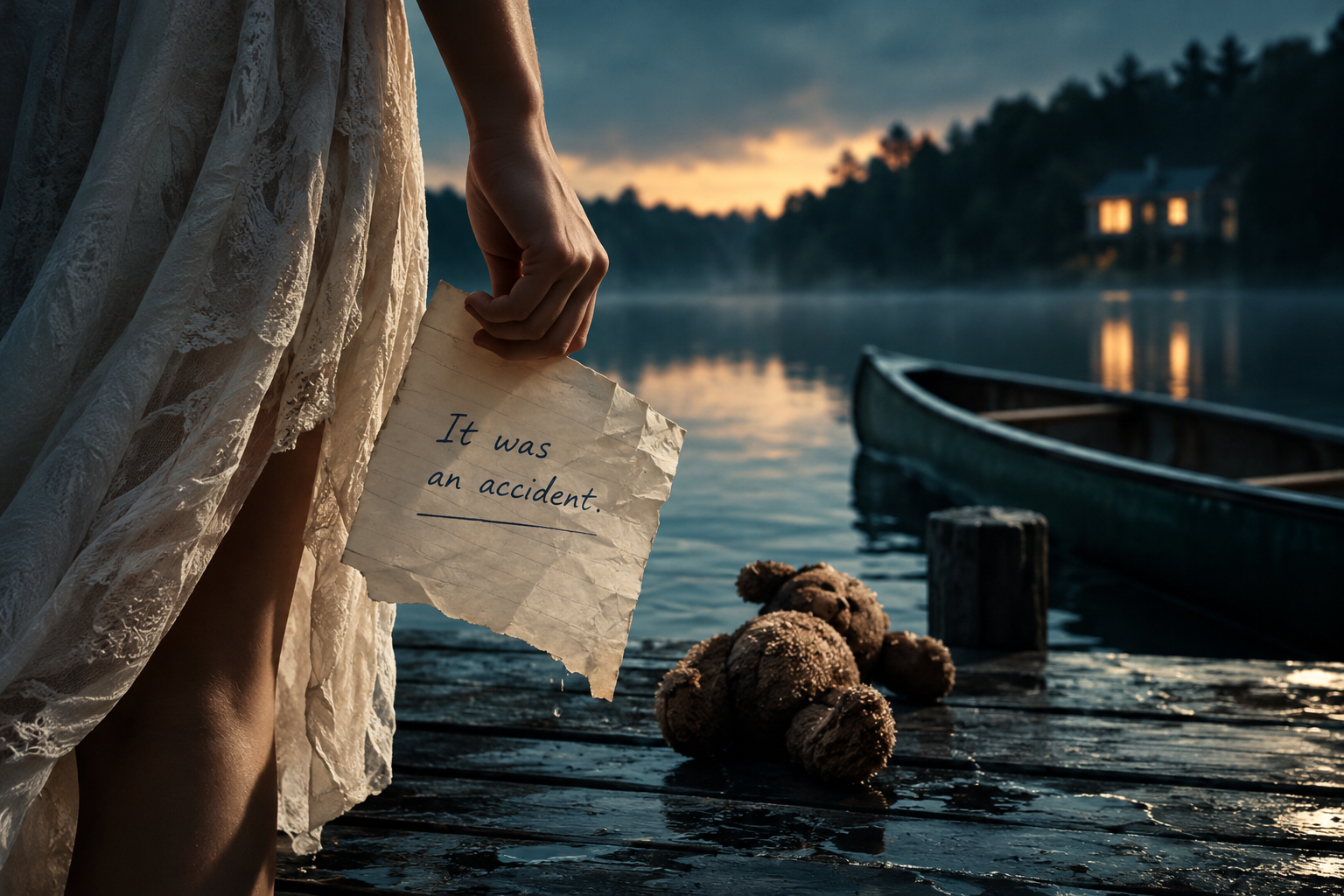
The earlier death of Harper Crawford is different. Harper, the young daughter of Verity and Jeremy, drowned during a canoe outing with her mother and twin brother Crew. A manuscript apparently written by Verity claims that she deliberately overturned the canoe and allowed Harper to die. A later hidden letter insists that the incident was accidental and that the manuscript was fictional.
Neither account is independently verified. The audience therefore knows that Harper drowned but cannot conclusively establish whether her mother murdered her.
Seven months after Verity’s murder, Lowen discovers the letter while preparing to leave the house with Jeremy and Crew. She is pregnant with Jeremy’s child. The letter claims Jeremy had previously attempted to murder Verity after mistakenly believing her writing was an actual confession.
Lowen chooses not to share the letter. She leaves with Jeremy despite knowing that their relationship may have been founded on a catastrophic misunderstanding.
This is the film’s final moral reversal: the woman who arrived seeking the truth ultimately becomes responsible for keeping it hidden.
The Crawford Family Before Lowen Arrived
Verity Crawford was a successful thriller writer whose literary career had made her a recognisable public figure. She lived with her husband Jeremy and their children, Harper and Crew, at a remote family property. The apparent privilege of their lives conceals a devastating history.
Harper died during a family boating incident. Her twin brother survived. Following the tragedy, Verity was involved in a serious car crash that left her seemingly unable to move, speak or respond normally to the people around her.
Jeremy became responsible for caring for Verity and raising Crew. As Verity could no longer complete her bestselling series, he arranged for another writer to continue the books.
That writer was Lowen Ashleigh, who was experiencing professional and personal instability when the opportunity arose. Her literary agent Corey encouraged her to consider the lucrative assignment, although the family’s circumstances made it unusually complicated.
The job placed Lowen in an emotionally charged situation. She was expected to work within the home of the incapacitated author she was replacing, surrounded by the surviving members of a family still dealing with an unexplained death.
What Happened To Harper Crawford?
Harper’s drowning is the first crucial event in the family’s history, even though the film initially presents it as a past tragedy rather than a potential murder.
Harper and Crew were twins. During an outing on the lake, their canoe overturned. Crew survived, but Harper drowned.
The mystery concerns how the canoe overturned and whether Verity made a deliberate decision to endanger her children.
At first, the audience understands Harper’s death through the family’s apparent account of an accident. That interpretation becomes much darker when Lowen finds Verity’s unpublished manuscript.
The Manuscript Claims Verity Murdered Harper
The manuscript presents Verity as a woman whose overwhelming fixation on Jeremy caused her to resent the attention he gave their children.
Rather than portraying motherhood as a source of affection, the text describes jealousy, hostility and a willingness to harm those who came between Verity and her husband.
It includes an alleged earlier attempt to smother her children when they were infants.
The most consequential episode concerns the canoe. In the manuscript’s account, Verity deliberately destabilises the boat, creating the conditions for Harper’s drowning.
She then saves Crew while allowing Harper to die.
If this description is truthful, Harper’s death was an intentional killing made to resemble an accident.
For Lowen, the manuscript appears to provide the explanation Jeremy has been missing. It also transforms Verity from a helpless patient into someone who may have committed an appalling crime and escaped responsibility.
The Final Letter Says Harper’s Death Was Accidental
The letter discovered near the ending offers a completely different interpretation.
Verity claims she loved her children and never deliberately harmed them. According to this account, Harper’s drowning was a genuine accident, and the manuscript was not an autobiography.
Verity explains that her disturbing writing was an exercise in constructing a convincingly evil fictional narrator. The exercise supposedly involved reimagining experiences from her own life through the perspective of someone capable of terrible acts.
This changes the apparent significance of the manuscript. Instead of providing evidence of murder, it could be an example of a novelist exploring violence and obsession in fiction.
The distinction is fundamental. Writing a fictional confession about a real family tragedy would be disturbing, particularly if someone else discovered it without context, but it would not establish that the writer committed the acts described.
However, Verity’s letter is not independent proof of innocence. It is another account written by the same person, containing claims that benefit her and cannot be tested through the film’s available evidence.
The Complete Chronology Of Verity In The Order Events Occurred
Because the film reveals much of its backstory through written material and recollections, its chronology is easier to understand when separated from the order in which Lowen discovers the information.
First: Verity And Jeremy Build Their Family
Verity becomes a successful writer, marries Jeremy and has twins, Harper and Crew.
Their family appears prosperous, although the manuscript later suggests deep tensions surrounding Verity’s relationship with motherhood.
Whether those tensions existed exactly as described is disputed. The film establishes the relationships, but the manuscript’s account of Verity’s private motives cannot be treated as independently confirmed.
Second: The Alleged Attempt To Harm The Children
The manuscript describes Verity attempting to suffocate her children while they are infants.
This claim becomes significant because it suggests a possible history of deliberate violence before Harper’s death.
Yet it appears within the same disputed document as the supposed murder confession. Without additional corroboration, the allegation remains part of the manuscript’s version of events.
Third: Harper Drowns During The Canoe Outing
The canoe overturns while Harper and Crew are on the lake with their mother. Harper drowns, and Crew survives.
Under the manuscript’s interpretation, Verity engineers the incident and selectively rescues Crew. Under the letter’s interpretation, the tragedy is accidental.
The film does not resolve that conflict.
Fourth: Verity Writes The Disturbing Manuscript
Verity’s writing describes events that, if genuine, would make her responsible for her daughter’s death.
The document also supplies the emotional explanation for the alleged crime: possessive jealousy over Jeremy’s attention.
The timing of Jeremy’s discovery becomes critically important.
The final letter says he found and believed the manuscript before Verity’s car crash. The film’s later depiction of his reaction to the manuscript creates a significant problem for that explanation.
Fifth: Verity Is Seriously Injured In A Car Crash
Verity survives a major road accident and subsequently appears severely incapacitated.
Jeremy cares for her at the family home, and the household operates around the assumption that she cannot communicate normally.
The letter alleges that Jeremy deliberately caused the crash after reading the manuscript.
In that version, he drugged Verity and arranged the vehicle crash to kill her.
This accusation remains unverified. The film does not independently establish that Jeremy caused the earlier collision or that he was already aware of the manuscript when it happened.
Sixth: Lowen Moves Into The Crawford Home
Lowen arrives to complete Verity’s unfinished literary series.
She begins sorting through material relating to the author’s work, develops a connection with Jeremy and encounters troubling behaviour that makes her question whether Verity is as incapacitated as everyone claims.
Crew’s interactions with his mother deepen that suspicion. A disturbing incident involving a knife suggests that he may know more about Verity’s condition than the adults realise.
Seventh: Lowen Reads The Manuscript And Falls For Jeremy
As Lowen reads the manuscript, she becomes convinced that Verity murdered Harper.
Her attraction to Jeremy complicates that judgement. The man she increasingly wants to be with is also the husband of the woman she believes is a killer.
Their growing intimacy creates a personal incentive for Lowen to interpret the evidence against Verity.
That does not mean Lowen invents the manuscript, but it makes her less independent than she initially appears.
Eighth: Verity’s Pretence Is Exposed
Lowen accumulates reasons to believe Verity can move and respond.
When Jeremy confronts his wife about the manuscript and the apparent deception, she abandons the pretence of helplessness.
This confirms that Verity is not as incapacitated as she has led others to believe.
It does not establish why she deceived them, nor whether she killed Harper.
Ninth: Jeremy Kills Verity
Convinced that his wife has committed murder, Jeremy becomes violent and suffocates her.
Lowen helps direct the killing towards a method that can be disguised, then assists with the aftermath.
Jeremy and Lowen place Verity’s body in the lake, where Harper previously died.
They construct an explanation in which Verity supposedly regained some movement, wandered from the house and drowned.
The police accept their account during the film’s depicted investigation. Jeremy and Lowen remain free.
Tenth: Lowen Finds The Letter Seven Months Later
Lowen is now pregnant with Jeremy’s child.
While preparing to leave the house, she discovers the hidden letter claiming Verity’s innocence and accusing Jeremy of the earlier attempted murder.
The discovery means Lowen can no longer be certain that she helped kill a murderer.
She may instead have helped a dangerous husband murder a woman who was hiding from him.
Nevertheless, she conceals the letter and leaves with Jeremy and Crew.
The film does not confirm what becomes of them afterwards.
Why Was Verity Pretending To Be Paralysed?
The revelation that Verity can move creates one of the film’s strongest moments of apparent certainty.
For much of the story, her condition makes her seem incapable of harming anyone or defending herself. Discovering the pretence undermines that assumption.
But the physical deception has two possible explanations.
If the manuscript is truthful, Verity may be concealing her recovery because she fears being exposed as Harper’s killer.
Remaining apparently helpless could reduce suspicion and give her opportunities to observe or manipulate the household.
If the letter is truthful, the explanation is self-preservation.
A woman whose husband has already tried to murder her might reasonably fear that revealing her recovery would place her in danger again.
In this version, pretending to be incapacitated is a desperate attempt to survive until she can escape with Crew.
The same behaviour therefore supports opposing narratives.
Deception is established; the motive behind it is not.
This matters because viewers can easily mistake proof that someone lied about one thing for proof that every accusation against them must also be true.
The Biggest Clue Against Verity’s Final Letter
One of the most important differences between the novel and the film concerns Jeremy’s knowledge of the manuscript.
In the original book, Jeremy’s reaction when Lowen reveals the manuscript can suggest that he already knew about its existence.
That possibility is consistent with Verity’s subsequent claim that he had discovered it before her car crash.
The film alters the sequence.
Jeremy appears to read the manuscript after Lowen brings it to him and before he confronts Verity.
If that scene accurately represents his first discovery, then Verity’s claim that Jeremy previously read it and attempted to murder her becomes much harder to reconcile with events shown on screen.
There are conceivable explanations.
Jeremy might be pretending not to have seen it, or he may be familiar with the document while concealing his knowledge from Lowen.
However, the film does not independently establish either explanation.
This is arguably the strongest reason to question the letter. Its accusation against Jeremy depends on an earlier discovery that the film does not clearly confirm.
It is not proof that Verity murdered Harper.
A dishonest letter would not automatically make every passage of the manuscript truthful.
But it prevents the audience from accepting Verity’s final version without scrutiny.
Who Killed Verity, And Why Was Her Body Put In The Lake?
Unlike Harper’s death, Verity’s murder is directly established by the film.
Jeremy kills Verity, and Lowen is actively involved.
The narrative does not depend on a confession or disputed document to establish their responsibility.
Jeremy apparently believes that he is confronting the woman who deliberately drowned his daughter.
The manuscript supplies an emotionally overwhelming accusation, and Verity’s ability to move makes him feel further deceived.
Yet a belief in someone’s guilt is not proof.
Jeremy does not obtain a reliable independent determination of what happened to Harper before killing his wife.
Lowen’s role is equally important.
She is not simply an uninvolved observer of an impulsive act. She contributes to the killing and the construction of the subsequent cover-up.
Putting Verity’s body in the lake gives the staged death a plausible narrative connection to the family’s history.
The location is already associated with tragedy, and the cover story depends on Verity apparently emerging from her incapacitated state before wandering into the water.
It also creates a grim parallel: Harper died in the lake under disputed circumstances, while Verity’s body is placed there after a murder the audience knows occurred.
That repetition is a major storytelling choice.
The same location contains one uncertain death and one certain homicide, inviting viewers to reconsider how easily an apparently convincing explanation can conceal deliberate violence.
What Did Verity’s Final Letter Actually Reveal?
The letter makes three central claims.
First, that the manuscript was a fictional writing exercise rather than a truthful autobiography.
Second, that Harper’s death was accidental.
Third, that Jeremy discovered the writing, believed it and tried to kill Verity in the car crash.
Those claims collectively transform the entire story.
If they are true, Lowen has misunderstood the family from the moment she found the manuscript.
Verity would then be a bereaved mother who used disturbing fictional material to process or reinterpret personal experience.
Jeremy would be a man who responded to that material with an attempted murder before eventually killing his wife.
Lowen would have assisted him in the final act.
The letter also explains why Verity might have hidden her recovery. She would have been living with someone she believed capable of killing her and attempting to protect her surviving child.
But there is no independent verification of the account.
Verity wrote the manuscript and the letter. Both can serve self-interested purposes, and the audience cannot simply assume that the later document is more reliable because it appears at the end.
The final twist therefore changes the nature of the question.
At first, viewers ask whether Verity was a murderer. Afterwards, they must ask whether anyone had enough evidence to reach that conclusion at all.
Was Jeremy The Real Villain All Along?
Jeremy is unquestionably responsible for Verity’s death. Whether he is also responsible for her earlier crash remains uncertain.
His apparent grief over Harper helps explain why he reacts so violently to the manuscript.
Yet the film asks viewers to distinguish understandable emotional devastation from an acceptable response.
If Verity deliberately killed Harper, Jeremy still chooses to commit murder rather than allow the allegation to be independently investigated.
If Verity was innocent, the consequences are even more disturbing: he kills a woman after accepting fictional writing as a confession.
His actions also complicate the film’s romantic structure.
Lowen increasingly sees Jeremy as someone deserving rescue from an appalling marriage, but his conduct reveals that he may himself be dangerous.
By the ending, it is impossible to separate the apparent romance from violence and concealment.
Lowen has chosen to build a future with someone she knows has killed his wife.
The possibility that Jeremy also orchestrated the car crash means she cannot confidently assume that his violence belonged exclusively to a single extraordinary confrontation.
Is Lowen Actually The Most Dangerous Character?
Lowen arrives as the apparent audience surrogate: an outsider trying to understand a disturbing family situation.
Her curiosity gives the story its investigative momentum.
Over time, however, her professional role becomes inseparable from her desire for Jeremy and fascination with Verity.
She moves into Verity’s home, reads her private writing, develops intimacy with her husband and increasingly occupies the position that Verity once held.
The film’s additional fantasy sequence involving a kiss between Lowen and Verity makes that fixation more explicit than in the novel.
Lowen’s interest is not limited to learning about Verity; it also involves an unsettling attraction to her identity and place within the household.
After the murder, Lowen receives the relationship and future she previously could not have.
She is pregnant, living with Jeremy and becoming a maternal presence in Crew’s life.
The final letter puts that future at risk.
Revealing it could undermine her assumptions about Jeremy and force her to confront her own responsibility in Verity’s death.
Her decision to remain silent can therefore be interpreted as an act of self-preservation.
She chooses a stable future over an uncertain truth.
That does not establish that she planned the entire sequence or consciously engineered Verity’s death from the beginning.
The theatrical ending does not make her a secret mastermind.
It does, however, make her an accomplice who knowingly preserves the consequences of a murder.
Why Does The Film Finish With Verity’s Hot Ones Interview?
One of the adaptation’s most distinctive additions is the emphasis on Verity’s public celebrity.
The film includes fictionalised appearances within recognisable interview formats, including Hot Ones and Call Her Daddy.
The final return to Verity’s interview persona reinforces the distinction between public identity and private truth.
The audience has encountered several versions of Verity: the bestselling author, the mother mourning her daughter, the apparently helpless patient, the monstrous voice of the manuscript and the frightened woman described in the hidden letter.
None offers an entirely dependable portrait.
The public interview presents yet another carefully mediated version, designed for an audience who may feel they know a celebrity despite having limited access to her private life.
Ending with that image also returns control of the story to Verity, even after her death.
The film began by allowing others to interpret her; its conclusion reminds viewers that her public presentation was itself another performance.
The image is not evidence that she was innocent or guilty.
Its value lies in exposing the limits of confidently judging someone through curated narratives.
Why The Director Refused To Confirm Which Version Was True
Director Michael Showalter explored alternative endings before choosing the film’s unresolved conclusion.
Some proposed versions would have presented Lowen as considerably more calculating or offered an additional visual twist involving Verity.
Those possibilities were not adopted for the final theatrical version.
The filmmakers instead retained Lowen’s uncertainty after she discovers the letter.
That choice is important because a definitive revelation would reorganise the entire story into a more conventional mystery.
A confirmed confession would make Verity the central murderer.
Proof that the letter was true would transform Jeremy into a straightforward villain and Verity into his victim.
Keeping both accounts unresolved forces a more difficult assessment.
The characters’ behaviour can be judged even when the audience lacks a complete explanation of their motives.
The uncertainty is therefore intentional rather than simply a missing final clue.
It prevents the film from providing an easy moral resolution to the violence that has occurred.
What Happens To Crew After The Ending?
Crew survives the family’s tragedies and leaves the house with Jeremy and Lowen.
The film does not show his adult life or reveal whether he later discovers the circumstances of his mother’s death.
His position is nonetheless profoundly unsettling.
He has lost his twin sister and his mother. The two adults now responsible for him are concealing their involvement in his mother’s killing.
Crew may also possess memories of his mother’s behaviour that could become significant as he grows older.
His apparent awareness that Verity could communicate while supposedly incapacitated is one reason Lowen became suspicious during her stay.
It is plausible that future questions about the lake, his mother’s recovery or the official explanation of her death could expose contradictions in the family story.
But the film does not establish that he will investigate or reveal anything.
The strongest conclusion is that Crew’s immediate future appears outwardly secure while resting on a deeply unstable foundation of deception.
What Most Likely Happens To Jeremy And Lowen Afterwards?
The film offers no definitive continuation, but its ending provides enough information to consider several plausible futures.
Their Relationship Becomes A Shared Secret
Jeremy and Lowen are connected by their responsibility for Verity’s death.
Either could expose the other, and both have a strong reason to preserve the accidental-drowning account.
This may create loyalty, but it also creates vulnerability.
Their apparent partnership is built on mutual knowledge of a serious crime rather than an ordinary romantic beginning.
Lowen May Eventually Begin To Fear Jeremy
Lowen knows that Jeremy is capable of killing someone he believes has betrayed him.
The letter raises the possibility that the car crash was an earlier example of the same behaviour.
If she begins to accept Verity’s version, Lowen could come to fear that Jeremy might turn against her if their relationship deteriorates or if he discovers she concealed evidence.
That possibility is an interpretation, not a future event confirmed by the film.
The Cover-Up Could Be Reinvestigated
Investigators might revisit Verity’s death if credible new information emerges.
The manuscript and letter would provide competing accounts of the family’s history, while the circumstances of the staged drowning could invite renewed scrutiny.
Any investigation would need to establish what actually occurred rather than treat either written account as proof.
In particular, the letter’s accusations about the earlier crash would require corroboration.
The film does not show such an investigation or reveal whether Jeremy and Lowen eventually face legal consequences.
Crew Could Become The Key To The Truth
Crew is the surviving child who experienced the family before Lowen entered it.
He may know details that neither the manuscript nor the letter adequately explains.
As he becomes older, his memories could challenge the account he was raised to believe.
Equally, he may never acquire enough information to understand the events around him.
The ending leaves that uncertainty intact, making Crew’s future one of its most troubling unresolved consequences.
How Is The Verity Film Different From Colleen Hoover’s Book?
The novel and film share the core dilemma involving Verity’s manuscript, the hidden letter and Lowen’s uncertainty.
However, several alterations materially affect how audiences interpret the ending.
The most obvious difference concerns the children.
The novel contains three Crawford children: twin daughters Harper and Chastin, and their younger brother Crew.
Chastin dies following a severe allergic reaction, and Harper later drowns.
The film omits Chastin, making Harper and Crew twins and concentrating the family’s history around one child’s death.
The film also removes Lowen’s sleepwalking storyline, which in the book creates uncertainty about her own perceptions.
As a result, the screen adaptation places somewhat more emphasis on Verity’s deception and the conflicting written accounts.
Another addition is Lowen’s imagined intimacy with Verity, reflecting her fascination with the novelist and the prospect of taking her place.
The confrontation also differs.
In the film, Jeremy apparently encounters the manuscript through Lowen shortly before killing Verity, potentially undermining the hidden letter’s claim that he had already read it before the crash.
Finally, the death cover-up changes.
In the novel, Verity’s death is disguised as an incident in her bed.
In the film, Jeremy and Lowen place her body in the lake and claim she drowned after wandering outside.
The lake therefore becomes a repeated symbol of uncertainty and deliberate concealment, rather than simply the location of Harper’s earlier death.
So Was Verity Innocent Or Guilty? The Strongest Interpretation
There are persuasive reasons to doubt both accounts.
The manuscript is detailed and incriminating, and Verity’s sustained deception makes it difficult to trust her.
However, its claims are not corroborated merely because she wrote them, and the final letter supplies a conceivable reason for producing disturbing fictional material.
The letter, meanwhile, explains why an innocent woman might pretend to be incapacitated.
But it also advances a self-serving explanation for the manuscript and makes accusations about Jeremy’s knowledge that are difficult to reconcile with the film’s portrayal of his discovery.
The film therefore offers no reliable way to settle Harper’s death.
Anyone declaring Verity definitively innocent or guilty is reaching further than the evidence shown permits.
What can be established is narrower and more troubling.
Jeremy deliberately kills Verity, and Lowen helps him.
Afterwards, Lowen learns enough to recognise that her earlier interpretation may have been wrong, yet she chooses to protect their future rather than reveal the new information.
The most compelling reading is that Verity explores the danger of turning a powerful narrative into an unquestionable truth.
The manuscript convinces Lowen that Verity deserves condemnation. The letter makes that conclusion uncertain.
Neither account can undo the murder committed in the intervening period.
Whether Verity was monstrous, innocent or something more complicated, the surviving characters have already become responsible for a terrible crime.
They drive away with Crew towards an apparently ordinary family life while leaving the most important questions unanswered.
The final horror of Verity is not simply that the audience cannot identify the original villain. It is that Jeremy and Lowen can live as though the mystery has been solved, even when their own actions make that impossible.
Sources And Further Evidence
Amazon MGM Studios — Verity Film, Cast And Story — Official release information, principal cast and adaptation background.
TIME — Making Sense Of The Ambiguous Ending Of Verity — Film chronology, ending and filmmaker commentary.
People — The Biggest Differences Between The Verity Book And Movie — Changes to the characters, children and final events.
Vulture — The Meaning Of Verity’s Hot Ones Interview — Analysis of the closing interview.
PEDESTRIAN.TV — Major Changes Between The Verity Book And Film — Further comparison of the film adaptation and novel.
