The Meaning of Zero in Shikishima’s Story
What Can A Monster Take From A Country Already At Zero?
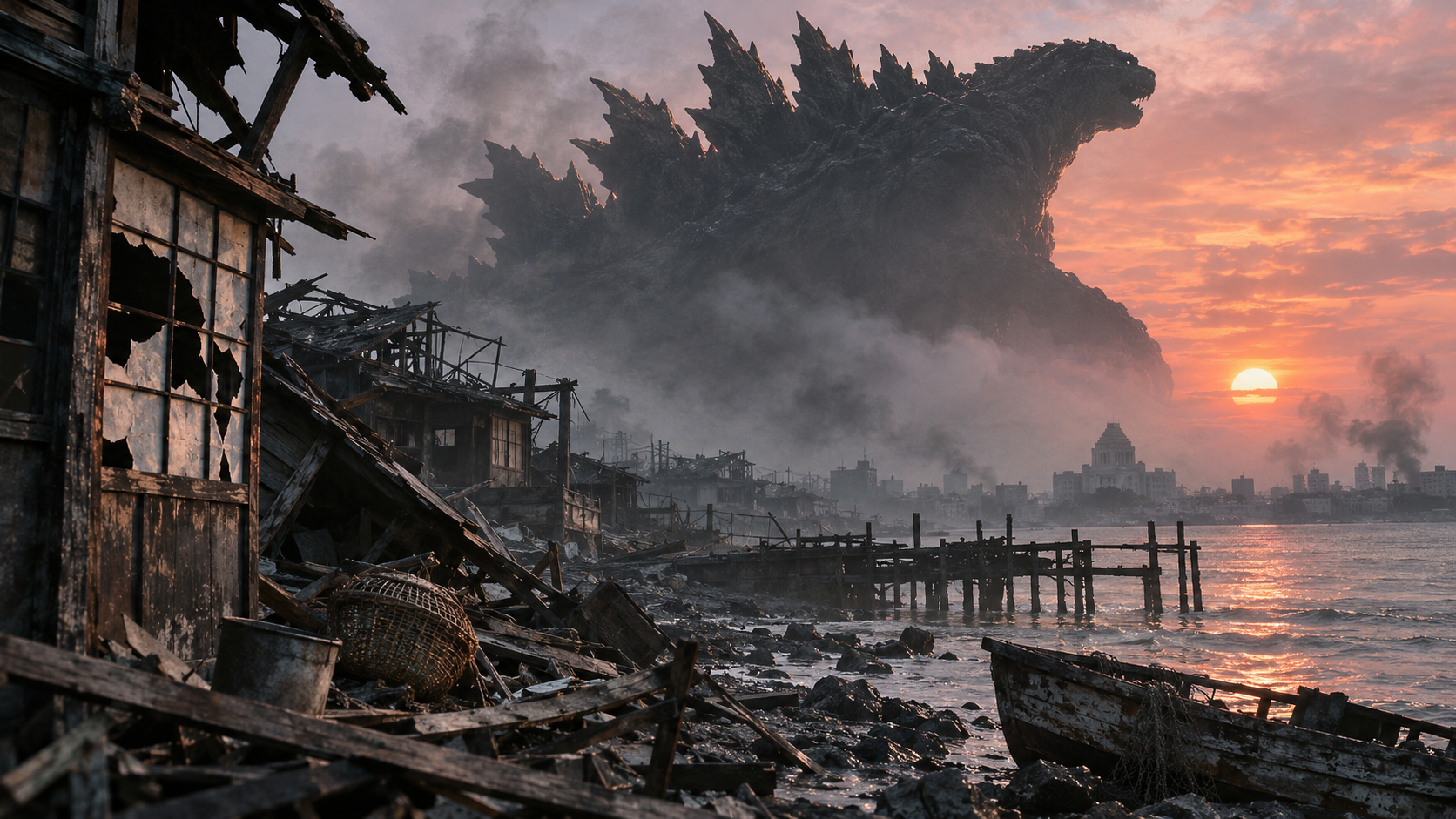
A Godzilla title containing a minus sign looks like an instruction about viewing order. Perhaps this is the film that goes one place before the original, or an origin story explaining where the creature came from. The arithmetic in Takashi Yamazaki’s film belongs to the people on shore. War has reduced Japan to zero. Godzilla arrives and drives it below that point.
That explanation, also used in the official presentation of the sequel, gives a newcomer a way into the film without revealing its ending. Watch what people have just begun to recover by the time the monster comes inland. The losses that matter are measured in meals, shelter and people who expect somebody to come home.
What Zero Looks Like In Shikishima’s Tokyo
Kōichi Shikishima has survived the war. Returning to Tokyo puts a sharper edge on the word “survived”. Much of the city has been destroyed. The family home he might once have imagined walking back into is gone. His survival as a former kamikaze pilot also carries a particular burden. People trained him for a mission in which coming home was never the intended outcome.
Then the story makes room for two people who have no formal claim on him. Noriko is looking after a small child, Akiko. The three begin to share what they have. If the film simply moved from the ruins to an attack, “zero” would be a description of damage. By giving this household time to form, Yamazaki changes what the audience is counting. Somewhere to sleep becomes a home because a particular person will be there when the door opens.
The arrangement gives Shikishima a dilemma that a monster cannot settle for him. He can earn money and help a child eat while privately believing he has no right to a future. From outside, a household appears to be taking shape. From inside his head, the war continues to make demands. The title accommodates both experiences. A city can be rebuilding faster than one of its inhabitants.
Why The Minesweeping Job Matters
One of the film’s smartest choices is the work Shikishima takes on the water. Mines remain dangerous after the fighting that put them there has ended. Clearing them is paid work. The wage can help buy ordinary necessities, although earning it requires the crew to go close to objects designed to sink ships.
That makes the boat more than a convenient place to encounter Godzilla. The crew already works on the boundary between a war officially over and a sea still full of its consequences. A minesweeper’s job depends on understanding the danger well enough to approach it. Godzilla confronts the men with a danger for which their experience has supplied no adequate scale.
It also changes the emotional weight of a cut from sea to land. By the time the men have somebody to get back to, a shot of a boat in trouble carries a second, invisible location inside it. The audience knows who could be left waiting. This is how the film makes an extraordinary creature fit a story about the cost of earning a living.
What The Minus Sign Adds To The Destruction
Audiences have seen cities collapse in monster films for decades. Usually there is a baseline of apparent normality against which the disaster registers. Here the baseline is itself a disaster. When Godzilla attacks a district of people travelling, working or shopping, the very existence of those ordinary activities represents effort someone has already expended.
Imagine losing a window in a storm. Now imagine losing the window you finally managed to replace after spending a winter with boards across the opening. The physical damage could be identical. The second loss reaches backwards and takes some of the meaning out of the repair. Yamazaki builds his spectacle around that kind of second blow.
There is a political edge to giving the story to civilians and former servicemen. Men once received orders from a state prepared to spend their lives. The relationships they build afterwards offer another basis for action. Duty can grow out of wanting the person next to you to survive. A newcomer can follow that argument by paying attention to who gets to make a decision and whose life a plan assumes can be sacrificed. The resolution is worth discovering in the film.
Do You Need To Watch The 1954 Godzilla First?
The original Japanese film offers a rich historical comparison, especially in the way an enormous creature brings memories of mass destruction into public life. You can nevertheless understand Shikishima’s predicament, Noriko’s decision and the boat crew’s predicament from the material in Minus One itself. The minus sign supplies no homework and counts no earlier instalments.
For a first viewing, the most valuable piece of context is small. The leading character has been taught to imagine an honourable end to his life much more readily than an ordinary continuation of it. Watch what changes whenever the camera finds him doing something as unheroic as coming home from work. Those passages give the action scenes much of their force.
Why A Train Is Such An Effective Measure Of Godzilla’s Size
Height figures are useful for comparing models of a monster. They do remarkably little for a viewer trying to imagine being on a Tokyo street when the animal comes through. A train does the job almost immediately. People know how high a carriage door is, what it feels like to stand in an aisle and how much force a moving train seems to possess. Bring Godzilla and a train into the same sequence and the carriage transfers its familiar scale to the creature.
Yamazaki can then reverse the comparison. A vehicle built to carry large numbers of people along a fixed route becomes vulnerable to a creature that can ignore the tracks altogether. A passenger has fewer choices than a pedestrian about where to go next. The same arrangement that makes a train efficient on a normal morning makes it frightening when familiar rules cease to hold.
That use of public infrastructure also gives destruction an afterlife. An audience may see a carriage lifted for a few seconds. A city has lost a way for people to get to work, find relatives or reach a hospital. The minus sign covers these consequences as well as the spectacular sight. Look for the ordinary things on screen that would take longest to put back together.
Why The Effects Award Fits A Story About People
Godzilla Minus One won the Academy Award for visual effects in 2024. The category understandably draws attention to the creature, its skin and the scale of the water around it. Yet the narrative achievement depends on the effects and the domestic scenes agreeing about the kind of world these people inhabit. If the city before an attack feels like scenery waiting to be demolished, the finest work on a monster will have little to subtract.
The small boat helps bridge those halves of the film. A horizon seen from near the surface lets a viewer share the crew’s limited information. Water can conceal an approach. A wake can reveal mass before the whole body appears. A change in the pitch of the deck registers in a human body before anyone has time to explain it. The audience measures the creature through decisions the men must make about where to look and what to do with their hands. A computer-generated image and a performance contribute to the same moment of recognition.
Where Does Minus Zero Fit?
Godzilla Minus Zero is Yamazaki’s follow-up. Its Japanese release was scheduled for 3 November 2026, followed by the North American opening on 6 November. The title invites audiences to carry the original arithmetic forward. It would be easy to turn that invitation into a claim that the new title promises recovery, repeats the first film’s outcome or announces a specific fate for a character. The words alone establish none of those things.
What the first title does establish is a powerful question to take into the next film. Once a family has lost almost everything and begun again, where should anyone draw the line marked zero? Shikishima’s neighbours, his crewmates and the child waiting at home would each have reason to put it somewhere different.
