

China Warns Of A Space Arms Race — What Weapons Are Actually In Orbit?
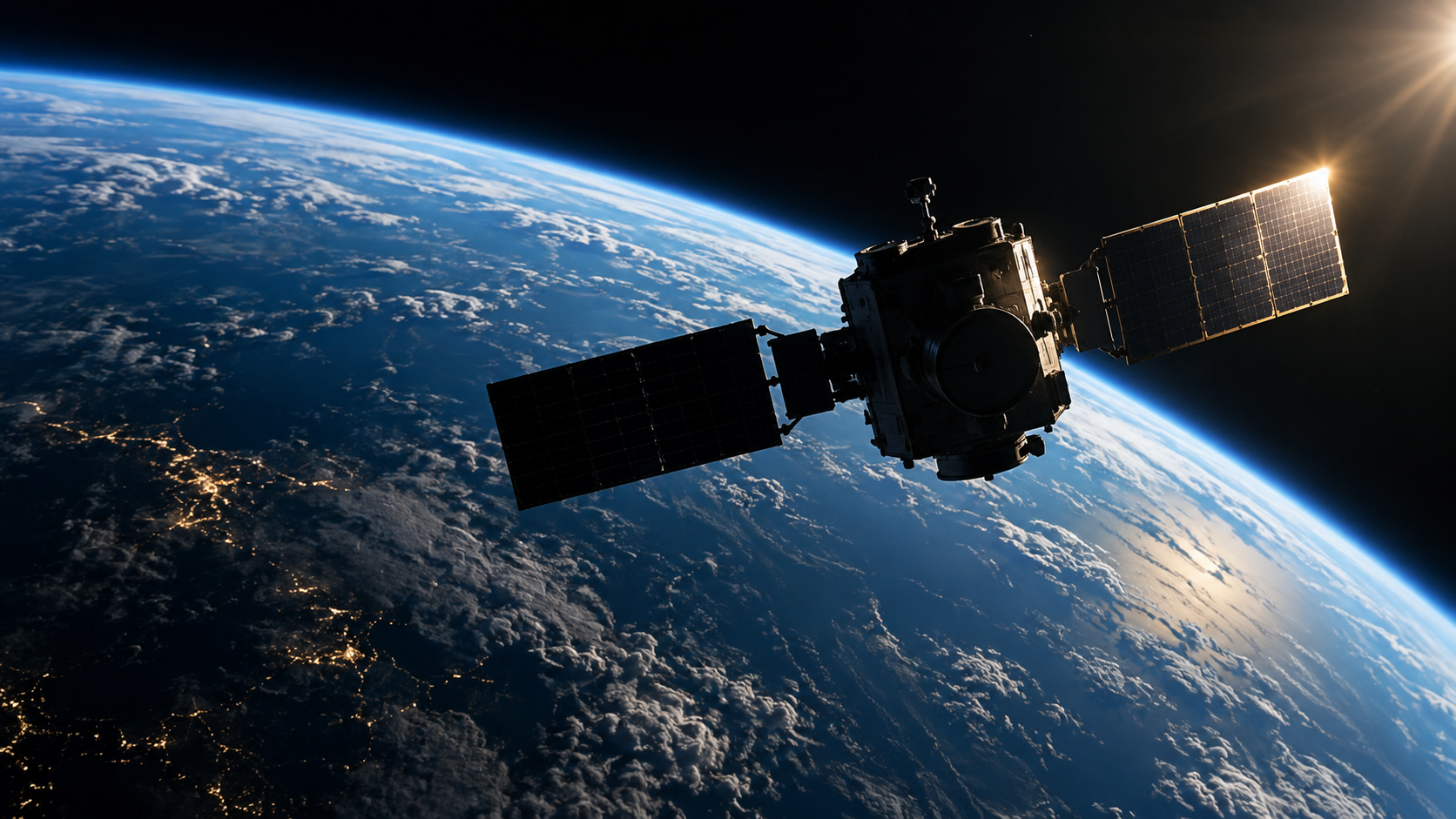
Space Weapons Explained: What Is Real And What Remains Secret?
America Says It Has Weapons In Orbit, But Their Identities And Capabilities Remain Undisclosed.
The United States has publicly acknowledged that it operates weapons in orbit, prompting China to warn against a further military build-up in space. The immediate answer to the obvious question—what weapons are actually up there—is less spectacular than some headlines suggest: Washington has confirmed a capability without identifying the systems, their numbers or precisely how they work.
Air Force Secretary Troy Meink made the disclosure at the Air, Space and Cyber Conference in Maryland on 14 September 2026. Chinese foreign ministry spokesperson Guo Jiakun responded the following day, while Chinese state media warned of an arms race. Reuters reported those reactions on 16 September.
This is a significant public acknowledgement. It is not a published inventory of orbital missiles, lasers or armed satellites. Understanding the difference requires separating weapons stationed in orbit from weapons on Earth that can attack satellites, and separating a spacecraft’s demonstrated manoeuvres from assumptions about its military purpose.
What The United States Has Actually Confirmed
Meink referred to “on-orbit space control weapons” and described their purpose as protecting the joint force against hostile action. Reporting from the conference did not identify the weapons. The public statement therefore establishes what a senior US official says the military possesses; it does not allow an independent technical assessment of each system.
In his subsequent remarks, Space Force chief General Douglas Schiess defended the decision to speak more openly about orbital capabilities. Defense One reported that he framed it around deterrence and the protection of military operations and space assets. That is the American explanation for the disclosure, rather than a neutral assessment of how other states will interpret it.
The distinction matters because disclosure itself can be strategic. A government may reveal enough to discourage an opponent while withholding details that would help the opponent defeat the capability. Conversely, the absence of detail can encourage rivals to assume a worst-case interpretation. The same announcement may therefore reassure domestic audiences while increasing uncertainty abroad.
Claims that the announcement proves a particular classified satellite carries a laser or projectile go beyond the available evidence. A serious account should be able to say both that the acknowledgement matters and that the equipment remains unidentified. Secrecy is an information gap, not a licence to fill the gap with the most dramatic design imaginable.
Military Satellites And Orbital Weapons Are Different Categories
Military activity in space is not new. Satellites support communications, navigation, reconnaissance and warning functions. A spacecraft can be essential to warfare without itself carrying a mechanism intended to disable another spacecraft. Its military value and its classification as a weapon are separate questions.
One helpful distinction is between a system that supplies information and a system intended to interfere with an opponent. A satellite that observes a region can support targeting. A satellite that deliberately interferes with another spacecraft’s electronics performs a different function. Both may be military assets, but describing them identically obscures what has changed.
There is another category: equipment with both peaceful and hostile applications. A robotic servicing spacecraft might extend the life of an ageing satellite. Similar proximity and manipulation capabilities could be threatening if used against another operator’s spacecraft without consent. Intent, behaviour and authorisation become central to interpretation.
This is why an exact global count of “weapons in space” is not publicly available. There are problems of classification as well as secrecy. Counting every military satellite exaggerates the arsenal; counting only objects openly advertised as weapons risks excluding capabilities whose purpose is deliberately ambiguous.
The Five Main Ways To Attack A Space System
Secure World Foundation’s 2026 Global Counterspace Capabilities Report, edited by Victoria Samson and Kathleen Brett, assesses capabilities across five broad categories: co-orbital systems, direct-ascent systems, electronic warfare, directed energy and cyber operations. It covers 13 countries and uses an information cut-off of 28 February 2026.
That taxonomy is useful because it breaks the association between space warfare and explosions above the atmosphere. Some attacks would involve an object approaching another in orbit. Others would target radio links or computer systems from the ground. The intended result might be temporary disruption, permanent damage or the loss of confidence in information.
The location of the attacker is therefore a basic question. A weapon can threaten a satellite without ever completing an orbit. Equally, an object in orbit may be capable of threatening another satellite even when it resembles an inspection or servicing vehicle. These are different pathways to interfering with the same service.
For readers trying to interpret a new claim, four questions help: where is the system located, what effect has been demonstrated, what purpose is attributed to it, and who supplies that attribution? A report that answers only the last question is describing an assessment, not revealing the complete machinery.
Co-Orbital Systems: When One Spacecraft Approaches Another
Co-orbital activity involves objects operating in orbit in relation to other objects. Rendezvous and proximity operations allow a spacecraft to approach, inspect or interact with another spacecraft. Those capabilities can support valuable servicing missions, but they also create opportunities for interference.
A threatening encounter need not resemble a fighter aircraft chasing another through the sky. Orbital motion imposes constraints on how spacecraft change position. An observer needs a sequence of measurements, information about the orbital geometry and context about the mission. A single image showing two objects apparently close together proves very little.
The critical distinction is between capability and use. Demonstrating the ability to approach a satellite may show technical sophistication. It does not automatically demonstrate the ability to disable that satellite, and it does not prove an intention to do so. Yet the approach can still be strategically concerning when the operator provides no explanation.
The term “hunter satellite” is consequently best treated as a description of a suspected role, rather than a standard technical category with a fixed payload. It can cover very different ideas, from tracking another spacecraft to approaching it with equipment intended to interfere. Readers should ask what the underlying observation actually shows.
Robotic Arms: The Same Capability Can Repair Or Threaten
Robotic manipulation illustrates the dual-use problem clearly. A spacecraft able to grasp, stabilise or move another object could assist with servicing or debris management. Those functions are potentially beneficial because replacing every failed satellite is costly and abandoned hardware contributes to a more difficult operating environment.
However, the same broad physical capability can be viewed differently without the target operator’s consent. Moving a functioning satellite away from its intended orbit could interrupt its mission even without smashing it into fragments. Contact with sensitive components could also present a risk. These are general possibilities, not confirmed descriptions of the newly acknowledged US weapons.
China’s Shijian-21 mission has become a prominent example in the wider debate over orbital servicing and manipulation. Public accounts of its movement of a defunct BeiDou satellite have been discussed in specialist assessments. The relevant point is the demonstrated servicing-type activity; labelling the entire mission an attack would add a claim that those observations do not establish.
Clear notification, consent and safe approach procedures would help distinguish a service from a threat. They would not remove every possibility of deception, but they would create a baseline against which unusual behaviour could be assessed. Without such expectations, ordinary technical progress can become harder to distinguish from preparation for conflict.
Russia’s Satellites Show Why Attribution Matters
Russian co-orbital activities have generated repeated Western concerns. Secure World Foundation maintains a separate assessment of Russian co-orbital anti-satellite testing, illustrating that these questions predate the latest American announcement. Historical observations should nevertheless remain attached to their dates rather than being presented as a live inventory.
In 2020, the United States and United Kingdom accused Russia of testing a space-based anti-satellite weapon after an object was released from a satellite. In 2024, Washington described another Russian launch as a possible counterspace threat; Moscow rejected the accusation. An observed release or orbital placement and a government’s interpretation of its purpose are related but distinct evidence.
That distinction is especially important when discussing nuclear capability. US allegations about a Russian nuclear anti-satellite programme have attracted attention, but they should not be converted into a verified claim that an operational nuclear weapon is orbiting overhead. Public concern, intelligence assessment and confirmed deployment are not interchangeable.
Nor does a nuclear power source make a spacecraft a nuclear weapon. Space missions can use nuclear energy for electricity or heat without carrying a nuclear explosive device. The physical equipment and intended effect determine the issue, not the appearance of the word “nuclear” in a description.
Direct-Ascent Missiles: Weapons That Reach Space From Earth
A direct-ascent anti-satellite weapon is launched towards a satellite rather than stationed in orbit waiting for a target. It may intercept an object above the atmosphere, but that does not make it an orbiting weapon. This distinction is frequently lost when historical satellite-destruction tests are placed beside claims about equipment already deployed in space.
China’s 2007 destruction of one of its own satellites is a major example in the history of destructive testing. Russia’s 2021 test is another. The United States and India have also conducted destructive satellite intercepts. These events establish that the ability to hit an orbital object is not merely theoretical, while leaving the status of other systems to be assessed separately.
A successful test also has limits as evidence. It demonstrates performance against a particular target in particular circumstances. It does not prove the ability to destroy any satellite at any altitude whenever desired. Different orbital regimes and mission conditions impose different constraints.
The damaging legacy can extend beyond the test itself. Breaking an object into fragments adds collision hazards for operators that had no role in the demonstration. That is why the argument over destructive testing concerns the shared space environment as well as the relationship between the countries conducting and observing the test.
Jamming: A Satellite Can Be Disrupted Without Being Destroyed
Electronic warfare targets the signals connecting a space system and its users. Jamming interferes with reception; spoofing attempts to make a receiver accept misleading information. Neither requires a cinematic blast, and neither necessarily involves hardware placed in orbit.
Meadowlands is an instructive example. L3Harris and US Space Systems Command describe it as a ground-based system using radio-frequency equipment to disrupt satellite communications. It belongs in a discussion of counterspace capability, but presenting it as proof of which weapons Meink says are in orbit would be a category error.
Temporary disruption can still be consequential. A service may be most valuable during a narrow operational window, so restoring it later does not necessarily undo the effect of losing it at the critical moment. Reversibility in engineering terms is therefore different from reversibility in practical consequences.
Attribution can also be difficult. A user experiencing an unreliable signal does not immediately know whether the cause is interference, equipment failure or another problem. Evidence must connect the observed effect with a source and an explanation. A disrupted service alone should not be treated as proof of a particular state’s attack.
Lasers: Plausible Capability Does Not Establish An Orbital Arsenal
Directed-energy systems include lasers that can interfere with sensors or, under suitable conditions, damage equipment. Their effects depend on the target, exposure and engineering characteristics. The same word can describe very different levels of capability, so a claim about a laser requires more detail before its military significance can be judged.
A ground-based laser and an orbital laser also face different operating conditions. A ground system must account for the atmosphere and access to the target. An orbital system faces constraints involving power, heat and spacecraft design. Neither should be assumed to possess unlimited reach or continuous effectiveness.
US threat assessments have described Chinese ground-based laser capabilities as a concern. That is an attributed military assessment, not independent proof that China has deployed an orbital beam weapon. Similarly, discussions of possible American directed-energy payloads do not identify the systems covered by Meink’s announcement.
The honest answer to whether there are operational US laser weapons in orbit is that the disclosure reviewed here does not establish it. The possibility can be explained without being promoted into a fact. That boundary is the difference between a useful explainer and an illustrated catalogue of speculation.
Cyberattacks Can Reach Space Through Infrastructure On Earth
A space service includes more than the spacecraft. Ground stations, operator accounts, software, communications links and user terminals all contribute to its operation. An attack on one of those components can affect the service without physically touching anything in orbit.
This creates an important problem for the phrase “space weapon”. Malicious software operating on a terrestrial network might interfere with satellite operations, but it is not an object orbiting Earth. Its relevance comes from the function it disrupts, rather than its location.
Security therefore needs to follow the service from end to end. Protecting an expensive satellite while neglecting the systems that manage it would leave a gap between the appearance of resilience and its reality. The weakest component can determine how a much larger system behaves under pressure.
The same reasoning helps explain why an outage does not prove an orbital attack. Before assigning a cause, investigators need to examine ground infrastructure and ordinary failure modes as well as possible hostile activity. A dramatic location should not push less dramatic explanations out of the investigation.
What The Outer Space Treaty Actually Prohibits
The 1967 Outer Space Treaty does not impose a blanket prohibition on every conventional weapon in Earth orbit. Article IV prohibits placing nuclear weapons or other weapons of mass destruction in orbit, installing them on celestial bodies or stationing them in outer space in other ways. It also imposes specific peaceful-use requirements concerning the Moon and other celestial bodies.
That legal distinction matters. A headline saying any orbital weapon automatically violates the treaty overstates the text. Equally, the absence of a blanket conventional-weapons ban is not a declaration that every conceivable operation is lawful. Other treaty duties and international law remain relevant to conduct.
The treaty’s provisions on due regard and potentially harmful interference also belong in the discussion. The legal question is not exhausted by asking whether a payload contains a prohibited type of weapon. How a state behaves, what it affects and the obligations applicable to that behaviour can also matter.
This is a general explanation of the framework, rather than a legal judgement on unidentified US equipment. Without knowing the systems or their operation, a confident finding of compliance or breach would exceed the public evidence. The announcement raises questions that its limited technical detail cannot resolve.
Golden Dome Is A Separate Question
The proposed Golden Dome missile-defence architecture has made space-based defence more prominent in public debate. Its broader ambitions should be distinguished from the specific capability acknowledged this September. An announcement that weapons exist in orbit does not establish that a complete nationwide interception architecture is operational.
Detection and interception are also different functions. A satellite can help identify and track a missile without carrying the equipment that destroys it. Plans involving orbital sensors should therefore not automatically be described as plans for orbital interceptors, or vice versa.
The practical question for any proposed architecture is what has actually been funded, built, launched, tested and integrated. Those milestones require different evidence. A concept can be strategically significant while remaining a concept; a launch can be technically successful without proving the entire defence system works.
This is the same discipline needed when assessing ambitious spaceflight timelines. Separate the announced destination from the demonstrated steps needed to reach it. Otherwise a future programme and an existing capability become indistinguishable in the reader’s mind.
Why China’s Arms-Race Warning Deserves Context
China’s response presents American orbital weapons as a threat to stability. The US presents its capability as protection against hostile action. Both positions should be understood as strategic statements from interested governments, rather than accepted as complete accounts of the environment.
The arms-race concern has a recognisable mechanism. One state develops a capability it regards as defensive; another sees a threat and develops a countermeasure; the first then treats that response as evidence that further preparation is necessary. Neither side has to announce an intention to start a war for the cycle to intensify.
China’s own counterspace activities make it misleading to portray Beijing simply as a spectator to military competition in orbit. At the same time, those activities do not make every warning about escalation invalid. A government can contribute to a security problem and still identify a real danger in its further development.
The relevant question is which behaviours would reduce uncertainty for all operators. Advance notification, clearer statements of purpose, limits on destructive testing and channels for resolving dangerous encounters could be useful even between rivals. Agreement on every political dispute is not a prerequisite for reducing the risk of a mistaken interpretation.
The Consequences Would Reach Far Beyond The Military
Space systems support civilian services as well as defence. A conflict affecting shared infrastructure could therefore have consequences for organisations and users far removed from the original confrontation. The scale would depend on which systems were affected, available alternatives and the duration of disruption.
It would be inaccurate to say that one damaged satellite would automatically end the internet or disable every navigation receiver. Services differ in redundancy, geographic coverage and dependence on particular components. Resilience has to be assessed system by system rather than assumed either absent or complete.
Destructive attacks raise an additional problem because debris does not respect the ownership of future targets. Fragments can remain hazardous and impose costs on other spacecraft. The longer-term environment can deteriorate even when the immediate military objective is limited.
This is why the most useful question is broader than who could win a confrontation. What would remain usable afterwards, and how would uninvolved operators protect essential services? A strategy that protects one asset while making its operating environment less sustainable may exchange an immediate advantage for a persistent vulnerability.
What We Can Say With Confidence
The United States now publicly says it possesses on-orbit weapons. It has not supplied enough information to identify them. Counterspace capabilities also include ground-launched interceptors, terrestrial jammers, directed-energy systems and cyber operations, which should not be confused with an inventory of weapons stationed overhead.
China and Russia have demonstrated or been assessed to possess significant relevant capabilities, but each claim needs its own evidence and date. Servicing manoeuvres, suspected weapons tests and intelligence allegations do not all establish the same thing. Nuclear-powered spacecraft should never be casually conflated with nuclear weapons.
The strategic change is the greater willingness to acknowledge orbital weapons openly. What happens next will depend on deployments and behaviour as much as rhetoric. Until more details emerge, precision is more revealing than speculation: the arsenal is acknowledged, its contents remain largely hidden, and the consequences of a mistake would be shared.
