Inside The CIA Black Sites: The Secret Prisons Of The War On Terror
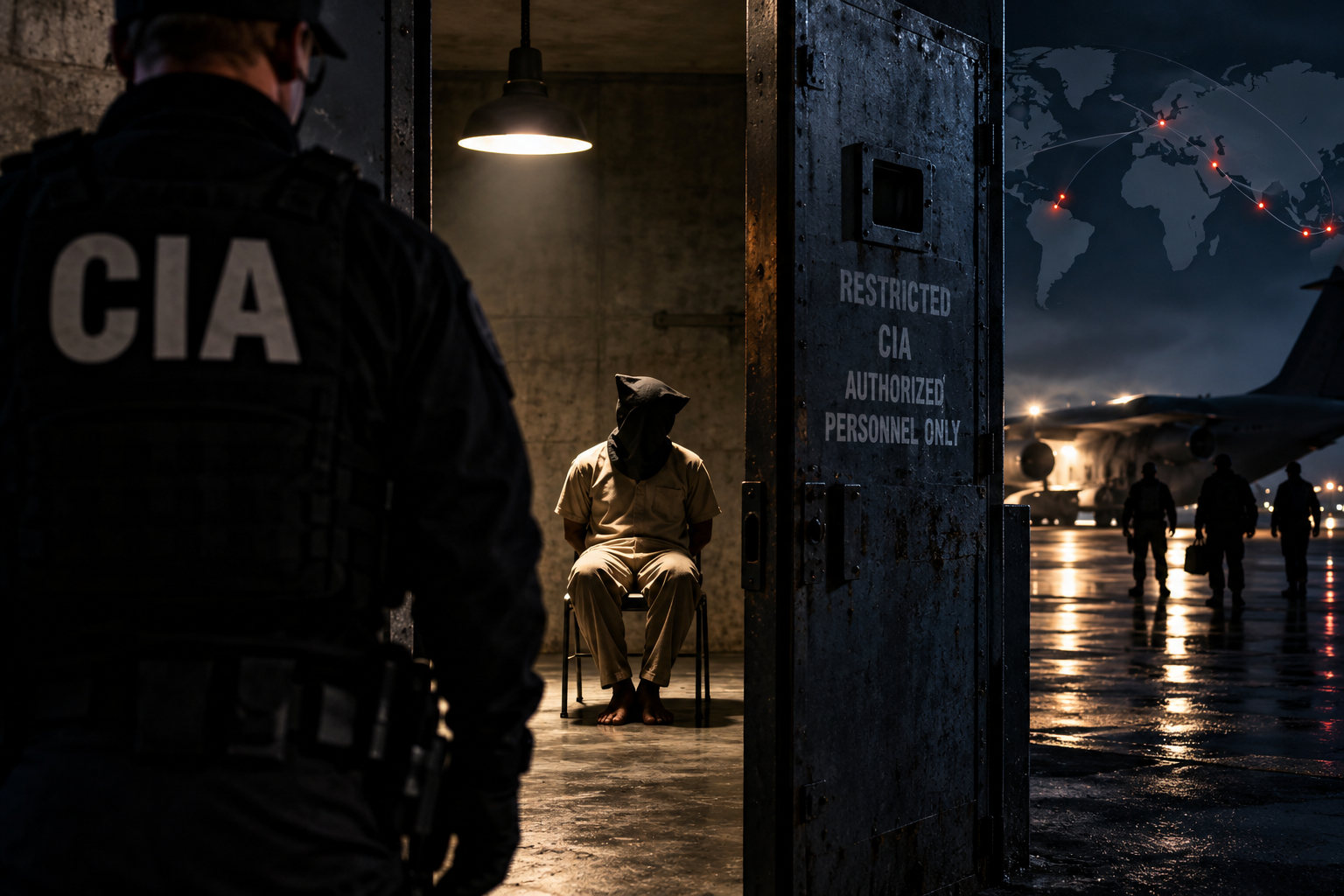
The CIA Black Sites Explained: Inside The Hidden Detention System Built After 9/11
Behind The Doors Of America’s Hidden Detention Network
After 9/11, the United States created a clandestine detention network beyond ordinary prisons and public scrutiny. Years of declassified records, court judgments and investigations have since revealed how it worked, what happened inside it and why its legacy still matters.
In the months after the attacks of 11 September 2001, the Central Intelligence Agency was given extraordinary authority to hunt al-Qaeda leaders across the world. What followed was not simply an expansion of surveillance or covert operations. The CIA became the operator of a secret detention system.
Prisoners were captured, moved across borders on covert flights and held in facilities whose locations were officially denied or concealed. Some were subjected to waterboarding, prolonged sleep deprivation, stress positions, forced nudity, confinement in small boxes and other coercive methods. At least one detainee died in CIA custody. Others were held even though the CIA later concluded they should not have been detained in the first place.
The programme was born from a genuine fear that another mass-casualty attack could be imminent. It was also built with haste, secrecy and unusually weak outside scrutiny. Those conditions shaped almost everything that came next.
More than two decades later, the CIA no longer operates the detention programme that produced the black sites. But the record left behind by the programme remains central to arguments about intelligence, torture, national security, presidential power and what democratic governments are prepared to do when they believe another attack may be coming.
What A CIA Black Site Actually Was
The phrase “black site” sounds almost cinematic, but its meaning was brutally practical. A black site was a secret detention facility whose existence, location or purpose was concealed from the public and often from ordinary legal oversight.
These were not conventional American prisons. Detainees were not entered into an open criminal justice system when they arrived. Their families were generally not told where they were. The International Committee of the Red Cross did not initially have routine access to them. For long periods, some prisoners effectively disappeared into a system that the US government would not publicly acknowledge.
The CIA’s programme was separate from the detention operation at Guantánamo Bay. Guantánamo became visible, controversial and legally contested, but it was still a known US military facility. The black sites were designed to be the opposite: hidden locations used for people considered especially important to counterterrorism intelligence.
The broader system also included “extraordinary rendition”, the covert transfer of suspects between countries outside normal extradition procedures. Aircraft linked to the programme crossed multiple jurisdictions. Foreign intelligence services, security agencies, airports and governments were drawn into the network to varying degrees.
That international architecture became one of the reasons the programme was so difficult to keep secret. A single hidden prison could perhaps be concealed. A network requiring aircraft, airspace, guards, host-country cooperation, medical support, interrogators and repeated prisoner transfers left traces.
The Programme Began In The Panic After 9/11
The black sites cannot be understood without the atmosphere immediately after the September 11 attacks.
Nearly 3,000 people had been killed. Al-Qaeda had demonstrated that it could plan an operation across several countries, penetrate the United States and turn civilian aircraft into weapons. American officials did not know whether another wave of attacks was already being prepared.
On 17 September 2001, President George W. Bush signed a covert action authorisation giving the CIA expanded counterterrorism powers, including authority to capture and detain people believed to pose a continuing serious threat to the United States or to be planning terrorist activity.
The authority created a problem the CIA had not fully prepared to solve: if it captured senior terrorism suspects, where would it hold them?
The Senate Intelligence Committee later concluded that the agency was not ready to run a detention and interrogation programme when it began doing so. CIA officials considered different options, including military facilities, but secrecy complicated every choice.
The capture of Abu Zubaydah in Pakistan in March 2002 forced the issue.
Zubaydah was badly wounded during the raid that led to his capture. American officials believed he possessed important information about al-Qaeda and possible future attacks. Rather than placing him immediately in a recognised military prison, the CIA moved towards clandestine detention abroad.
The agency had entered the prison business.
That was a profound shift. The CIA was built primarily to collect intelligence, recruit sources, analyse information and conduct covert operations. Running prisons required different expertise: detention procedures, medical safeguards, interrogation standards, record keeping, logistics and long-term legal planning.
The Senate investigation later found that the programme expanded before those systems were properly established.
Abu Zubaydah And The First Major Test
Abu Zubaydah became the first major detainee around whom the CIA’s post-9/11 interrogation programme developed.
His case is important because it shows how quickly the programme moved from secret detention to coercive interrogation.
During 2002, CIA officers and contractors debated how to extract information from him. The agency sought legal approval for techniques that went far beyond ordinary questioning. Many of those methods had roots in Survival, Evasion, Resistance and Escape training, known as SERE, which was intended to prepare American military personnel for abusive treatment if captured by hostile forces.
Techniques authorised for use on Zubaydah included walling, facial slaps, cramped confinement, stress positions, prolonged sleep deprivation and waterboarding.
Waterboarding became the most infamous method associated with the programme. A detainee was restrained while water was poured over cloth covering the face, creating a sensation of drowning and triggering intense physical panic.
CIA records examined by the Senate showed that Zubaydah was waterboarded repeatedly during August 2002. Interrogators also confined him in boxes and used prolonged sleep deprivation. The intensity of the sessions alarmed some personnel involved.
What happened to Zubaydah became a template for the programme’s expansion. Once techniques had been legally approved and operationally introduced, they were applied to other prisoners judged resistant or believed to possess urgent intelligence.
The central argument was straightforward: conventional questioning might be too slow if a detainee knew about an imminent attack.
The difficulty was just as fundamental. Intelligence officers could rarely know with certainty what a prisoner actually knew, whether the prisoner was withholding it or whether harsher treatment would produce truth rather than compliance, confusion or fabrication.
That problem would follow the programme for its entire existence.
A Secret Network Spreads Across The World
The exact map of the black-site system remained classified for years, and parts of the record are still redacted. But investigations, court judgments and declassified American documents have established significant parts of the network.
Facilities associated with the programme operated in Afghanistan. European investigations and later court rulings established the involvement of Poland, Romania and Lithuania in hosting secret CIA detention operations. Thailand has also been widely identified as an early location connected to the programme.
The facilities were not all identical. Some were temporary. Some held only a small number of people. Others became major nodes in the system.
One of the most notorious facilities was known in CIA records as COBALT, in Afghanistan. It became associated with chaotic management, harsh treatment and poor record keeping.
The Senate Intelligence Committee found that COBALT eventually housed more than half of the 119 detainees it identified as having passed through CIA custody. The facility operated with severe management failures. The committee found that some interrogators used unauthorised techniques and that senior leadership did not always have a clear understanding of what was happening inside.
In November 2002, Gul Rahman died at COBALT after being held partially naked and chained to a concrete floor in cold conditions. His death became one of the clearest examples of how far the programme had moved from its original intelligence mission into dangerous and poorly controlled detention practices.
The network did not remain fixed. Detainees were moved between sites as political, security and legal pressures changed. A facility could become compromised. A host government could become nervous. A court ruling could alter the legal environment. A prisoner could be moved simply because the CIA wanted to change the conditions under which he was held.
The result was a detention system designed around mobility and secrecy.
Rendition Was The System’s Circulatory Network
Secret prisons required a secret transport system.
Extraordinary rendition provided it.
Detainees were flown between countries on aircraft connected to CIA operations or contractors. Flight plans could involve indirect routes and multiple stops. Prisoners were restrained, searched and transported under tight security. The objective was to move them without the ordinary public procedures associated with extradition, criminal charges or open deportation.
Over time, investigators reconstructed parts of this movement through aviation records, airport data, billing documents, corporate records and the accounts of detainees.
European inquiries described the rendition system as a web connecting detention sites, military installations, airports and intelligence partners.
The network depended on cooperation. The United States could not simply operate sensitive detention facilities inside allied countries without some level of local support, permission or tolerance. That raised a larger question: where did American responsibility end and host-country responsibility begin?
European courts later answered part of that question by finding states responsible for allowing CIA detention and transfers on their territory.
The black-site story is therefore not solely an American story. It is also a story about how alliances behave when intelligence cooperation is pushed into areas that elected legislatures, courts and publics may never have explicitly approved.
What Happened Inside The Black Sites
The best-established account of interrogation practices comes from American government records, the Senate investigation, CIA documents and later legal proceedings.
The methods varied by detainee and period, but the programme included techniques such as prolonged sleep deprivation, forced standing, stress positions, forced nudity, dietary manipulation, facial slaps, walling, confinement in small boxes and waterboarding.
Sleep deprivation could last for days. Prisoners could be shackled in positions designed to prevent normal rest. Constant light or noise could be used. Detainees were sometimes kept isolated for extended periods, uncertain where they were or how long their confinement would last.
Some techniques were officially authorised. Other conduct exceeded authorised boundaries.
That distinction mattered legally inside the programme, but it did not eliminate the wider argument over whether the authorised system itself amounted to torture or cruel, inhuman or degrading treatment.
European human-rights judgments later found serious violations connected to the programme. Former senior CIA officials have also acknowledged that the agency was unprepared for the detention mission, while US law now prohibits the use of the former programme’s interrogation architecture.
One practice revealed in the Senate report drew particular criticism: the use of rectal hydration or feeding on some detainees when records did not establish a medical necessity for the procedure in the way it was used.
The programme’s defenders argued that officials were confronting senior members of a terrorist network after an attack that had killed thousands and while further plots were feared. Critics argued that the techniques were abusive, legally corrosive and operationally unreliable.
Those arguments still matter, but the underlying conduct is no longer seriously disputed in broad outline. The central dispute is now over how it should be judged and what intelligence value, if any, can fairly be attributed to coercive methods rather than to detention and questioning more generally.
Khalid Sheikh Mohammed And The Most Aggressive Interrogations
Khalid Sheikh Mohammed, commonly known as KSM, was captured in Pakistan in March 2003. American authorities identified him as the principal architect of the September 11 attacks.
He became one of the highest-value prisoners in the entire programme.
CIA records show that Mohammed was waterboarded extensively. He was also subjected to prolonged sleep deprivation and other coercive techniques.
His interrogation sits at the centre of the long-running dispute about effectiveness.
The Bush administration argued that information from CIA detainees helped identify operatives, disrupt plots, understand al-Qaeda networks and protect lives. In 2006, when President Bush publicly acknowledged the CIA detention programme, he described it as one of the most important counterterrorism tools available to the United States.
The later Senate Intelligence Committee investigation reached a sharply different conclusion about the role of the enhanced techniques themselves. It found that the CIA had overstated their effectiveness and that valuable intelligence had often been obtained before coercive methods were used, through other collection streams or through ordinary questioning.
The CIA disputed important parts of that assessment. In its formal response to the Senate study, the agency argued that information obtained from detainees had produced significant intelligence and helped the United States understand and disrupt terrorist activity, while also acknowledging inaccuracies in some previous representations. The CIA’s response did not argue that coercive methods were the only way to obtain the intelligence, nor did it present the response as an endorsement of those techniques.
Some members of the Senate Intelligence Committee also rejected the majority’s effectiveness conclusions.
That distinction is essential. There are at least three separate questions: whether detainees in CIA custody provided useful intelligence; whether coercive treatment caused them to provide intelligence they would otherwise have withheld; and whether the techniques were lawful or acceptable. Those are not the same question.
The historical record supports a strong conclusion on the first: CIA detainees did provide information. The second remains deeply contested. The third led to major legal, political and institutional changes.
Abd Al-Rahim Al-Nashiri And The Limits Of Control
Another high-profile detainee was Abd al-Rahim al-Nashiri, accused by the United States of involvement in the bombing of the USS Cole in Yemen in 2000.
His treatment became notorious because it showed that even within an already coercive programme, interrogators sometimes crossed internal limits.
Investigations documented an incident in which a CIA interrogator used an unloaded handgun and a power drill to threaten al-Nashiri. He was also subjected to painful stress positions and other abusive treatment.
Those actions were not simply controversial in hindsight. They raised concerns within the CIA itself.
The incident exposed a structural weakness. A system built in extreme secrecy can reduce the number of people able to challenge what happens inside it. When operations are compartmentalised, legal review may occur at headquarters while the reality of detention unfolds thousands of miles away in a closed facility run by a small group.
The more extraordinary the mission, the more important supervision becomes. In parts of the black-site programme, supervision was exactly what failed.
The CIA Wrongfully Detained People
Perhaps the most damaging finding in the Senate investigation was not about the treatment of the most notorious al-Qaeda suspects. It was about people who should not have been in CIA custody at all.
The Senate committee identified at least 119 people who had been detained by the CIA. It concluded that at least 26 were wrongfully held under the agency’s own detention standard.
That figure matters because it changes the way the programme must be understood. A secret detention system does not only create risks for guilty or dangerous people. It creates a profound risk when intelligence is wrong.
Some detainees were held on weak, mistaken or fabricated information. The Senate found examples in which people remained in custody even after questions arose over whether they met the required detention threshold.
The problem was intensified by poor record keeping. At one stage, CIA personnel reported discovering that the agency was holding detainees about whom it knew very little.
The case of Khaled El-Masri became one of the best-known examples associated with the rendition system. El-Masri, a German citizen, was seized in Macedonia in 2003 after being mistaken for a terrorism suspect with a similar name. He was transferred to Afghanistan and held for months before being released.
The European Court of Human Rights later found Macedonia responsible for violations connected to his secret detention, ill-treatment and transfer.
His case demonstrates the basic danger of combining secrecy, coercive detention and imperfect intelligence. In an ordinary justice system, a mistaken identity can be challenged through lawyers, courts and records. In a black site, the mechanisms designed to expose a mistake may barely exist.
How The Secret Programme Became Public
The black sites were created to remain hidden. They did not stay hidden.
The truth emerged in layers.
Former detainees described secret transfers and locations. Aviation researchers and investigators traced suspicious aircraft movements. Human-rights organisations assembled testimony. European institutions examined airport and flight records. Courts tested claims that governments had permitted covert detention on their territory. American documents were declassified. The CIA Inspector General examined the programme internally. Congress eventually conducted its own massive investigation.
Each source had limitations. Detainees could not always identify where they had been held. Flight logs could show aircraft movement without proving who was on board. Governments denied allegations. Important records remained classified or redacted.
But the evidence accumulated.
In 2006, President Bush ended the central public fiction that no CIA detention programme existed. He announced that 14 detainees previously held by the CIA had been transferred to Guantánamo Bay and acknowledged that a separate CIA programme had held and questioned suspected terrorist leaders outside the United States.
He did not reveal the locations of the secret facilities.
The admission changed the argument. The question was no longer whether a secret CIA detention system existed. It was how large it had been, where it had operated, what had happened inside it and whether the intelligence gained justified the methods used.
Poland, Romania And Lithuania
Europe became one of the most important arenas for answering those questions.
Council of Europe investigations concluded that secret CIA detention facilities had operated in Poland and Romania. Later litigation produced further findings concerning Lithuania.
The European Court of Human Rights ruled in cases involving Abu Zubaydah and Abd al-Rahim al-Nashiri that European states had violated rights by enabling CIA secret detention, ill-treatment and transfer operations.
These judgments mattered because they converted parts of what had once been dismissed as allegation into formal legal findings against host states.
The cases also exposed a difficult feature of intelligence alliances. Governments often rely on secrecy to protect cooperation with foreign services. But when that cooperation involves detention and coercive treatment, secrecy can collide with legal obligations that continue to exist even during counterterrorism operations.
The black sites therefore created two levels of accountability. The first concerned the United States and the CIA. The second concerned governments that allowed facilities, aircraft or operations connected to the programme to use their territory.
For years, those governments faced the same problem: admitting cooperation could damage intelligence relationships and domestic political credibility, while continued denial became harder as evidence accumulated.
The Legal Architecture That Made The Programme Possible
The black sites were not created in a legal vacuum. They were created inside an intense argument about what existing law permitted after 9/11.
US government lawyers produced opinions analysing the limits of the federal torture statute and the president’s wartime authority. Those legal interpretations became a foundation for the use of coercive interrogation techniques.
The administration maintained that the authorised programme was lawful and that the United States did not torture.
Critics argued that the legal reasoning had been constructed to permit conduct that would ordinarily have been recognised as torture or cruel treatment.
The dispute changed as courts, Congress and later administrations altered the framework.
The Supreme Court’s 2006 decision in Hamdan v Rumsfeld increased pressure on the administration by holding that Common Article 3 of the Geneva Conventions applied to the conflict with al-Qaeda for purposes relevant to the case. That raised new questions about treatment standards and prosecution.
The same year, the Bush administration publicly acknowledged the CIA programme and transferred major detainees to Guantánamo.
The system was beginning to move out of the shadows, even before it formally ended.
Did The Black Sites Stop Terrorist Attacks?
This is the question that keeps the controversy alive.
The Bush administration said the programme produced intelligence that helped disrupt plots, identify terrorists and prevent attacks. CIA officials have maintained that information from detainees contributed to important counterterrorism successes.
The Senate Intelligence Committee’s majority report did not accept the broader claim that the enhanced interrogation techniques themselves were an effective means of acquiring intelligence or cooperation. Its review found examples in which detainees gave useful information before coercive techniques, in which intelligence came from other sources, and in which prisoners under coercion produced false or fabricated information.
The CIA formally disputed important elements of that analysis. Its own review argued that detainee information was significant, while conceding that some agency descriptions of particular successes lacked precision.
The minority views attached to the Senate study also challenged the majority’s conclusions and argued that the record supported a more positive assessment of intelligence obtained from detainees subjected to enhanced methods.
There is no simple experiment that can resolve the dispute. Intelligence operations do not offer controlled trials in which the same prisoner is questioned under identical conditions with one variable changed.
What can be said with confidence is narrower.
Detainees provided useful intelligence. Coercive methods also produced false information. The CIA made claims about effectiveness that the Senate majority found were inaccurate or overstated. The CIA disputed important parts of that finding. And the United States later abandoned the programme and legally restricted interrogation techniques available to government personnel.
That is a less dramatic conclusion than either side’s strongest political argument, but it is closer to the documentary record.
Why The Black Sites Were Different From Guantánamo
The two systems are often blurred together, but they were not the same.
Guantánamo Bay was a Department of Defense detention facility. Its existence was public. Journalists, lawyers, the Red Cross, courts and members of Congress could eventually scrutinise aspects of what happened there, even amid intense legal restrictions and secrecy.
The CIA black sites were specifically designed to avoid that visibility.
A prisoner could be moved from one country to another without public notice. The location might be known only to a narrow group inside the US government and the host country. The detainee might not know which country he was in.
In September 2006, 14 high-value detainees were transferred from CIA custody to Guantánamo. That transfer marked a crucial transition from a secret intelligence detention system towards a more visible military detention process.
The distinction matters because Guantánamo remains open, while the CIA black-site detention programme does not.
The wider history of US wars in the Middle East shows how 9/11 produced several different systems at once: open wars, covert operations, military detention, intelligence detention and expanded counterterrorism powers. Treating them as one single policy hides how differently each was authorised and controlled.
Obama Ordered The CIA Prisons Closed
Barack Obama took office in January 2009 promising a break with key parts of the previous administration’s detention and interrogation policy.
On 22 January, he signed Executive Order 13491.
The order required humane treatment, restricted interrogation methods to those authorised by the Army Field Manual and directed the CIA to close any detention facilities it was operating as quickly as possible. It also stated that the CIA should not operate such detention facilities in the future, while excluding short-term transitory holding facilities from that definition.
The order also required US agencies to provide the International Committee of the Red Cross with notification of and timely access to people detained in armed conflict under US control.
The CIA’s black-site programme, in the form developed after 9/11, was over.
Congress later strengthened the interrogation restrictions. Section 1045 of the National Defense Authorization Act for Fiscal Year 2016 limited interrogation of individuals in US custody or control in armed conflict to techniques authorised by the Army Field Manual. The restriction applies across the US government, including the CIA.
That legal change is one of the programme’s clearest long-term consequences. Future presidents may change counterterrorism policy, but recreating the post-9/11 interrogation system would face statutory restrictions that did not exist when the black sites were first created.
What Accountability Followed?
The scale of the programme produced far less criminal accountability in the United States than many critics expected.
The Department of Justice examined allegations of detainee mistreatment and investigated two deaths connected to US custody. In 2012, the department closed those investigations without criminal charges, saying the admissible evidence would not be sufficient to obtain and sustain convictions beyond a reasonable doubt.
That did not settle the moral, legal or political debate. It meant that the specific federal criminal investigations ended without prosecution.
Other forms of accountability developed elsewhere.
The Senate Intelligence Committee spent years reviewing millions of pages of CIA records. Its study became the most detailed official American examination of the programme, although only the executive summary, findings and related material were made public. The complete report remains classified.
European courts produced judgments against states involved in secret detention and rendition. National investigations examined local cooperation. Former detainees pursued civil claims. Declassified records exposed internal CIA concerns and management failures.
But there was no single courtroom reckoning that resolved the programme in the way a conventional criminal case might.
That helps explain why arguments about the black sites remain so unsettled. The historical record is extensive, but the accountability was fragmented across legislatures, courts, executive investigations and international institutions.
The Senate Torture Report Changed The Public Record
In December 2014, the US Senate Select Committee on Intelligence released the declassified executive summary and findings of its study of the CIA detention and interrogation programme.
The investigation was based primarily on more than six million pages of government records.
Its findings were devastating for the agency’s management of the programme.
The committee concluded that the CIA’s enhanced interrogation techniques were not an effective means of acquiring intelligence or gaining detainee cooperation. It found that the techniques were more brutal than the agency had represented to policymakers and the public. It said the CIA had repeatedly provided inaccurate information about the programme. It identified management failures, inadequate preparation, poor record keeping and wrongful detention.
The report also found that at least 39 of the 119 known CIA detainees had been subjected to enhanced interrogation techniques.
The CIA challenged several major conclusions. Its response argued that the Senate study did not adequately recognise the intelligence value of information obtained from detainees and disputed aspects of the committee’s methodology and interpretation.
The existence of that disagreement should not be erased. But neither should it obscure what both sides effectively accepted by then: the CIA had operated a secret detention programme, coercive techniques had been used, serious mistakes had occurred, and the programme had become an institutional burden the United States chose not to continue.
The Black Sites And The Iraq War Era
The black sites were created for counterterrorism, not as a direct instrument of the 2003 Iraq invasion. Yet both belonged to the same larger transformation of American national security after 9/11.
The United States increasingly embraced preventive action, expanded intelligence authorities and a willingness to operate beyond traditional peacetime limits. Afghanistan, rendition, secret detention, Guantánamo and Iraq were separate policies, but they interacted in the public mind and in the eventual crisis of trust surrounding the War on Terror.
That broader context is explored in what might have happened if the Iraq invasion never took place. The comparison matters because Iraq and the black sites produced different kinds of blowback. Iraq reshaped states and regional power. The detention programme reshaped arguments over law, intelligence and American credibility.
Both demonstrated the same underlying problem: decisions made under extreme threat can outlive the emergency that produced them.
Could CIA Black Sites Ever Return?
The precise post-9/11 system would be difficult to recreate legally in the United States today.
Executive Order 13491 directed the CIA to close detention facilities and barred the agency from operating them in the future, apart from short-term transitory holding arrangements. Federal law also restricts interrogation methods for people in US custody or control in armed conflict to those authorised by the Army Field Manual.
Those safeguards do not make every future controversy impossible. Governments still conduct covert operations. Intelligence services still cooperate with foreign partners. Suspects can still be captured or transferred under different legal authorities. Questions about proxy detention, foreign custody and intelligence-sharing have not disappeared from counterterrorism.
But the institutional position of the CIA has changed.
During her 2018 confirmation process to lead the agency, Gina Haspel described the detention and interrogation programme as a lesson in what happens when the CIA is asked to perform missions outside its core expertise. She said the agency had not been prepared to run the programme and supported the current legal restrictions.
More recent confirmation records have continued to treat the statutory interrogation limits as binding on the CIA.
The black-site era therefore survives more as a warning than as an active policy model.
The Legacy Is Larger Than The Buildings
The physical locations were only one part of the system.
The deeper legacy lies in the decisions that made them possible: secret legal interpretations, fear of another attack, compartmentalised intelligence operations, allied cooperation and a belief that exceptional threats required exceptional tools.
Some of the people held in CIA custody were senior figures in al-Qaeda and other terrorist organisations. Some were accused of involvement in mass-casualty attacks. Some provided intelligence that American officials considered valuable.
Others were wrongfully detained.
Some interrogations stayed within the programme’s approved boundaries. Others crossed them. Some techniques were authorised by lawyers at the time and later prohibited. International courts found that aspects of the system violated fundamental rights. American investigators concluded that agency management had failed in serious ways.
That mixture is what makes the history difficult.
It is easier to tell the story as one of ruthless intelligence officers operating without rules, or as one of heroic counterterrorism professionals doing whatever was necessary to prevent another 9/11. Neither version adequately describes the record.
The programme was created by officials who believed the United States faced an urgent and unconventional threat. It also produced secrecy, abuse, wrongful detention, distorted information and institutional failures serious enough to trigger years of investigation and a fundamental change in law and policy.
The most important lesson of the CIA black sites is therefore not that democracies never break their own rules. It is that emergency powers can create systems whose consequences become clear only after the fear that produced them has begun to fade.
The prisons were designed to leave almost no public trace.
They failed.
Flight records survived. Detainees survived. Government cables survived. Investigators followed the routes. Courts tested the denials. Congress obtained millions of pages of internal records. The programme that depended on invisibility eventually became one of the most documented intelligence controversies of the post-9/11 era.
And that is why the black sites still matter. They are not simply a grim historical footnote to the War on Terror. They are a case study in what happens when intelligence, law and fear are allowed to operate behind the same locked door.
Sources
US Senate Select Committee on Intelligence — Findings And Conclusions Of The Committee Study Of The CIA’s Detention And Interrogation Program — Principal official findings on detainee numbers, wrongful detention, interrogation methods, management failures and the committee’s assessment of effectiveness.
The White House — Executive Order 13491: Ensuring Lawful Interrogations — The January 2009 order requiring closure of CIA detention facilities and restricting interrogation methods.
European Court of Human Rights — Abu Zubaydah v. Lithuania — Judicial findings concerning Lithuania’s involvement in the CIA secret-detention programme and associated human-rights violations.
Next Reads
History of U.S. Wars in the Middle East Explained — The wider history of American military intervention, from the Gulf War through Afghanistan, Iraq and the modern regional security order.
What If the Iraq Invasion Never Happened? — A counterfactual examination of how the Middle East and American foreign policy might have developed without the 2003 invasion.
Is the UK-US Special Relationship Breaking Down? — A look at the intelligence, military and political relationship that has underpinned British-American security cooperation for decades.
