Iran War Explained: What Led to It, What Has Happened, and Why Hormuz Could Decide What Comes Next
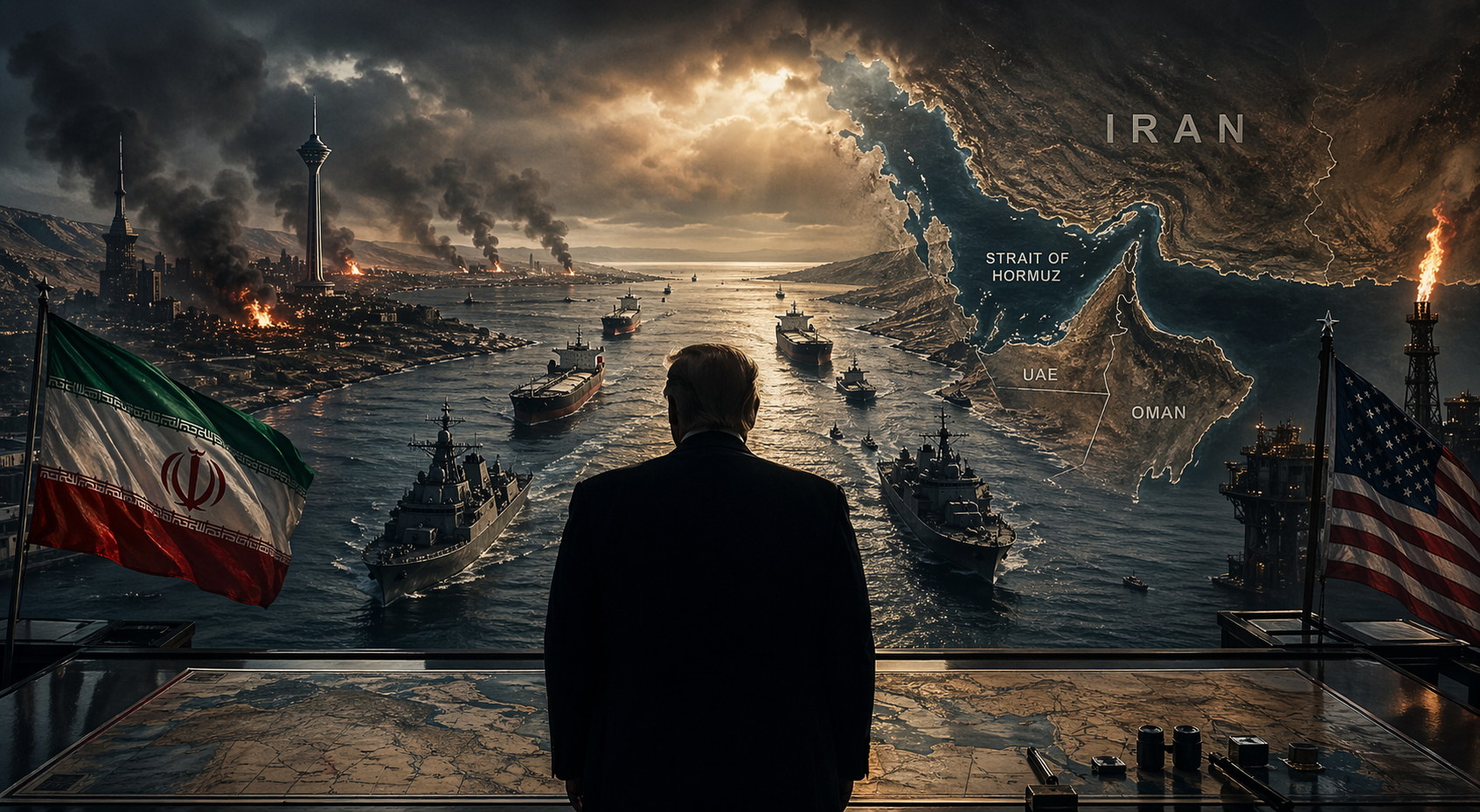
Trump, Hormuz and the Iran War: The Real Story Behind the Blockade and the Threats
Iran War to Date: How the Middle East’s Most Dangerous Chokepoint Became the Front Line of a Wider Power Struggle
What began as a campaign of pressure and pre-emption has turned into a war over deterrence, oil flows, nuclear leverage and political survival — with the Strait of Hormuz now sitting at the centre of the global risk map.
The Iran war did not erupt out of nowhere. It emerged from a longer chain of maximum-pressure policy, nuclear confrontation, regional proxy warfare, escalating threats around shipping, and then a decisive military break on February 28, when the United States joined Israel in attacking Iran over what Washington said were imminent security threats, especially tied to Iran’s nuclear programme. Since then, the conflict has centred not only on strikes and retaliation, but on the question of who can control the Strait of Hormuz — the narrow maritime artery through which roughly a fifth of global oil supply moves.
That is the real scale of the crisis. This is not simply a bilateral war story. It is a regional military conflict fused to a global energy shock, to a nuclear standoff, and to domestic political pressure inside the United States. The current ceasefire is fragile and due to expire on April 22, 2026, with fresh talks still uncertain. The most important fact right now is that the war has not been cleanly resolved; it has merely moved into a suspended, dangerous phase where blockade, tanker seizures and threats of renewed force are shaping what comes next.
What makes this conflict different from many earlier U.S.-Iran crises is that the centre of gravity is not only inside Iran. It is in the Gulf. It is at sea. It is in shipping insurance, oil markets, LNG cargoes and tanker routes. The Strait of Hormuz has been effectively closed for much of the conflict since February 28, briefly reopened during the ceasefire period, and then thrown back into crisis after renewed U.S. enforcement actions. That is why the war matters far beyond the region.
What led up to the war
The lead-up was a story of steadily rising pressure. After returning to office, Donald Trump restored a “maximum pressure” posture on Iran, with the stated aim of denying Tehran a nuclear weapon, countering its missile capabilities and curbing its regional influence. In February 2026, he signed an executive order setting up a process to impose tariffs on countries that do business with Iran, deepening the economic squeeze and widening the confrontation beyond sanctions into trade coercion.
At the policy level, the official U.S. line was unambiguous. Washington framed Iran as a nuclear and missile threat, a sponsor of militant proxies, and a regime that had to be denied both strategic reach and economic breathing room. That policy language mattered because it set the intellectual and political groundwork for escalation long before the strikes began. The war did not arrive as a sudden break from policy. It was the most violent expression of a direction already in motion.
The Strait of Hormuz was already part of that escalation logic before the main ceasefire drama. Senior U.S. officials were publicly warning in March that any Iranian attempt to impose a “tolling system” or illegal control over the strait would be unacceptable. In other words, Washington was already signalling that maritime freedom in Hormuz had become a red line. That matters because it helps explain why the war quickly fused military aims with shipping enforcement and blockade politics.
Then came the decisive step. According to current reporting, the war began on February 28 with U.S.-Israeli strikes on Iranian territory. From Washington’s point of view, the campaign was presented as a mission to dismantle Iran’s ballistic missile systems, weaken its ability to project power, and prevent it from acquiring nuclear weapons. From Tehran’s point of view, it was an act of aggression aimed at crippling the state and forcing capitulation. However one frames it, the conflict crossed into open war at that point.
What has happened so far
The first broad phase of the war was direct military escalation. The United States and Israel hit Iranian military infrastructure, while Washington described its objectives in sweeping terms: destroy missile capacity, crush the ability to threaten U.S. forces and partners, sever proxy support, and stop Iran ever obtaining a nuclear weapon. The official messaging later claimed extensive damage to Iran’s missile arsenal, drone capability and defence-industrial base. Those claims should be treated as wartime claims from one side, but they reveal the scale of ambition behind the campaign.
Iran’s answer was not simply to absorb blows. It leaned into the one lever that could impose pain on the wider system: Hormuz. As the war developed, the strait was effectively closed, choking a route through which nearly 20% of global oil supply flows. This was not a side issue. It became the economic heart of the war. Oil prices jumped, LNG disruptions intensified, and the energy shock rapidly fed into inflation fears and political pressure well beyond the Gulf.
That economic impact has been severe enough for the energy crisis to be described as historically extreme. The International Energy Agency said the war had triggered the biggest energy crisis in history, while strategic reserves were authorised for release on a huge scale to stabilise markets. The U.S. Energy Information Administration said Brent averaged $103 a barrel in March and daily prices had touched almost $128 on April 2, reflecting how quickly a Gulf conflict can turn into a global macroeconomic shock.
The next phase was brinkmanship. Trump escalated his public rhetoric dramatically, warning that if Iran did not reopen the Strait of Hormuz and make a deal, the United States would strike bridges and electric power plants. He also said Washington would hit Iran “extremely hard,” with rhetoric that at times sounded closer to coercive demolition than limited war. The pressure culminated in an April 8 p.m. deadline linked to reopening the strait.
That matters for two reasons. First, it showed Trump using public threat as a negotiating instrument, not merely as messaging. Second, it widened the war’s implied target set toward civilian infrastructure, which drew condemnation and concern from critics and legal experts cited in reporting. This was no longer simply about hitting missile sites. It was about threatening to make the cost of defiance unbearable.
Then, just hours before the deadline, the confrontation swerved. On April 7, the United States and Iran agreed to a two-week ceasefire that included reopening the Strait of Hormuz. Trump pulled back from his most destructive threats, and diplomacy — mediated through Pakistan — re-entered the picture. For a moment, it looked as though both sides had decided they were close enough to the edge.
Markets responded immediately. Oil dropped sharply after Iran said commercial vessel passage through Hormuz would remain open for the ceasefire period and Trump declared it “a brilliant day.” The reaction showed exactly what the market believed: the war’s key risk premium was not abstract regional instability, but the physical status of the strait.
But the ceasefire did not solve the underlying conflict. It froze it. The war’s latest phase has been defined by maritime enforcement and fragile diplomacy. The United States has maintained a blockade posture and continued seizing Iranian-linked vessels. Iran has treated that as a violation of the truce framework. After the U.S. seized an Iranian-linked tanker near Sri Lanka and earlier captured an Iranian cargo ship, Tehran reversed course and moved again to close Hormuz, while demanding an end to the blockade and recognition of its right to enrich uranium.
That is where things stand now. Talks in Islamabad have been discussed and in some reporting both sides have signalled willingness to re-engage, but participation remains uncertain and the ceasefire is nearing expiry. The war is therefore sitting in a narrow corridor between re-escalation and shaky diplomacy, with neither side having conceded its core demand.
Why the Strait of Hormuz matters so much
Most wars have a battlefield. This one has a chokepoint.
The Strait of Hormuz is one of the most important energy passages on Earth. Current U.S. energy data describes it as a major world oil transit chokepoint through which nearly 20% of global oil supply flows. Separate U.S. energy analysis also shows that around one-fifth of global LNG trade transits Hormuz, much of it from Qatar. That means disruption there does not stay regional for long. It hits oil, gas, shipping, inflation expectations and central-bank calculations almost immediately.
It is also difficult to bypass. There are alternative routes and pipelines for some producers, but not on a scale that fully neutralises a prolonged closure. That is why even temporary disruption matters so much. The world economy does not need Hormuz to be permanently sealed to feel pain. It only needs risk, uncertainty and intermittent interruption. Insurance costs rise. Cargoes reroute. Traders panic. Governments release reserves. Politicians feel the shock.
In this war, Hormuz has become both weapon and symbol. For Iran, it is leverage: proof that even under military pressure, Tehran can still impose system-wide costs. For Washington, keeping Hormuz open has become a test of credibility, because allowing Iran to dominate the strait would look like permitting energy blackmail at the world’s most sensitive maritime bottleneck. This is why U.S. officials have repeatedly said the strait will be open “one way or another.”
Trump’s rhetoric and what it tells us
Trump’s rhetoric has been one of the defining features of the war. He has swung between maximal threat and optimistic deal-making, often in rapid succession.
At his most aggressive, he warned of raining “hell” on Tehran if the strait stayed shut, said Iran could be hit “extremely hard,” threatened to destroy bridges and power plants, and suggested that the country could be taken out in one night. That language served a purpose: it raised perceived U.S. willingness to escalate and tried to force Tehran into a choice between concession and devastation.
At the same time, Trump has repeatedly moved back toward negotiation when economic pressure became harder to ignore. He later spoke of the chance of a deal, said that if one happened oil would go “way down,” prices would fall, inflation would ease, and the risk of nuclear catastrophe would recede. He has also said a new Iran deal would be better than the 2015 accord and more recently pushed back against claims that high gasoline prices could last until 2027, insisting prices would fall as soon as the war ends.
This is not just inconsistency for its own sake. It reflects the political tension at the heart of Trump’s position. He wants coercive dominance abroad while avoiding prolonged economic pain at home. Reporting shows the war has exposed exactly that pressure point: high gasoline prices, rising inflation and political risk ahead of midterm elections. In simple terms, Trump wants Iran squeezed, but not at an oil price that punishes him domestically.
That helps explain the shape of his messaging. The rhetoric is harsher when he wants leverage. The tone softens when markets or domestic politics become more urgent. The result is a strategy that can look contradictory from outside, but follows a recognisable internal logic: escalate fast, shock the other side, then seek a deal before the economic consequences harden into political damage.
The blockade
The blockade is one of the most important and least fully understood parts of the war.
In current reporting and official messaging, Washington has described a naval blockade and maritime sanctions enforcement posture aimed at countering Iranian coercion and restoring or defending safe passage through Hormuz. The White House has openly celebrated Trump’s “naval blockade” as a major show of leadership, while the State Department has said the United States is acting to limit Iran’s ability to generate revenue as it tries to hold the strait hostage.
In practice, that blockade has blended military, legal and economic pressure. It has involved sanctions on oil transport infrastructure, warnings to foreign buyers and banks dealing with Iranian oil, the lapse of waivers that had eased some flows, and the physical seizure of Iranian-linked vessels. Taken together, this is not just a traditional naval cordon. It is a coercive economic-maritime campaign built to strip Iran of both leverage and revenue.
Iran, unsurprisingly, sees the blockade very differently. Tehran has treated it as illegitimate pressure, a breach of ceasefire understandings, and proof that Washington wants to dictate not only military terms but commercial sovereignty and nuclear policy. That is why the blockade matters so much to the next phase. For the United States, it is leverage. For Iran, lifting it is a condition of any serious settlement.
The broader international response shows the stakes. The European Union is preparing to widen sanctions criteria to target those who obstruct navigation in Hormuz. That signals that the struggle over the strait is no longer treated merely as one episode inside a regional war. It is being institutionalised as a major international security and sanctions issue.
What media misses
The deepest logic of this war is not only military. It is coercive interdependence.
Iran cannot match the United States and Israel conventionally in a clean head-to-head war over time. But it does not need to. Its most powerful option is to threaten the systems other countries depend on: shipping lanes, oil flows, LNG cargoes, insurance confidence and inflation stability. That is the real meaning of Hormuz in this conflict. Iran’s leverage is not that it can win a classic battlefield victory. It is that it can make everybody else pay for trying to break it.
The United States understands that, which is why this war has involved blockade, tanker seizures and relentless emphasis on the strait. Washington is not just fighting Iran’s missiles. It is fighting Iran’s leverage over the world economy. When officials say Hormuz will be open “one way or another,” that is not rhetorical decoration. It is the strategic core.
There is another point many miss. The war is not only about whether Iran can be forced back. It is also about whether the United States can impose order quickly enough to avoid proving the opposite: that even a heavily pressured Iran can still shake global markets, push prices higher, and force Washington into negotiation under economic strain. The longer the crisis lasts, the more that question sharpens.
What lies ahead
The most likely next phase is not peace in any durable sense. It is renewed bargaining under threat.
Current reporting suggests both sides have at least left the door open to further talks, with Islamabad emerging as a potential venue. But the terms remain fundamentally unresolved. Tehran wants the blockade ended and insists on recognition of its right to enrich uranium. Trump has warned military action could resume unless Iran yields on core U.S. demands, including highly enriched uranium. That is not a settled peace framework. It is a live confrontation with a diplomatic overlay.
The most likely scenario is therefore an extension of the current pattern: partial de-escalation, intermittent maritime incidents, sporadic threats, and intense bargaining over uranium, sanctions and shipping. The war may become less visibly explosive without becoming truly over. That would still leave markets nervous and the region vulnerable to a fresh trigger.
The most dangerous scenario is a collapse of talks combined with renewed U.S. strikes and a harder Iranian move against Hormuz. If that happened, the crisis could snap back from uneasy pause to acute escalation very quickly. Oil prices would likely surge again, energy disruption would deepen, and outside powers would face rising pressure to take sides more openly.
The most underestimated scenario is a deal that looks limited but changes the war’s political meaning. Trump has signalled interest in a new agreement and clearly wants relief from the economic blowback. Iran may also judge that preserving regime survival, partial enrichment rights and some easing of pressure is better than a longer war of attrition. A narrow, ugly, highly transactional deal is therefore easier to imagine than a grand strategic settlement.
What would such a deal look like? Probably not trust, reconciliation or anything close to it. More likely: some form of ceasefire extension, conditional shipping guarantees around Hormuz, tighter monitoring or removal of parts of Iran’s highly enriched stockpile, and a partial unwinding or reconfiguration of blockade and sanctions pressure. Each side would sell it as strength. Neither side would mean peace by it.
The hardest truth is that the war has already changed the region even if a second ceasefire holds. It has shown how quickly a direct U.S.-Iran conflict can cascade into a world energy crisis. It has shown that Hormuz remains the pressure valve of the global economy. And it has shown that Trump’s approach — maximum threat, maximum spectacle, then rapid movement toward a deal when prices and politics bite — is now one of the defining facts of the crisis itself.
This is why the Iran war is bigger than the daily battlefield picture. It is a contest over whether military superiority can outrun economic vulnerability; whether blockade can break leverage without deepening the crisis; and whether coercion can deliver a stable settlement before the system starts to crack. The war to date has not answered those questions. It has only made them impossible to ignore.
If Hormuz stays open and talks resume, the world will breathe easier. If the blockade hardens, tanker seizures continue and deadlines return, the crisis will remain one spark away from a much wider detonation. That is the real state of play now: not resolution, not full escalation, but a highly combustible pause at the mouth of the Gulf.
