Why Has Russia Not Published a Full Count of Its War Dead Since 2022?
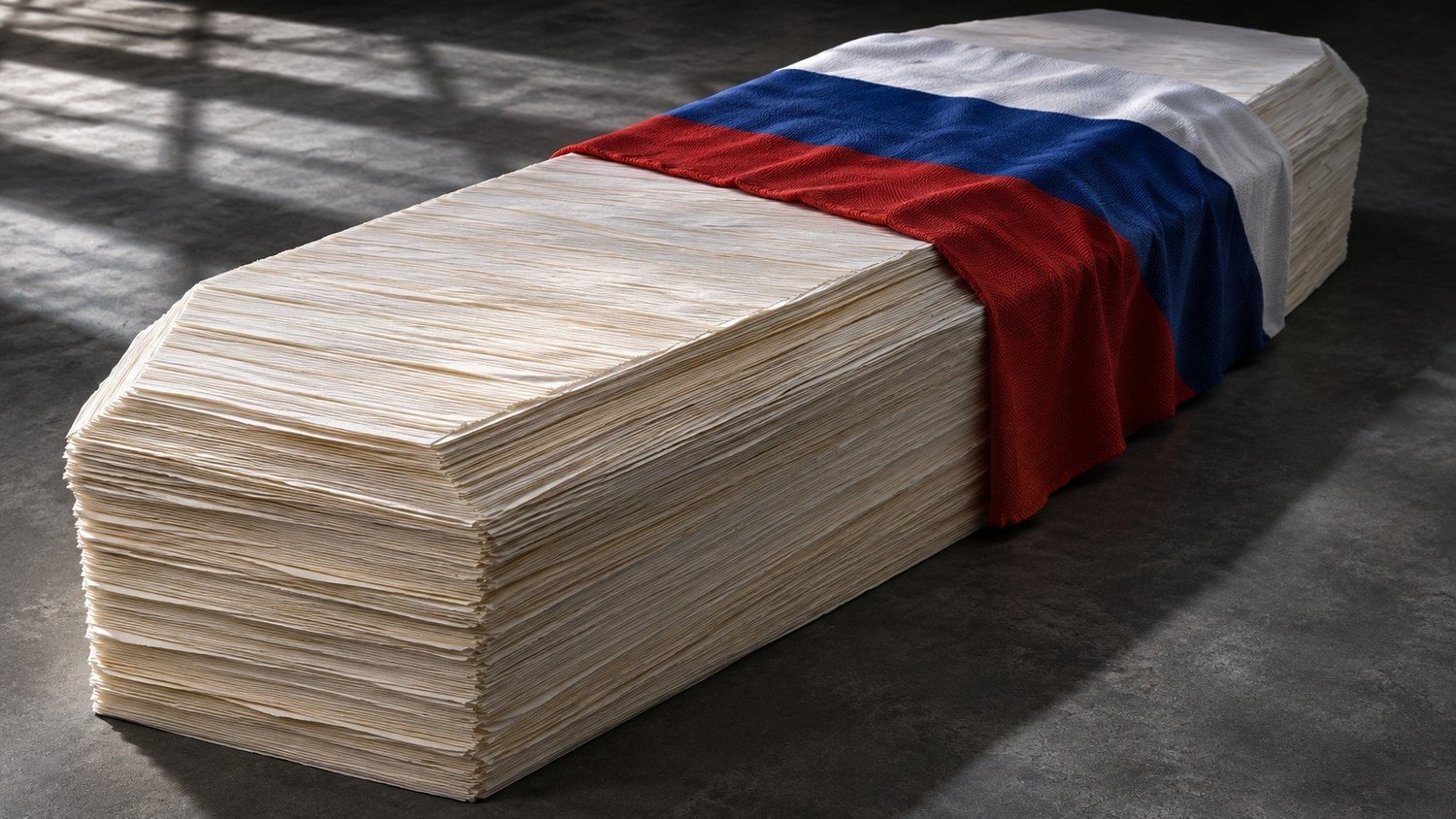
Russia has not published a full count of its war dead since September 2022, when its defence ministry admitted to just under 6,000. Nearly four years on, the most detailed estimate yet suggests the true figure is more than a hundred times higher. On 23 November, the exiled Russian outlets Mediazona and Meduza published an analysis of leaked records from Rosstat, Russia's state statistics agency, concluding that around 700,000 Russian soldiers have probably been killed in the war against Ukraine.
The number has travelled fast, and it is easy to misread. It is not a list of 700,000 names, nor is it Russia's official toll. It is a statistical estimate built on top of a much harder figure: at least 490,000 military deaths recorded in Russia's own civil registration data. Understanding the gap between those two numbers is the key to understanding what the war has cost Russia, and why the true figure is so difficult to pin down.
Where the Leak Came From
On 1 November, two hacking groups, the Belarusian Cyber Partisans and Ukraine-linked Silent Crow, said they had broken into Rosstat's network. Rosstat confirmed it had suffered cyberattacks between 29 October and 1 November but said it found no evidence that its databases had been compromised or that protected data had leaked.
The hackers shared the files with several news organisations. According to Mediazona, the material contained 11,658,178 unique death records covering 2021 to late September 2026. The data has not been independently verified by an official body, but analysts who have examined it consider it authentic. Janis Kluge of the German Institute for International and Security Affairs told Al Jazeera there was "no longer any doubt" that the database was real.
How the data was checked
Mediazona says it tested the leak against several independent sources. Its own named list of confirmed Russian war dead, built with BBC News Russian since 2022, matched 95.1% of entries for deaths up to late September. The team also checked the files against probate records, court rulings and Rosstat's earlier published statistics. Its argument is that a forged or doctored database would not line up so closely with records gathered separately over four years.
Counting the 490,000
Russia's death records do not contain a simple box marked "killed in the war in Ukraine". So Mediazona and Meduza combined several indicators to identify military deaths among men aged 18 to 64:
- About 425,000 records with an explicit military cause, such as a war-injury medical code, military wording, or a manner of death recorded as "operations of war".
- About 45,000 men declared dead by courts, usually soldiers who went missing and whose bodies were never recovered.
- About 20,000 identified through secondary signs, such as occupation combined with wounds, death notices or combat wording.
Together they come to roughly 490,000 registered military deaths by 29 September 2026. Civilian deaths in eight war-affected areas, including occupied parts of Ukraine and Russia's Belgorod and Kursk border regions, were filtered out. Mediazona estimates its false-positive rate at about 0.7%.
Other outlets that analysed the same leak reached similar totals. Mediazona lists counts of 490,000 from BBC Russian, Der Spiegel and Novaya Gazeta Europe, 472,000 from The Insider, 499,000 from IStories and 521,000 to 537,000 from the Dossier Center, the last two including foreign nationals. The Financial Times, working with data to August, reported at least 450,000 deaths.
From 490,000 to 700,000: The Missing and the Late
The jump to 700,000 comes from two groups the registry undercounts.
Soldiers missing in action
Mediazona has gathered more than 160,000 posts from relatives searching for missing soldiers since 2023. Fewer than 10% of those men were later found alive. Many of the rest will eventually be declared dead by a court, often years later, and some never will be. The analysis found that earlier estimates based on probate data tracked regular combat losses closely but began to undercount the missing systematically from early 2025.
Deaths registered late
Military deaths in Russia are typically registered weeks or months after they happen. Mediazona says that since mid-2025 the number of deaths registered more than a year late has been about 50 times the pre-war level. That means the most recent months in any dataset are always the least complete.
To fill both gaps, the team modelled how deaths from each month have been registered over time and projected forward. The headline result is "more than 700,000" deaths, with its methodology section suggesting a figure of 720,000 or more by the autumn. The Financial Times, using a different approach to late registrations, has estimated the registered toll will rise to about 550,000.
The important caveat: 490,000 is close to a documented floor. Everything above it is an estimate, and Mediazona says its most recent figures are deliberately conservative. There are also known holes in the data: roughly 20,000 deaths from 2022 to mid-2023, many registered in Simferopol, were missing from the leak, and losses among the so-called "people's militias" of Donetsk and Luhansk in 2022 are largely invisible.
How This Compares With Other Estimates
| Source | Estimate | What it counts |
|---|---|---|
| Mediazona/BBC named list (23 Nov) | 289,000 | Individually confirmed deaths, a minimum |
| Rosstat leak, registered deaths | At least 490,000 | Deaths recorded by Russian authorities to 29 Sept |
| Mediazona/Meduza model | About 700,000 | Registered deaths plus missing and late registrations |
| The Economist (30 Oct) | 374,000–770,000 killed | Statistical model; 1.4–2.1 million killed and wounded |
| GCHQ director (May 2026) | Almost 500,000 killed | UK intelligence assessment |
| Ukraine's General Staff | About 1.64 million | Killed and wounded, Ukrainian claim |
One source of confusion is worth clearing up. Vladimir Putin has repeatedly said that about 700,000 Russian troops are fighting in Ukraine. That is a claim about deployed forces, not deaths, and the overlap in numbers is a coincidence.
Who Is Dying
The leak and earlier reporting paint a consistent picture of who bears the cost. The Financial Times found that the average age of the dead rose from 34 in the first year of the war to 40 in 2025, reflecting Russia's reliance on older volunteers lured by large signing bonuses. Men aged 35 to 44 were the largest group. The dead come disproportionately from poorer regions and ethnic-minority republics: in Zabaykalsky Krai, the FT counted about 12,300 deaths, roughly one for every 80 residents.
The data also shows where the killing has been heaviest. The FT identified about 120,000 deaths with a recorded location in the Avdiivka–Pokrovsk area, the scene of grinding Russian offensives in 2024 and 2025, and 48,000 around Bakhmut.
Why Losses Have Not Stopped the War
If Russia's losses are this high, why has the Kremlin not changed course? Analysts point to deliberate choices that have limited the political cost at home.
After the unpopular partial mobilisation of September 2022, Moscow shifted to recruiting prisoners, ethnic minorities and volunteers attracted by high pay, which spared the big cities. Writing for the Atlantic Council on 17 November, David Kirichenko of the Henry Jackson Society argued that these recruitment methods and large state payouts to bereaved families have kept backlash muted, and that Putin shows no sign of being pushed towards compromise by casualties alone.
There are signs of strain. Kirichenko notes that some regions have sharply cut compensation for families of the dead, with Saratov reducing it by 90%. Western officials estimated in August that Russia was losing about 6,000 more troops a month than it was recruiting. Kluge, the German analyst, has suggested the deaths amount to around half a percent of Russia's working-age population, meaning the main impact may be political and social rather than economic.
Analysis: numbers on this scale are unlikely to change the Kremlin's calculations on their own. What they do is make the human cost harder to deny. Every independent count published since 2022 has been revised upwards, and the Rosstat leak suggests that even well-informed outside estimates were, if anything, too cautious.
What We Still Do Not Know
- The true total. The 700,000 figure depends on modelling the missing and late-registered dead. It could rise further as more deaths are recorded.
- The wounded. The leak covers deaths only. Estimates of total Russian casualties, killed and wounded, run well above a million.
- Ukraine's own losses. Kyiv does not publish comprehensive figures. The independent UALosses project has recorded about 116,000 Ukrainian service members killed and 106,000 missing, according to figures cited by The Economist.
- Moscow's response. The Kremlin treats military losses as a state secret and has not commented on the analysis.
The Bottom Line
The most solid number to emerge from the leak is not 700,000 but 490,000: deaths that Russia's own bureaucracy has recorded, which already exceed most published estimates. The 700,000 figure is a careful attempt to account for the men the system has not yet counted. Either way, the documents show a war that has killed Russian soldiers on a scale not seen since the Second World War, and a state that has worked hard to keep that cost out of sight.
Sources
- Mediazona: Analysis of leaked Rosstat mortality records (23 November 2026)
- Mediazona: Russian losses in the war with Ukraine (named list)
- Kyiv Independent: Russian war death toll likely near 700,000
- Al Jazeera: Russian casualties "reach 450,000": what that means for the Ukraine war
- Atlantic Council: Russia's colossal losses in Ukraine will not push Putin toward peace
- Kyiv Post: The Economist's updated estimate of Russian losses
- Military Times: Nearly 500,000 Russian soldiers killed, UK intelligence chief says
- Washington Times: Over 700,000 Russian soldiers have died fighting in Ukraine, new research says
