

Saudi Arabia Activates Red Sea Pipeline as Hormuz Disruption Hits Markets
Saudi Aramco Reroutes Oil as Hormuz Crisis Forces Global Energy Shift
Saudi Aramco Reroutes Oil Exports to the Red Sea as Hormuz Crisis Forces Global Energy Logistics Shift
Saudi Arabia’s state oil giant is quietly rewriting global energy logistics.
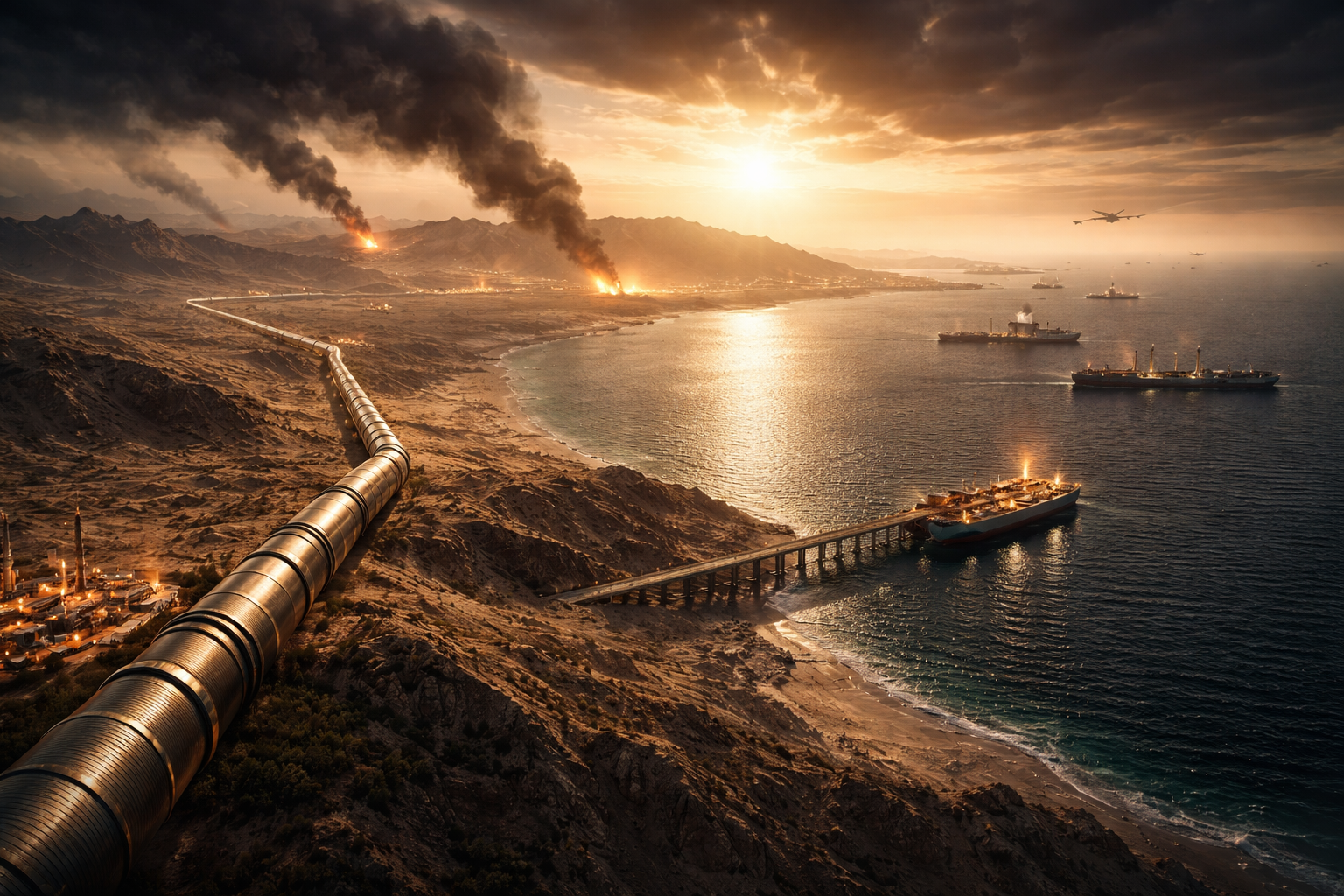
Saudi Aramco has begun diverting crude exports away from the Strait of Hormuz and toward the Red Sea port of Yanbu, using the kingdom’s cross-country East–West pipeline to bypass the region’s most dangerous maritime chokepoint.
The move comes as shipping through the strait has slowed dramatically amid escalating conflict and attacks on vessels, forcing oil producers and tanker fleets to improvise new routes almost overnight.
For the global economy, the situation is not just a temporary diversion. It is the first real test of whether the world can function without its most critical oil artery.
The story turns on whether the global oil system can adapt faster than the conflict escalates.
Key Points
Saudi Aramco is rerouting crude shipments to the Red Sea port of Yanbu using the East–West pipeline to bypass the Strait of Hormuz.
The pipeline can carry up to roughly five million barrels per day, partially replacing exports that normally leave through the Gulf.
The shift follows escalating attacks and threats in the Strait of Hormuz, through which about 20% of global oil normally passes.
Tankers and buyers are already adjusting loading plans to account for dual export routes from Ras Tanura and Yanbu.
Even with the pipeline, the Red Sea route cannot fully replace Hormuz capacity, exposing limits in the global oil transport system, particularly as the Strait of Hormuz remains critical for meeting global oil demand and ensuring energy security.
The Strategic Chokepoint That Still Controls the Oil Market
For decades, the Strait of Hormuz has been the single most important artery of the global energy system.
The narrow passage between Iran and Oman connects the Persian Gulf’s oil fields to the open ocean. Roughly one-fifth of the world’s oil trade normally flows through the strait, making it one of the most critical maritime chokepoints on Earth.
When tensions escalate there, the effects ripple instantly through energy markets.
The current crisis began in late February 2026 following military strikes in the region and retaliatory threats against shipping. Tankers slowed or halted their transit, several vessels sustained damage, and insurance costs surged as the strait effectively became impassable for many commercial ships.
With millions of barrels of crude suddenly unable to leave the Gulf, producers faced a stark choice:
store oil they could not export, cut production, or find a new route.
Saudi Arabia chose the third option.
The Pipeline That Lets Saudi Oil Escape the Gulf
Saudi Arabia is one of the few producers with a partial workaround.
The kingdom built the East–West pipeline, a massive energy corridor stretching from its eastern oil fields across the desert to the Red Sea port of Yanbu.
Under normal circumstances, most Saudi exports still leave via Gulf terminals like Ras Tanura. But the pipeline allows crude to bypass Hormuz entirely.
Aramco has now started redirecting cargoes and tanker loading schedules to Yanbu, shifting exports onto vessels waiting in the Red Sea instead of the Persian Gulf.
The system can move about five million barrels per day, which is substantial but still less than the roughly seven million barrels Saudi Arabia typically exports globally.
In other words, the pipeline provides a pressure valve—but not a full replacement.
The Oil Market Is Already Rewiring Itself
The rerouting of Saudi crude is triggering a cascade across the global shipping system.
Tanker fleets are repositioning toward the Red Sea, while buyers in Asia and Europe are being asked to prepare alternative loading plans depending on which terminal Aramco uses.
Some governments are also stepping in to help move the oil further along the chain. Egypt has signaled that Saudi crude arriving in the Red Sea could move north via the SUMED pipeline, allowing it to reach the Mediterranean without sailing through the Suez Canal.
These changes are happening rapidly because the global oil market operates on extremely tight timing.
Refineries depend on steady deliveries. Storage tanks fill quickly if shipments stall. Within days of disruption, producers can be forced to reduce output.
That is already happening in parts of the Gulf.
What Most Coverage Misses
The key shift is not just the rerouting itself. It is the proof that the global oil system is beginning to reorganize around chokepoint risk.
For decades, the Strait of Hormuz functioned as a near-inevitable transit corridor. Energy planners assumed disruptions would be short-lived because there was no viable alternative.
But the current crisis shows that large producers are now testing permanent bypass infrastructure.
Saudi Arabia’s East–West pipeline, the UAE’s Fujairah pipeline, and potential Red Sea–Mediterranean routes like SUMED, which stands for Suez-Mediterranean Pipeline, all exist precisely for this scenario.
None of them individually replace Hormuz. But together they create a partial parallel system.
That means the geopolitical leverage of the strait—long considered Iran’s most powerful strategic card—may be gradually weakening.
The Real-World Stakes: Prices, Shipping, and Energy Security
For consumers and governments, the consequences are immediate.
Energy markets react quickly to supply disruptions because oil demand is relatively inelastic in the short term. Even small supply shocks can drive large price swings.
The current crisis has already pushed crude prices sharply higher and increased insurance premiums for ships operating in the region.
Longer routes also mean higher costs. If tankers must reposition to new ports or take extended routes, shipping expenses rise and delivery schedules stretch.
Those costs eventually flow through the entire economy—from fuel prices to airline tickets to household energy bills.
For countries heavily dependent on Middle Eastern oil, especially in Asia, the logistical uncertainty is as worrying as the price spike itself.
The New Geography of Oil Trade
If the conflict continues, the global oil map could start to shift.
Three structural changes would signal that the rerouting is becoming permanent:
sustained tanker traffic increases at Yanbu and other Red Sea export terminals
expanded use of cross-country pipelines that bypass Hormuz
long-term changes in shipping routes linking the Red Sea, Mediterranean, and Asian markets
But the system remains fragile.
Even the Red Sea route depends on another chokepoint: the Bab el-Mandeb Strait, which is a narrow passage connecting the Red Sea to the Indian Ocean.
If instability spreads there as well, tankers could face an even longer detour around Africa.
That possibility highlights the deeper reality of the moment: the world’s energy supply still runs through a handful of narrow waterways.
And when those waterways become battlefields, the global economy moves with them, leading to increased shipping costs, supply chain disruptions, and potential shortages of essential resources worldwide.
