The Real Reason NATO Now Faces Its Most Dangerous Test in Decades
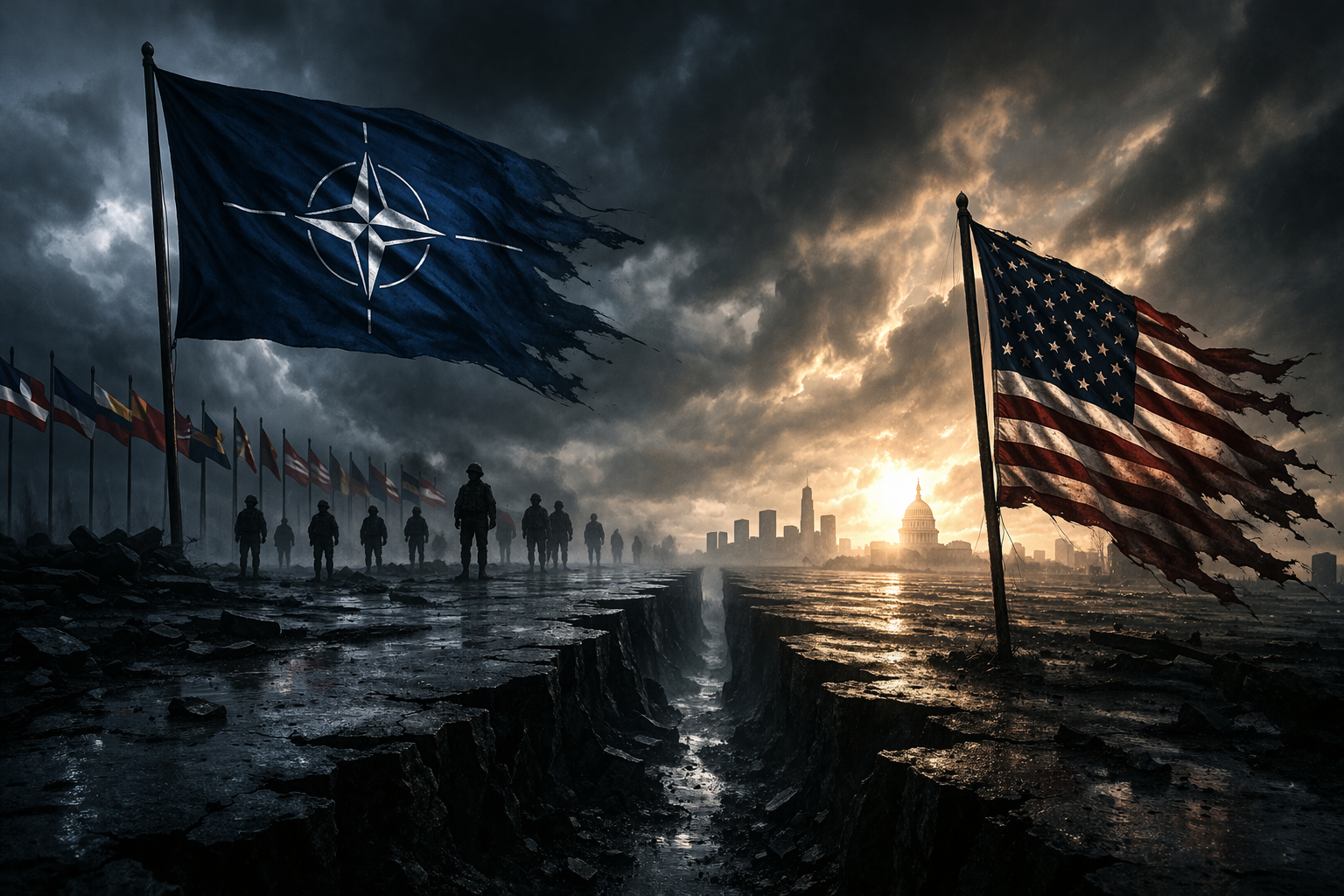
Trump’s NATO Threat Revives the League of Nations Nightmare
Could NATO End Up Like the League of Nations?
NATO is not the League of Nations, and it was built to avoid the League’s most significant weaknesses. But the comparison is no longer silly. The real danger is not that NATO suddenly disappears. It becomes an alliance on paper, but its most important member no longer fully believes in it. That is how institutions start to hollow out. That risk looks more serious because President Donald Trump has again threatened to pull the United States out of NATO, reigniting a fight over whether America still wants to anchor Europe’s security order.
The League of Nations failed because it was supposed to preserve peace without having the power, unity, or enforcement machinery to stop great powers from breaking the rules. NATO, by contrast, was created in 1949 as a military alliance with a stringent security guarantee at its core. Its purpose was not just to talk about peace but to deter war by making clear that an attack on one member could trigger a collective response.
That does not make NATO invincible. It has survived for decades because the United States stayed committed, Europe stayed strategically dependent, and adversaries believed the alliance would act if tested. The question now is whether that political belief is starting to weaken faster than NATO’s military structure.
The story turns on whether NATO remains a real security pact or drifts toward becoming a prestige brand with fading US commitment.
Key Points
The League of Nations was founded after World War I to prevent another war, but it lacked credible enforcement, suffered from great-power divisions, and was fatally weakened by the United States never joining.
NATO was formed in 1949 as a very different model: a binding transatlantic military alliance designed to deter Soviet expansion, stabilize Western Europe, and anchor the US in Europe’s defense.
NATO has faced repeated internal strains, including burden-sharing fights, disputes over military interventions, and questions about strategic purpose after the Cold War.
The alliance expanded after Russia’s invasion of Ukraine, with Finland joining in April 2023 and Sweden in March 2024, taking NATO to 32 members.
Trump’s latest withdrawal threat matters because NATO’s core strength is not paperwork alone. It is the credibility of US commitment.
US law now purports to block unilateral withdrawal without congressional approval, but the constitutional fight is unresolved if a president tries to force the issue.
What the League of Nations Was Supposed to Do
The League of Nations was created after World War I and formally began in 1920. Its purpose was ambitious: prevent another major war through collective security, arbitration, diplomacy, and the idea that aggression against one state should concern all states. It grew out of Woodrow Wilson’s postwar vision that rules and institutions could restrain power politics.
In principle, that was a historic leap. In practice, it rested on fragile foundations. The United States, whose president had championed the idea, never joined. That was a crippling blow. Without US participation, the League lost much of the political weight, economic leverage, and strategic credibility it would have needed to discipline major aggressors.
The League also depended too heavily on consensus and voluntary compliance. It had moral authority, committees, and procedures. What it did not have was a reliable way to force great powers to stop. When Japan moved into Manchuria, when Italy attacked Ethiopia, and when the broader European order started to crack in the 1930s, the League looked increasingly like an institution that could condemn aggression but not reverse it.
That is why the League still matters as a warning. It is the classic example of an international body that had ideals but not enough coercive muscle, political unity, or buy-in from the strongest states.
Why the League Failed
The cleanest explanation is this: the League promised collective security without creating a system strong enough to deliver it.
First, the United States stayed out. That was not a minor detail. It meant the institution began life without one of the few powers capable of shaping global enforcement.
Second, Britain and France, the two leading powers inside the League, often lacked either the unity or the appetite to impose serious costs when aggressors tested the system. They were constrained by domestic politics, war fatigue, economic weakness, and competing strategic priorities.
Third, the League had no standing military power of its own. It depended on member states to act, and member states often preferred caution, delay, or self-interest. That turned collective security into something closer to optional security.
Fourth, the interwar world was turning harsher just as the League’s credibility was eroding. Economic crisis, nationalism, revisionist powers, and failed disarmament efforts all made the institution look weaker when strength was most needed.
So the League did not fail because the idea of cooperation was ridiculous. It failed because the states that created it never gave it enough hard power, unity, or enforceable commitment to survive a real stress test.
How NATO Was Built Differently
NATO was founded in 1949 in a very different strategic environment. Europe had just been devastated by World War II. The Soviet Union was expanding its influence. Western Europe was militarily weak. The United States concluded that security in Europe could no longer be treated as someone else’s problem.
The North Atlantic Treaty did something the League never really managed. It tied North America and Western Europe together in a formal defense pact. Article 5 became the core promise: an attack on one ally would be treated as an attack on all. That commitment was designed not mainly for use in war, but to prevent war by making aggression look too costly to attempt.
NATO’s official history describes its purpose as broader than simply answering the Soviet threat. It was also meant to prevent the return of destabilizing nationalism in Europe and encourage political integration under a strong American security umbrella. That is crucial. NATO was not just a military club. It was a system for organizing Western power.
Over time, NATO evolved rather than vanished. It endured after the Cold War, expanded eastward, and most recently added Finland in 2023 and Sweden in 2024 after Russia’s full-scale invasion of Ukraine transformed European threat perceptions. NATO now has 32 members.
The Strains NATO Has Already Survived
NATO has never been as unified as its public image suggests. Burden-sharing complaints are older than many people realize. NATO officials have been acknowledging for years that arguments over who pays, who deploys, and who takes risk are built into the alliance’s history.
The alliance also wrestled with its purpose after the Cold War. It moved into crisis management and out-of-area missions, including Kosovo, Afghanistan, and Libya. Those operations showed NATO could adapt, but they also exposed limits: uneven military capabilities, strategic disagreements, and different political tolerances among allies. Afghanistan in particular bound the alliance together operationally while raising hard questions about long campaigns, nation-building, and what success even meant.
Then there is the internal political problem. NATO is a military alliance, but it is ultimately made of governments with different electorates, different geographies, and different risk calculations. Some allies focus more on Russia, some on terrorism, some on the Mediterranean, and some on domestic fiscal constraints. That does not destroy an alliance by itself. But it means cohesion is always something NATO has to actively maintain.
And yet NATO’s defenders have a strong argument too. Article 5 has only been invoked once, after the September 11 attacks on the United States. That matters because it cuts directly against the caricature that NATO is simply Europe taking from America. In its one formal collective-defense activation, the alliance rallied to the US.
What Most Coverage Misses
The easy version of this story is that NATO lives or dies on troop numbers, budgets, or legal text. Those things matter. But the deeper hinge is credibility.
The League of Nations collapsed because aggressors stopped believing its warnings. NATO would face danger much earlier than any formal collapse if allies and adversaries started doubting whether the United States would really honor the alliance under pressure. A deterrent can weaken before a treaty breaks.
That is why Trump’s rhetoric matters even before any withdrawal attempt succeeds. If the alliance’s central guarantor repeatedly treats membership as conditional, transactional, or disposable, NATO’s political deterrent can start thinning out in advance. The structure may remain. The certainty may not.
The US Withdrawal Threat Is No Longer Abstract
This issue is not a theoretical debate from Trump’s first term anymore. Trump said he was strongly considering taking the United States out of NATO after accusing allies of failing to support his position over the Strait of Hormuz and the Iran conflict.
There are two layers to that threat. One is legal. Article 13 of the North Atlantic Treaty allows a member to leave with one year’s notice. But US domestic law now complicates any attempt by requiring either a two-thirds Senate vote or an act of Congress for withdrawal and by restricting spending to support such an exit. Reuters notes that the constitutional issue is unresolved if a president tries to push past Congress anyway.
The other layer is strategic. Even if a formal exit never happens, a president can still undermine an alliance by questioning its value, reducing trust, narrowing commitments, or making allies doubt Washington’s reliability. In alliance politics, ambiguity from the strongest member can do real damage without any official rupture.
That is the real comparison with the League of Nations. NATO is structurally stronger, militarily deeper, and institutionally more serious. But like the League, it depends in the end on whether the major powers inside it are still willing to back the system when it becomes costly.
The Alliance’s Next Test
NATO is unlikely to end up exactly like the League of Nations because it was designed to solve the League’s core defect: the gap between declared principles and usable power. It has integrated military structures, a binding defense treaty, decades of interoperability, and a far stronger record of practical cooperation.
But that does not mean the alliance is safe by default. The League’s lesson was not simply that weak institutions fail. It was that institutions fail when the strongest states stop treating them as vehicles worth defending. NATO’s military capabilities are substantial. Its political center of gravity is what now looks shakier.
So the better answer is this: NATO will not become the League of Nations overnight, and probably not in exact form at all. But if American commitment keeps turning conditional, if European rearmament remains uneven, and if adversaries decide the alliance’s core guarantee is now uncertain, the comparison will stop sounding dramatic and start sounding analytical. Watch three things next: whether Trump sustains this withdrawal push, whether Congress and the courts draw a hard line, and whether European allies act as if they may need to deter Russia with less certainty of American backing. That will tell us whether NATO is merely under strain or entering the kind of credibility crisis that kills alliances slowly, from the inside out.
