The World Isn’t Sliding Into World War — It’s Fracturing Into Something More Dangerous
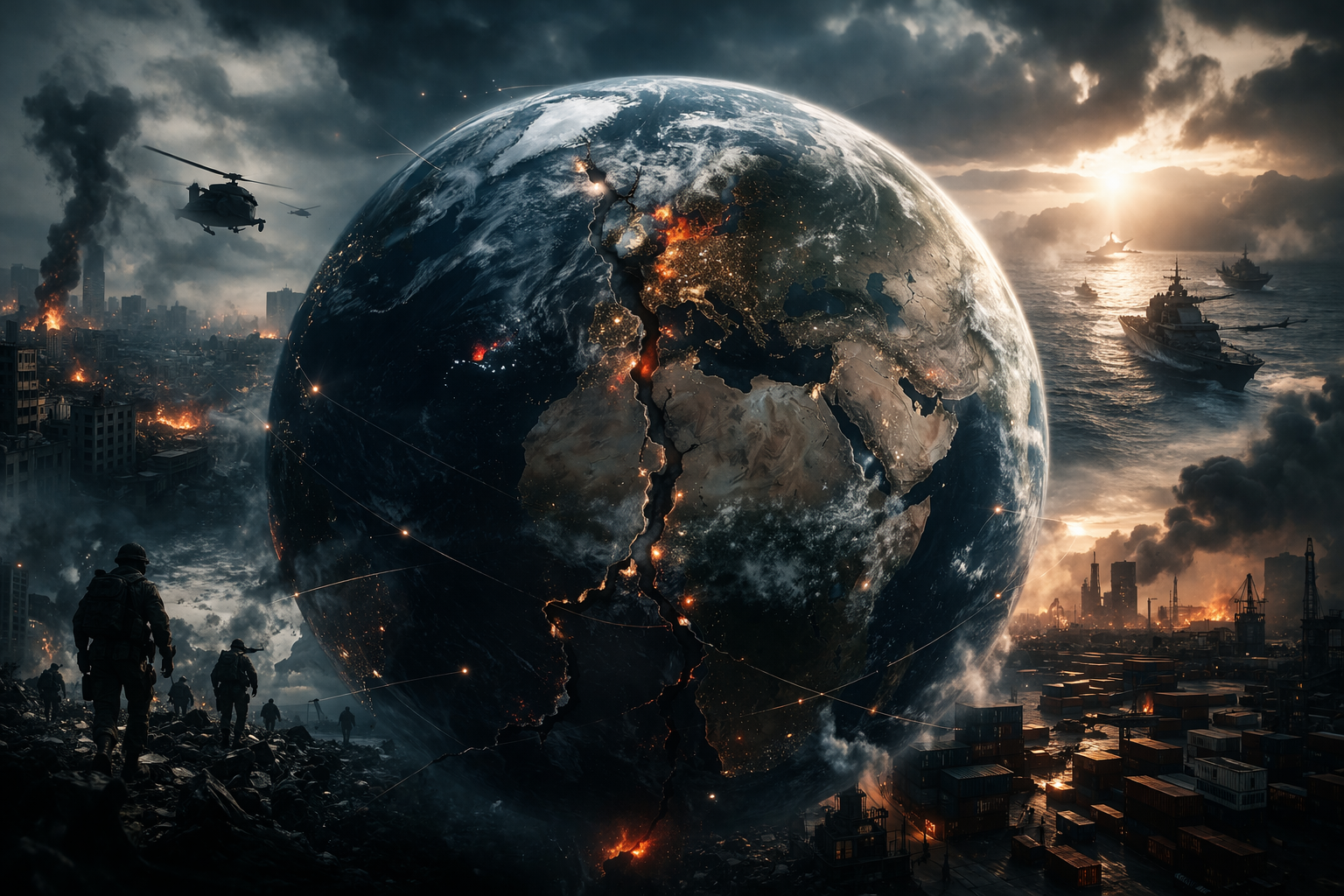
The Real Global Danger Is Not One Giant War But A Planet Full Of Escalation Traps
An era of overlapping crises, economic warfare, and escalation traps is quietly replacing the old idea of global war.
The Question Everyone Is Asking—And Getting Slightly Wrong
“Are we heading toward global conflict?”
It’s the right instinct but the wrong frame.
The world is not the same as it was in 1914 or 1939. There’s no single trigger point, no obvious alliance chain reaction, and no clear dividing line between peace and war.
Instead, something more complex—and arguably more dangerous— is happening.
Conflicts are multiplying.
They are overlapping.
And they are starting to connect.
Not into one war.
But the system is under pressure.
The World Is Already More Violent Than It Feels
The first uncomfortable truth is this:
We are already living through a historically high level of conflict.
Around 130 active conflicts globally, more than double 15 years ago
Multiple long-running wars with no resolution pathways
Rising proxy conflicts across regions with weak governance
This conflict doesn’t feel like “world war” because it’s fragmented.
But fragmentation is the point.
Instead of one dominant conflict, we now have:
Ukraine (Europe / Russia–NATO tension)
Middle East escalation (Iran conflict, regional spillover)
Sahel instability (terrorism, migration pressure)
Indo-Pacific tensions (China, Taiwan risk)
Each one alone is manageable.
Together, they create systemic strain.
The Real Shift: From Global War To Global Pressure
What has changed is not just the number of conflicts — it’s how they interact.
Modern geopolitical risk is no longer isolated.
It is interconnected pressure.
A war in one region now:
Disrupts global energy flows
Triggers inflation worldwide
Shifts military postures elsewhere
Changes political calculations in unrelated theatres
Take the current Middle East conflict:
It has already disrupted ~20% of global oil supply routes via the Strait of Hormuz
It is driving inflation and slowing global growth
It is increasing financial instability in emerging markets
That’s not a regional issue.
That’s a global stress multiplier.
Why This Feels Like The Start Of Something Bigger
The anxiety people feel isn’t irrational.
There are real signals of escalation:
Central banks now rank geopolitics as the top global risk
Economic confrontation and trade conflict are rising sharply
Military flashpoints between major powers remain “even chance” scenarios
There are also clear escalation pathways:
A NATO–Russia incident in Europe
A Taiwan Strait crisis involving the US and China
Regional wars pulling in external powers
These are not theoretical.
They are structurally plausible.
But Here’s The Critical Insight Most People Miss
The world is not drifting toward one big war.
It is drifting toward continuous escalation without resolution.
That is a different—and more unstable— system.
Why?
Because:
No single conflict forces global clarity
No actor wants full-scale war
But many actors are willing to take limited risks
This creates what analysts call an “escalation trap”:
Each side believes it can control the situation
Each escalation is justified as limited
But the overall system becomes more volatile
We are already seeing these effects in the Iran conflict:
Tactical actions are expanding geographically
New actors are being drawn in
Strategic goals remain unresolved
That is exactly how prolonged instability forms.
What Media Misses
What Media Misses
The dominant narrative asks:
“Which conflict will start World War III?”
The better question is
“What happens when none of them do—but all of them keep escalating anyway?”
Because that is the world we are entering.
A world where:
Wars don’t end cleanly
Tensions don’t reset
Pressure accumulates across systems
It doesn’t explode.
It compounds.
The Economic Layer Makes This More Dangerous
The threat is not just about military conflict.
It’s about geoeconomic warfare.
Sanctions, trade restrictions, resource control, and financial flows are now core weapons.
And they are accelerating instability:
Energy shocks ripple instantly through global markets
Supply chains become strategic vulnerabilities
Capital flows can reverse rapidly in crises
The IMF is already warning that
Emerging markets are increasingly exposed to sudden shocks
Financial systems are more sensitive to geopolitical stress
This situation creates a feedback loop:
Conflict → economic stress → political instability → more conflict
The Most Likely Future: Not One War, But A Tighter System
So what happens next?
The Most Likely Path
Continued regional conflicts
No decisive global war
Increasing economic fragmentation
Persistent instability as the baseline
The Most Dangerous Path
A single miscalculation links two major powers directly
A regional war triggers alliance obligations
Escalation outpaces diplomacy
The Most Underestimated Path
No “big war” at all
But a permanent state of global tension that reshapes economies, politics, and daily life
That last scenario is already forming.
This Is The End Of “Normal” Peace
For decades, the global system operated on a fragile assumption:
That major war was unlikely, and stability would broadly hold.
That assumption is now breaking.
Not through one dramatic event.
But through accumulation.
More conflicts
More pressure points
More interconnected risks
Less trust between powers
The result is not an apocalypse.
It is something colder.
A world where instability is constant, escalation is always possible, and peace is no longer the default — just the temporary absence of something worse.
And that may be harder to live with than a war you can clearly see coming.
