Trump Shocks NATO: Turkey Back In, Greenland Back On the Table
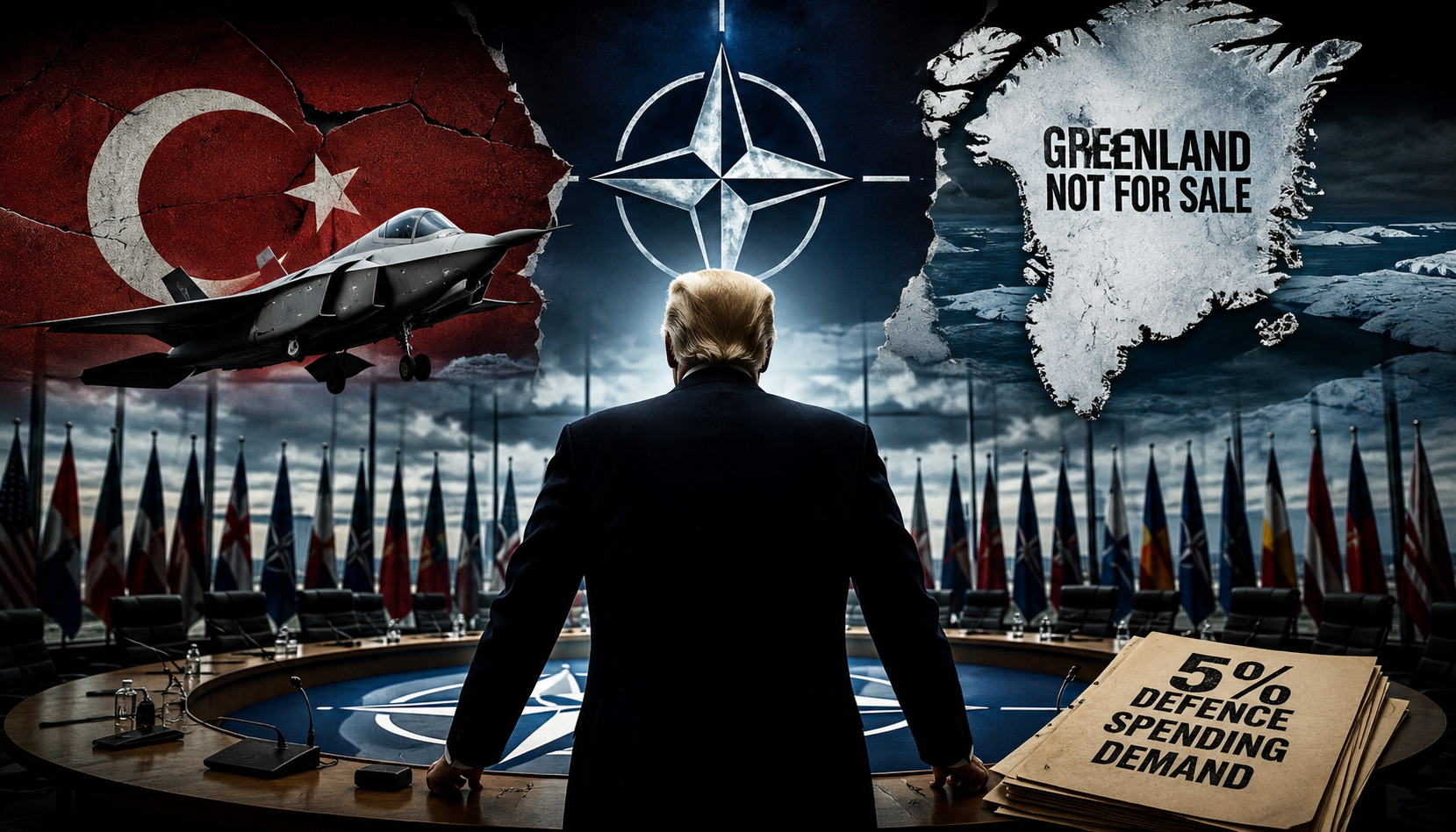
NATO Summit Erupts as Trump Rewrites the Rules of Western Power
NATO Summit: Trump Turns the Alliance Into a Bargaining Table
The significance of the Ankara NATO summit is that it exposes a new operating reality inside the alliance: NATO still exists as a military bloc, but politically it is becoming more transactional, more conditional and more vulnerable to pressure from its own most powerful member.
Three developments matter most. Trump announced the lifting of US sanctions on Turkey, opening the door to a possible F-35 fighter jet breakthrough after years of tension over Ankara’s Russian S-400 air defence purchase. He also revived his claim that Greenland should be under US control rather than Danish sovereignty, immediately creating friction with Denmark and Greenland. At the same time, allies are trying to prove that they are increasing defence spending fast enough to satisfy Washington, with NATO focusing on a historic 5% defence investment plan and new defence production commitments.
The summit therefore matters because it is not only about Russia, Ukraine or defence budgets. It is about who controls NATO’s political direction. Trump is using America’s military weight to force concessions, reward preferred partners, punish perceived free-riders and pressure even close allies over territory. That is a much deeper shift than a noisy summit row.
Why Lifting Turkey Sanctions Is So Significant
Turkey’s dispute with the US began when Ankara bought Russia’s S-400 missile system. Washington argued that the system posed a risk to NATO technology and removed Turkey from the F-35 programme; the US also imposed CAATSA sanctions on Turkey’s defence procurement body in December 2020.
Trump’s move to lift sanctions is significant for three reasons.
First, it restores Turkey’s leverage inside NATO. Ankara has long played a balancing role between East and West: a NATO member, a Black Sea power, a state with influence in Syria and the Caucasus, and a government that has maintained working relationships with Russia while still being part of the Western security architecture. Bringing Turkey closer to the US defence system again gives Erdoğan a major strategic win.
Second, it signals that Trump values Turkey’s military geography more than the old sanctions logic. Turkey controls access to the Black Sea through the Turkish Straits, borders Syria, sits near the Caucasus, and acts as a southern anchor for NATO. In a world shaped by Russia, Iran, Ukraine, the Eastern Mediterranean and Middle Eastern instability, Turkey is too useful to leave frozen out forever.
Third, it weakens the idea that NATO discipline is rule-based. If Turkey can buy Russian systems, be removed from the F-35 programme, wait out the dispute, then return under a friendly US president, other allies will read the message. Punishment inside NATO may not be permanent. Strategic usefulness can outweigh previous red lines.
That does not mean F-35 deliveries are automatic. Reporting indicates Trump has opened the door, but legal, congressional and technical barriers may still matter, especially because Turkey’s S-400 issue was treated as a direct security risk to the aircraft programme.
Greenland Is the Most Dangerous Symbol
The Greenland claim is arguably even more destabilising than the Turkey move. Turkey is a hard bargaining case between allies. Greenland is different because it raises sovereignty pressure inside NATO itself.
Trump’s argument is strategic: Greenland sits in the Arctic, close to Russian and Chinese activity, and has major military value for North Atlantic and Arctic security. The US has long seen Greenland as strategically important. But saying that Greenland should be controlled by the US rather than Denmark turns an Arctic security issue into a direct sovereignty dispute with a NATO ally. Denmark rejected the idea, while Greenlandic leaders stressed that Greenland’s future should be decided by its own people.
That matters because NATO’s deterrence credibility rests on the idea that members defend one another’s sovereignty. If the leading NATO power publicly pressures another member over territory, the alliance’s moral and legal logic becomes blurred. Russia and China do not need to believe NATO will collapse; they only need to see that internal pressure can fracture unity.
The deeper geopolitical risk is precedent. If Washington can argue that strategic geography justifies control over Greenland, rivals can use similar language elsewhere. Moscow can frame parts of Eastern Europe or the Arctic as essential to its security. Beijing can frame Taiwan and the South China Sea as strategic necessities. NATO’s argument has always been that borders and self-determination cannot simply be overridden by power. Greenland makes that argument harder to present cleanly.
Defence Spending Becomes the Price of Protection
The summit’s defence-spending focus is the other major story. NATO’s official summit material says the Ankara agenda centres on progress toward a historic 5% defence investment plan, including production, procurement, cooperation and industrial deterrence.
This is not just accounting. It is the re-pricing of American protection.
Trump’s core argument is that Europe has relied too heavily on US military power. That argument has force: European states have underinvested for decades, and Russia’s war against Ukraine exposed gaps in ammunition production, air defence, logistics and high-readiness forces. NATO estimates now show several frontline or exposed allies, including Lithuania, Estonia, Latvia, Poland and Greece, are already projected to spend above 3.5% of GDP on core defence in 2026, while larger states such as Germany, Britain and France remain below that new core benchmark.
The political problem is that spending is no longer being framed only as collective responsibility. It is being framed as the condition for US patience. That changes allied behaviour. European governments are scrambling to buy equipment, expand production, announce contracts and demonstrate seriousness because they fear strategic abandonment as much as they fear Russia.
The result is a paradox. Trump’s pressure may genuinely increase European defence capacity. But it may also weaken NATO’s trust base. Allies may spend more while trusting America less.
Ukraine, Russia And The Message To Adversaries
For Russia, the summit sends mixed signals. On one hand, higher European defence spending, more production and stronger procurement are bad news for Moscow. A NATO that can manufacture more shells, air defences, drones and missiles is harder to intimidate.
On the other hand, the political signal is messy. If the US is openly pressuring Denmark over Greenland, rewarding Turkey despite previous Russian-system tensions, criticising allies over Iran, and suggesting reduced US commitments in Europe, Russia can conclude that NATO’s military machine is still strong but its political centre is less stable. Reports ahead of the summit described European leaders trying to show they are stepping up as Washington cuts back commitments to the alliance.
For Ukraine, this matters directly. Ukraine depends not only on weapons but on Western predictability. A transactional NATO means Kyiv may receive support, but that support becomes more vulnerable to bargaining between capitals. If Trump prioritises deals with Turkey, pressure on Europe, or a future settlement with Russia, Ukraine has to plan for a less automatic Western pipeline.
Implications For The US, Europe And The Arctic
For the US, Trump’s approach increases short-term leverage. He can force spending, reopen defence deals, extract attention and reshape summit agendas around American demands. But it also increases long-term alliance hedging. European states will spend more, but they will increasingly ask how to defend themselves if Washington becomes unreliable.
For Europe, the lesson is brutal: defence autonomy is no longer a French slogan or Brussels talking point. It is becoming a survival requirement. The Financial Times’ analysis of how Europe would fight without America reflects a wider strategic shift: European capitals are now seriously considering military planning, procurement and command assumptions that reduce dependence on US support.
For the Arctic, Greenland becomes a pressure point. The Arctic is warming, opening new routes, resources and military competition. Russia has major Arctic capabilities. China calls itself a “near-Arctic” power. The US wants control, access and strategic depth. But if Washington pursues that through pressure on Denmark and Greenland rather than partnership, it risks turning a shared Western security interest into an intra-alliance crisis.
The Real Meaning Of The Summit
The Ankara summit shows NATO is not dying. In some material ways, it is hardening: more spending, more procurement, more industrial focus, more pressure to prepare for conflict.
But politically, the alliance is becoming harsher. The old model was: America leads, Europe follows, NATO stays united. The emerging model is: America bargains, Europe pays, Turkey manoeuvres, smaller allies worry, and adversaries watch for cracks.
That is the true geopolitical implication. NATO’s deterrence may become more expensive and more militarised at the exact moment its internal trust becomes more fragile.
The biggest winner is Turkey, which regains status and bargaining power. The biggest loser is Denmark, because Greenland has been dragged back into great-power pressure. The biggest strategic beneficiary may be European defence industry, because panic over US reliability will drive spending. The biggest risk is that NATO becomes a stronger military machine but a weaker political community.
