Trump vs. the Supreme Court: A Tariff Ruling With Global Consequences
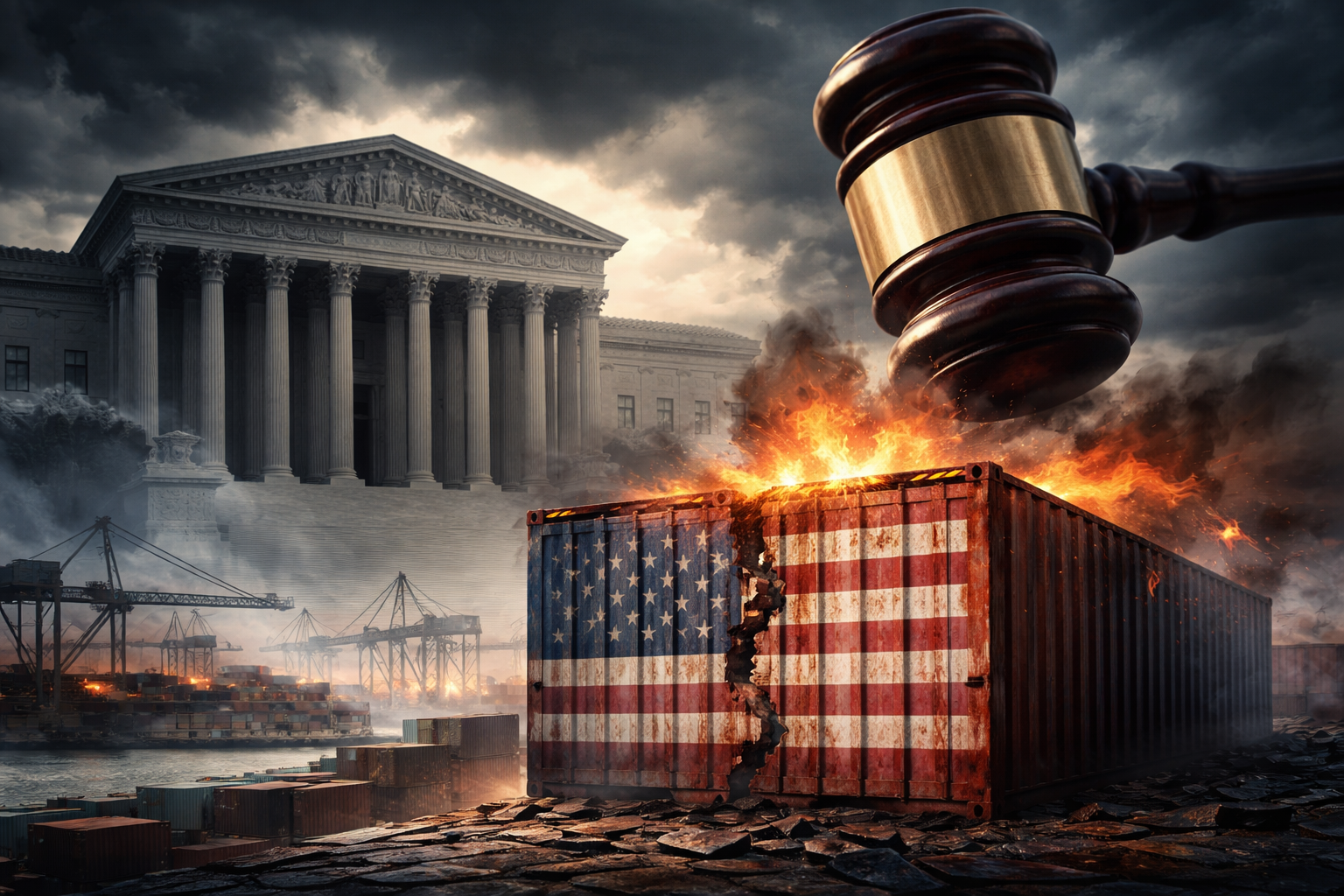
Trump’s Tariff Machine Hit a Constitutional Wall
The Supreme Court Blocked Trump’s Emergency Tariffs. The Global Fallout Is Just Beginning.
A single Supreme Court ruling has significantly weakened the presidential trade power. But the economic danger didn’t vanish. It moved.
The Court held that the International Emergency Economic Powers Act (IEEPA) does not authorize the President to impose tariffs, squarely tying tariffs to Congress’s taxing power.
The White House pivoted immediately to a different statute—Section 122 of the Trade Act of 1974—built for temporary import surcharges tied to “international payments” problems. This action not only maintains the tariff threat, but also places it under strict time constraints.
The narrative hinges on whether tariffs transform into a sudden, abrupt shock, or a cyclical deadline that renders investment, diplomacy, and supply chains a perpetual state of uncertainty.
Key Points
The Supreme Court ruled 6–3 that IEEPA does not authorize the President to impose tariffs, emphasizing that tariffs sit inside Congress’s taxing authority.
The administration moved to Section 122 of the Trade Act of 1974, which allows a temporary import surcharge, but it is capped in duration without congressional extension.
Economically, removing the IEEPA tariffs reduces the size of the tariff shock, but the remaining tariff regime still raises prices and weighs on jobs over time, according to modeling by Yale’s Budget Lab.
A large refund question now hangs over businesses and federal revenue: reports put roughly $130–$140+ billion of collected tariffs in legal limbo, with repayment timelines unclear.
Geopolitically, allies may welcome the legal constraint on emergency tariff power, but they still face an escalatory tariff posture and are openly discussing retaliation tools, including the EU’s Anti-Coercion Instrument.
The president cannot “defang” the Supreme Court by himself, but the politics around court structure, jurisdiction, and compliance can still create institutional stress.
IEEPA is a 1977 emergency-powers law most associated with sanctions and financial restrictions during declared national emergencies.
The key fight in this case was whether IEEPA’s language about regulating “importation” can be stretched to include tariffs—broad taxes on goods entering the United States.
The Court’s answer was no. Its logic was simple and structural: the Constitution assigns the power to “lay and collect” taxes and duties to Congress, and when Congress grants tariff power elsewhere, it tends to do so explicitly and with constraints. The Court said IEEPA lacks that explicit tariff grant.
Section 122 of the Trade Act of 1974 is different. It is designed for temporary import surcharges and other measures when the president finds “fundamental international payments” problems. The White House proclamation explicitly invoked that rationale.
Meanwhile, foreign governments watch the U.S. legal system not as civics trivia, but as a signal: will U.S. trade policy be predictable enough to negotiate with—or volatile enough to retaliate against?
A tariff empire meets a constitutional wall of tax power
The Court’s ruling is not a general statement about whether tariffs are wise. It is a statement about ownership: tariff power is taxation power, and taxation power is Congress’s. In the syllabus, the Court emphasized that the president has no inherent peacetime authority to impose tariffs and rejected the idea that IEEPA silently hands over unlimited tariff-setting discretion.
That matters economically because it constrains the easiest route to sweeping, immediate tariffs. It matters politically because it forces tariff policy to either (a) fit inside narrower statutes or (b) become a legislative project that is slower and messier.
The court’s message: “regulate importation," is not a blank check
The government argued that “regulate” can include tariffs. The Court pushed back: tariffs are different in kind because they operate directly on domestic importers and raise revenue for the Treasury—i.e., they are a classic branch of taxing power.
This reasoning also disrupts a well-known executive practice: enacting a comprehensive emergency statute, followed by the courts acting as referees after the fact. In this case, the Court asserted its authority early and forcefully.
The new trap: a 150-day tariff cliff that invites brinkmanship
The immediate pivot to Section 122 keeps tariffs alive, but it changes their character. A temporary surcharge is, by design, time-limited without congressional buy-in, and reporting describes it as an unusual step in modern U.S. trade policy.
The move creates a constraint with a real economic bite: businesses hate cliffs. If a tariff can rise, fall, or be replaced by another authority on a short timeline, firms respond by delaying investment, front-loading imports, reshuffling suppliers, and building cash buffers instead of expanding. That behavior can blunt the “growth” story even when the tariff rate itself looks manageable.
Scenario paths to watch:
One path is that Section 122 becomes a bridge to other, slower tools—like country- or sector-specific investigations under different statutes—creating a patchwork tariff regime. Another is that Congress extends the surcharge, turning a temporary lever into a semi-permanent one.
The market mechanism: prices, planning, and the “uncertainty premium” in plain English
Here is the clean economic picture. Removing the IEEPA tariffs lowers the peak tariff shock, but it does not reset the economy to a “no tariff world.” Yale’s Budget Lab estimates that without the IEEPA tariffs, the average effective tariff rate remains high, with a short-run price level increase and longer-run output and labor-market drag from remaining policies.
Then comes the second mechanism: refunds. Reporting suggests that roughly $130–$140+ billion in collected tariffs could be contested, creating cash-flow fights and years of litigation over who gets paid, when, and through what process.
That refund overhang is not just an accounting problem. It can freeze decisions. If you are a mid-sized importer, you can’t price confidently if you might owe more later—or get a refund later—or neither.
The geopolitical spillover: allies weigh retaliation, and trust becomes a policy constraint
Allies can simultaneously welcome the Court’s limit on emergency tariff power and fear what comes next: a White House searching for alternative legal tools while escalating tariff levels. Reuters reports European discussion of countermeasures and explicit reference to the EU’s Anti-Coercion Instrument—an expanded toolkit that goes beyond classic goods tariffs.
The strategic risk is a feedback loop. U.S. tariff uncertainty pressures allies to hedge. Hedging reduces cooperation. Reduced cooperation makes Washington more likely to use coercive trade tools. That invites retaliation, which raises prices and deepens political pressure at home.
What Most Coverage Misses
The hinge is this: the Supreme Court did not end the tariff agenda—it turned tariffs into a countdown clock that changes behavior before any tariff is even paid.
Mechanism: a time-limited tariff authority forces firms and governments to act on timelines, not fundamentals. Businesses move orders earlier, pause investment, and reprice risk. Foreign governments time their retaliation and negotiations to align with U.S. political windows, as waiting can be rational when policies may expire or mutate into new legal forms.
Signposts to confirm it in the coming days and weeks: whether the administration asks Congress to extend the surcharge and whether it launches parallel investigations under other statutes to rebuild longer-duration tariff power.
What Happens Next
In the next 24–72 hours, the signal is operational: how Customs treats collections and what guidance businesses receive on refunds and compliance, because clarity—or the lack of it—will shape pricing, inventory, and hiring decisions.
Over the next few weeks, watch the diplomatic calendar. EU countermeasures are not just about economics; they are about deterrence—teaching Washington that tariff coercion has a cost. The more credible the EU’s retaliation toolkit looks, the more it shapes U.S. domestic politics around “standing firm.”
Over months, the biggest question becomes legislative. If tariffs migrate from emergency improvisation into explicit congressional authorization, they become slower to start—but harder to unwind. That would mark a structural change in U.S. trade policy.
Real-World Impact
A consumer-goods importer that built its 2026 plan around “stable” landed costs now faces whiplash: tariff exposure that might be reversed by refunds, replaced by a temporary surcharge, or reimposed through a different channel. That uncertainty pushes costs into pricing and pushes risk into inventory.
A manufacturer that depends on imported components sees a second-order squeeze. Even if final-goods tariffs are politically popular, input-cost volatility hits production schedules and hiring plans first.
A European exporter trying to plan U.S. sales has to price for both the tariff rate and the credibility of U.S. promises. If the rate can change with a court ruling or a statutory pivot, the “safe” option becomes fewer commitments and shorter contracts.
The power fight that will outlast the tariffs
Trump cannot personally strip the Supreme Court of its constitutional role. He cannot fire justices, and he cannot rewrite Article III by executive order.
However, there are still forms of pressure that can be significant: political attacks that challenge judicial independence, legislative proposals that reshape jurisdiction at the margins, and court-structure debates that intensify whenever the Court obstructs a major agenda. Congress controls the number of justices and has recognized authority over parts of the Court’s appellate jurisdiction, even if those moves are politically explosive and legally contested.
