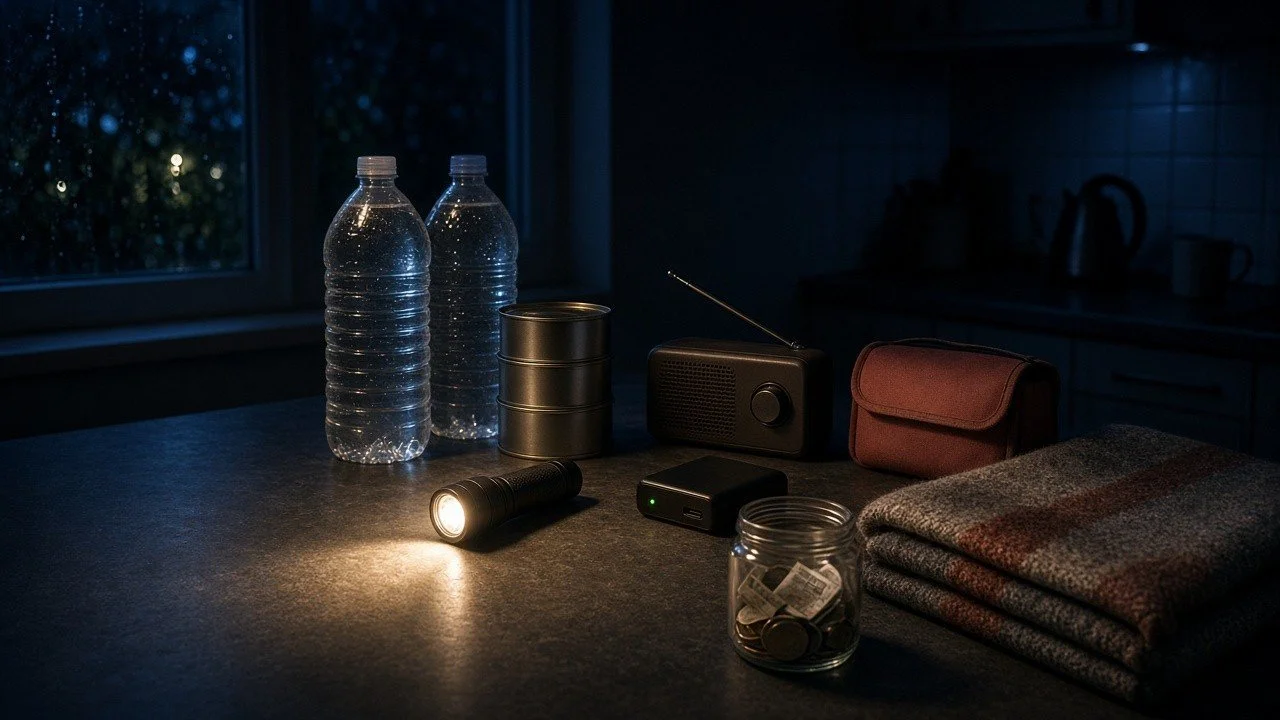
The Be Ready checklist asks households to keep three days of essentials at home.
Why Is The Government Suddenly Telling Every Household In Britain To Keep Three Days Of Food And Water At Home?
If you have noticed more bottled water in other people's trolleys lately, there is a reason. On 22 October 2026 the government launched Be Ready, a public campaign asking households across the UK to prepare for up to three days of disruption to everyday services such as power, water, phones and the internet.
It is not a warning that something specific is about to happen. But it is the clearest message yet from Whitehall that families should not assume the lights, taps and card machines will always work, and that those who can look after themselves for a few days should do so.
Here is why the campaign was launched, what the official checklist asks you to have, how shoppers have responded, who cannot afford to follow it, how it compares with advice in the Nordic countries and what the list leaves out.
Why The Government Launched Be Ready
The Cabinet Office describes Be Ready as the first stage of a three-year campaign to help people feel better prepared for events such as severe weather. Its announcement pointed to storms last winter and wildfires this summer as examples of how quickly ordinary disruption can knock out phone signal, water supplies and the internet.
There are three main reasons behind it.
Taking pressure off emergency services. The logic is simple: if households that can manage for a few days do so, responders can concentrate on the people who cannot. The Security Minister, Dan Jarvis, put it plainly: "Those who can follow this advice should follow this advice."
Catching up with Europe. The government says the campaign brings the UK into line with European neighbours that already run similar programmes, and that the three-day benchmark at its heart is also used by France, Ireland and the Netherlands.
Low public preparedness. The government's own national survey of preparedness, carried out between February and May 2026 with 10,791 adults, found that only 13% felt their household was largely or totally prepared for an emergency. A quarter thought they could meet their household's basic needs for one day or less if a power cut also took out their gas and water.
Public worry has also shifted. In the same survey, 28% thought war was likely or very likely to affect their local area in the next two years, up from 19% a year earlier. The campaign itself is framed around everyday emergencies rather than conflict, and officials have been careful to present it as practical rather than alarming.
Be Ready is not entirely new. The government has published household resilience advice since May 2024 on its Prepare website, which has now been rebranded. More than 500 organisations have signed up to share the messaging, and radio and social media advertising is aimed particularly at families with young children and older people.
What Is On The Be Ready Checklist?
The official checklist is built around being ready for three days. It encourages people to start with what they already have, build up gradually during normal shopping trips and check supplies every six months.
Water: bottled water for three days, at 3 litres per person per day for drinking. The guidance notes that more would be needed for cooking and washing.
Food: three days of non-perishable food that does not need refrigeration or cooking, such as tinned meat, fish or vegetables, dried fruit and nuts. It advises buying food you would normally eat.
Hygiene: hand sanitiser, wet wipes and bathroom products.
Light and warmth: a torch with spare batteries (the guidance says torches are safer than candles), plus blankets, sleeping bags and warm clothing.
Communication: a battery or wind-up FM radio, with the frequencies of your local stations written down, and a charged power bank.
Money and documents: cash in a mix of coins and notes, as well as cards; printed copies of important documents; and a written list of emergency contacts, regular medication and doses.
Medical: a first aid kit, and essential medication. It suggests requesting repeat prescriptions up to five working days before you need them.
Babies and pets: ready-to-feed baby formula, because you may not be able to boil water, nappies and wipes; pet food and water.
Several of the most useful steps cost nothing. The campaign puts heavy emphasis on the Priority Services Register, which lets energy and water companies know that a household needs extra help during an outage. Many households are eligible, including those with children under five. The government's survey found only 44% of people had heard of it.
How Shoppers Responded
Shoppers did take notice. According to Worldpanel by Numerator, in the ten days after the launch, sales of hand sanitiser rose by 83% compared with the same period last year, bottled water by 67% and tinned and jarred goods by 37%. The number of people buying tinned meat each day rose by 43%, equivalent to around 400,000 extra shoppers a day.
But this was not a rush on the shelves. Worldpanel found that the typical amount bought stayed at around 500g of tinned meat, and that fewer than a third of households bought bottled water in October. "This wasn't panic buying," said Fraser McKevitt, the firm's head of retail and consumer insight. The growth came from more people adding a few recommended items to their weekly shop, which is what the government asked them to do.
Who Cannot Afford To Stock Up?
This is where the campaign runs into the cost of living. In the government's own 2026 survey, 29% of adults said not having enough money was something that could stop them taking further steps to prepare for emergencies, up from 27% the year before. A quarter worried that supplies would go out of date and be wasted, and 18% said they did not have space to store them.
The gap between advice and reality is stark when it comes to water. At 3 litres per person per day, three days means 9 litres per person, or 36 litres for a household of four. The survey found that only 4% of people had enough bottled water at home to cover their household for three days at that rate. Most, 82%, had less than a single day's worth. Around 60% said they had three days of non-perishable food that needed no cooking, down from 66% in 2025.
The government has tried to address this. The campaign was developed with charities working with people in insecure housing and people who use food banks. The official guidance says many steps are free or low-cost, that you do not need to do everything at once, and that not everyone will be able to take every action. It even suggests that people with spare items could donate them to others who cannot afford their own.
What it does not offer is any help to buy the kit. For a household already choosing between food and heating, a checklist that starts with dozens of litres of water and a cupboard of tins is a big ask, even if it is spread over months. Grocery price inflation was still running at 2.6% in the four weeks to 1 November, according to Worldpanel.
How Britain's Advice Compares With The Nordic Countries
The UK's three-day target sits at the lighter end of European guidance.
Sweden asks households to plan to manage water, food, communication and heating for at least a week. Its civil defence agency says this followed a 2020 government decision and, since 2024, it has used the phrase "at least one week". It accepts that 72 hours is "better than nothing" and tells people who cannot store a week's supplies to "do what you can".
Norway raised its recommendation in May 2024 from at least three days to one week, and sent an updated preparedness brochure to every household that autumn. Its emergency planning directorate says the share of people storing drinking water rose from 21% in 2017 to 47% in 2024.
Finland and Denmark recommend three days, like the UK. Denmark's emergency agency says the EU also recommends three days, and that factors such as geography and weather help explain why neighbouring countries differ.
The difference is not just the number of days. Sweden's checklist goes much further on staying warm and fed without mains power. It includes a camping stove and fuel, preferably for outdoor use, matches and candles, a kerosene lamp, and an alternative heat source fuelled by kerosene, LPG, diesel or wood, with advice to use stoves outdoors where possible and to keep rooms ventilated.
What The Be Ready Checklist Leaves Out
The UK list is short by design, and much of it is sensible. But compared with the Nordic guidance, and with the problems people actually face in a long outage, there are some notable gaps.
A way to heat food or water. The checklist sticks to food that needs no cooking. That avoids fire and carbon monoxide risks, but it means no hot drinks or warm meals for three days in a winter power cut. Sweden explicitly includes a stove and fuel for safe outdoor use.
Heating beyond blankets. The UK advice relies on warm clothing, blankets and sleeping bags. That is the safest option for most homes, but there is little on how to keep one room warm, or how to look after older or vulnerable people as temperatures drop.
Toilets when the water stops. The checklist mentions "bathroom products" but says nothing about what to do if you cannot flush. Denmark's agency gives practical advice on lining a bucket or toilet bowl with a strong waste bag and disposing of it safely.
Water for washing and cooking. The UK figure covers drinking only. The guidance says more would be needed for other tasks but does not say how much.
A plan for people who cannot afford it. There is encouragement to build up slowly and to donate spare items, but no costed list, no budget version and no direct support.
Anything beyond three days. Three days is a starting point. Norway and Sweden both now plan for a week, arguing that authorities may need that long to reach everyone.
None of this means the UK checklist is wrong. It is a floor, not a ceiling, and the government's wider pages also cover household emergency plans, grab bags, car kits and checking on neighbours. But if you want to go beyond the minimum, the Nordic lists are a useful guide.
A Practical, Low-Cost Way To Start
You do not need to buy everything this week. The official advice itself suggests building up over time, and a few steps cost nothing:
Check whether you are eligible for the Priority Services Register and sign up.
Write down key phone numbers, including 105 to report a power cut in England, Scotland and Wales, and keep them on paper.
Note the radio frequencies for your local stations.
Find out how to turn off your gas, electricity and water.
Swap numbers with a neighbour, especially anyone who lives alone.
After that, add an item or two to your normal shop: a pack of bottled water, a couple of tins you would eat anyway, batteries for a torch you already own. Rotate them into your normal meals before they expire, so nothing goes to waste.
Recent events have shown how quickly the systems we depend on can fail. In France, a cyberattack forced supermarkets to destroy food after hackers turned fridges up to 50C. Our guide to how cyber attacks make money and wage war explains why critical infrastructure has become a target, and why Britain's infrastructure faces its own test in extreme heat.
The point of Be Ready is not to make anyone frightened. It is to make a few days without power or water a nuisance rather than a crisis, and to make sure help reaches those who need it most.
Next Reads
Europe's Heat Emergency Is Moving Toward Britain, And The Real Test Is Infrastructure
Hackers Turn French Supermarket Fridges Up To 50C As Cyberattack Forces Stores To Destroy Food
Cyber Attacks Explained: How They Make Money, Wage War And Shape The Future
