What Caused the 2008 Great Recession? The Main Drivers, Ranked
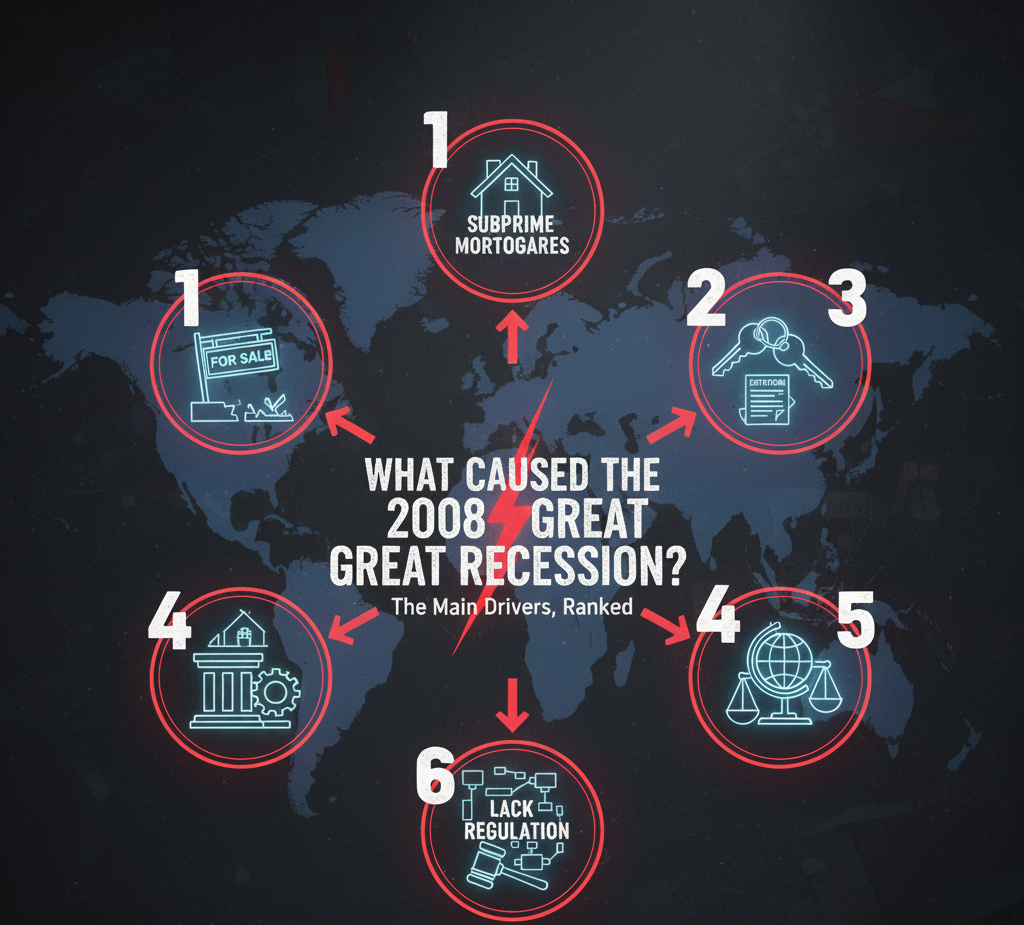
The 2008 Great Recession did not come from a single bad decision or a lone villain. It was the result of years of choices about housing, debt, regulation, and risk that all went wrong at the same time. When the US housing market cracked, those choices turned into a global crisis that wiped out jobs, savings, and trust in the financial system.
The debate has never really stopped. How much blame sits with reckless lenders? How much with regulators who stepped back? How much with global investors who wanted higher returns and did not ask enough questions?
This piece ranks the main causes of the 2008 Great Recession, from the core drivers to the amplifiers that turned a housing slump into a worldwide shock. It explains how those causes interacted, what they changed in politics and markets, and why the consequences are still visible in today’s economy and public mood.
By the end, the picture that emerges is not of a “bolt from the blue,” but of a slow-building storm that was visible to anyone willing to look closely at the numbers.
The story turns on whether a global financial system built on complex debt could ever be stable when so few people truly understood the risks.
Key Points
The Great Recession grew out of a massive US housing bubble, fuelled by easy credit and a surge in risky “subprime” mortgages.
Financial engineering turned those mortgages into complex securities, spreading bad loans through banks and investors worldwide.
High leverage and a huge “shadow banking” system meant that small losses could threaten entire institutions almost overnight.
Regulators and central banks underestimated the risks, trusting markets and models that assumed house prices would not fall everywhere at once.
Credit-rating agencies and incentive structures rewarded short-term profits over long-term safety, masking how fragile the system had become.
Global savings imbalances and low interest rates helped pump money into US housing and credit markets.
The sudden freezing of interbank lending, after key institutions failed, turned a financial crisis into a deep real-economy recession.
Background
The Great Recession refers to the severe global downturn that began with financial stress in 2007, escalated with major bank failures in 2008, and dragged on in various forms for years afterward. It was the worst global economic shock since the Great Depression in the 1930s.
The spark came from the United States, where years of rising home prices had encouraged households, lenders, and investors to believe that housing was a one-way bet. Mortgages were extended to borrowers with weak credit histories. Those loans were bundled into securities and sold to investors around the world. As long as house prices kept rising, the system looked profitable and, to many people, safe.
When US house prices began to fall, defaults rose. Losses started to show up in places far removed from the original borrowers: on the balance sheets of big banks in New York, London, Frankfurt, and beyond. Trust between financial institutions broke down. Funding markets seized up.
What followed was more than a banking shock. Credit to households and businesses dried up. Trade and investment collapsed. Unemployment surged. For many people, it felt less like a “financial event” and more like a long, grinding economic winter.
Understanding what caused that chain reaction means breaking the crisis into its main drivers and seeing how they reinforced each other.
Ranked Causes of the 2008 Great Recession
1. The US housing bubble and subprime mortgage boom
At the top of the list is the housing bubble itself. For years, US home prices rose faster than incomes, rents, and fundamentals could justify. Cheap credit, cultural pressure to own a home, and the belief that property “never goes down over time” all fed into that rise.
Subprime mortgages—loans to borrowers with weak or limited credit histories—grew rapidly. Many featured low “teaser” rates that later reset higher. Some required little documentation of income or assets. The assumption was that even if borrowers struggled, rising home values would let them refinance or sell at a profit.
When prices flattened and then fell, that assumption collapsed. Homeowners found themselves owing more than their houses were worth. Defaults spiked. The damage did not stay inside the US housing market; it spread through the financial system that had been built on top of it.
2. Securitisation and complex mortgage-backed products
The second key cause was the way those mortgages were transformed into financial products. Banks pooled thousands of home loans into mortgage-backed securities (MBS) and even more complex instruments such as collateralised debt obligations (CDOs).
On paper, this looked like diversification: combine many loans, slice them into different risk tiers, and sell the safest slices to cautious investors. In practice, the structure made it hard to see what was really inside. When defaults rose, no one was sure how to value these securities.
Because these products were held by banks, insurance companies, pension funds, and money market vehicles, losses in one corner of the system quickly showed up elsewhere. Securitisation did not remove risk; it spread it and made it harder to track.
3. Excessive leverage and the growth of shadow banking
Third is leverage—how much debt financial institutions used to finance their investments—and the rise of “shadow banking,” where non-bank entities performed bank-like functions without the same regulation or backstops.
Large investment banks and other institutions often borrowed heavily using short-term funding to hold long-term, illiquid assets. This worked as long as lenders were happy to roll over that funding. When doubts arose, funding could vanish in days. That is exactly what happened as subprime losses emerged.
Shadow banking chains meant that many credit activities had moved outside traditional banks, into vehicles and funds that lacked deposit insurance or central bank access. When stress hit, there were few safety nets. Small shocks were amplified into systemic threats.
4. Regulatory and supervisory failures
Fourth is the failure of regulators and supervisors to keep up with the speed and complexity of financial innovation. In the years before the crisis, there was a broad belief that markets could police themselves, and that sophisticated investors could manage risk without heavy-handed oversight.
Capital rules often allowed banks to hold relatively small cushions against certain securities that were treated as low risk. Off-balance-sheet vehicles let them move exposures out of sight. Gaps between different regulators—national and international, banking and securities—left room for risky activities to grow.
Central banks saw the housing boom but tended to view it as manageable. Stress tests and scenarios rarely assumed a nationwide housing downturn combined with a freezing of wholesale funding markets.
5. Credit-rating agencies and distorted incentives
Fifth place goes to the role of credit-rating agencies and incentive structures throughout the system. Ratings on many mortgage-backed securities and CDO tranches were far more optimistic than the underlying loans justified.
One core conflict was that issuers paid for ratings. Firms structuring securities could shop around for the most favorable treatment. At the same time, many investors were constrained by rules that pushed them toward highly rated assets, giving those ratings enormous influence.
Inside banks, traders, executives, and originators were often rewarded for the volume and short-term profitability of deals, not for their long-term performance. That encouraged aggressive lending, lax standards, and a willingness to believe models that told a comforting story.
6. Global savings imbalances and ultra-easy credit
Sixth is the global backdrop: large savings surpluses in some countries and strong demand for “safe” dollar assets. Capital flowed into US and European financial markets seeking yield. With interest rates low, investors were eager for products that promised a bit more return without, supposedly, much more risk.
That push for yield helped fuel demand for mortgage-backed securities and related products. For borrowers, it translated into easier access to credit and cheaper loans. For the global system, it meant that a problem rooted in US housing would have international fallout almost by design.
7. Contagion, panic, and policy missteps in the early phase
Finally, the way the crisis was handled in its early stages played a role in turning a severe financial problem into a full-blown Great Recession. As key institutions failed or were rescued on different terms, markets struggled to predict who would be supported and who would not.
Uncertainty over how governments and central banks would respond raised risk premiums and encouraged hoarding of cash. Interbank lending dried up. Even healthy firms found it hard to roll over funding. The sudden withdrawal of credit to households and businesses deepened the downturn.
Analysis
Political and Geopolitical Dimensions
The Great Recession reshaped political landscapes across many countries. In the years that followed, anger at bailouts, austerity, and perceived unfairness fueled populist movements on both the left and right. Many voters concluded that the system protected banks while leaving ordinary people to bear the cost through lost jobs, foreclosures, and squeezed public services.
Geopolitically, the crisis weakened confidence in Western financial leadership. It also highlighted how tightly connected economies had become. European banks were heavily exposed to US mortgage products. Emerging markets felt the shock through trade, capital flows, and commodity prices. The crisis became a global event, not just a US or European one.
Economic and Market Impact
Economically, the Great Recession caused sharp drops in output, employment, and trade. Unemployment in many advanced economies stayed elevated for years. Some people who lost jobs never fully recovered their previous incomes or career trajectories.
Financial markets experienced extreme volatility. Stocks plunged. Credit spreads widened dramatically. Central banks responded with aggressive interest rate cuts and unconventional measures such as large-scale asset purchases. These steps stabilised the system, but they also led to a long period of very low interest rates that reshaped investment and housing markets in the following decade.
Social and Cultural Fallout
The social impact went beyond income and jobs. Trust in institutions—governments, central banks, and large financial firms—took a hit. For many households, the crisis shaped attitudes toward debt, homeownership, and the promise that each generation would be better off than the last.
In some countries, younger people entered the labour market during or just after the downturn, facing weak demand and fewer good-quality jobs. That experience influenced views on inequality, fairness, and the credibility of economic experts. Cultural narratives about “rigged systems” and “elite failure” drew heavily on memories of the crisis.
What Most Coverage Misses
One often overlooked factor is how deeply the crisis was rooted in everyday incentives, not just exotic products. Loan officers, securitisation teams, traders, ratings analysts, and even borrowers often made choices that were rational from their own, narrow point of view. The problem was that when those incentives were stacked on top of each other, they created system-wide fragility.
Another underappreciated point is that the crisis was not purely a story of “greed versus prudence.” It was also about complacency and overconfidence in models that relied on recent history. For years, house prices had not fallen nationwide in the United States. Statistical tools built on that period treated such a fall as extremely unlikely. When the improbable happened, the models offered little guidance.
Finally, the long shadow of the Great Recession still shapes policy choices. Decisions about bank capital, consumer protection, stress testing, and crisis playbooks today are all rooted in the lessons—and scars—of 2008. Many debates about inflation, interest rates, and public debt are coloured by the fear of repeating either the pre-crisis excess or the post-crisis stagnation.
Why This Matters
The causes of the 2008 Great Recession still matter because many of the underlying forces have not disappeared. Housing markets remain central to household wealth. Financial innovation continues, often outpacing regulation. Global capital still moves quickly in search of yield.
In the short term, understanding the crisis helps explain why regulators are stricter about bank capital and why central banks are cautious when stresses appear in funding markets. When news breaks about regional bank failures, property downturns, or sudden liquidity strains, the playbook is influenced by 2008.
In the longer term, the Great Recession left a legacy of higher public debt, deeper distrust, and more polarised politics. It also set the stage for later policy choices, from prolonged low interest rates to large-scale stimulus in response to the pandemic.
Events to watch in any future stress include sudden shifts in housing markets, spikes in credit spreads, signs that interbank lending is freezing, and emergency policy meetings or announcements by central banks and finance ministries. When those appear together, memories of 2008 return quickly.
Real-World Impact
A construction worker in Florida saw the boom and bust first-hand. During the housing surge, overtime was constant and new developments sprang up on the edge of town. When the bubble burst, projects were cancelled, hours were cut, and eventually the job disappeared. Savings went into paying the mortgage for as long as possible before the house itself was lost.
A small manufacturer in Germany exported high-end machinery around the world. After the financial crisis hit, orders from overseas clients dropped sharply as their own access to credit dried up. The firm cut investment, delayed hiring, and focused on survival. The recession in distant housing markets turned into idle time on factory floors thousands of miles away.
A middle-aged couple in Nevada treated their home as their main retirement asset. As prices rose, they refinanced and took equity out to pay for home improvements and cover other debts. When prices fell, they found themselves underwater with limited time to rebuild savings before retirement. The crisis changed their plans for work, spending, and support for their children.
A recent graduate in Spain entered the job market just as the crisis triggered a sharp downturn in Europe. Temporary contracts, low wages, and repeated spells of unemployment shaped the first decade of working life. The experience left a lasting imprint on views about job security, housing, and the value of formal qualifications.
Conclusion
The Great Recession of 2008 was not an accident in an otherwise healthy system. It was the outcome of a housing bubble, complex financial engineering, high leverage, regulatory blind spots, and incentives that rewarded short-term gains over long-term resilience.
The core choice facing policymakers, markets, and households today is how far those lessons have truly been absorbed. Stronger rules and better oversight exist, but new forms of risk have emerged in areas such as corporate debt, private markets, and non-bank finance.
The clearest signs of which way the story is going will come when the next serious stress hits: whether funding markets keep functioning, whether losses are contained without panic, and whether governments and central banks can act quickly without reigniting the same moral hazard debates that followed 2008. The Great Recession may be in the past, but its causes still shape the future.
