A Letter Could Travel Farther Than The Person Who Wrote It.
Somewhere along the road west from Dunhuang, a bundle of letters came to rest near a watchtower. The paper had been folded and the names of senders and intended recipients written on the outside. The people who unfolded it again were separated from its writers by roughly sixteen centuries. These were letters in Sogdian, a language of Central Asia. Their authors had expected news, requests, complaints and business information to cross distances that could keep members of a family apart for years. For once the failure of the post has allowed us to look inside the bag.
Those folded sheets suggest a wider answer to the question of what the Silk Roads carried. Cloth travelled, along with metals, vessels and many other goods. So did accounts of events, promises to pay, religious teachings, practical skills and the very personal consequences of somebody going away. Roads linked communities because people could find food, shelter, assistance and another carrier along the way. A journey that crosses a continent on a map was made up of nights when somebody had to decide whether it was safe to set down a load and sleep.
Where Exactly Was The Silk Road?
The familiar singular name encourages a misleadingly simple image. There was no continuous strip of paving that ran from a Chinese workshop to a Mediterranean shop door. There were routes with different histories, passing through river valleys, around deserts and over mountain passes. Settlements along them grew or declined. Rulers altered conditions of access. A traveller choosing a way ahead had to know which route made sense for this load, in this season, with the supplies and assistance actually available.
Along the corridor running west from the ancient Chinese capitals towards Central Asia, the surviving places include trading settlements, fortified sites, posthouses, mountain paths and religious buildings. Their variety tells us what distance demanded. A person could not eat a road, drink a pass or sleep under the protection of a line on a map. Those needs were met in particular places by people who spent much of their own lives close to home. The long journey depended on a great many short journeys made to keep it going.
Picture a settlement at the point where travellers must choose between two routes. Its importance need bear little relationship to its size. A person there may have recent information about the pass ahead, the condition of animals coming down or the supply of water along the other route. Good advice can prevent the loss of a whole load. A meal and a piece of news might be acquired in the same conversation. In that sense the stopping place is part of the route itself.
A place can also cease to be a useful stop. Water shifts. Political conditions make another route more attractive. A settlement unable to protect stores or supply enough provisions loses custom. Those who made a living there have reasons to move, and the departure of experienced people makes the route harder for others to use. When archaeologists find the remains of an important place in what now seems an unlikely setting, some part of the missing infrastructure may have consisted of relationships as well as buildings.
What Happened When A Caravan Stopped?
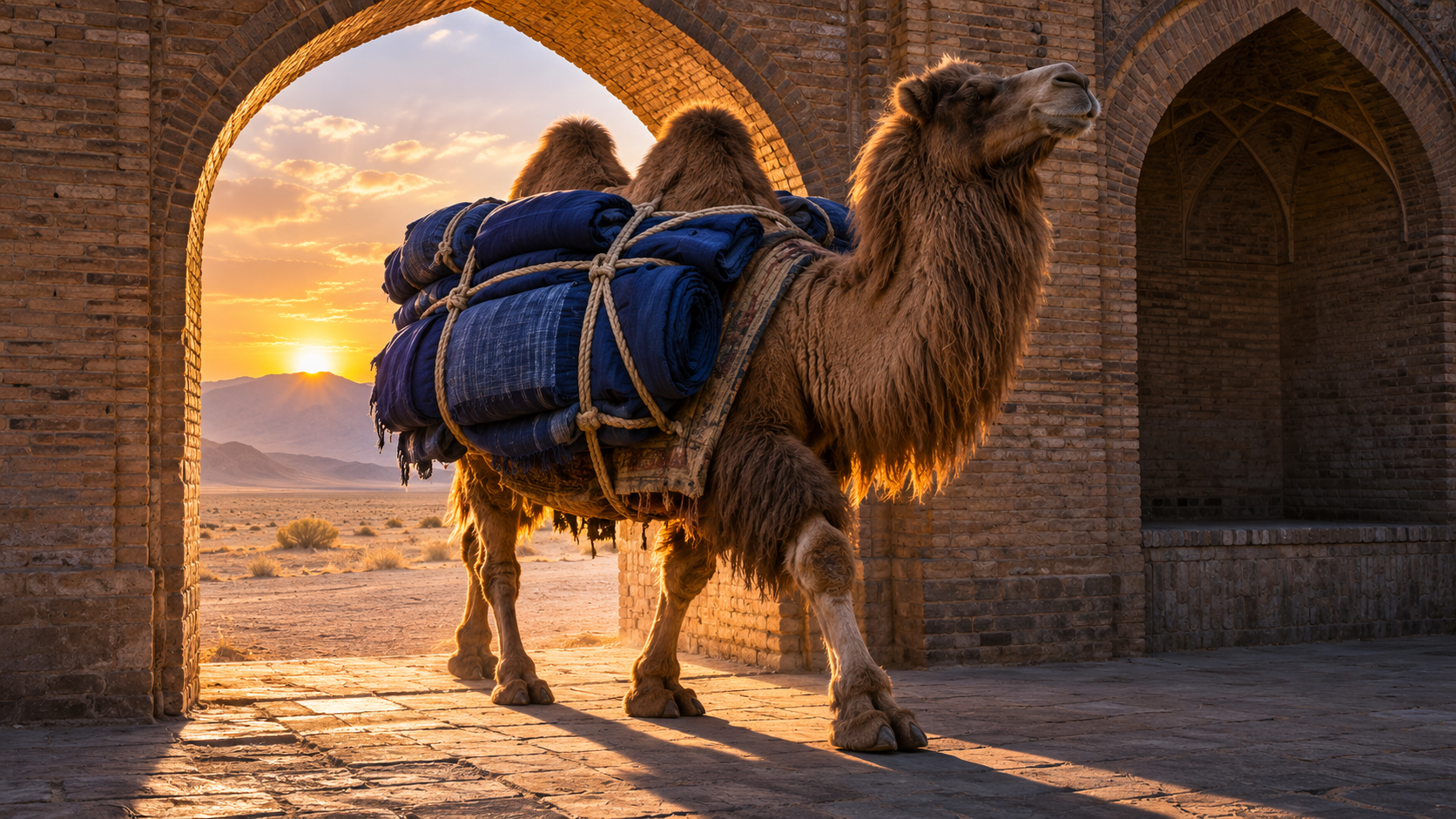
Imagine an evening arrival at a caravanserai, one of the lodging places associated with long distance trade. These establishments varied with region, date and patronage. A courtyard with covered accommodation around it offers a useful example. A gate gives access to an enclosed space. Loads can be brought in. People and animals need places to stand and rest. A traveller who has been attending to the route all day can finally turn to the condition of the goods and the needs of the night.
An animal that has carried weight for hours carries the immediate history of the journey on its body. A badly balanced load can rub. A small injury left unattended can determine whether the entire group moves on tomorrow. Water, fodder and an opportunity to examine the animal therefore belong among the first concerns at the stop. The valuable cargo attracts our eye in a museum. The animal and the person able to recognise a problem early may have mattered rather more to its chances of getting there.
Where would the traveller sleep? The answer could depend on money, status, available space and what needed watching. Expensive goods create their own demands. A small bundle might be kept close. Something awkward to move requires a secure place and an arrangement about who can approach it. A gate that closes at night makes it easier to control access, though the gatekeeper then becomes someone whose judgement matters to everyone inside. Physical protection and trust in particular people work together.
Eating brings the network down to the scale of the bowl. Someone grew or obtained the food, transported it to the stop and prepared it. A busy route can therefore feed local demand for grain, animals, fuel and labour. Prices may rise when many travellers arrive together. A place celebrated for connecting distant civilisations can be experienced by a local household as a particularly busy week of cooking, repairs and carrying water. Those experiences belong to the same history.
Did One Merchant Travel All The Way?
Some travellers made extraordinary journeys. A great deal of trade could proceed through exchange between people with shorter ranges. One person knows the routes and customers east of a settlement. Another has connections farther west. They need to reach an agreement about quality, quantity, price and payment. Once a bundle changes hands, it can keep moving after its first carrier returns home. An object found far from its place of manufacture is consequently evidence for a connection. It need say little about the length of any one person's itinerary.
Take a length of carefully made cloth. Its value derives partly from the labour already invested in the thread and weave. A buyer may also value the colour, the feel of the surface, an association with a distant place or the possibility of selling it again. The person who made it cannot know every purpose to which it will be put. Cloth can be cut, presented as a gift, used in an exchange or kept as a visible sign of access to unusual goods. Its meaning changes while the fibres remain the same.
A vessel has different requirements. Empty space within it takes up room. A knock can break it. Packing material and careful handling have to be included in the cost of transport. Sending a fragile vessel a long way makes sense under different conditions from sending a concentrated quantity of a valuable metal. This helps explain why the goods that dominate a museum display can give a skewed impression of everyday trade. A desirable object surviving far from home catches attention. Much more routine trade between neighbouring settlements keeps people supplied without leaving comparable headlines.
The transfer between carriers is a moment at which local expertise matters. How much will somebody farther along actually pay? Is the claimed origin reliable? Can a defect be discovered without damaging the goods? A trader who speaks two languages and understands two sets of expectations has an advantage that no pack animal possesses. The arrangement can work even when neither party knows the people at the remote ends of the chain.
What Did People Do When They Missed Home?
The letters found near Dunhuang include correspondence associated with a woman named Miwnay. She complained of abandonment and of the difficulties facing her and her daughter. Here is the other side of commercial mobility. A person capable of travelling far from home can leave someone behind who lacks the resources or permission to follow. The connection that makes a merchant's career possible can impose long periods of dependence on members of the household.
Sending a letter required more than having something to say. There had to be suitable material, somebody able to write, a known destination and a reasonable chance of finding a carrier. A recipient who had moved might never receive the message. The writer then faced a difficult silence. Had the person declined to answer, had the message been lost, or was the reply still coming? The cost of uncertainty belongs among the burdens of distance, even though it can never be read off a scale of miles.
A commercial letter in the same collection carries alarming news from China. The information has also helped scholars discuss the date of the correspondence. That is an unexpected afterlife for a report sent among contemporaries. An event mentioned because it might affect relatives, partners or business prospects becomes a clue to the age of the paper on which the writer mentioned it. Comparing the report with other accounts requires allowance for the time taken by news to travel and for what the writer could actually have known.
There is a human distinction between news that an event has taken place and news of somebody one loves. A traveller can confirm that a city has been affected by fighting and still be unable to say whether a particular household is safe. A merchant may be able to describe the consequences for a market while knowing nothing about a distant relative. Letters from the road preserve both kinds of concern. A network admired for its reach still contained agonising gaps for people trying to use it.
How Could A Belief Travel?
A religious teaching weighs very little in the luggage of someone who knows it by heart. Sustaining it across generations in a new place requires considerably more. People need a shared language or the means to translate. They need occasions to meet and people willing to teach others. If a community builds a place of worship, somebody must provide the site, materials, labour and maintenance. A belief can cross a pass with one traveller. Becoming part of the life of a settlement is a longer undertaking.
Near Dunhuang the Mogao caves preserve the results of such sustained effort. Buddhist communities and patrons supported the creation of sanctuaries with sculpture and painted walls across many centuries. The buildings and routes of trade help explain how people and resources reached the area. The images inside the caves tell us that people stayed long enough to make places of great artistic and religious specificity. A place at a crossroads can develop a deeply local history precisely because many people arrive there from elsewhere.
Think of the work contained in a wall painting. A suitable surface must be prepared. Materials must be obtained and applied in an order that allows the image to hold together. Artists need familiarity with the figures and conventions their audience will recognise. A person supplying resources may expect a particular religious benefit or a visible association with the work. A traveller who sees the finished painting encounters the outcome of many decisions made before the moment of viewing.
Translation presents another difficulty. A word familiar in one language can carry several associations that no single word conveys in another. A teacher may choose an expression people already know, then have to explain where the resemblance ends. A translator can introduce new vocabulary that takes time to become familiar. Ideas change through these encounters partly because keeping a meaning alive in a different setting requires active decisions. Transmission is work, and it is work done by particular people.
What Was The Sea Doing While The Caravans Travelled?
Look south from the overland routes and another extensive system of exchange comes into view. Ports around the Indian Ocean connected parts of eastern Africa, Arabia, South Asia and regions farther east. Seasonal winds shaped the timing of many voyages. A ship able to carry substantial cargo still had to depart at a useful time and reach a harbour where people could unload, trade and repair. The sea opened possibilities while imposing a calendar that no merchant could simply set aside.
A port has an evening rhythm of its own. Goods arriving in a vessel often need smaller craft, landing places or labourers before they can enter a warehouse. Fragile cargo requires care at the very point where it moves between different kinds of transport. A trader on shore can see a ship arrive hours or days before a particular item becomes available for sale. The last short distance can contain a surprising amount of the cost and difficulty of the whole voyage.
At Kilwa Kisiwani, off the coast of what is now Tanzania, merchants participated in a flourishing Indian Ocean trade. Among the goods associated with the port were gold and imported ceramics. Chinese porcelain found its way into an East African world with its own tastes, architecture and political institutions. The people living there decided what to buy, what to display and on what terms to deal with the next visitor. Calling the port a stop on someone else's route would tell only a small part of its history.
Objects link the port to places inland as well as across the water. A commodity reaching the coast may already have passed between several communities. Its arrival creates further work for people who can store, value and move it. The wealth of a port therefore depends partly on relationships beyond sight of its harbour. A person standing by the water sees the ship most clearly. The people who have brought goods from inland can be easy to overlook even when the ship has come specifically to acquire their cargo.
Who Could Afford To Wait For The Wind?
A long pause in a foreign port is easier to manage if somebody there knows your name. A contact may help with accommodation, recommend a person who can make repairs or advise against an unfavourable deal. Relationships cultivated on previous journeys reduce the work of beginning again each time. Families with members living in several places can exchange information and handle business across considerable distances. As Miwnay's letters remind us, the advantages can be distributed very unevenly within those families.
Waiting also ties up capital. Goods held in a warehouse cannot simultaneously be used to pay expenses somewhere else. A person with access to credit can take advantage of a favourable purchase while awaiting payment for an earlier sale. A person without credit may have to sell quickly on poor terms. The difference between wealth and poverty on a trading route sometimes lies in how many days somebody can afford to remain in one place.
A worker hired to carry cargo has a different relationship with the schedule. A succession of arrivals may bring abundant work followed by a long interval of uncertainty. A craftsperson supplying repairs benefits from vessels calling regularly, though the need for a particular repair is hard to predict. A household that feeds visitors may need to obtain more fuel and food in advance. For all of them the seasonal wind has consequences long after it has performed its obvious task of moving a sail.
External visitors often leave descriptions of the unusual. They notice a type of building, a practice of exchange or a food they encounter for the first time. People who live in the port may be preoccupied with a damaged landing place, a difficult neighbour or the price of a staple. Archaeology can help restore that everyday perspective. Cooking vessels, house plans and traces of ordinary repair tell us how a place worked between the arrivals that make it into travel narratives.
What Else Travelled Without Anyone Choosing To Send It?
People and animals moving between communities can also carry illness. The movement of goods can bring organisms into a new environment. The consequences depend on the organism, how it spreads, the people or animals it encounters and the local conditions on arrival. A well connected place may receive repeated introductions. The existence of a trade route is one part of an explanation for the spread of disease. Establishing the path of a particular outbreak requires evidence that reaches well beyond a line between two cities.
Rumour travelled by a related social mechanism. A recent arrival brought an account of something seen or heard. The next listener had to judge the speaker's reliability, the age of the news and its relevance to the next journey. An exaggerated warning might delay a departure unnecessarily. Failing to heed a sound warning could cost much more. A merchant who paid close attention to the source of a report had a practical reason for doing something remarkably like historical research.
So did reputation. A single deal is an encounter between a small number of people. An account of how it went can reach others before the trader does. A person dealing with an unfamiliar buyer may rely on recommendations from somebody known to both. A relationship damaged at one stop can influence the terms available farther along. Reputation becomes a kind of travelling possession that cannot be packed or fully controlled by the person to whom it belongs.
All of this helps explain why stopping places mattered so much. A gated courtyard can shelter bodies and bundles. It also brings into conversation people who have seen different stretches of road. A harbour gathering crews from several directions does something similar. A place that allows a traveller to sleep also allows information to change hands. By morning, a route that looked sensible the night before may have become an undertaking worth postponing.
What Lay Beyond These Connected Shores?
The Sogdian letters never reached the people whose names appeared on their folds. The porcelain reached Kilwa. Teachings found a home in sanctuaries near Dunhuang. These are quite different outcomes of the same broad human capacity to build chains of exchange longer than a single life or journey. The great routes had no single owner and no fixed destination. They grew out of local skill, repeated visits, relationships tested by distance and the simple need to find enough water and a safe place for the night.
Across the Atlantic, people in the Americas had long built networks of their own. They grew crops with histories quite separate from the grains of Eurasia, moved goods between different environments and developed cities, ports and routes suited to their worlds. In the coming chapter the Atlantic becomes the centre of an encounter that would bind those histories together under profoundly unequal conditions. For many of the people who crossed it, departure would be enforced and the possibility of going home taken away.
For tonight, keep the folded letter in mind. A writer expected somebody far away to unfold it and understand. The difference between the freedom to send a message, the freedom to make a journey and the freedom to return is easily missed when the whole world fits on one map. At the shores of the Atlantic those differences will become the heart of the story.
Sources
Nicholas Sims-Williams — Ancient Letters — The folded correspondence found near Dunhuang.
UNESCO — The Persian Caravanserai — Lodging, water and roadside services.
UNESCO — Mogao Caves — Buddhist sanctuaries at a crossroads.
UNESCO — Ruins of Kilwa Kisiwani and Ruins of Songo Mnara — East African ports in Indian Ocean trade.
Next Reads
The Mongol Empire Explained: How Genghis Khan Built The Largest Contiguous Empire In History — How Mongol power changed movement across Eurasia.
The East India Company: How A Trading Business Acquired Territorial Power — How an overseas trading organisation acquired political power.
The Bronze Age Collapse: Why Ancient Kingdoms Fell Around 1200 BC — An earlier example of societies dependent on long-distance exchange.
