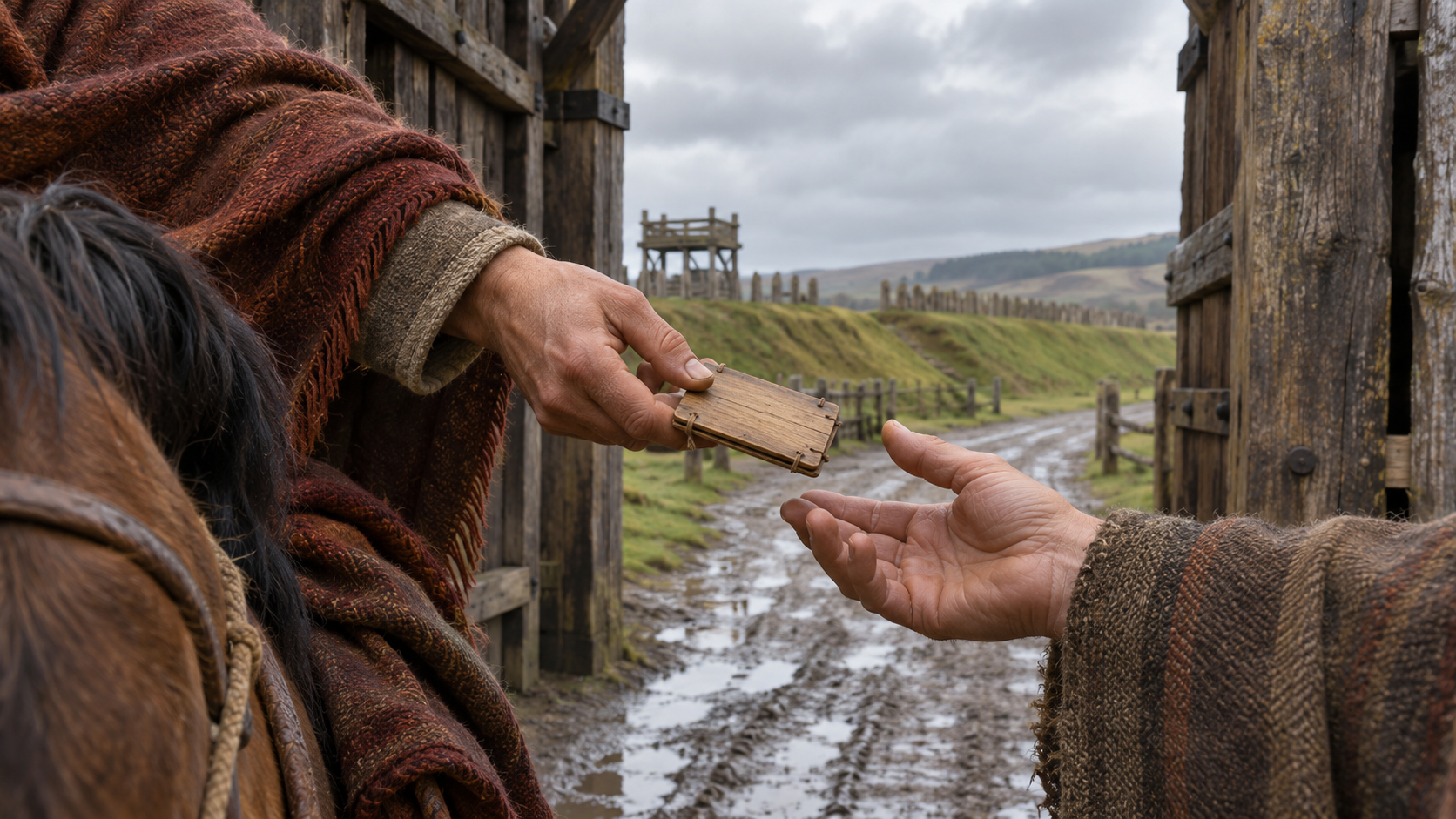
A Birthday Invitation Reached The Edge Of Roman Britain.
Claudia Severa wanted her friend to come over in September. The occasion was her birthday. Her husband and little boy sent their greetings. Another hand had written most of the invitation, but near the end the handwriting changed. Severa seems to have taken over to add an affectionate farewell herself. The invitation reached Vindolanda, a Roman fort in what is now northern England. Around nineteen centuries later it is possible to read the message. Whether the friend managed to come is a different matter. The reply has never reached us.
The gap between sending an invitation and sitting down with the person you invited is a good measure of what an empire could do. A message needed a carrier, a route and a destination that somebody knew how to find. A guest needed time, means and the freedom to travel. Rulers brought faraway places within reach through roads, records, local intermediaries, supplies and the threat of force. The people who lived along those roads made their own uses of them. A command, a parcel of clothing and the hope of an afternoon in good company might all travel in the same direction.
What Would An Empire Look Like From The Ground?
A map invites you to take in the whole territory from above. The colour runs without interruption between a capital and a distant shore. At the height of summer the colour remains the same as it does after winter rain. Someone setting off on foot encounters quite another geography. A river may be passable in one place and dangerous a short distance away. A cart might manage a dry stretch comfortably and have considerable difficulty there a week later. Information about conditions can be as important to a journey as knowledge of the route.
The traveller would also meet other people's authority in particular places. A person at a gate wants to know the purpose of a visit. An official asks to see a document. Somebody claims a payment before goods can go farther. Day after day an empire renews itself through encounters of this kind. Most subjects will never stand in the presence of the ruler whose name legitimises them. They may have strong opinions about the person authorised to act on the ruler's behalf in their own neighbourhood.
Distance introduces a further complication for the ruler. An instruction has to travel out, and a report of what happened has to come back. An official at a distance can act before a reply arrives or wait while the problem changes. The centre needs people capable of making decisions locally and has reasons to worry about what those people do with the discretion they receive. Written records and regular routes make it easier to ask questions afterwards. They also create work for people who know how to present a decision in an acceptable form.
Think back to the keeper of the barley account at Uruk. The tablet let a second person consult a transaction after the participants had gone away. Extend that principle over a much wider territory and a king can learn something about supplies he never handles. The figures remain useful only if people agree on units, dates and responsibilities. A tidy set of impressions hundreds of miles away will never feed the traveller who arrives at an empty store.
Who Fed Somebody On The King's Business?
Long before Severa's birthday, the Persian kings governed an empire that reached across a great expanse of western Asia and beyond. At Persepolis, in present day Iran, excavators found an administrative archive associated with the fortifications. Its records from the reign of Darius the First deal extensively with food. Among their recipients were people travelling on official business. The machinery of a large state becomes easier to understand when a traveller arrives needing a meal.
A traveller carrying every provision for a long journey soon faces a problem. The provisions add weight. Carrying the weight consumes energy. An animal can take a larger load but requires food and water of its own. Supplies available at intervals along a route change what it is reasonable to attempt in one trip. Access to those supplies also gives whoever controls them a great deal of influence over who can move, how quickly and under whose authority.
Imagine the question from the position of the person in charge of a store. A party arrives claiming to be entitled to food. Issuing the supplies promptly helps the king's business proceed. Giving away supplies to anybody who claims an entitlement soon empties the building. Refusing a legitimate traveller brings its own consequences. A recognised authorisation is useful because it helps the storekeeper make a decision under these conditions. The record of what was issued can later explain why a quantity is missing from the stock.
The archive at Persepolis includes documents bearing seal impressions and writing in different languages. Some pieces carry impressions without a written text. For somebody accustomed to finding a name at the bottom of a modern form, this is an invitation to think again about identification. A recognised design can do useful administrative work even for people whose spoken languages differ. A person trained to read an account may still need another person's knowledge to identify the relationships behind a particular seal.
How widely did the system reach? The archive tells us a great deal about a regional administration operating in the heartland and along routes connected with it. Its survival in one place gives us no grounds to assume that every distant district used exactly the same arrangements. A large empire could sustain local variation in languages, offices and habits while directing resources towards the requirements of its rulers. What united its territories might be experienced quite differently according to where a particular person stood.
What Did The Arrival Of A Garrison Change?
Travel west and forwards in time to northern Britain towards the end of the first century of the common era. At Vindolanda, soldiers and the people attached to the garrison needed regular supplies. The best known frontier monument in the region, Hadrian's Wall, still lay in the future when Severa's invitation arrived. People were already living, working, writing to friends and trying to get deliveries through a landscape where the Roman state maintained a military presence.
A garrison concentrates consumers in a particular place. Food that once supported nearby households may find additional buyers. Animals must be fed as well as people. Clothing wears through. A damaged item might be repaired locally, while a replacement could come from farther away. A supplier who can meet an urgent need may gain a customer. Another household may face demands over which it has very little choice. The fact that an army creates business tells us little by itself about who enjoys the profit and who bears the costs.
From inside the fort the surrounding land can look like the source of today's provisions. From the perspective of a farmer outside it, the fort can represent a market, an obligation or a force capable of overriding local arrangements. A cart taken for a particular journey is temporarily unavailable for other work. An animal fed through winter represents labour already invested before it becomes useful to somebody else. The same delivery enters the accounts of supplier and recipient under very different descriptions.
Military service also moved people. A frontier garrison could bring individuals from other parts of the empire into regular contact with each other and with local communities. Names, languages and relationships in the surviving material give glimpses of these movements. The convenient phrase Roman Britain can make life at a fort sound more uniform than it was. A shared regulation or a common need for footwear could connect people whose birthplaces, prospects and reasons for being there differed considerably.
What Went Into A Parcel From Home?
One fragmentary letter from Vindolanda mentions socks, sandals and undergarments. Its words have often been enlisted to illustrate the climate of northern Britain. At the scale of a person's day there is a simpler human fact to attend to. Clothing touches the body for hours at a time. A small discomfort can become a persistent preoccupation when someone must continue walking or working. A parcel of practical clothing carries a kind of attention that a formal instruction from headquarters could never supply.
The fragment also contains greetings. Objects and messages travel together naturally. Somebody who is going in the right direction can take a bundle as well as a few words. Once the journey is being made, it becomes worth asking whether anybody else needs something carried. A network capable of moving an official dispatch consequently opens opportunities for private errands. The extent of those opportunities depends on relationships and access. An officer's family and a person newly arrived without acquaintances may find the same distance very different to negotiate.
What would it take to send clothing to somebody you care about? First you need a reasonably reliable idea of where they are. You need to obtain the items or make them, find a carrier and make sure the destination is understood. The intended recipient needs to be there when the parcel arrives or have somebody willing to keep it safe. An empire that keeps people far from home creates the need for such journeys at the same time as its routes help make them possible.
Archaeology has recovered footwear from Vindolanda in quantities that make the bodies of its inhabitants easier to imagine. Shoes differ in size, shape, wear and purpose. A small shoe makes room in the picture for a child. Wear marks can indicate repeated use. An object fitted to somebody's foot can bring us close to a particular life even when the owner's name is lost. The written mention of clothing and the physical remains illuminate each other without requiring the tempting claim that a particular shoe belonged to a particular correspondent.
What Happened When The Roads Were Bad?
A business letter from Vindolanda brings us close to an ordinary difficulty of transport. Its writer, Octavius, was trying to manage a set of transactions involving supplies and money. Road conditions entered his calculations. A road can appear as a clean, decisive line on an imperial map while the person who must load a vehicle on it has serious reservations. The difference is important because the cost of moving goods helps determine which transactions can go ahead at all.
Imagine the choice available to a carrier. Take a heavy load in one journey and the animal may struggle on a poor surface. Divide the load between two journeys and the cost in time rises even if both succeed. Delay until conditions improve and a customer may have found another supplier. The trader has to consider what condition the goods will be in when they arrive and whether payment will be available then. Most of these calculations leave little physical evidence. A worried letter can preserve a few of them in motion.
Credit helps bridge the time between obtaining goods and receiving payment. It introduces a new dependence on trust and timing. A person rich in goods can still have difficulty meeting an obligation that requires money now. Somebody waiting for a debt to be paid may in turn owe money to a third party. Delayed transport can therefore travel through a chain of obligations much faster than the original load travels down the road.
The business of empire depended upon many people working through such difficulties. A governor might know the route was open while a supplier knew that a particular stretch was expensive to cross with a laden cart. Both statements could be accurate. The first matters to someone deciding whether a message can get through. The second matters to the household that stands to lose money on a delivery. Daily life gives the infrastructure its units of measurement in tired animals, extra journeys and hours of daylight used up.
Who Had Time To Attend A Birthday?
Severa wrote to Sulpicia Lepidina, wife of a commanding officer. That relationship helps place the invitation socially. A woman associated with a military household could have access to people able to carry a message and assist with arrangements. The invitation also shows the personal work required to sustain a friendship. Severa chose an occasion, expressed a wish to see Lepidina and sent regards that drew their households into the exchange. The last lines bring her physically close as she takes a writing instrument in her own hand.
There is a small intimacy in a change of handwriting. Think of a formal card on which somebody adds a few words beneath the printed message. The addition can seem to bring the sender into the room. At Vindolanda the change has an exceptional value to historians because it preserves evidence of a woman's handwriting in Roman Britain. To the recipient its importance might have been simpler. She knew this person, and the words came from somebody who hoped to see her soon.
How much should we infer from the apparent use of a scribe? Having another person write most of a message could reflect convention, convenience or the organisation of a household with access to trained writers. Adding a few lines shows an ability to participate in the act of writing. The physical document cannot unambiguously tell us how confident Severa would have been composing a different text or how often she chose to do so. It gives us an actual occasion on which two hands contributed to one message.
Would ordinary people have marked birthdays in the same way? The survival of this invitation establishes an occasion within a particular social circle. A household able to produce correspondence and send it to a fort has a better chance of becoming visible in the archive than many people who celebrated together within walking distance. A verbal invitation costs little and disappears as soon as the hearer leaves. The most elegant surviving testimony to friendship can also remind us how many more friendships must have left nothing we can read.
What Could An Empire Demand Of Its People?
The quiet familiarity of socks and invitations can make a military frontier seem almost domestic. It was also a place where organised force sustained claims over territory. The authority of an army depends partly on its ability to make people do things they would otherwise decline. It can occupy land, restrict movement and direct resources towards its own maintenance. A person encountering a garrison therefore faced questions that would never arise between two households simply exchanging favours.
Taxation is one way a distant authority can appear in the calendar of a home. When a delivery or payment falls due, a household may have to arrange its work around the deadline. An official collecting grain needs a way of judging quantities. Somebody expected to pay money may have to obtain it through sale or employment. The form in which a demand is made can therefore alter the kind of work a household does and the people it must deal with before the demand is met.
Local intermediaries become especially important under those conditions. A person who understands the language and conventions of an administration may help a neighbour present a claim. The same position can be used to favour friends, delay an unwelcome demand or make somebody else's life difficult. A ruler seeking dependable information has reason to cultivate such people. A community seeking protection from arbitrary demands has reason to cultivate them too. The interests meet in the individual who translates an order into something that happens on the ground.
A translation could even change the practical meaning of a deadline. A date expressed in a calendar used by officials has to become a day that a grower can identify. An order naming a district must reach the households whose produce is being counted. Somebody who knows both the official schedule and the local season can anticipate a clash between them. Whether that person can secure an extension is a question of influence as much as an ability to read.
What happens at the edge of imperial attention? An administration may insist on precise accounts of provisions issued to official travellers while taking little interest in the way a family shares an evening meal. A garrison commander may devote great care to the state of a particular route and know comparatively little about what happens a short distance away from it. The colour covering a map gives an impression of equal intensity. Daily life is better understood through the specific places and moments where authority mattered.
Where Did The Road End For The Night?
A road reaches an important limit when the traveller needs somewhere to sleep. The next stretch can wait until morning. The animal needs water now. A bundle must be kept dry and the message carried inside it must remain legible. An official traveller may be entitled to supplies. Somebody travelling on private business may have to pay, draw upon a connection or settle for whatever shelter is available. The evening reveals distinctions that a map of the route cannot show.
Consider again the different journeys gathered into this chapter. The traveller in the Persian heartland is visible because somebody recorded the provision of food. The person whose clothing was mentioned at Vindolanda enters our story because ink survived on wood. Severa and Lepidina are present through an invitation. None of these people set out to explain how empires functioned. Their ordinary requirements show why a faraway ruler needed local stores, literate officials and reliable carriers, and why people living within that system could put it to uses quite their own.
There is a final detail to keep from the birthday message. Severa could send an invitation because she expected it to be possible for another woman to visit. That expectation contained a whole unspoken geography of routes, time and assistance. In other parts of the ancient and medieval world, a trader arriving in an unfamiliar place faced a wider version of the same problem. Goods could travel as far as the next person willing to take them, and that person had to know where it was possible to stop.
In the next part of the story, evening finds us in a lodging place along one of the networks now called the Silk Roads. A traveller can set down a load. Somewhere there is water for an animal and a place to hear news of the way ahead. Ask what has come in through the entrance today and the answer may include a length of cloth, a letter, an unfamiliar word and an idea that will travel much farther than the person who brought it.
Sources
Roman Inscriptions of Britain — Tablet 291 — The birthday invitation and its two hands.
Roman Inscriptions of Britain — Tablet 343 — Octavius on business, payment and transport.
Roman Inscriptions of Britain — Tablet 346 — Clothing and greetings in a fragmentary letter.
University of Chicago — News & Notes, Summer 2007 — The Persian archive of food distributions and travel.
Next Reads
Why Empires Fall: Power, Resources And The Myths Of Collapse — What resources and communications could sustain an empire.
Top 10 Reasons the Roman Empire Collapsed — The pressures on Roman authority over distant territories.
The Mongol Empire Explained: How Genghis Khan Built The Largest Contiguous Empire In History — Another empire that depended on movement across great distances.
