Somebody Kept An Account Of The Barley.
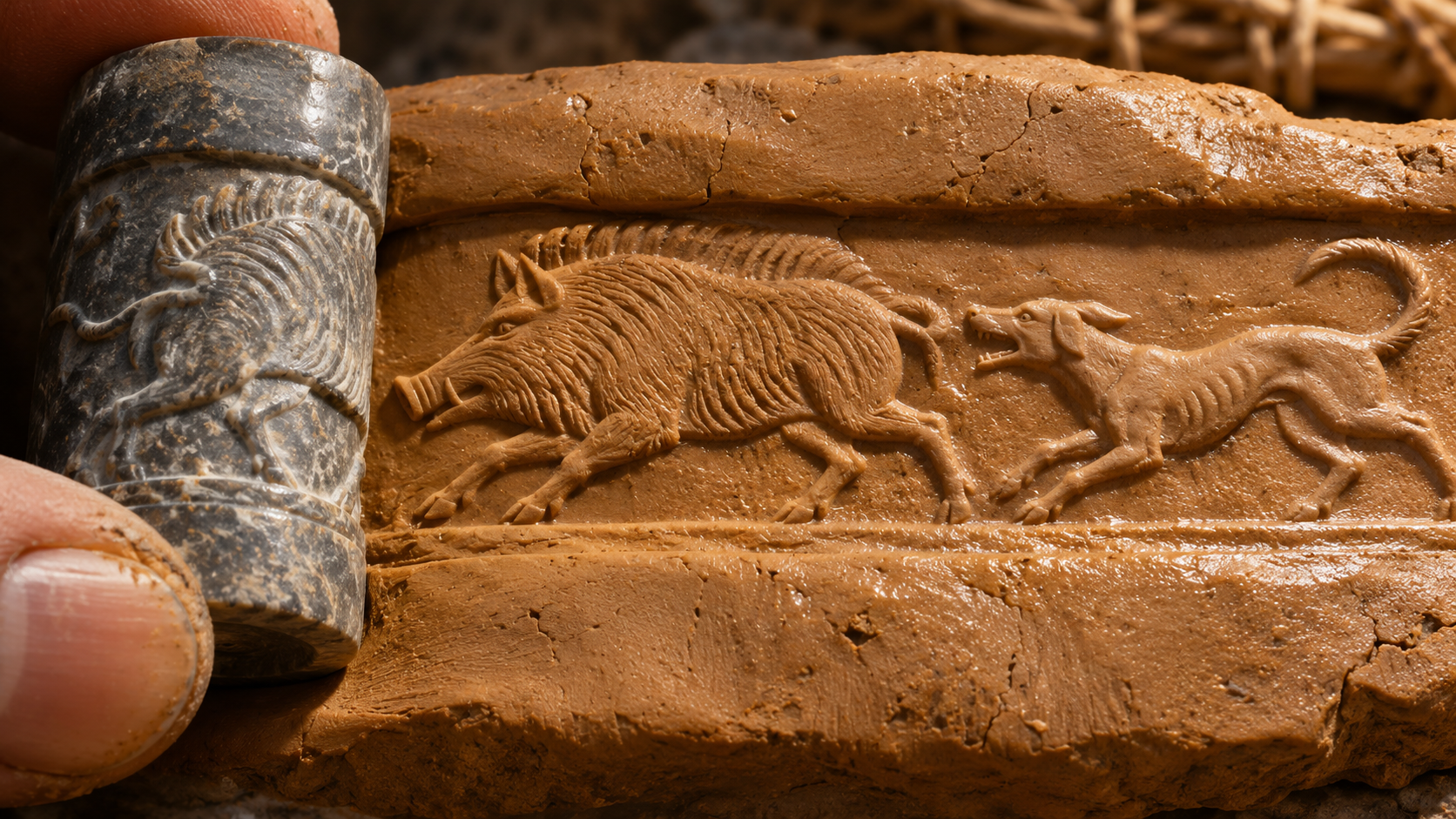
There are hunting dogs on an ancient account of barley. They belong to a design rolled across the clay with a carved seal. A human figure and wild boars share the surface with marks that concern the distribution of grain. Make an impression on soft clay and the smallest movement of a hand can survive the person who made it by more than five thousand years. We can still see the hunt. We can still recognise the keeping of an account. Somewhere among the marks lies the ordinary working day of the person who put the two together.
The tablet comes from the world of early southern Mesopotamia, in present day Iraq. At Uruk, one of its great settlements, people began leaving written records during the closing centuries of the fourth millennium before the common era. Some of the earliest deal with goods and the portions distributed to workers. Writing answered a problem created by scale. Grain, people and obligations could move through more hands than any one person could follow. A durable record let someone in another room, or somebody coming to work the following morning, pick up an account where the first person had left it.
Where Did A City Find Its Breakfast?
From a distance the buildings would have been the most striking thing about Uruk. For the purposes of breakfast the important ground lay beyond them. Grain grows where there is soil, water and somebody to tend it. Building a house occupies ground on which grain will no longer grow. Build enough houses close together and most inhabitants begin their day at some distance from the fields that support them. A city can wake only because work started elsewhere long before the people inside it get up.
Follow one imagined load from the field. Someone must decide how much of the harvest to retain for seed, how much belongs to the people who grew it and how much is due elsewhere. The crop has to be put into a form that can be moved. Carrying it overland consumes energy. Moving it on water, where a channel permits, brings its own requirements for access and unloading. A store needs space in which to receive it. Something so undemanding as eating a portion of barley depends on successful transfers along the way.
The rivers and lowlands of southern Mesopotamia offered immense opportunities for growing food. Water also has a habit of arriving where it is inconvenient and failing to arrive where somebody has planted a crop. Directing it towards one area affects what happens farther along. A channel that works this year may need clearing before it can do the same job again. Irrigation turns a relationship between a grower and the ground into a relationship involving other people who draw on the same water or maintain its route.
It is easy to imagine one powerful ruler issuing instructions for all of this. In practice, neighbours can maintain a shared stretch of channel because their crops depend on it. A large institution can claim produce or direct labour where its interests extend. Different arrangements can overlap. The existence of an impressive city establishes that substantial resources could be brought together. It takes other evidence to determine which decisions were taken in a household, which required negotiation between neighbours and which arrived as commands.
What Made Uruk Feel Like A City?
Stand at the base of a large mudbrick building and look closely at the wall. At Uruk, coloured clay cones were inserted into surfaces to make geometric patterns. Close to the building each cone is the result of a small act of manufacture and placement. Step back and individual pieces disappear into the design. Something similar happens when we speak about the building as a whole. The eye takes in a monument. Its construction consisted of relatively small tasks repeated by a great many hands.
Mudbrick has an interesting relationship to water. Water helps turn the raw material into something a worker can shape. Drying gives the brick its usefulness. Later exposure to water can damage the resulting wall. A finished structure therefore creates a future demand for maintenance. The work done to put a roof over one generation's head can become an obligation inherited by the next. A city is busy even during a period when nobody adds a single new building to its skyline.
There is another kind of scale to notice at ground level. In a small settlement, a stranger may stand out simply because most faces are familiar. In a large settlement there will be people whose homes and occupations you know little about, even if they have lived there all their lives. You can depend on their work without recognising them. A pot made in one quarter can end up beside a hearth in another. The person eating from it need never set foot in the workshop.
What holds that kind of place together? Habit does some of the work. People know where to take a damaged object and where a delivery is expected. Buildings make certain movements convenient and others difficult. Established claims on food and labour give people reasons to appear in particular places. Kinship and friendship still matter within the city. Around them grows another set of relationships in which people deal with each other as the holder of a position, the bearer of a seal or the person entitled to receive a particular quantity.
How Do You Count A Delivery?
Suppose two people arrive at a store and each says they have brought a basket of grain. A basket is an adequate description for somebody who merely wants to know what they are carrying. It is less useful when a person has to decide whether the same obligation has been met in each case. Baskets vary. A load can settle. Grain heaped above a rim looks different from grain levelled across it. Counting containers will answer the question only if everyone has agreed what the container represents.
A measure solves part of the difficulty by putting an agreement into a physical object. Fill to a known point and the quantity can be compared with the result of filling the same measure tomorrow. Now the person receiving goods can distinguish the amount due from the amount actually deposited. There are still questions of grain quality and condition. Yet one aspect of a transaction has become easier to compare across time, across holders and potentially across places.
Numbers themselves can work in ways that feel unfamiliar. In an administrative system the unit chosen for grain can differ from the unit used for another commodity. Learning to read a record involves knowing which system applies. A row of impressions that seems obvious to somebody trained in the work may be difficult for a visitor to interpret. The tablet and the understanding of the tablet belong together. Lose the surrounding conventions and even a well preserved account can turn into a puzzle.
Consider what happens at the end of a busy day. There have been several deliveries and several distributions. Looking at the store tells you roughly how much remains. It cannot by itself tell you whether a particular obligation was fulfilled. The account lets somebody revisit an individual part of the day's traffic. That is a new kind of memory. It can preserve the answer to a specific question even after the grain delivered in the morning has gone out again with somebody else.
Why Write On Clay?
Clay was available in a landscape where people already knew how to use it for buildings, containers and other objects. In a prepared, moist state it takes a mark readily. A person can press a form into the surface, draw a sign or roll a seal across it. The resulting object can be small enough to hold in one hand. Once dry it can retain the information while a person carries it to another place or leaves it among other records.
Now imagine making a correction. While the material is still pliable, a surface can be worked again. Timing matters. A fresh tablet invites certain changes that become much harder after it dries. The object therefore has a useful sequence of states, each suited to a different stage of the work. A record that needs frequent adjustment and one intended to be kept for consultation may begin with the same handful of earth, then follow quite different paths.
The carving on a cylinder seal gives clay a further capacity. Roll the cylinder across the surface and a repeating design appears. Cut the design carefully once and it can leave recognisable impressions on many different occasions. Someone familiar with the image can associate a marked object with its seal. This is an economical way to add identity or authority to a transaction. The person consulting the impression need not have watched while the original carving was made.
What exactly does an impression guarantee? A seal can indicate access to a particular object and an accepted procedure for using it. The value of the mark depends on who controls the seal and whether others recognise its authority. An image of animals cannot independently verify the amount of barley entered beside it. Trust still rests on an arrangement between people. The remarkable thing is that a little carved stone can allow that arrangement to operate between individuals who never stand in the same room.
Could The People Receiving Rations Read?
A person whose portion is recorded on a tablet need never read a single sign for the tablet to affect their life. Someone else measures the goods, enters the quantity and uses the record to decide whether a claim has already been met. The recipient may judge the fairness of the portion by sight or by comparison with what others receive. The two people can experience the same transaction through different kinds of knowledge. One knows how the entry should look. The other knows how far the food has to stretch.
An early tablet interpreted as a record of beer allocations preserves signs representing vessels and quantities. Grain can feed people in more than one form, and brewing involves several stages between field and finished drink. A record of portions gathers the results of that labour into a few marks. It can connect a quantity of finished product with a group entitled to receive it. A reader looking for a personal account of how the drink tasted will find that the tablet is admirably precise about something else.
What was a ration worth? Its importance to a recipient would depend on the rest of the household's means of support, the number of people drawing on the food and the regularity with which it arrived. A fixed portion might offer security through a period when other supplies varied. Dependence on a distributor could also leave somebody vulnerable to interruption or exclusion. The fact of an allocation is easier to establish than the degree of freedom enjoyed by the people receiving it.
The same difficulty arises when calling a distribution a wage. A modern wage normally brings to mind money that can be used for many purposes. A quantity of grain can be consumed, stored or exchanged, but the options depend on local arrangements and the condition of the food. People can work under very different obligations and still receive a regular portion. An account of quantities is a good starting point for understanding their working lives. It is a poor substitute for asking who could leave and what happened if they did.
What Else Went On While The Accounts Were Being Kept?
The durable tablet gives the person holding a stylus an unusually prominent place in our story. Elsewhere there was food to prepare, water to carry and clothing to make and mend. Somebody had to find fuel. A broken container could mean an extra trip before cooking could begin. Children had to learn where they were allowed to go and whose work could be interrupted. Few domestic acts called for a written record. They occupied much of what people would have remembered if we could have asked them about the day.
Take a potter's work as an example. The city offers access to many potential users within reach of one workshop. Making containers repeatedly can reward a person who develops a reliable rhythm or produces forms suited to a particular task. Many vessels doing similar jobs can look much alike even when individually made. An archaeologist recovering fragments can examine how forms recur, where the clay came from and what traces of use remain. These are ways to recover the work of people rarely identified by name.
Or take the person who brings building material to a site. Early in the work there may be open space to move a load. Later, walls narrow the approach. A place that is easy to reach empty handed can become awkward while carrying something heavy. The building grows through innumerable adjustments at the scale of a human body. A list of people receiving food for their labour can make a workforce seem interchangeable. Watching the actual work for a day would reveal just how much depends on particular people knowing what to do.
Who looked after children during all of this? The city gives us grounds to ask how proximity affected the possibilities. Adults working together near a dwelling can share some tasks of supervision. Work at a distant site takes a person away for longer. Someone who cannot freely leave their post has fewer choices when a dependent needs them. The institutions visible in early records had consequences within households, even where the records themselves have nothing to say about the person waiting at home.
When Could A Sign Begin To Speak?
A picture of a jar can identify a kind of object. A mark beside it can state an amount. With enough agreed conventions, people speaking different languages could understand the practical meaning of the combination. Now try recording the personal name of somebody whose name means little to the person doing the writing. Or try recording a promise about what somebody intends to do at a later date. A system designed to count material things encounters a different kind of task.
One solution is to use a sign for the sound of a word. Imagine an English speaker drawing a bee to suggest the sound at the start of the word beyond. The reader has to recognise the insect, know what it is called and understand that the sound is doing the work on this occasion. A picture that once referred to something with wings can now help write a word about distance. The possibilities grow rapidly once signs can represent elements of speech.
Early Mesopotamian writing developed over centuries. The earliest surviving records give particularly good evidence for administration. Later cuneiform could be used for letters, legal agreements, literary compositions, scholarly observations and much else. To treat the earliest accounts as though their makers already foresaw all these uses would be to give them a peculiar kind of hindsight. A procedure worth learning because it helps settle a delivery can be adapted by people whose needs its early users never encountered.
There is a beautiful consequence for our understanding of Uruk. The city eventually became inseparable from stories of Gilgamesh, a king whose name travelled through a much later literary tradition. People who know almost nothing of early barley accounting may have encountered the grief or restlessness of that hero. The ability to carry such experiences across distance and time grew from a history in which practical marks on clay played a leading part. The listeners who first heard a good story needed no writing. Writing gave the story another way to find listeners.
Did Every City Need The Same Invention?
Cities developed in several parts of the world under quite different circumstances. Writing has histories in Egypt, China and the Americas that deserve explanations grounded in their own evidence. A sequence reconstructed for Uruk cannot serve as a timetable through which every growing settlement had to pass. Oral testimony, standard measures, repeated procedures, recognisable symbols and trained memories can all do demanding administrative work. A place can be complex while leaving researchers with great difficulty reading its records or even recognising them as records.
What Uruk offers is a particularly clear example of a connection between scale and the kinds of information people choose to preserve. The person remembering who borrowed a cup within a household can consult the people involved. The holder of a much larger store may receive goods from one group, distribute them to another and answer for the balance to a third. The need to communicate between those positions gives a durable account a specific job. That is a narrower explanation than announcing the birth of civilisation, and a more revealing one.
It also changes who becomes visible to history. Large institutions generate records about things important to large institutions. A household meal may leave crumbs. A delivery to an institutional store can leave a labelled quantity and an impression made by a responsible official. A future investigator can recover a great deal about the second event while scarcely glimpsing the first. The unequal visibility belongs partly to the surviving evidence and partly to the interests of people who decided what was worth recording in the first place.
Who Carried The Record Beyond The City?
By the end of a working day a tablet could contain information about people the person holding it had never seen. That is an extraordinary achievement for an object that fits in the hand. Yet it could go no farther on its own than the barley. Someone still had to carry it. The journey took time, and the recipient still had to decide whether to trust the person who arrived with the message. The more widely an institution extended its reach, the more it depended upon very ordinary travellers.
Think of the equipment needed for a message to reach a distant place. A route must be known. Water, shelter and a means of finding food must be available along it. An official who wishes to send a reply needs somebody going the other way. Delay matters because conditions may have changed between the writing and the reading. A ruler can issue an instruction in a moment. Its actual influence extends only as far as people can carry it, understand it and act.
That will be the scale of the next night's journey. We shall leave the store and travel through landscapes where rulers claimed authority across distances that took many days to cross. At the far edge of one such empire, a woman sent another woman an invitation to a birthday. The same world that moved soldiers, taxes and official orders also gave that small, hopeful message a chance of reaching a friend.
Sources
Metropolitan Museum of Art — Uruk: The First City — The decorated buildings, barley account and administration of Uruk.
Ira Spar — The Origins of Writing — How signs for goods developed phonetic uses.
Metropolitan Museum of Art — Proto-cuneiform tablet with seal impressions — The barley account showing hunting dogs and boars.
Next Reads
History of Money Creation: From Ledgers to Crypto — Why records of debts could matter before coinage.
What Makes A Civilisation? The Evidence Behind The Label — How historians identify a city in the archaeological record.
The Hidden Engine of Civilization: How Mathematics Was Born, Shaped the World, and Is Quietly Rewriting the Future — How counting and measuring became practical tools of administration.
