The Oldest Thing In This Room Might Be The Bedding.
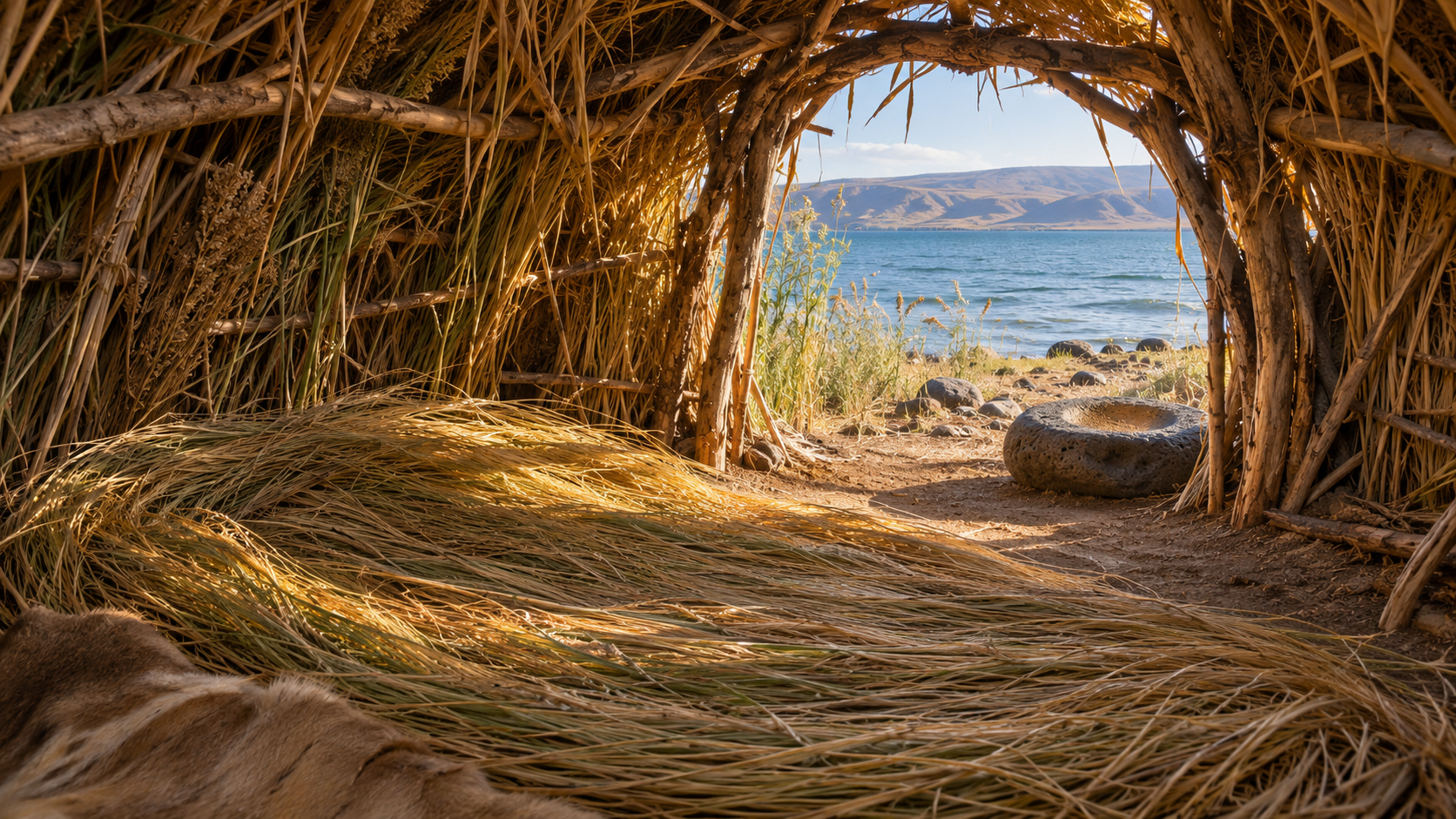
There is grass on the floor of a dwelling beside the Sea of Galilee. It was laid there roughly twenty three thousand years ago. There are few things in the history of the world quite so easy to understand as the wish to have something comfortable between a tired body and the ground. A visitor who knew nothing of the language spoken at this lakeshore might still have understood what this part of the floor was for. Somebody had gone to the trouble of gathering bedding and bringing it home.
The place is called Ohalo Two. People there fished, gathered wild plants, worked stone and built shelters from local vegetation. Their food came from a landscape they knew how to use in considerable detail. A day here might involve preparing a small quantity of grain inside a dwelling, working on a cutting edge near the entrance or bringing fish up from the shore. The floor preserves a little of the arrangement of the work. Even across the time that separates us, one can begin to find one's way around the room.
This is a different encounter from following the footprints at Laetoli. The people at the lake belonged to our own species. They had left their belongings in places where water and sediment eventually protected an extraordinary range of fragile material. A seed, a fish bone and the edge of a building have survived together. Stand in imagination at the entrance for a while. Instead of asking what all hunter-gatherers everywhere did with their evenings, we can begin with the much more satisfying question of what actually went on here.
What Was Inside A Hunter-Gatherer Home?
Start with the space your feet would occupy. In one hut, researchers examined the distribution of plant remains across a floor of about twelve square metres. There was a grinding stone in one part of the room. The material around it suggested that people had processed plant foods there. Elsewhere the remains of stoneworking marked another patch. The space between the two made sense as a way through. Each interpretation came from the relationship between finds. Lift the grinding stone and put it alone on a shelf and a good deal of the house disappears.
One advantage of arranging work in familiar places is that an ordinary movement can proceed almost without thought. Somebody entering with both hands occupied needs a clear patch in which to put something down. Somebody using a stone to process food needs enough room to move their arms. A worker removing sharp flakes benefits from knowing where those flakes have fallen. Even a very modest shelter becomes easier to use when its occupants know where to sit, where to step and what a hand might encounter in poor light.
How much can we say about furniture? In a modern house it can seem as though the room is a box and furniture is whatever gets carried into it. On a brush hut floor the distinction looks less clear. Bedding changes what a surface is good for. A heavy stone changes what work can be done within reach of it. A boundary made from branches alters light, shelter and access. Remove all the organic material from a modern bedroom and imagine the account an investigator might give of where its occupant slept. At Ohalo, the grass gives back a little of what time usually takes away.
The remains include several hut floors. It is easy to take that information and furnish an entire lakeside village in the mind, with everybody at home on the same evening. An archaeological plan can bring features together from different moments in the use of a site. Even within a single dwelling, a surface may be renewed or a familiar working area reused. The plan is an invitation to investigate how people occupied a place. It takes additional evidence to turn the plan into a census or assign one household to each outline.
What Did People Eat Before Farming?
At this lake the simplest answer begins with fish. There are also bones of birds and mammals, alongside a striking assortment of plant remains. The list matters less than the different work each food required. Catching something living in water draws on one set of skills. Knowing when seeds are ripe, collecting enough to bring home and processing them into a usable meal draw on others. People could obtain food from several parts of the local environment before they put any of those foods together to eat.
There is a quiet bias in the word hunting. The event most readily pictured is the instant a large animal is caught. It is dramatic, brief and easy to illustrate. Now think about what follows. A carcass has to be divided into manageable portions. Some parts are worth transporting when a whole animal is too heavy. Material that looks like the end of the hunt to an observer may be the beginning of several people's afternoon. A hide needs attention if it is to become useful. Bone can supply raw material for another task.
Grain presents an almost opposite problem of scale. One seed is easy to carry and offers very little to eat. A worthwhile quantity brings with it all the effort of collecting many small things and keeping them together. There must be a way to manage the harvest between the patch of plants and the working surface at home. Processing in a familiar spot makes practical sense when tools are heavy and the material arrives in batches. The stone stays where it is useful. The person and the food move to meet it.
What did a meal taste like? Identifying a plant tells us something about the ingredients available. It can be much harder to recover texture, flavour and the combinations people liked. Modern cooks can make quite different meals out of the same grain simply by changing how finely it is ground and how much water is added. The remains in the hut tell us enough to take the work seriously. Supplying a menu for a particular evening would take us beyond them. We can, however, put the time spent preparing food back into our picture of the day.
That time matters for another reason. People sometimes imagine the adoption of agriculture as the moment humans discovered grain. The grinding stone by the lake belongs to a world in which people already knew how to find and use wild plant foods. There is a considerable distance between recognising a good stand of edible grass and committing land, seed and labour to next year's harvest. The people who later started cultivating cereals were entering into a new relationship with plants that already had a place in human lives.
Did People Have To Move Every Day?
A person can travel a considerable distance during a day and still come back to the same sleeping place at dusk. That distinction is easily lost in the familiar description of hunter-gatherers as people who moved around. Someone might follow the shore in search of food, visit a source of stone or go looking for suitable branches. Moving a whole household would be another undertaking. It would involve deciding which belongings to take, what to leave and where dependants could manage the journey.
The lake offers a reason to stay. Water and several different kinds of food were available nearby. A useful place for processing plants had already been made. Local knowledge would grow with use. Someone could remember where an approach became difficult, which patch yielded well and how to recognise a change in conditions. Such knowledge makes a familiar place valuable even when people spend part of a year elsewhere. An abandoned shelter and a permanently forsaken home can look much the same on the day after departure.
How would anyone establish the season of a visit? The food itself can help. Plants ripen at particular times. Animals pass through different stages of growth. Finding resources associated with several seasons can support an interpretation that a place was used over an extended period. There is still a question of whether the remains accumulated during one continuous stay or over separate visits. To a person who went back year after year, the distinction between staying and returning may have mattered less than the continuing claim of the place on their memory.
A useful comparison lies across a great distance and thousands of years. At Star Carr, in what is now North Yorkshire, people also lived beside water. The lake that occupied the site has gone. Peat and waterlogged deposits preserved traces of wood, bone and antler that would usually have vanished. Among the finds were worked timbers along the lake edge. Building a surface of that kind meant bringing material together and investing labour in a place to which people expected access to matter.
Lay a timber across soft ground in imagination. Something changes immediately for the next person who needs to cross. An awkward footfall becomes more predictable. A load can be brought closer to the water. The improvement can outlast the visit of the person who made it. Hunter-gatherer landscapes could contain the results of human labour long before anyone laid out a field boundary. Some of that labour was invested in making regular movement easier. A mobile life and a carefully maintained place could be parts of the same arrangement.
Who Did The Work?
Inside structures at Star Carr, researchers looked closely at the used edges of stone tools. Contact with different materials can leave distinctive combinations of wear. Investigators compare archaeological edges with experimental examples, then look at where tools were deposited. The results suggested a variety of activities involving materials such as wood, hide, bone and fish. There were differences across the space. As at the much earlier site by the Sea of Galilee, the interior begins to look familiar once we ask where a person would sit to do particular work.
What the edges cannot usually identify is whose hand held them. A neat drawing could place a man outside hunting and a woman inside processing food. With the people drawn in, the interpretation would no longer look like a question. Yet it is the tool that was found in the structure. Its user could have moved between activities through a day or over a lifetime. Strength, skill, age, obligations to others and the opportunity available at a particular moment could all affect who undertook a task.
Consider the difference between carrying a heavy load and identifying a suitable material. A person who could no longer travel far might be able to judge the quality of a piece of antler more readily than somebody strong enough to bring it home. A skilled worker noticing a mistake early could save much more labour than the correction itself required. In a small group the value of one person's contribution depends partly on what other people have already done and on what the finished object allows them to do next.
A barbed antler point from Star Carr is a useful object to hold in the mind here. Long before a point could be used, someone had to obtain suitable antler and work it to shape. The finished implement concentrates those earlier decisions in an object small enough to carry away. Lose the point and the cost includes the time invested in preparing it. Find the point thousands of years later and the outline of the finished object is plain. The hands through which it passed are much harder to distinguish.
We call this work because it took effort and achieved something necessary. The boundary between work and company might have been less definite within a dwelling. There are tasks that can be done while attending to somebody nearby and tasks that demand close concentration. Much of what we know about other people today is learned while doing something else in the same room. A common working area creates the opportunity for that kind of life together. Its emotional texture is among the things the edges of the tools keep to themselves.
How Did Children Learn What They Needed To Know?
Imagine the knowledge concealed in a handful of gathered food. Somewhere outside the dwelling grew a plant worth collecting. Somebody had to distinguish it from the plants around it and recognise the stage at which it was useful. A child seeing the food on the floor at home would have access to the end of the process. Learning the rest would mean going outside with someone who knew the route, exploring independently or piecing the sequence together over repeated seasons. There was a curriculum in the landscape, although nobody has recovered its lessons in words.
Some skills offer immediate feedback. A piece of wood bends or breaks. A flake comes away too thick. A load tips because it has been tied unevenly. Other knowledge takes longer to check. A berry patch found at the wrong time might appear to have nothing to offer. The advice of somebody who remembers it in another season can spare the learner months of waiting. In a society that keeps its detailed maps in human memories, being able to consult another person expands the world accessible to a child.
Who watched small children while adults worked? There is no household register at Ohalo Two that will supply the names or the family arrangements. An infant and a child old enough to walk to the shore present different practical demands. A dangerous edge can be moved away from a resting place. Activities close to a shelter make it possible to attend to somebody nearby. Travel for food sometimes takes an adult much farther afield. These are ordinary constraints on the day, and allowing for them restores children to a picture that can otherwise look as though it were populated entirely by able adults.
There must also have been time spent becoming familiar with people. A child can learn who usually sits in a particular place, whose attention is easy to attract and which objects can be picked up before being able to explain any of those things. These small certainties are part of what makes a place feel like home. They also bring out the limits of our view across a hut floor. We can work out where an entrance lay and still know much less about that room than a child who had spent a week there.
Did Hunter-Gatherers Have Free Time?
There is a trap in trying to put a single number on the working day. Start the clock when somebody sets off to collect food and stop it on their return, and the grinding stone drops out of the calculation. Count the time spent working antler and you still need to decide how to count a conversation carried on during the work. Include walking and a further question arises. Was a visit to another household work, social life, the exchange of information, or all three at once?
The season matters too. A resource may become available in abundance for a brief period. It might be worth collecting as much as possible while the opportunity lasts, even if the hours are long. At another time the bottleneck might be waiting rather than continuous effort. Weather can close off access to a place or make a particular task uncomfortable. The question that matters to someone planning the day is often which tasks can wait until tomorrow and which will become impossible if they are put off.
Objects of personal adornment offer a glimpse of the uses of effort beyond the immediate business of obtaining a meal. Beads were among the finds at Ohalo. An object selected, worked or kept for its appearance carries a different kind of value from a portion of food. What a bead meant to its wearer is open. It might have mattered because of the way it looked, the person associated with it, the place it came from or a convention understood by others. A small object can occupy a large place in somebody's life without leaving a written explanation.
At Star Carr there were striking objects made from the skulls and antlers of red deer. Their makers modified them deliberately. People have proposed different uses, including wearing them in particular activities. Whatever interpretation one favours, the investment of skill is visible. Someone knew how to alter an elaborate natural form while preserving the parts they wanted. The confidence with which we can recognise the work sits alongside a much greater uncertainty about what another person would have understood on seeing the finished object.
What Happened As The Light Went?
Return to the lake in the older landscape. At Ohalo the hearths were outside the brush huts. That detail changes the evening. It is easy to build a fire at the centre of an imagined prehistoric home because so many pictures place it there. Here the archaeological remains invite us to move the image outside. Food processing, the use of fire and the place where somebody eventually lay down could belong to adjacent spaces. The inhabitants knew the few steps that joined them as intimately as we know the way from a kitchen to a bedroom.
A fire imposes its own quiet timetable. Somebody needs material to keep it going. A flame and a bed of embers offer different possibilities for heat and light. Conditions around the hearth change as the fuel burns down. Moving a little closer or farther away can matter. We can describe those physical differences without supplying a conversation or assuming that the whole community sat together in a ring. An evening has room for people to be doing separate things while remaining within reach of one another.
At the edge of sleep, the domestic detail that survives most clearly is still the grass. It had to be gathered, brought inside and arranged. Whoever carried it knew what that modest bit of work would do for the person who lay there afterwards. When we speak of ingenuity in deep history we tend to reach for an impressive implement. There is ingenuity too in making the ground a little kinder to the body that must rest on it until morning.
Beyond the shelter grew plants that people recognised and returned to collect. Inside lay the stone on which some of their seeds had been processed. Everything necessary to understand the appeal of ripe grain was already present in this lakeside world. Much later, in several parts of the earth, people would begin to change the terms on which they returned to useful plants. They would prepare a piece of ground, keep some seed back and take a chance on rain they could never command. What could make that extra work worthwhile?
Sources
Plant-food preparation area on an Upper Paleolithic brush hut floor at Ohalo II — How plant remains reveal the use of space.
The use of stone at Ohalo II — Tools, hearths and buildings beside the lake.
New insights into spatial organisation of the earliest post-built structures in Britain — Microscopic evidence for work at Star Carr.
Next Reads
Ancient Teeth May Reveal Humanity’s Earliest Habitual Drug Use — What plant traces on human teeth reveal about daily habits.
Sapiens Summary: How One Species Learned to Rule Reality — How Harari interprets food, cooperation and mobility before farming.
What Makes A Civilisation? The Evidence Behind The Label — How archaeologists distinguish settlements, cities and states.
