Someone Walked Across The Ash Long Before Our Species Existed.
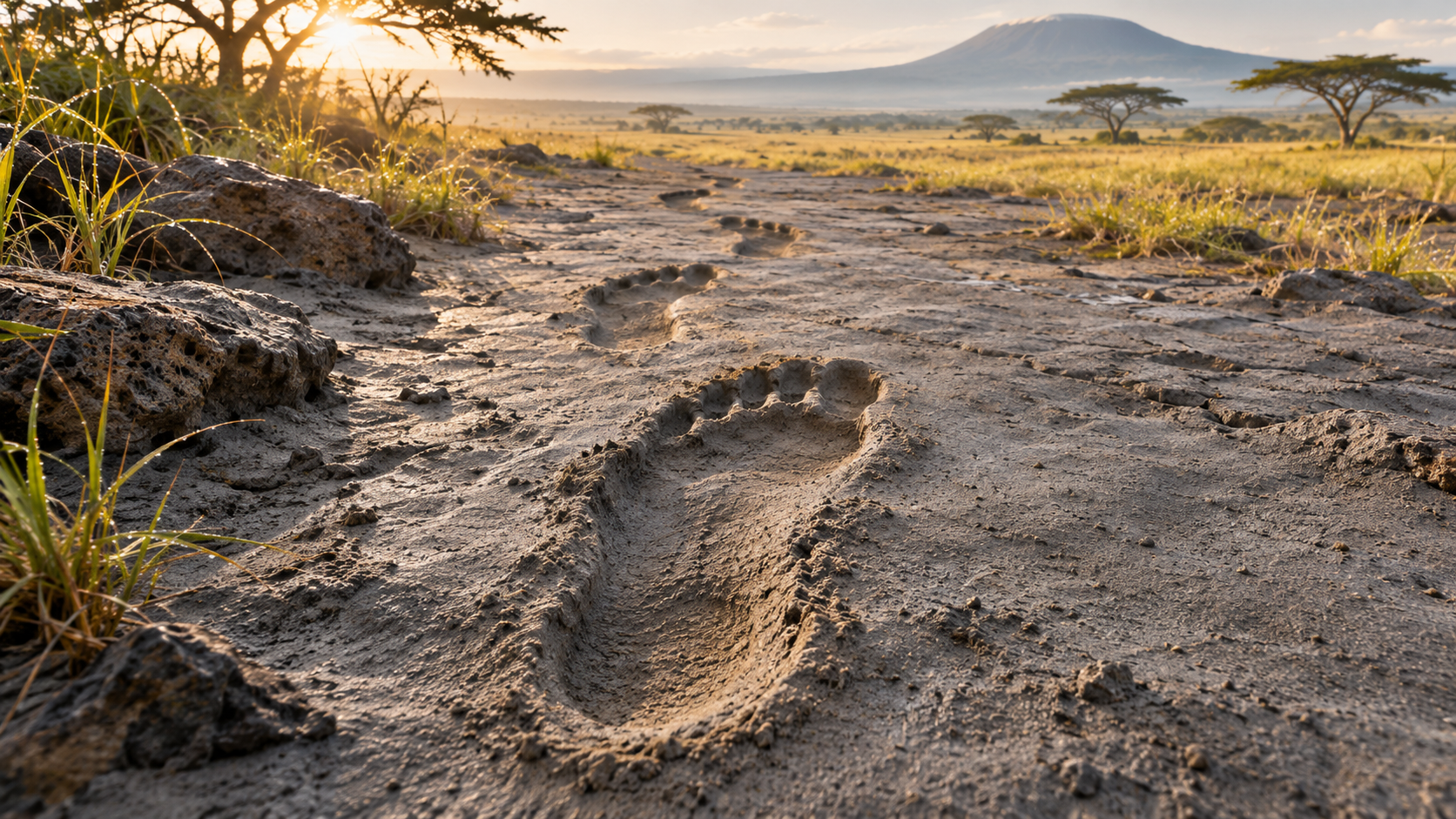
At Laetoli, in what is now Tanzania, a walker set a heel down in soft volcanic ash. The foot rolled forwards. The toes pressed into the surface and lifted clear. Another step followed, and another. You could stand beside the trail today and recognise the business of getting from one place to another. The unsettling thing is the date. Those feet crossed the ground some three million six hundred thousand years ago. Our own species appeared in Africa roughly three hundred thousand years ago. For most of the distance in time between those two events, there was already somebody on earth whose footprints you might recognise.
A history of how people lived can begin here, with an action that took a moment and almost invariably disappears. The tracks say something a skeleton alone could never say. A particular individual actually walked this way, on this piece of ground. They also introduce the peculiar order in which our history unfolded. Our ancestors and their relatives were walking upright while they still had small brains. Hands capable of grasping branches had a history far older than stone knives. Long before anyone sowed wheat or kept sheep, members of our wider family had already travelled far beyond Africa.
Follow the trail for a little while. There is no record of a destination. Nobody can say whether the walkers had eaten recently, whether water lay ahead, or what sound one might have made to get another's attention. Yet the world they occupied begins to come into focus once we ask a question modest enough for the evidence. What did it take for a creature with those feet, those hands and that particular body to get through a day?
What Could A Footprint Tell Us?
Think of the last footprints you left on wet sand. Someone coming along behind you could have worked out which way you were going. With a sufficiently long trail they could have measured the spacing of your steps and noticed where you turned. Then somebody else's footprints might have crossed yours. For a few hours a beach can hold a surprisingly intimate account of a morning. One incoming tide takes the whole account away.
At Laetoli the surface received the impressions, and material deposited over them protected their shape. The conjunction mattered. If the surface had been too hard, an animal could have crossed it without leaving a readable trace. Had the impressions been churned up or washed away before burial, the feet would have made exactly the same journey and we would have no reason to talk about it tonight. In deep history our acquaintance with an event often depends on something as ordinary as the consistency of the ground.
There is a tempting next step when several individuals leave tracks. We want to know whether they were a family. An illustration might supply a parent, a partner and a child, assign each a place in the group and turn all their faces towards a distant hill. Yet a difference in the size of two feet can have several explanations. The trail preserves the walkers' relation to a patch of earth with extraordinary fidelity. Their relation to one another belongs to a quite different order of knowledge.
Even the names we give the walkers come partly from discoveries made elsewhere. The species most often associated with the famous trails is Australopithecus afarensis. Say the name slowly once, then think of Lucy. She is the individual whose skeleton, found in Ethiopia, helped make this early relative familiar far beyond the world of fossil research. Lucy lived later than the Laetoli walkers. The two discoveries belong together because bones and footprints offer independent ways of asking how these creatures moved. They record different individuals in different places across a considerable stretch of time.
What Would It Have Been Like To Move In Lucy's Body?
Begin with a familiar balancing act. Take a step and, for a moment, nearly all your weight passes over one leg. The other foot is free to travel forwards. Repeat the movement and you can cross a room without thinking about the arrangement of your hips. For a researcher examining an ancient pelvis, that arrangement is full of information. Bones have to bear loads. Their shapes can narrow the range of movements a living body could perform comfortably and often.
Lucy and other fossils assigned to her species combine evidence of upright walking with features suited to climbing. The combination is easier to understand if you imagine the places a single individual might want to reach. A patch of food can lie at ground level. Another can hang beyond reach overhead. A creature able to move between those places has options that would disappear if either part of the landscape became inaccessible. A woodland seen from the height of a small walker has more than two dimensions.
We tend to imagine evolution by picturing one figure straightening up as a row of figures moves across a page. The picture leaves out the tree just beside the path. It also leaves out all the other creatures alive at the same time, each going about the business of feeding itself. Lucy's species existed for hundreds of thousands of years. Across that enormous span, individuals survived to maturity and raised young while possessing precisely the mixture of features that looks transitional in a modern diagram. For them it was a whole way of life.
Did they sleep in trees? It is a reasonable question to ask of an animal able to climb. The branches accessible to a small climber offer different possibilities from a place on the ground. A sleeping site also has to accommodate the body using it, and it must be possible to reach it again when light fades. Those considerations help explain why climbing ability matters to a reconstruction of the day. A skeleton alone cannot tell us which branch an individual chose, whether it built a sleeping platform, or how often a particular tree was used.
One reason to linger over such an apparently small uncertainty is that sleep takes up so much of a life. Someone writing the history of a modern household might find bills, photographs and a plan of the bedrooms. Far back in time we can have better evidence for the angle of a knee than for the resting place of the animal that owned it. There are parts of an ordinary day that become almost invisible when the people living it leave behind neither buildings nor words.
Where Would The Next Meal Come From?
Look at a tree from the point of view of a hungry visitor. A useful question is whether it bears something edible. A better question is whether that food is available today. The same tree can be a generous resource for a short season, an unprofitable detour a few weeks later, and worth remembering through all the intervening months. A creature able to find its way back when the fruit ripens has gained something valuable without changing the tree at all.
That simple observation helps restore time to the ancient landscape. Draw a map with water, shade and food marked on it and everything appears to be available at once. Walk through it and distances become a cost. Searching one place uses time that could be spent elsewhere. Eating something tough takes time too. A food that can sustain life when preferred resources grow scarce may be more important to survival than its place on a list of favourite foods would suggest.
Teeth offer an unusually direct point of contact with these questions. They are hard enough to survive when much of a skeleton has gone. Their overall form bears on what they can process. The wear on their surfaces can preserve evidence of what happened while an individual was alive. What an animal could chew and what it happened to chew in the period recorded by a tooth are related questions, and each can yield a different answer. Imagine trying to reconstruct your own usual diet from the evidence of one late supper.
Food therefore gives us one way to understand why human evolution involved so much branching. Different ways of obtaining and processing food can work in the same broad region. A creature with powerful chewing equipment and another able to open a resource with a sharp edge might solve part of the same problem in different ways. Both face costs. Growing and maintaining body tissue consumes energy. Finding a suitable stone and making an edge takes time. The balance depends partly on what the local surroundings offer.
Our nearest living ape relatives can help us frame questions about the older world. Watch how an animal handles an unfamiliar object, follows a familiar route or waits for access to food, and an apparently simple activity becomes a sequence of decisions. Living chimpanzees have continued evolving through the whole interval that separates us from our common ancestors. They have their own histories and ways of making a living. Looking at them gives us comparisons to test against the fossils. The life of our common ancestor still has to be reconstructed from evidence.
What Changed When A Stone Had An Edge?
There is a particular economy to a sharp flake. A relatively small piece of stone can bring a long, thin cutting edge into contact with a surface. Pressure applied through the hand is concentrated along that narrow edge. A task that teeth or fingers struggle to perform can become manageable. Once a useful edge is available, several different materials become candidates for cutting. The extent of the change would have depended as much on the task waiting to be done as on the stone itself.
Consider the decisions surrounding a piece of raw material. Is it the kind of rock that breaks in a useful way? Can a suitable piece be picked up nearby? Is it worthwhile to carry a heavier piece onwards in case something needs cutting later? At a place where good stone lies underfoot, a visitor can discard a used piece at little cost. The same piece may be worth carrying when the next supply is far away. A pile of stone left in one place can therefore reflect decisions made with other places in mind.
The smallest pieces can be particularly informative. A large worked object in a display case catches the eye, yet the chips detached in making it can reveal where work happened. When fragments can be fitted back together, the material sometimes lets an investigator follow a sequence of blows. Think of clearing the floor after somebody has mended a wooden chair. The finished chair might have gone home with its owner. Shavings and offcuts could still tell you which corner of the room served as the workshop.
Stone also introduces a striking distortion. Picture two activities occupying equal parts of an afternoon. One involves working a piece of rock. The other involves handling leaves or bark. Bury the remains and wait a million years. Under many conditions the stone has a much better chance of being there when someone returns. An inventory of durable finds can look like an inventory of everything the makers cared about. The difference between those two inventories includes some of the most interesting unanswered questions about their lives.
Did somebody teach the technique? Learning can take many forms. A novice can watch an experienced individual, pick up discarded pieces, try again in the same place or receive active guidance. Each route leaves different possibilities for the spread of a skill. Archaeologists can examine patterns of manufacture and sometimes the quality of particular attempts. Hearing the lesson would be another matter. A tool can demonstrate a maker's control over a material while leaving open whether the maker had words for the stages involved.
Who First Left Africa?
By the time we come to Homo erectus, the map has changed. Fossils associated with these early humans stretch from Africa into parts of Eurasia. Bodies with relatively long legs and shorter arms would have looked more familiar to a modern observer than Lucy's body. Walking overland had a long history by this time. What changes in this chapter is the geographical scale on which we can see members of our family making a living.
Imagine a map of that movement with the customary sweeping arrow removed. There are local patches of ground where a group can obtain water, food and materials. Beyond each lies another patch, which might be accessible in one season and difficult to reach in another. Moving into a neighbouring valley puts somebody beyond the edge of a previous range. Their descendants can grow up with that valley as the centre of the familiar world. After many generations, the combined distances can look like an expedition that no single traveller ever made.
A longer leg alone could never tell the whole story of that expansion. Reaching a place is only the beginning. Individuals have to survive repeated changes of season there. The resources that feed one adult must also sustain younger individuals who still depend on others. A route passable in a favourable year may close behind a group. When people talk about an early human species succeeding across a continent, they are gathering all of those local difficulties into a surprisingly small word.
Who cared for an individual who struggled to feed themselves? At Dmanisi, in Georgia, an early human skull and jaw show that an adult survived the loss of almost all their teeth. The healing of bone is what gives the find its human interest. Time passed between tooth loss and death. Perhaps the individual could find sufficiently soft food. Perhaps others helped. The possibility of care deserves attention precisely because the evidence is so specific about the difficulty and so quiet about the solution.
Consider what help could mean at the scale of a meal. It might take the form of access to a resource that one individual could reach more easily than another. Someone could leave a more manageable portion within reach. Nothing in the jaw identifies a helper or tells us what obligations existed within the group. What it does establish is that a serious change in the individual's ability to chew could be accommodated for a time. That small interval of survival belongs in the story alongside the great distances travelled by the species.
When Did Somebody Become The First Of Us?
If you could travel far enough back and stand beside successive generations of your ancestors, it would be difficult to find a morning on which the new species announced itself. A child belongs to the same living community as its parents. Over very many generations the distribution of inherited characteristics can change, especially when populations spend long periods apart, encounter different surroundings or come back into contact. Researchers looking across great intervals can recognise differences that would have been imperceptible from one generation to the next.
The name Homo sapiens gathers together our own species and the early people whose remains researchers assign to it. The earliest part of its known history lies in Africa. Think of the scale of that statement. Africa contains deserts, coasts, mountains, forests and grasslands. Rain and temperature have changed the connections between those environments over time. Saying that our species emerged in Africa gives us a continent and a deep history. It leaves a great deal to learn about the populations and places involved.
It also leaves open a question people often bring to the subject. When would we have recognised somebody as a person like ourselves? A skull can tell us about the shape of a face. A worked object can show a sequence of skilled actions. Recognition across a living encounter would involve things fossils preserve poorly. A familiar gesture could bring a face suddenly to life. A voice might tell you that a sound you had taken for background noise was directed at you. We should be careful about drawing the boundary of an inner life at the point where its traces become easy for us to recognise.
For part of their history, members of our species shared the earth with other kinds of humans. Among them were Neanderthals, whose remains have been recovered across parts of Europe and western Asia. Genetic evidence has introduced a degree of intimacy quite beyond what a map of overlapping ranges could establish. Some encounters produced descendants. Pieces of that ancestry survive in people living today. A family tree drawn with neat, permanently separate branches needs a way to show occasional connections between them.
This changes the tone of the familiar question about which group won. A named population can disappear as a distinct population while part of its ancestry passes into another. A technology can travel in a different direction from a particular line of descent. An encounter can have profound consequences for later generations while leaving little evidence of how it felt to the people involved. For those people the immediate concerns may have been as local as they were at Laetoli. Who else uses this ground? Where is the water? Can we stay here tonight?
Where Shall We Spend The Night?
The last question brings us back to the scale of an ordinary life. Over the immense interval from the Laetoli walkers to early members of our species, bodies, tools and ranges changed. Yet every individual in the story occupied just one place at a time. Darkness fell locally. A place to rest had to be chosen with the resources and knowledge available there. What looks to us like a turning point between great eras must have been experienced through particular feet, hands, mouths and eyes.
Think once more of the ash and of the extraordinary good fortune that kept those impressions legible. A foot presses down and for a fraction of a second the surface yields. The next stride takes its maker away. The trail brings us as close as we are likely to come to keeping pace with that individual. Farther along in time, a different kind of site will let us approach another part of the day. There the remains include material that people carried to a chosen spot, worked with, ate beside and left behind when they went away.
That is where we can sit down for the next part of the story. The journey for the day is over. Somebody has brought back food. There is a place to put it and work still to be done before anyone sleeps. What would an evening in a community of hunters and gatherers actually have been like?
Sources
Smithsonian — Laetoli footprint trails — Walking upright in eastern Africa.
Smithsonian — Australopithecus afarensis — Lucy and the evidence for climbing and walking.
Smithsonian — D3444 — Survival after extensive tooth loss at Dmanisi.
Smithsonian — Homo sapiens — The origins of our species.
Next Reads
Did Humans Evolve From Water? — How fossils help test ideas about the evolution of upright walking.
What If Neanderthals Survived Into The Modern World? — How the genetic legacy of other human populations frames a counterfactual.
Sapiens Summary: How One Species Learned to Rule Reality — A book-length interpretation of the emergence of our species.
