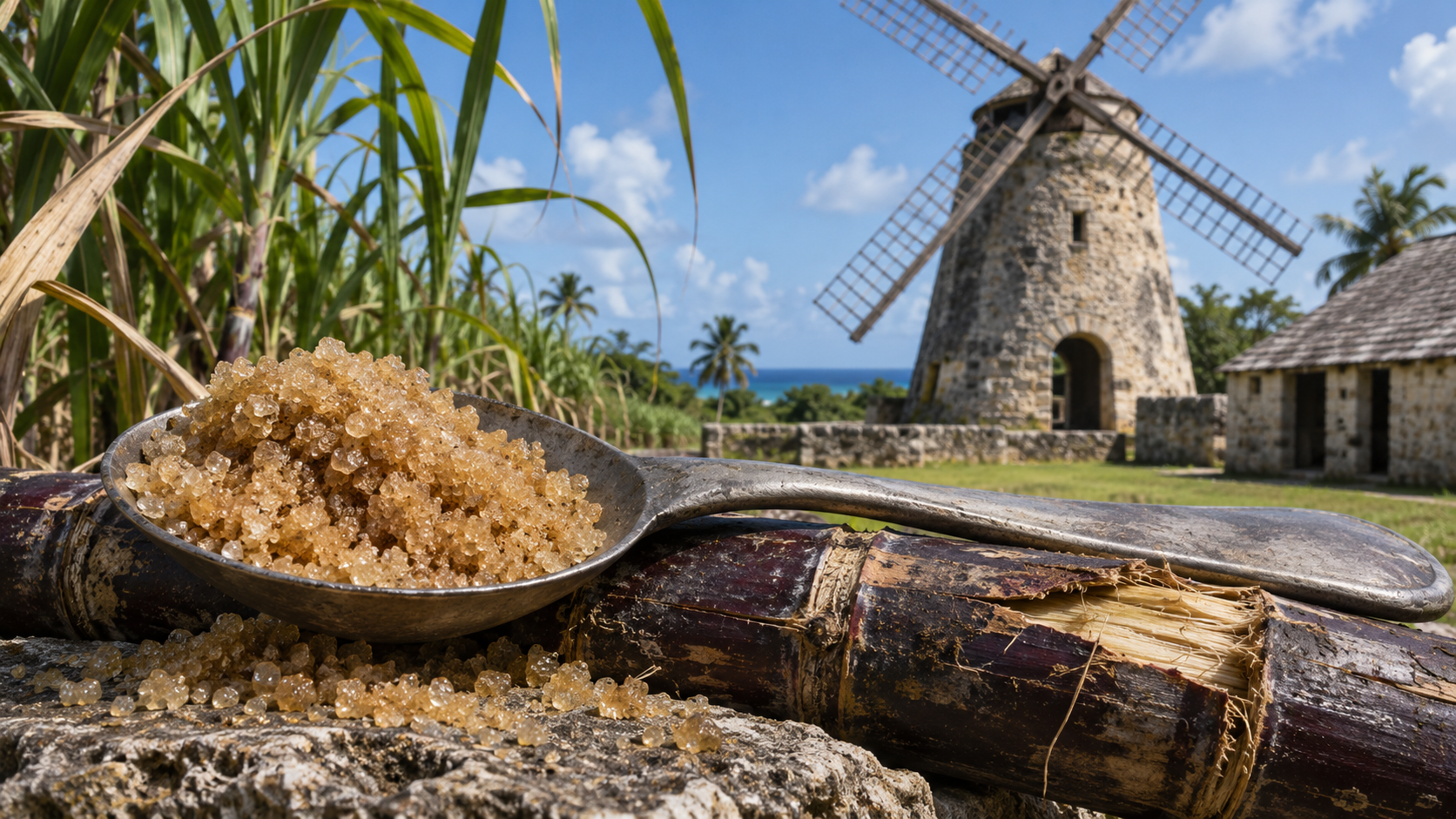
A Name In A Sugar Plantation Ledger Belonged To A Whole Life.
On the island of Barbados, somebody made a list in eighteen twenty eight of the people enslaved at Newton plantation. The document gives names and occupations. It belongs to a collection containing the kinds of records a business keeps about its affairs. There are accounts concerning livestock, money and sugar. Yet the people on that list each knew a world of which the columns offer scarcely a glimpse. Each had a history before the writer entered a name. Each had relationships whose value could never be measured by the work done for the estate.
How did the Atlantic become the centre of a new economy? Ships connected existing American, African and European worlds. Conquest and colonial rule determined who could claim land. Enslavement allowed owners to demand labour and profit from the sale of people and their children. Crops, animals, knowledge and disease crossed the ocean along with goods. To see what this changed in a day, we can follow something small enough to dissolve on the tongue. A spoonful of sugar linked somebody eating breakfast in Britain to people whose own time and meals were controlled on the other side of the sea.
Who Was Already At Home In The Americas?
The ocean crossing of fourteen ninety two takes on a different significance depending on which shore you stand. For the Europeans setting out under Columbus it was an uncertain voyage west. For the Indigenous peoples of the Caribbean, European arrival brought foreigners into a region already connected by its own routes. Islanders knew how to travel by canoe, obtain food from land and water and exchange things with neighbours. The shore at which the ships arrived was somebody's familiar place.
Consider the practical skill involved in feeding a household from local crops. Cassava can supply substantial food, but some varieties require careful processing to make them safe to eat. That knowledge consists of sequences of actions, tools and judgements passed between people. To an unfamiliar visitor the visible result might simply be a meal offered ashore. To its makers the meal embodied generations of experience. Encounter brought together people who understood very different things about the ground under their feet.
Farther west and south there were cities, intensive agricultural systems and states with long histories of expansion and conflict. In central Mexico, Tenochtitlan stood in a lake landscape connected by causeways and boats. In the Andes, routes linked communities at vastly different elevations. Describing all the inhabitants of the Americas as one side of a meeting erases differences that mattered immediately. Communities possessed their own rivals, alliances and reasons to distrust powerful neighbours. Those differences shaped how Europeans were received and what happened to the states they encountered.
Why did relatively small European expeditions win some consequential victories? Their weapons and animals mattered, but Indigenous allies supplied essential numbers, knowledge and political opportunities. Epidemic disease could devastate populations already dealing with warfare and the disruption of food supplies. The timing varied from place to place. A local leader deciding whether to support strangers acted in a particular set of circumstances. Knowing the later reach of colonial power gives us an advantage that none of the people making those early decisions possessed.
What Happened To A Household When Disease Arrived?
The introduction of pathogens across the Atlantic had catastrophic consequences in many American communities. Smallpox was among them. The harm extended beyond the people who died from an infection. A crop needs attention at particular moments. Children and sick relatives require care. When many people fall ill in a short interval, a household can lose both the person who knows what needs doing and the hands available to do it. The calendar carries on even as the capacity to meet it collapses.
A death can remove knowledge that seems almost impossible to put into a formal inventory. Which part of a field retains moisture longest? Who can be trusted to help after a poor season? Where does a household have a claim through a relative who lives elsewhere? Such things can be known by more than one person and still be vulnerable to sudden loss across a whole community. The consequences of an epidemic therefore reach beyond a count of deaths into relationships that made recovery possible.
Conquest added pressures of its own. People could be displaced, compelled to work for newcomers or prevented from using familiar land. Food removed from a community becomes unavailable to sustain its members through illness. Crowding or forced movement can alter the conditions in which infections spread. Separating each cause on paper helps explain its mechanism. In a particular life those causes could arrive together, which is one reason a single numerical explanation for the fate of an entire continent is so inadequate.
Survival deserves as much attention as loss. Indigenous communities maintained and adapted languages, knowledge, identities and claims to land across the centuries that followed. A map coloured according to the European power claiming a territory can hide the continuing presence of the people whose ancestors lived there. A colonial official's account of a crop or a route may rely on knowledge supplied by someone whose name the official never recorded. Reading those records requires attention to whom the writer depended upon.
How Did A Plant Cross An Ocean?
A sack of food and a supply of planting material make different journeys. The food need only reach someone who can eat it. A crop that is to take root in another region must arrive in a condition that allows propagation, reach suitable ground and find people willing to invest effort in learning what it needs. It must also find a place in local kitchens. Familiar ways of cooking can change, but a plant that grows well has only met part of the challenge.
Maize, potatoes and cassava were among the American crops that spread far beyond their places of origin. Their different characteristics helped them enter different environments. A tuber grown underground presents different opportunities and risks from grain ripening above it. A food suited to one altitude or rainfall pattern may struggle in another. Growers experiment, exchange planting material and retain varieties that suit their circumstances. An arrow crossing an ocean can stand for centuries of local decisions made after a seed or tuber reached land.
Movement also ran westwards. Europeans brought livestock and crops that altered the use of land in the Americas. An animal introduced to a new environment can spread beyond the boundaries intended for it. Land used for grazing may previously have supported crops or resources important to others. People with authority to recognise one form of ownership and dismiss another can turn an ecological change into dispossession. Animals and plants were biological participants in an encounter whose terms people also shaped through force and law.
It is possible to taste these movements in a familiar meal. A potato on a European table or cassava in parts of Africa has become thoroughly local through repeated cultivation and cooking. The long journey has almost disappeared into habit. What disappears with it can be the work of the original growers who domesticated the plant, the later growers who adapted it and the cooks who made it welcome in a new home. An ordinary dish contains as much human ingenuity as many objects kept under museum glass.
Why Did Sugar Take Up So Much Land?
Cane offers a crop whose sweetness can be concentrated into a product worth sending a long way. The plant is bulky. Cutting begins a race to process it efficiently. Juice must be extracted and concentrated, requiring a mill, fuel, equipment and skilled attention. Production rewards coordination between people working in the field, those moving the cane and those processing it. A pause at one stage can reduce the return on labour already expended elsewhere.
In Barbados, investors and planters developed a highly valuable sugar industry. Access to capital mattered because a mill and processing facilities cost money before a crop could repay it. Access to ships and commercial contacts mattered because the estate produced for export. The colonial order protected owners' claims to land and to the labour of enslaved people. This combination allowed an owner to direct work on a scale and under conditions that the people doing it could not freely refuse.
What would the harvest calendar mean to an enslaved household? An estate organised for rapid processing has strong incentives to demand labour when the cane is ready. A person might also need to prepare food, care for a child or tend a patch on which a household depends. Those tasks do not become less necessary when the estate claims more of the day. The ability of one party to determine the timetable places the cost of competing needs on the people who have the least power to rearrange it.
Imagine two clocks measuring the same working day. One measures time from cutting to processing and counts delay as a possible financial loss. The other measures time since a person last rested, ate or attended to a family member. A plantation account can be exceptionally detailed about the first clock. The surviving list at Newton makes a beginning towards seeing the second by giving us people with particular work to do. Their individual days extended well beyond the headings under which someone entered their names.
How Did People Come To Be Enslaved Across The Atlantic?
European and American traders participated in systems that took captive Africans to the Americas by force. African states, merchants and intermediaries played different roles in obtaining and selling captives. Other communities were raided, fought to protect themselves or suffered the loss of members through conflict and kidnapping. Africa contained many political worlds. To compress all of them into one actor would conceal the difference between somebody profiting from a sale and the person being sold.
Forced movement often began far from the sea. A captured person might be taken through unfamiliar places before reaching the coast. They could lose contact with family without anyone at home learning where they had gone. At embarkation the constraints became more severe. Slave ships confined large numbers of people under conditions that produced sickness, suffering and death. Survivors faced sale and further separation. Each purchase recorded as a transaction by the buyer represented a loss of authority over one's own movements for the person bought.
Shipping records let researchers reconstruct much about the traffic. They can identify ports, vessels, dates, departures and arrivals, and sometimes numbers embarked or disembarked. Coverage varies and some totals require estimation. The records preserve the categories their makers considered important. A captain could record a death without giving the person's name. Descendants seeking a particular ancestor can therefore confront a painful imbalance. A great deal may be known about the ship that carried somebody across the ocean while very little can be established about the identity that person carried aboard.
How did a shipowner calculate returns? The calculation included the expense of acquiring and outfitting a vessel, the terms on which capital was raised, the prices received and the risks of the voyage. Commercial records can make the enterprise seem impersonal because they are written in units of account. The capacity to price an enterprise in this way rested on the prior legal and political decision to treat human beings as saleable property. The columns make the system legible to its investors while obscuring what participation meant to its captives.
What Did People Make Of The Hours They Could Claim?
An enslaved person's day encompassed far more than work performed at an owner's direction. Food had to be obtained and prepared. Friends and relatives maintained attachments under conditions that could disrupt them without warning. People carried knowledge of crops, craft, language, music and worship into the places where they were compelled to live. New cultural practices arose as people from different backgrounds made lives together. The conditions imposed on them influenced what was possible. The creativity belonged to the people themselves.
On Caribbean plantations, the provision of food varied considerably. Enslaved people in some places cultivated food on provision grounds or obtained part of their diet through other forms of production and exchange. A plot can provide room for expertise, preference and household cooperation. It can also allow an owner to shift the labour of feeding the workforce onto people whose time the estate already claims. Both facts can be true of the same piece of ground. The decisive question is how much control its cultivators had over the hours and resources available to use it.
A meal assembled under those conditions can carry a history that estate accounts barely register. Someone knows how to prepare a root or stretch a limited ingredient. Another person obtains something useful through exchange. A child learns a taste or technique that will later feel inseparable from home. Small continuities matter especially where the power to maintain a household is insecure. They are also difficult for historians to recover in detail without oral traditions, material evidence and records made from perspectives beyond the estate office.
What did resistance look like in ordinary life? It included escape, organised revolt and the creation of independent communities by people who escaped slavery. It also included efforts to preserve relationships and make claims over time and movement against the demands of owners. Individual motives can be difficult to recover. A surviving description of disputed work may tell us more about an overseer's interpretation than about the worker's intentions. It is worth preserving that uncertainty while recognising the much larger fact that enslaved people continually contested the terms of the system.
Who Benefited At The Other End Of The Voyage?
By the time a portion of sugar reached a household in Britain, several transactions might have intervened between the buyer and the people who produced it. Shipping, finance, refining and retailing each employed people and created opportunities for profit. The customer could make a purchase without knowing the estate of origin. That distance allowed an intimate daily habit to depend on working conditions the consumer never witnessed. It also made the sugar bowl a place where campaigners could ask consumers to think about their part in the trade.
A dockworker unloading a ship occupied a different position from an investor receiving profits. A worker might depend on employment from a trade while receiving little of the wealth accumulated by its owners. Creditors could have claims on estates they never visited. Goods made in one region were exchanged in another. The resulting economy resembled a web with many participants and unequal shares of influence. The familiar triangle drawn in schoolbooks represents a set of crossings, but real ships, cargoes and payments followed more varied routes.
How far did Atlantic slavery contribute to Britain's industrial growth? The connections are visible in ports, finance, consumer markets and above all the supply of raw cotton to textile manufacturers. Turning all those connections into one precise percentage or a single indispensable cause is much harder. Britain also possessed coal, engineering traditions, domestic markets and institutions that shaped industrialisation. Explaining a particular mill's demand for fibres from enslaved labour gives a firmer starting point than trying to settle every question about national growth with a single claim.
The connection became particularly clear as mechanical spinning and weaving increased the amount of cotton British mills could process. A machine in a British town could enlarge demand for raw material produced by enslaved people across the ocean. Mechanisation in one place could coexist with intensified forced labour in another. A worker listening for a factory bell and an enslaved worker cultivating cotton lived under different labour systems. The material travelling between them linked the conditions of their days.
How Did People Obtain Their Freedom?
Abolition had many histories. Enslaved people forced change through resistance, flight, negotiation and revolution. Free people of African descent, formerly enslaved writers, religious groups, organisers and legislators participated in campaigns whose aims and methods varied. In the French colony of Saint Domingue an uprising became a revolution that culminated in Haitian independence in eighteen oh four. People whom the plantation system had made central to its wealth overturned slaveholding rule and established a new state.
Ending the legal trade in enslaved people and ending slavery itself were distinct changes. A law preventing one country from carrying captives across the Atlantic could coexist with continued enslavement in its colonies. Emancipation could be followed by compulsory labour arrangements, restrictions on movement or severe limits on access to land. The moment a law changed mattered enormously. What freedom meant in the working week depended on whether a person could leave, choose employment, keep a family together and obtain the means to live.
Return to the date of the Newton plantation list. In eighteen twenty eight slavery still existed in Britain's Caribbean colonies, despite Britain's earlier abolition of its transatlantic slave trade. The list therefore records people who could be assigned occupations within an estate years after the British trade had been outlawed. Later records of sugar and wages belong to a changed legal setting. The physical continuity of fields and buildings across those changes is one reason the specific rights of the people working there deserve close attention.
What Does A Spoonful Weigh?
On a kitchen scale the answer is straightforward. In the history of an Atlantic household the answer depends on whose hand holds the spoon. A buyer pays a price. A merchant considers a margin. Someone working on an estate measures the crop in hours spent cultivating, carrying and processing it. A name in a ledger can connect us to that last person, although the ledger was designed for someone else's purposes. Reading it with care begins with recognising the extraordinary difference between an occupation entered on a line and a life.
The ocean joined older worlds and helped create new ones. Foods travelled and took root. Communities rebuilt after catastrophic loss. States grew rich through coercion, and people deprived of freedom fought to regain it. Even the quietest breakfast could draw on all these histories at once. Beyond the sugar bowl there is another ordinary object that will carry the story forward, a length of cotton cloth whose price, texture and place in a household were about to change.
In a valley in Britain, water is being directed towards a mill. The building needs workers to arrive while the machinery is ready to run. A bell carries farther than a voice. For someone still at home when it sounds, the working day has already begun.
Sources
Barbados Museum and Historical Society — Slavery and Remembrance — The Newton plantation list and surviving estate accounts.
Library of Congress — 1492: An Ongoing Voyage — Life in the Americas and the consequences of sustained contact.
SlaveVoyages — Trans-Atlantic Slave Trade Database — Voyage records and reconstructions of forced Atlantic crossings.
UNESCO — The Industrial Heritage of Barbados — Sugar production and the plantation landscape.
Next Reads
Jamaica Takes Slavery Reparations Fight Directly to King Charles in Historic Legal Challenge — How the legacy of Caribbean slavery enters present-day reparations debates.
What Sparked the Industrial Revolution? — How overseas trade and raw materials supported industrial expansion.
The East India Company: How A Trading Business Acquired Territorial Power — How commercial interests became entangled with colonial government.
