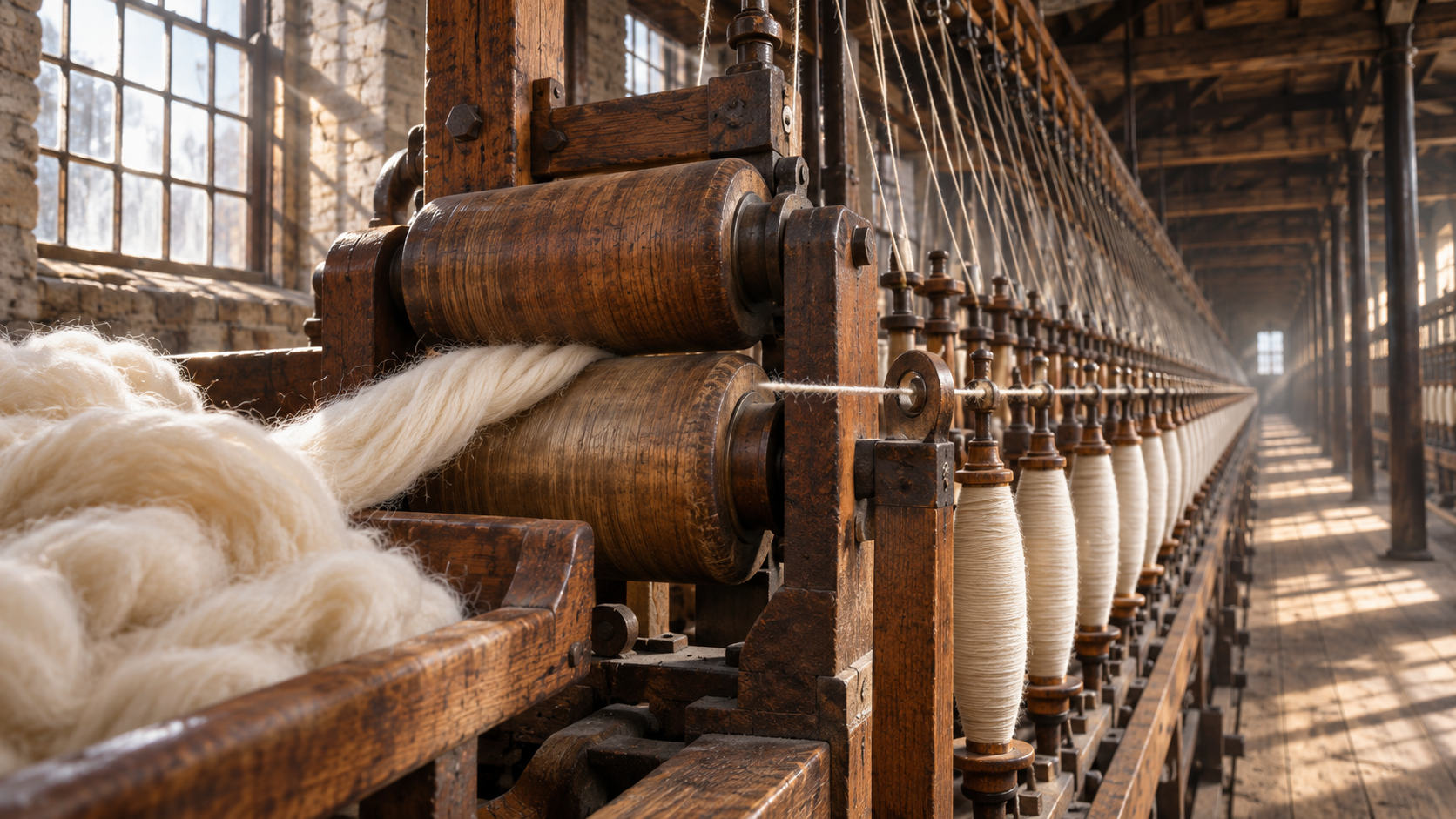
A River Could Set The Time In A Child's Bedroom.
At Quarry Bank in Cheshire there is a house built for children who worked in a cotton mill. The mill is close by, where the River Bollin offered power to turn machinery. Look at the two buildings together and a chain of decisions becomes visible. The river helped determine where the mill stood. The mill required workers within reach. Bringing children to live nearby put their meals, sleep and labour into a timetable organised around machinery. Water moving through a valley had become one of the things that determined when a child had to get out of bed.
Britain industrialised early through a combination of skilled work, markets, capital, access to energy, overseas trade and political power. No one of these explains the timing on its own. The changes happened unevenly, first in particular industries and places. Cotton spinning offers a way into the story because we can follow the material through almost every scale of a life. A fibre grown across the ocean went through workers' hands in Britain, entered a shirt and ended up next to the skin of somebody who might never see a mill.
What Took So Long About Making Cloth?
Take a small piece of cotton cloth between your fingers and look at its edge. There are threads crossing other threads. Before weaving could begin, somebody had to produce a great length of reasonably consistent yarn. Short fibres have to be drawn out and twisted so that they hold together. Too much variation makes the yarn difficult to use. A thin or weak spot can break at an inconvenient moment and interrupt another person's work. Consistency therefore has value at more than one stage of manufacture.
For a person spinning by hand, experience lives in the fingers. The hand judges the amount to draw and the twist needed to make it hold. The person can adapt to a change in the material with very little apparent interruption. A machine that repeats a movement has to confront the same variability in another way. It needs the fibres prepared suitably, the parts adjusted and a worker able to notice when the process begins to go wrong.
A new method can create a difficulty elsewhere simply by doing its own job well. Speed up weaving and the supply of yarn can become a constraint. Increase spinning capacity and more raw fibre must be obtained, prepared and brought to the machinery. More cloth must find buyers if the investment is to pay. The sequence of inventions often taught through surnames and dates makes better sense once these dependencies come into view. The introduction of one productive machine changes which problem is worth spending money to solve next.
There was already a market for desirable cotton fabrics before British mills expanded. Indian producers had long made cloth admired and traded across great distances. British manufacturers entered a world in which people already understood the comfort, appearance and uses of cotton. Commercial ambition, imitation and competition influenced what producers tried to make. A British factory is one chapter in a much longer global history of textiles, and that earlier history helps explain why an investor could expect buyers for a large output.
Why Build A Factory Beside A River?
A spinning wheel in a house can use the movement of one person's body. A roomful of machinery needs a more substantial and coordinated source of motion. Falling or flowing water can provide it. A wheel takes energy from the movement of water and transmits rotation through connected parts. Shafts and other mechanisms carry that motion to the places it is needed. Concentrating machines in one building allows several processes to draw on the same source. Once the wheel is turning, trouble at one connection can interrupt work farther along.
A useful site needs more than a river name on a map. The available flow, the change in height and the means of directing water towards machinery all matter. Seasonal variation affects how much power is available. Flooding can damage the installation. Engineering that improves reliability can be worth a considerable initial expense. A stream that looks unremarkable to a passerby might present an excellent opportunity to somebody who understands how to use a particular fall of water.
The Derwent Valley in Derbyshire preserves mills, workers' housing and a landscape altered to make industrial production possible. At Cromford, Richard Arkwright and his associates put water powered cotton spinning into large scale operation. The buildings make a simple fact visible. Once an expensive system of power and machinery occupies a particular spot, it is much easier to bring workers to that spot than to take the machinery from house to house. An industrial settlement begins to grow around the cost of moving things.
But a good water site can lie at a distance from a large workforce. Providing housing, attracting families and arranging for young workers to live close to the mill became part of the business of making yarn. The mill owner acquired an interest in activities that might otherwise have seemed entirely domestic. Whether workers could reach the building at the required time mattered to the return on machinery. The layout of a village could become part of the organisation of a working day.
What Changed When Everybody Had To Arrive Together?
Time had disciplined people long before the factory. A tide will not wait for a fishing boat. A ripe crop has a limited harvest window. Markets and religious observance already brought people together at appointed times. What the factory did in particular was synchronise many people's work with machinery owned and directed by someone else. An individual late to begin could affect a process involving colleagues whose own arrival had been perfectly punctual.
Imagine a family preparing for a shift. Someone must wake early enough to light a fire, organise a meal and reach work. If several people work at different tasks, the person responsible for the meal has to accommodate the others' deadlines. Clothing soaked through the day before still has to be made wearable. A delay caused by illness or a child needing attention can follow a worker through the gate as lateness. The employer sees the time of arrival. The household knows what it took to get there.
A bell carries the demand beyond the building. It can reach people who own no clock and make the hour of work public. A clock face or factory rule appears to apply equally to everyone. The ability to obey it comfortably is unequally distributed. Someone living near the entrance has a shorter journey. Someone caring for another person may already have put in a considerable amount of work before the paid day begins. The common starting time hides those differences.
What happens during a stoppage? The owner has capital standing idle. The worker may face uncertainty over earnings or be directed to other tasks. A broken part can reveal just how many people's activities depend on a mechanic who knows the machine well enough to repair it. In a household workshop an experienced worker may combine several responsibilities. In a factory the division of work makes each person dependent on more people whose tasks they may never have learned.
What Was It Like To Be An Apprentice Child?
At Quarry Bank the Apprentice House was home to children whose labour formed part of the workforce. Pauper apprentices could be sent from institutions responsible for poor children. Their arrangements differed fundamentally from those of an adult deciding whether to seek paid employment at the mill. The children lived under supervision and had limited control over where they worked or when they could leave. The building in which they rested belonged to the same system that governed their working hours.
Consider the distance from familiar people. A child moving away from an institution or community might have little opportunity to see somebody who had known them earlier. Learning the rules of the new household and learning the requirements of the mill could take place at the same time. Other children might become sources of practical knowledge and company. The surviving rules, buildings and medical records illuminate conditions of life. The friendships and private interpretations formed in the dormitories are harder to recover.
Why employ children? Some tasks could be allocated to young workers, and employers had strong financial incentives to obtain labour on favourable terms. Families relying on earnings from several members could have their own reasons for children to work. An apprenticed child sent under an institutional arrangement occupied a different position again. A broad statement about child labour can hide variation in bargaining power, payment, age, housing and the possibility of seeking help if something went wrong.
The Factory Act of eighteen thirty three placed restrictions on child employment in much of the textile industry and established inspectors. Legislation gave reformers a means to challenge conditions that an individual child could scarcely influence. Effective protection still depended on determining ages, knowing when and where a child was working and obtaining trustworthy information about hours. A rule written in Westminster had to be made effective inside buildings whose owners understood their operations far better than an occasional visitor could.
The most telling question about a limit on working time is what somebody can do with the hour released. It might become an hour of education, rest or family life. It might be absorbed by travel or other unpaid tasks. The family might lose part of the income it depended on. None of those complications cancels the value of protecting a child from excessive labour. They explain why reform of working hours intersected with education, wages, poverty and the availability of support beyond the factory.
Why Did Coal And Steam Matter If Water Already Worked?
A waterwheel ties production to a usable flow. A steam engine changes the geographical calculation. Fuel can be brought to a site selected partly for access to workers, markets and transport. Coal contains energy accumulated over geological time. Burning it makes heat available when required, provided the fuel keeps coming. Turning that heat into useful mechanical work required engines, engineering skill, maintenance and enough demand to justify the cost.
Coal was present in more than one country. Its importance in Britain depended partly on where deposits lay in relation to users and how cheaply fuel could be moved. Coal is heavy. A seam with expensive access to markets can be commercially less attractive than a more conveniently placed supply. Water transport, canals and eventually railways changed those costs. The price that matters to a mill is the price at the point of use, after the work of extraction and transport has been paid for.
Mines presented problems of their own, including water underground. Engines used for pumping had a practical early application where fuel might be available close at hand. Improvements in engines created uses farther from the original setting. Better engineering could reduce the amount of fuel required to obtain a given amount of work. New applications in turn rewarded further improvements in the production of components, the skill of mechanics and the organisation of maintenance.
Steam also shifted where some of the inconvenience of production fell. Fuel had to be mined and transported. Burning it produced smoke in places where people lived and breathed. The cost visible in a manufacturer's accounts might exclude much of the cost borne by neighbours who washed soot from a sill or lived with polluted air. Cheap energy at the point of purchase could come with burdens distributed across a much larger population and, through accumulated emissions, across a much longer span of time.
Did A Machine Make The Worker More Skilled?
The answer depends on the worker and the task. A machine can take over a movement that once required years of practice. It can create demand for someone who sets up, maintains or repairs equipment. A person monitoring several operations has to decide which needs immediate attention. A worker whose role is narrowed to a single repetitive action can lose control over the pace and variety of the day. All these changes can occur within the same industry.
Take the small event of a thread breaking. Somebody needs to notice, know how to restore continuity and do so without losing more time or material than necessary. Repeated experience can make the judgement rapid and almost invisible to an observer. Calling the process automatic because machinery supplies the motion overlooks the attention that holds the process together. Calling every worker a master craftsperson would equally obscure real changes in autonomy and training.
The machine also belongs to somebody. A hand tool a worker owns can travel with its owner. A large installation in somebody else's building places the worker in a different position when negotiating pay or deciding where to work. Skills may remain portable while the opportunity to use them depends on access to expensive machinery. Employers face dependencies too. Losing workers who understand the peculiarities of an installation can reduce output even if the machinery itself remains untouched.
Workers responded collectively as well as individually. Disputes over wages, hours and the introduction of machinery were often arguments about who would gain from increased productivity and who would bear disruption. Someone whose livelihood disappears may understand the machine perfectly well. The prospect of cheaper cloth in another household offers little immediate help in paying for food. Over time unions, political campaigns and regulation helped change the conditions under which industrial work was organised.
What Difference Did The Factory Make At Home?
A wage arriving regularly can make some planning easier while creating dependence on work continuing. A family may obtain food, rent and fuel through cash payments timed differently from wages. If illness prevents work, the need for food continues and the need for care may rise. Savings, relatives, neighbours or organised forms of assistance can matter greatly during a short interruption. Two families receiving similar wages can have different degrees of security because their obligations and reserves differ.
Industrial towns brought households close together. Proximity could offer access to shops, neighbours and employment. Rapid growth could also overwhelm arrangements for water, waste removal and decent housing. A dwelling offered at a price a worker could afford might be close to polluted water or have too little room for the number of people needing shelter. An urban wage can be higher than a rural income while urban rent and food consume much of the difference. Comparisons of living standards have to follow money all the way into the household.
Cloth itself changed the domestic calculation. When fabric becomes cheaper relative to income, replacing or buying an item may become possible for more households. Quality and durability still matter. Washing, drying and repairing clothing consume time regardless of how quickly a factory produced the original yarn. A reduction in purchase price can alter habits of dress and expectations of cleanliness while leaving somebody with considerable additional work to maintain them. The labour saved in the mill and the work done at home belong to different accounts.
The effects extended far beyond Britain. British manufacturers sold into markets where other producers had established livelihoods. Imperial policy shaped the terms of competition. The growth of demand for raw cotton bound industrial output to slavery in the United States and to other growing regions. A change in supply on one side of the Atlantic could leave British workers without enough material to keep a mill running. People whose daily routines seemed entirely local had become vulnerable to events they could neither see nor control.
Why Britain, And Why Then?
Several explanations can be true at different scales. A particular inventor needs an engineering problem worth solving and people willing to support experiments. An investor needs a credible market. A factory needs power, material, labour and a workable route to customers. A country can possess abundant coal without having all those conditions in the same regions at the same time. Where they did come together, each successful investment could make the next one more attractive.
Wages and energy prices affected which inventions were profitable. An expensive machine that reduced labour requirements made more commercial sense in some settings than others. Improvements in transport altered the balance again. The importance historians assign to relative prices, scientific culture, empire, trade and institutions differs because they ask partly different questions. Explaining the first commercial success of a particular spinning technology calls for a narrower account than explaining how industrial production spread across an economy.
Perhaps the most useful correction to a short answer is to change the scale once more. Britain did not wake one morning and choose steam power. Quarry Bank began with water. Domestic production and factory work overlapped for a long time. A household in one region could continue familiar work while another family's entire schedule changed around a new mill. Industrialisation describes the accumulation and spread of such changes. The factory bell sounded at a particular place and hour before it became a symbol of an age.
When The Bell Fell Silent
At the end of a shift somebody still had to go home and arrange the rest of the day. A child needed rest. A garment needed washing. A fire required fuel. The hours claimed by a factory were counted because keeping track mattered to the people who owned and worked in it. The care that made it possible for somebody to return next morning was much less likely to appear in the same account. The Apprentice House at Quarry Bank preserves an unusual physical connection between those parts of life.
Across the next generations, networks of power, water, transport and information would reach deeper into households. A distant generating station could light a room. News spoken into a microphone could arrive in a kitchen while somebody made breakfast. A public decision about sanitation could affect whether a child grew up with safe water at the tap. Some households would obtain those advantages decades before others. The history of the modern home lies partly in the distance between an invention and the day somebody can actually use it.
For tonight the water is still passing the mill. The wheel might be stopped for maintenance while the river goes on. Inside a nearby bedroom, sleep takes its own time. Tomorrow another sound will reach us indoors. Somebody will turn a dial, a voice will rise through the quiet, and an event on the other side of the world will become part of the morning.
Sources
National Trust — Quarry Bank — The mill and the Apprentice House.
UNESCO — Derwent Valley Mills — Water-powered manufacturing and workers’ housing.
UK Parliament — The 1833 Factory Act — Child employment restrictions and inspection.
Science and Industry Museum — Textiles Gallery — The global cotton trade and Manchester manufacturing.
Next Reads
What Sparked the Industrial Revolution? — A wider account of the causes behind mechanised production.
The Radium Girls: The Factory Workers Who Fought Radiation Poisoning — A later generation of factory workers challenged the costs of industrial labour.
The East India Company: How A Trading Business Acquired Territorial Power — How imperial commerce connected British consumers and producers overseas.
