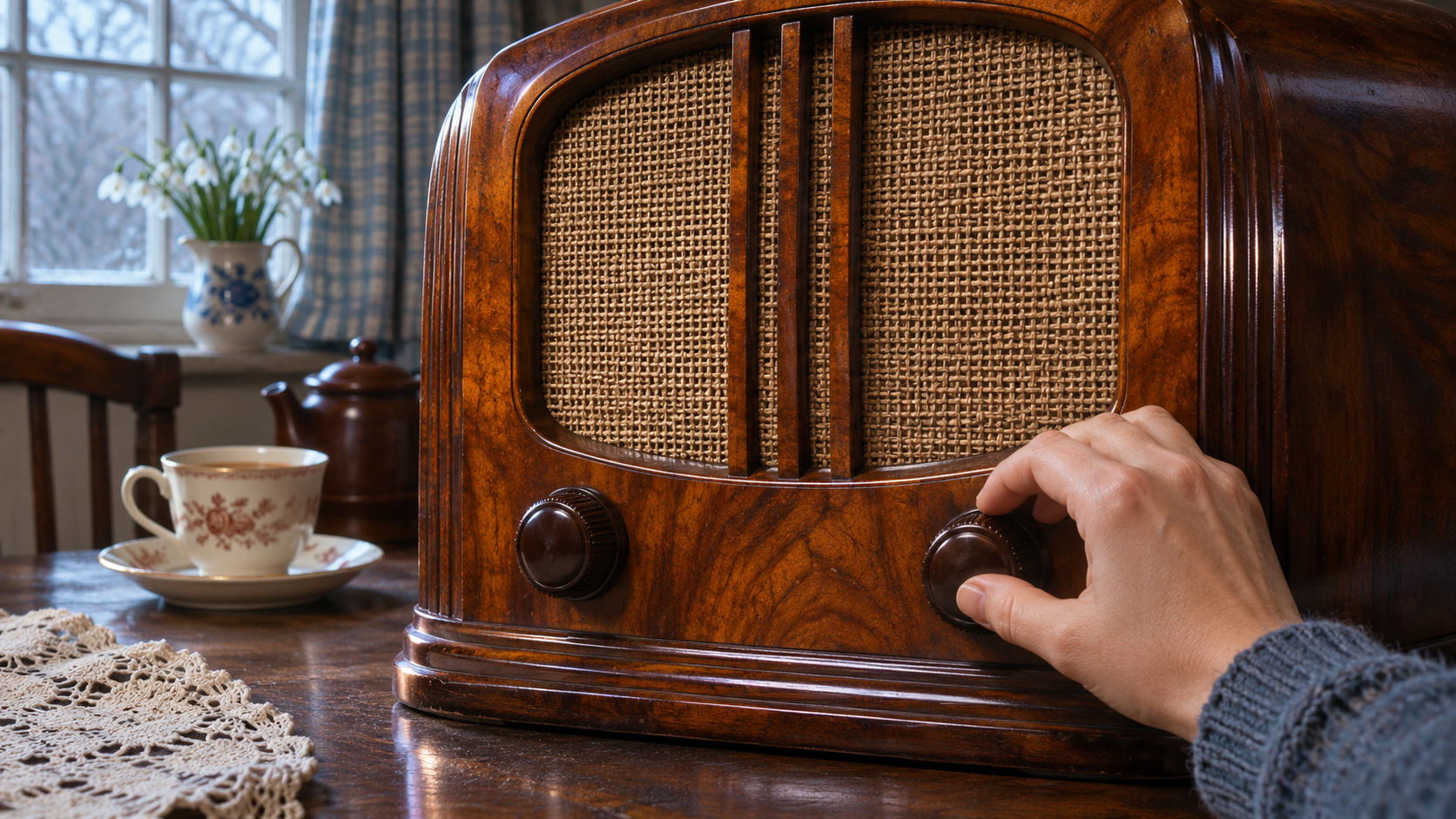
A Voice Came Through The Wall Without Anyone Opening The Door.
On a Sunday morning in September nineteen thirty nine, a listener in Britain could sit beside a wireless set and hear the prime minister announce that the country was at war with Germany. His voice could arrive in a suburban sitting room and a village kitchen at almost the same instant. The radio might belong to a neighbour. Somebody would have to know when to turn it on and where to find the station. Then, for a few minutes, what happened in a room in London became part of the history of countless rooms whose occupants the speaker would never meet.
Start with that remarkable intimacy. In the previous chapter the factory bell reached out into the neighbourhood and told somebody when to get up. Here a voice crossed a country and gave people news that would shape where their children slept, what food they could buy and when they might see a relative again. During the twentieth century, distant institutions entered daily life through the wireless, the ration book, the electricity meter and the health worker's knock. The effect depended on who controlled the connection and what a household could do once the news arrived.
What Did War Sound Like Before The Wireless?
Go back twenty five years to the beginning of the First World War. In Britain a person might have learned of war from a newspaper, a posted notice or another person hurrying home with news. A family trying to follow somebody serving overseas could read reports and search names, but general news offered a poor guide to the fate of one individual. A letter that arrived today described a person who had been safe enough to write on an earlier day. The interval between writing and reading was the space in which worry could grow.
A letter created an occasion of its own. The person who first received it could read it aloud, pass it to somebody else or decide that a particular passage should wait. A familiar turn of phrase carried information that a formal report could never provide. Even an account of indifferent food or the difficulty of finding dry clothes might offer something precious. A relative had noticed the same small annoyances they used to notice at home. The person who had gone away was present again in the room for as long as the reading lasted.
The war reached households far beyond Europe. Men recruited in British India and in other parts of European empires served in distant theatres. Supplies and labour followed military priorities. Decisions made by colonial authorities affected people who had little say in those decisions. A family wondering when someone might return could therefore have more in common with a family thousands of miles away than with the official defining its contribution to the war. An empire on a map was also an arrangement for separating people from the rooms in which they were known best.
The end of fighting could have different dates inside a single home. The arrival of a newspaper announcing an armistice was one event. The arrival of a particular relative was another. A person returning with a lasting injury might need help for decades. Someone who had taken on paid work or new responsibilities in a relative's absence faced another change on their return. The war could finish in the public square while continuing to determine who earned the money, who did the shopping and which chair stayed empty at supper.
What Changed When A Family Could Hear The Same Voice?
By the time of the second war, broadcasting offered a different experience of distance. A letter could be read whenever there was a quiet moment. A scheduled broadcast asked listeners to arrange a quiet moment together. If the family possessed one receiver, somebody decided which station it would carry and how loudly it would play. A neighbour with a set might have company. Somebody just outside the room might hear only the change of tone that made everyone else stop talking.
A broadcast could bring reassurance through the simple fact of a familiar voice returning at an expected hour. It could also make frightening news harder to avoid. The speaker had no way to see which listeners had understood a place name or needed the announcement repeated. People discussed what they had heard afterwards. They compared reports, filled gaps and tested interpretations against the circumstances of people they knew. A national audience could hear the same words and produce very different accounts of what those words meant for tomorrow.
Consider the difference between receiving news and being in a position to use it. A warning that supplies will be scarce is valuable to someone able to lay in a modest reserve. A family living from one wage payment to the next has fewer choices. A parent hearing that children can be evacuated faces questions about where they will go, whether younger siblings will stay together and what it will be like to sleep in a house full of unfamiliar people. A national decision becomes intimate through the details an announcement necessarily leaves out.
The British government's wartime researchers even investigated how housewives responded to a radio programme about cooking. The title, The Kitchen Front, captured the official wish to connect household work to the prosecution of the war. For a listener trying to make the ingredients on hand into something children would eat, the attraction of the broadcast could be much more immediate. Did the advice work with the cooker, fuel, money and time actually available in this kitchen? A technically sound recipe could still be a poor answer to that particular question.
How Much Was A Ration Coupon Worth?
A ration book made a national policy small enough to carry to the shops. For goods subject to the British rationing system, the shopper needed both the relevant entitlement and the money to pay. The coupon helped establish a claim on a limited share. A book filled with unused coupons could mean that a household had been unable to afford its allocation. Possession of the book alone could therefore tell an investigator relatively little about what actually appeared on the table.
Planning a week's meals involved fitting together several different calendars. There was the day on which money came in, the period during which a particular entitlement applied and the uncertain day when a shop might have something worth buying. Children got hungry on their own timetable. Hours spent queuing were unavailable for paid work or looking after somebody at home. A neighbour willing to hold a place or keep an eye on a child could make a difference no entry in the ration book would reveal.
The book also made private information legible to somebody else. A shopkeeper might learn a family's habits through repeated visits. An official could count registered customers and arrange supplies accordingly. The more closely rules attempted to reflect different needs, the more information someone had to gather and check. Allocating extra food to a person with a particular entitlement depended on an administrative system able to recognise that person when they appeared at the counter.
At the end of the war these habits did not disappear with the announcement of peace. Britain continued rationing some foods into the nineteen fifties. A child born after the fighting could grow up acquainted with a ration book before having any personal sense of its origins. That delay is worth remembering because so many public histories leap straight from victory to abundance. On the scale of a kitchen cupboard, reconstruction arrived in small increments, each of which could be measured in what somebody was finally able to serve.
What Could A Family Carry When A Border Moved?
In August nineteen forty seven, British rule in India ended and the independent dominions of India and Pakistan came into being. Independence grew out of decades of political organisation, protest, negotiation and argument across the subcontinent. The Second World War had put Britain under enormous strain and sharpened challenges to the continuation of imperial rule. The people who made independence possible had visions of political freedom that went far beyond the question of whether Britain could afford to remain.
Partition turned a political settlement into an immediate question of home. New boundaries divided Punjab and Bengal. Amid terrible violence and fear, millions of Muslims, Hindus and Sikhs left their homes. Some went on foot, others by road or rail. Someone hearing a statement about a boundary in a distant assembly might have had to decide within hours whether a familiar route was safe. There was no guarantee that a neighbour across the street and a relative across the district had received the same news.
A surviving trunk lock brings us close to one family's journey. Chaudhry Bhawani Das Arora and his wife, Chhinko Bai Sachdeva, used it to secure the belongings they brought when they fled their village in western Punjab. In nineteen fifty five, after the family had built a home in Panipat, the lock and its key were kept in a cupboard. Their grandson later gave the lock to the Partition Museum. This was an object that could cross a border in a hand, travel into a second home and survive to speak to people born long afterwards.
What could that lock do on the journey? It could hold the lid closed. It could offer a little security while a family had other things to attend to. It could protect only what had fitted inside in the first place. The house itself, the neighbour who recognised a child's voice and the route someone knew well enough to walk in darkness were all outside its reach. Once the trunk was unpacked, the family kept a small working part of the journey that had brought them there.
Another family brought a different kind of paper into the historical record. Yash Vir Datta was about ten when he fled Sialkot with his parents and siblings. In Delhi they stayed in temporary settlements before reaching a refugee camp at Feroz Shah Kotla. His father received a ration card bearing the names of members of the family. It offered the authorities the information needed to supply food. Years later it gave his son a record of the household as it had arrived together in a new place.
Set that card beside the British ration book for a moment. Each made a claim on food manageable at scale. Their owners reached the distribution point by profoundly different routes. A system devised to share supplies can acquire a meaning its designer never anticipated. A document once presented to establish who should receive a portion can become evidence, long after the emergency has passed, that the people named on it belonged to one another.
When Did The Electricity Actually Reach The House?
Independence gave governments choices about public investment that colonial rule had denied them. Among the most consequential were choices about which communities would receive electricity, water, schooling and transport. The same questions arose in different forms in countries rebuilding after war and in towns growing faster than planners expected. A minister could announce an electrification programme on the radio. The date that mattered inside a particular house was the evening somebody first reached for a switch and the light came on.
Getting power as far as a village was only one stage. A building needed a connection and safe wiring. A household needed to afford the charges and the appliances it hoped to use. Supply needed to be dependable enough for people to organise their day around it. The same line passing down a street could serve a well equipped workshop, a house with a single bulb and another dwelling whose occupants could see the line overhead while continuing to use other sources of light.
One lamp can alter the use of a room. The circle of light makes reading possible in a place where daylight had previously set the limit. Someone can mend a garment after the evening meal. A child can find the missing piece of a game. The same extra hours can also become hours during which more work is expected. Whether the lamp creates leisure depends partly on who is free to decide what happens under it. At bedtime its most welcome quality can be how little effort it takes to leave the room dark.
Refrigeration makes a different promise. Cooling slows the rate at which many foods spoil. A family may be able to keep something bought yesterday for a meal tomorrow and to space shopping trips farther apart. That advantage depends on reliable power, money for the appliance and enough food to make storage useful. The refrigerator also has to be cleaned, repaired and eventually replaced. A device sold as a way to save time redistributes the work of obtaining a meal across several days and among several people.
Follow a water pipe to its final destination and the change becomes still more personal. Someone who once carried water can use the journey time elsewhere. A household can wash more readily when it can draw a small additional quantity without making another trip. Safe water depends on what happens upstream, on treatment, maintenance and the condition of the distribution system. The person turning a tap may never meet the people whose routine work makes it reasonable to put a glass beneath it.
How Did A Disease Disappear From An Ordinary Childhood?
Earlier in this story, smallpox crossed oceans and devastated communities in the Americas. During much of human history a parent could face this disease having seen what it had done to neighbours or relatives. By the end of the twentieth century children could grow up across the world with almost no occasion to learn its name beyond a lesson. That disappearance was one of the greatest changes ever made to the background of an ordinary life. It came about through vaccination and a worldwide public health effort whose final stages depended on finding individual people.
Consider the difference between a vaccine stored in a building and a person reached by a vaccination programme. The gap between them can contain a journey, unfamiliar languages, missing records and somebody who has good reasons to distrust a stranger arriving with instructions. Health workers needed supplies, knowledge of local conditions and help from people who knew their own communities. As cases became rarer, finding out where transmission was continuing became an increasingly important part of the task. Counting how many people had received a vaccine could never answer the whole question.
The last known naturally acquired case occurred in Somalia in nineteen seventy seven. The patient, Ali Maow Maalin, recovered. The effort then required sustained searches to establish whether anyone else had been missed. A health team that found nobody still had information to contribute, provided it could explain where it had looked and how. In nineteen eighty the World Health Assembly declared smallpox eradicated. Maalin later worked on efforts against polio in his own country. The story that made his name famous was only one part of his working life.
A parent in a later generation could benefit from that extraordinary coordination while giving it very little thought. This is one difficulty in telling the history of public health. It is possible to exhibit a surviving ration card and identify the hands that held it. There is no equivalent object for the night a child slept soundly because a disease had been eradicated before they were born. Part of what made the modern home different consisted of whole sequences of frightening events that no longer had to take place.
How Did A Computer Learn To Point To Another Room?
Near the end of the century a scientist working at CERN proposed a way to link information held on different computers. Tim Berners-Lee put forward the idea in nineteen eighty nine. The laboratory brought together researchers who used different machines and moved between institutions. A document known to one person might be exceedingly difficult for another to locate. The original practical question sounds familiar to anybody who has arrived in an unfamiliar workplace. Who knows where the information is, and will it still be findable after that person goes home?
The World Wide Web joined documents through addresses and links that a browser could follow over a network. The internet already connected computers. The web gave people a way to move among resources presented through a common system. At CERN the first web server ran on a computer in Berners-Lee's office. A handwritten warning asked people to leave the machine switched on. Behind the extraordinary prospect of consulting information from far away lay an ordinary office problem. Somebody tidying up at the end of the day might turn off the wrong equipment.
The early project relied on people making it usable beyond the machine on which it began. Nicola Pellow, then a student on placement, wrote a browser that could work on a wider variety of computers. In nineteen ninety three CERN made its web software freely available in the public domain. A person elsewhere could set up a server and make material available without obtaining a separate commercial licence from CERN. That decision helped a practical solution to a laboratory's information problem travel far beyond the scientific community that had prompted it.
For someone encountering the web at home, there was a new pattern to asking a question. A radio programme arrived on a schedule. A web page could be requested when a question arose, and a link on the page could lead to somebody who had written in another city or country. The freedom to choose the next destination came with new judgements about who had put information there, how recently it had been updated and whether it deserved trust. Finding an answer and finding a good answer remained different accomplishments.
What Did The Century Leave Beside The Bed?
The listener who heard the prime minister in nineteen thirty nine might have recognised the impulse behind somebody consulting a screen at night. Has there been news? Is someone I care about safe? What should I expect when I wake up? Across the century the possible answers began arriving faster and from many more directions. A family could hear a leader speak, carry proof of its members across a border, benefit from the work of a health team and discover a page written on the far side of the world. Each connection also depended on somebody responsible for keeping it open.
In one home a lock and key were put away for safekeeping. In another somebody turned out an electric light and left a refrigerator running. Somewhere else a scientist left a particular computer switched on. These small decisions continued to have effects after the people who made them had gone to sleep. Our own homes already contain arrangements that somebody in a future century may study with the same curiosity. They will probably have questions about things we barely notice and take for granted conveniences we have yet to imagine.
The next morning in this story lies a hundred years beyond our own. We cannot recover it from a museum drawer or find a witness who remembers how it began. We can enter it as a possibility, taking with us what these earlier homes have taught us to ask. Where does the water come from? Who has done the work that allows somebody else to rest? Which sound tells a child it is time to get up? Outside the imagined window it is still dark. In a moment the year will be twenty one twenty six, and an ordinary day will begin.
Sources
UK National Archives — Home Front 1939–1945, part two — The ration book and wartime domestic life.
The Partition Museum — Refugee Artefacts — The trunk lock and Delhi ration card, with the families' accounts.
World Health Organization — Smallpox — The eradication campaign and its outcome.
CERN — A short history of the Web — The first server and browsers and the release of web software.
Next Reads
War of the Worlds Radio Broadcast Summary: Key Ideas and Modern-Day Parallels — How a twentieth-century broadcast became part of radio history.
The East India Company: How A Trading Business Acquired Territorial Power — The corporate origins of British territorial rule in India.
How People Born Between 1990 and 2010 Could Live Through the Next Great Transformation — How technological changes reshape a single generation’s experience.
