Someone Will Still Have To Put The Kettle On.
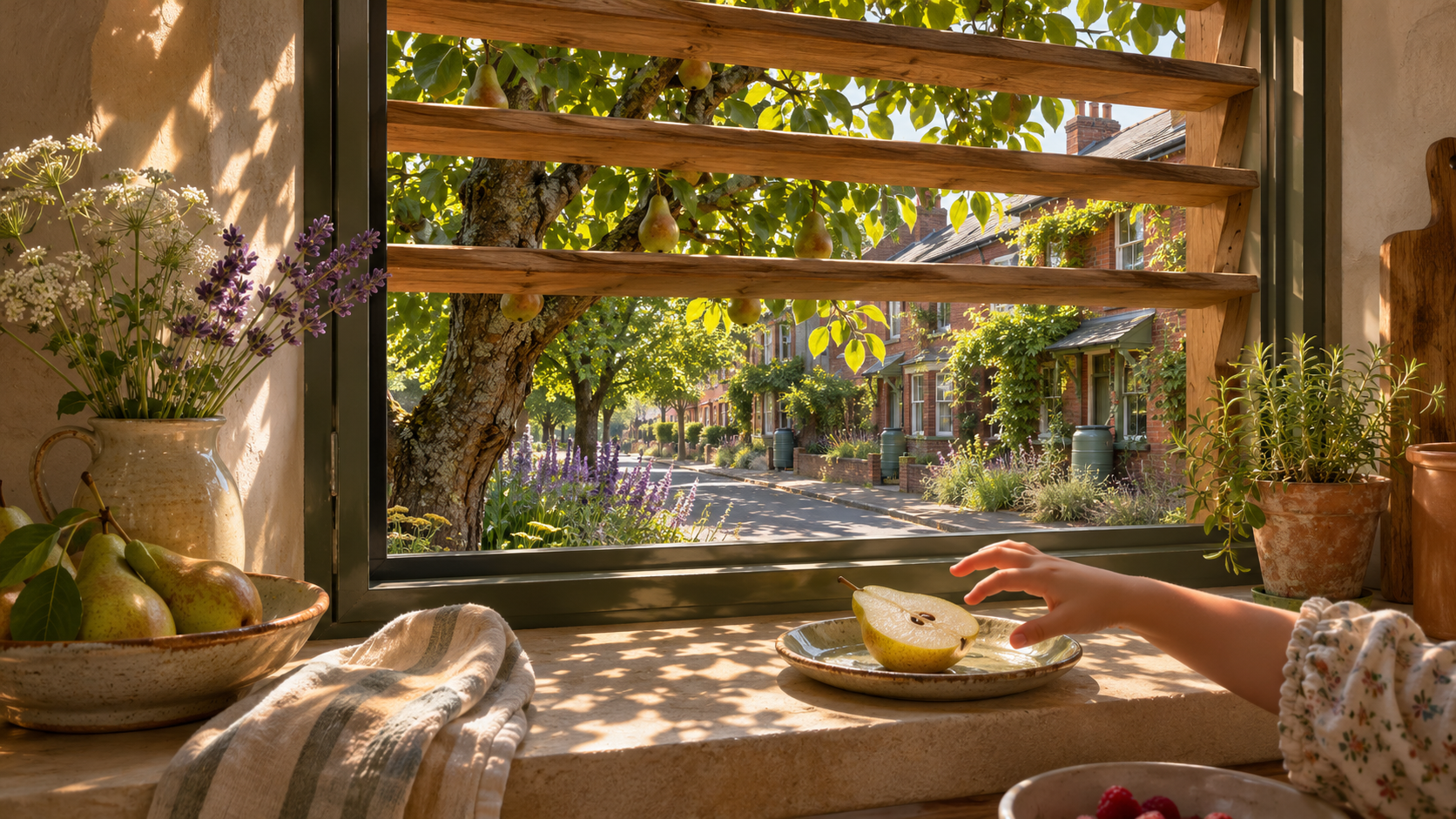
The first person awake puts a hand on the kitchen window. The glass feels cooler than the frame. Outside, the leaves of a pear tree are almost still. Through an open vent comes the small, irregular sound of wheels passing over a drain cover. A child left a cup on the sill last night. The person who has come to make breakfast moves it out of the sun. If you could borrow a few seconds from a morning a hundred years ahead, you might recognise it before you noticed anything strange.
Let this be one possible summer day in the English Midlands in twenty one twenty six. The household, the street and the things that happen here are imagined. The house has been adapted to keep people comfortable through hot weather. Its residents have access to electricity, education and medical care, and a say in how the street is run. Each of those conditions has a history. Change one and you could tell a very different story about a family living a few miles away.
Will the people in the kitchen still be human as we understand the word? Almost certainly. A century amounts to a handful of human generations. Inherited variation will continue to change, as it has throughout our history. The most striking differences between this morning and yours are likelier to concern the things other people have prepared for you before you wake. In our imagined house, that preparation began with somebody deciding where to plant a tree.
What Will Wake Us Up?
Mara, who is nine, hears her father slide a chopping board out of a narrow gap beside the sink. She knows the sound well enough to guess how far breakfast has progressed. Downstairs, the shutters have already moved on the east side of the house. A sensor outside measures the sunlight. When the sun reaches the windows at an angle that would heat the kitchen, a motor lowers the slats. This morning the top one catches on a twig. Her father leans out and clears it with his hand.
The shutter and the tree do related jobs on different timetables. A shutter installed over the winter can cast shade the following summer. A tree planted by a previous generation may take years to put leaves in the right place. It requires water while its roots establish themselves. Someone must preserve enough ground around the trunk. When Mara runs her finger through the dust on the sill, she is touching the edge of decisions made long before her birth about which parts of the street could be built on.
The family rents its home. Many years earlier the town required owners to improve homes that became dangerously hot. In this imagined street, a common design for the shutters made replacements inexpensive, and a local workshop still makes the moving parts. Farther along the valley, other towns made different decisions. A person there might wake in an upper room that has held yesterday's heat all night. Both households could consult the same weather forecast. Their ability to do anything about it would depend on matters as prosaic as the terms of a lease.
Climate studies already give a firm basis for taking heat seriously. Further warming increases risks, and what happens during the coming decades depends substantially on emissions and on the protection communities can provide. No particular temperature follows from writing a future date at the top of a page. The tree gives us something more honest to imagine. It offers shade to the people beneath its crown on a particular morning. Whether a whole neighbourhood enjoys similar protection is a question about land, time, money and the people allowed to decide.
What Will Breakfast Taste Like?
There is bread on the board. Her father cuts the heel for himself because he likes it toasted. Mara puts a pear between two bowls so it will stay where she can slice it. Her grandmother takes a little milk with tea. The food is deliberately familiar. New foods can acquire a place on a table, but a family has good reasons to keep making things it already enjoys. A breakfast that takes ten minutes, suits everyone and leaves few dishes to wash has a great deal in its favour.
The bread also gives us a way of seeing change that has failed to announce itself. Its flour comes from several farms whose growers choose varieties at different times. One well timed shower can do more for a field than an exquisite forecast of a drought. A grain store makes it possible to keep flour moving between one harvest and the next. If a season fails in one region, access to supplies elsewhere can help, provided the price does not put a loaf beyond the household's reach. These are descendants of difficulties that an early farmer would have recognised immediately.
In our imagined district, school kitchens buy part of their grain under agreements lasting several years. A farmer who knows roughly what a buyer will take can try a crop suited to a warmer growing season without staking the whole farm on finding customers. The school accepts some variation in its menu. This has taken meetings, calculations and cooks willing to adapt. It brings no guarantee against a bad harvest. The result, on one ordinary morning, is a piece of toast that Mara hardly thinks about as she reaches for the jam.
Her grandmother's milk carries a much older story. Most babies make an enzyme called lactase that helps them digest the sugar in milk. In many people lactase production falls as they grow up. In others it remains high enough for them to digest substantial amounts of fresh milk as adults. Genetic differences affect this pattern, though the presence of a particular variant does not describe everything an individual can comfortably eat. Quantities matter. Preparing milk as different foods can change the amount of lactose a person consumes.
Residues on ancient European pottery show people using milk long before the genetic trait for persistent lactase production became widespread there. One investigation compared evidence of milk use with ancient genetic data and indicators of conditions in which people lived. The researchers suggested that periods of famine and infectious disease helped shape the advantage of retaining lactase. A dependence on milk in a crisis could have different consequences from an occasional drink when other food was plentiful. The precise historical circumstances remain open to investigation. There was a long interval between the practice of dairying and the later spread of an inherited trait.
That time lag is worth carrying into the rest of the day. A cupboard can change its contents within a week. A community can change what its children learn to cook within a generation. Changes in the frequency of an inherited characteristic run on another timetable and depend on who leaves descendants. A person waking in twenty one twenty six could have a radically unfamiliar breakfast while having a digestive system perfectly familiar to a doctor practising a hundred years earlier. The difference between changes in what we inherit and changes in what we learn will matter again tonight.
How Will A Child Get To School?
Mara and her grandmother take the longer way. It follows a covered path beside the water, with several seats along it. Her grandmother can walk for a comfortable distance, then benefits from a short rest. There used to be a gap between seats near the bridge. People planning the route thought in terms of its total length. People using it knew that the troublesome part was a particular stretch with nowhere to sit. In our story somebody listened, and there is now a bench where the older woman wants one.
They stop there without ceremony. A driver taking goods to the school draws up on the far side of the stream. Somebody has forgotten a delivery and comes back with a second small crate. These movements are familiar enough to be unremarkable, yet their timing contains a decision about summer heat. Heavy outdoor work in this district begins early when a particularly hot day is expected. Other tasks shift later. A timetable intended to protect a delivery worker changes the hours of the people opening the kitchen, and those hours can affect who takes their own children to school.
How much longer will people live? That question has at least two meanings at a bench beside a stream. One concerns the number of years a person survives. Another concerns how many of those years allow the person to do the things that matter to them. Public health researchers distinguish health and functional ability, and emphasise the relationship between a person's capacities and their environment. A seat in a useful place cannot reverse ageing. It can make the difference between joining a grandchild on the way to school and watching her leave alone.
A different district might spend heavily on treating individuals while leaving streets difficult to navigate. A wealthier family could buy assistance that another family lacks. Two people born on the same day could consequently experience the same age as quite different stages of life. We need no precise prediction of future life expectancy to understand the morning on the bench. The grandmother wishes to keep company with somebody she loves. A short break makes that possible, and Mara has something to show her in the water while they wait.
Will There Still Be Teachers?
There is a patch of damp plaster in the school hall. The older children have put small pencil marks along its edge, with the date written beside each one. A program has suggested several possible causes and drawn a diagram of where moisture could be entering. The caretaker has a different suspicion. To settle the matter, the class is keeping a record of the weather and the times the kitchen equipment runs. Somebody still has to decide which observations would distinguish one explanation from another.
In our version of the future, the school has access to software that can generate a useful explanation in several languages and adjust a practice exercise to the pupil working through it. That assumption gives the teacher choices. A child who understands the arithmetic but has difficulty with the wording can hear the question again in familiar terms. Another child can try a harder exercise without waiting. The teacher can devote attention to the pupil who has learned to produce correct answers by a method she cannot explain.
The wet patch introduces a different sort of lesson. An account can be fluent and internally consistent while resting on a mistaken assumption about what lies behind a wall. No amount of polished phrasing makes the wall transparent. Mara can walk over, look up and notice that a faint new mark extends beyond the pencil line. The teacher can ask what would change the child's mind. A caretaker who remembers an earlier repair may know something missing from every drawing in the school's files.
Most children learn a great deal by seeing adults discover that they were wrong. There is a particular kind of freedom in watching a trusted teacher alter an explanation because somebody noticed something. That exchange would still depend on the time available and the trust in the room. One school could use software to give a teacher more of that time. Another could use it to put more children under a single adult's supervision. The same technical achievement opens both possibilities. Which one Mara experiences depends on a decision about the purpose of education.
Before lunch, she copies the shape of the patch onto paper. The marks have become a record that another class can consult after the present observers have gone home. The keeper of an account at ancient Uruk would have understood the usefulness of that arrangement. A durable mark allows two people who never meet to contribute to the same enquiry. In a school surrounded by machines capable of generating new accounts almost instantly, the pencil mark has earned its place by recording one small thing that somebody actually saw.
Who Will Still Need To Work?
Mara's father repairs fittings used in local homes. Today he has a replacement hinge for an upstairs shutter and an older customer who wants the handle moved lower. His workshop can produce parts to standard dimensions with very little intervention. Arriving at the customer's door, discovering that the drawing is out of date and arranging a solution the resident can operate with one hand occupy most of the morning. The most useful part of the job is knowing which additional question to ask before removing the old fitting.
Could machines eventually do much of that too? Possibly. A century leaves ample room for advances in dexterity, planning and the ability to navigate an unfamiliar house. The more interesting question for this street is who would get the benefit. A machine owned by the workshop might allow its staff to finish earlier while maintaining their incomes. A remote company controlling a design that only its own equipment can repair might collect a charge each time a handle breaks. Both results are compatible with greater productive capacity.
In the district we have imagined, public buildings use replacement parts that several workshops can supply. The policy arose after a manufacturer stopped supporting equipment that still had useful years left. A superficially inexpensive fitting had become costly to replace. Residents asked for a standard they could keep using. There is a long human history in that request. The person who chose a stone worth carrying and the potter who knew which vessel would fit a familiar measure both understood that the value of a thing depends partly on what else works with it.
Will people work fewer hours? The hinge gives us a better question to begin with. Who gains an hour when a repair takes an hour less? It could go to a worker, an employer, a customer or a family member waiting for help. Greater output alone cannot decide. Working lives in the factory age were shaped by laws, bargaining and the private demands of a household. In our future the father reaches home early enough to begin supper. The day might easily have been written so that his employer assigned him another address.
Will Humans Still Be Evolving?
Mara's grandmother has kept photographs of relatives at different ages. In one picture her own grandfather stands beside a kitchen table with much the same habit of resting two fingers on its edge. Families are good at noticing a resemblance, sometimes where it is partly learned. A shared gesture may be imitated. An inherited difference concerns biological material passed between generations. Evolution describes changes in inherited variation in populations across generations. It continues wherever reproduction, inheritance and changing populations continue.
There are several ways that can happen. A new genetic variant can appear through mutation. People migrating and having children can change how variants are distributed. Chance affects which variants persist, particularly in small populations. In some environments an inherited difference affects the likelihood of leaving descendants. Under those conditions natural selection can change how common the difference becomes. None of these processes requires a species to be working towards a goal. Several can operate at once, and a change in one generation need never become a permanent trend.
Does medicine stop the process? Care can alter the consequences of particular inherited conditions. A person who would previously have died young may now survive and have children. Changes in shelter, diet, relationships and exposure to infection also alter the circumstances in which people live and reproduce. The relevant environment for humans has included the things humans make for a very long time. The expression of affection beside a sickbed is an act for the sake of this person now. Any effect on a population generations later is a different question altogether.
What about the possibility of changing inherited characteristics deliberately? There is an important distinction between treating cells in one person's body and making a change that descendants could inherit. The second raises questions extending far beyond the individual receiving care, including uncertainty about effects across a lifetime and the rights of people who cannot consent to the decision. Social acceptance, regulation, access and scientific reliability would all affect how widely any future intervention was used. Even then, altering a few families would have very different consequences from changing the distribution of a trait across a whole population.
Traits people often imagine choosing for future children are shaped by many biological and environmental influences. The conditions in which a child grows, learns, eats, sleeps and forms relationships can have lasting effects. Picture someone investing great effort in predicting a child's future abilities while ignoring the temperature of her bedroom or whether she can get to school. The bench, the shutters and the teacher all belong in a serious discussion of human potential. Their effects could reach a child's life well before anybody could assess the distant consequences of a change to an inherited sequence.
Could Our Descendants Become Another Species?
A thousand years sounds immense to someone trying to picture a grandchild grown old. In evolutionary terms it is a much shorter interval than the spans that separated many of the populations we met at the beginning of this story. The appearance of a distinct species involves enduring divergence. Among sexually reproducing organisms, strong barriers to the exchange of inherited material between populations can matter greatly. Geography, behaviour and different environments can contribute over long periods. A difference in clothing, accent or technological habit gives us little basis for declaring a new species.
Imagine a community living far from Earth. The distance by itself tells us very little. How many people live there? How often can others join them? Are they able to have children safely, and can those children grow to adulthood? Do families maintain contact and relationships with people elsewhere? Without answers, the idea of a new branch of humanity is an illustration in search of a history. An isolated group could change over many generations. A colony drawing new residents steadily from elsewhere would have a different future.
Back on Earth the people sharing this meal have ancestors who lived in different places. Movement connects populations, as our history of roads, ports and forced Atlantic crossings has shown. The conditions of movement matter profoundly to the people involved. Someone can make a free decision to build a life in another country or cross a border because remaining at home has become impossible. Biology can record an exchange of ancestry. It cannot tell us who was welcomed, who lost their home or what name somebody wanted their children to remember.
What Will A Family Remember At The End Of The Day?
By evening the shutter is working again. The customer can reach her new handle. There is no answer yet about the damp patch at school, though the children have recorded another day's evidence. Mara fills the watering can and carries it out with both hands. Some water spills onto the paving beside the tree. She puts her bare foot into the wet patch and then onto a dry slab. For a little while there is a dark outline of her sole, unmistakable to anyone who has ever come indoors from a pool.
At Laetoli in Tanzania, more than three and a half million years ago, other feet left impressions in volcanic ash. Their makers belonged to a human family with a future no individual alive then could have imagined. Ash held the marks long enough for people of another species, our own, to study the shape of the steps. Mara's mark will dry before dark. Nothing about its disappearance makes the life that left it less complete. Most things done in love or ordinary necessity have always vanished just as quietly.
We began with the question of what it took to get through a day. There were people who knew where to find food, who laid grass on a hut floor, who kept grain dry and who remembered the road to somebody else's house. There were others who claimed the power to decide where a person worked or slept. Each generation inherited arrangements it could sustain, challenge or change. The future hidden inside today's arrangements is close enough to touch. There is a little more shade in this imagined street because somebody once planted a tree.
Mara puts the can down by the door. Her grandmother has saved the other half of the pear for her. The last light lies along the sill where the cup stood this morning. Soon somebody will draw the shutter by hand, leaving enough space for cooler air to enter. Beyond that narrow opening, the street grows quiet. There is still a chair beside the bed, and for a few minutes longer someone with time to sit in it.
Sources
University of Bristol — Famine and disease drove the evolution of lactose tolerance in Europe — Ancient pottery, DNA and models of the spread of lactase persistence.
Intergovernmental Panel on Climate Change — Climate Change 2023: Synthesis Report — Climate risks and the effects of adaptation and emissions choices.
World Health Organization — Ageing and health — Functional ability and the environments in which people age.
Smithsonian Human Origins Program — Laetoli Footprint Trails — Age, setting and likely makers of the opening chapter's footprints.
Next Reads
How People Born Between 1990 and 2010 Could Live Through the Next Great Transformation — How a long life can span several technological transitions.
Biggest Technological Advancements Year by Year from Now to 2040 — A nearer horizon for thinking through possible technological change.
What If Neanderthals Survived Into The Modern World? — Another counterfactual about biology, society and the human future.
