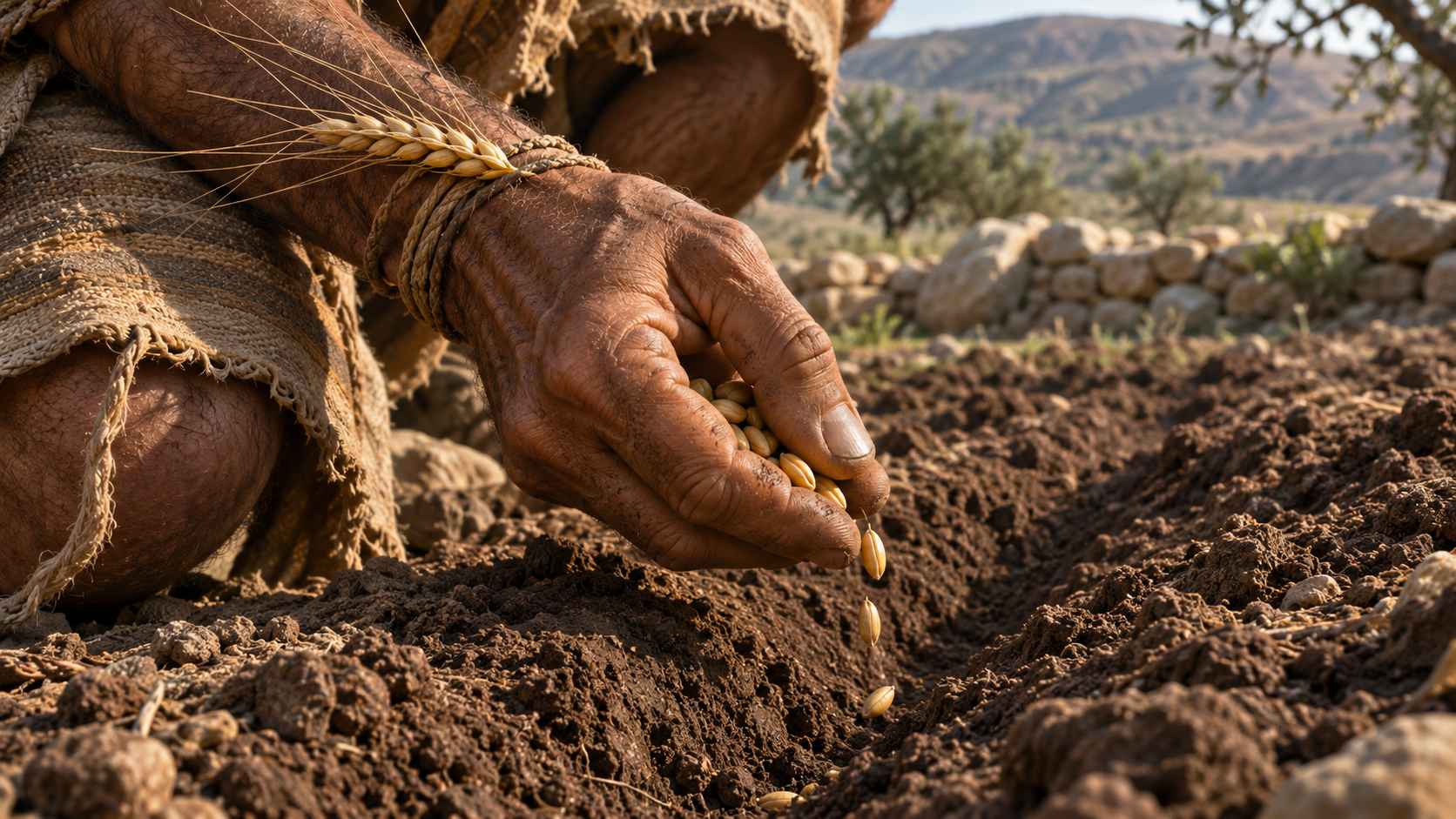
People Learned To Make Bread Before They Learned To Farm.
The bread survived because it burned. At a place called Shubayqa, in what is now north eastern Jordan, tiny charred fragments lay among the remains of ancient hearths. Under a microscope, researchers could see features of plant tissue and the structure of a prepared food. Some of the pieces resembled flatbread. People had been doing something recognisably like baking here more than fourteen thousand years ago. Whoever prepared the food had lived by hunting and gathering, thousands of years before farming became an established way of life in the region.
It is an unexpectedly good place to begin the story of agriculture. At the end of the previous evening we left a grinding stone beside a lake. Here, much later, we have something closer to a meal. A knowledge of edible seeds, tools to process them and the ability to make them into something worth eating could all exist before a household planted a crop. Farming began when people in particular places started investing labour in the future supply of useful plants and animals. The reasons varied. So did the time between the first experiment and the first generation whose supper depended upon its success.
How Much Work Went Into A Mouthful?
Take a handful of grain and think backwards from the moment somebody can eat a piece of bread. There is heat to supply. There is a mixture to prepare and some means of bringing its ingredients together. The useful part of the grain has to be separated from material that would make unpleasant eating. Farther back, someone had to recognise the plants, reach them when the seeds were available, gather a worthwhile quantity and bring it home. Quite a long part of the day can be concealed in the faint traces of a burnt mouthful.
The experimental work needed to understand the fragments at Shubayqa reverses that sequence. Researchers begin with the finished material and ask what kind of preparation could have produced its interior. Looking at a charred lump with the naked eye takes them only so far. Magnification can reveal pieces of the original ingredients. The sizes and arrangement of cavities can give clues about how the ingredients were worked. Where several observations fit together, a broad category of food can become recognisable even after the original smell and taste have disappeared.
Was bread an everyday food? The hearths cannot tell us how often it appeared at a meal. The labour required makes it reasonable to ask whether people prepared it for particular occasions. A food that is costly to make can be worth serving when people gather. Equally, the return might have lain in taste, texture or convenience once the food was prepared. An object in a hearth can establish that people knew how to do something long before it can establish what that activity meant to them.
The practical sequence has an important consequence for the supposed first farmer. Whoever began tending cereals in this region could have inherited generations of expertise in the later stages of the process. Making more of a plant grow within reach of home changes the beginning of the chain. Established ways of processing and eating it give the extra supply a purpose. There need never have been one extraordinary individual who imagined the whole journey from bare earth to bread and persuaded everybody else to follow.
What Would Make A Patch Worth Tending?
Imagine a place just beyond a settlement where an edible plant already grows. This is a thought experiment, the sort of modest situation in which an ambitious change becomes easier to understand. If competing vegetation is cleared away, the useful plants may do better. If seeds that might have been eaten are scattered over suitable ground, some may grow where they will be easy to find again. The extra labour is limited. Other food can still be gathered while the experiment takes its chances with the weather.
Whether such work pays depends partly on whether the people doing it can return. A patch left far from the places a group normally visits is a poor investment unless somebody has good reason to pass that way again. Land close to a dependable source of water may already lie on a regular route. A small change in how a familiar site is used can make sense well before it would be sensible to settle beside the site all year. Revisiting, tending and living permanently in one place are different commitments.
A household seeking a little more food within walking distance may be willing to try something a household with ample access to wild resources would find unnecessary. A family looking for a dependable reserve might choose a crop that can be dried and stored. An unusually successful harvest could encourage people to extend the area they tend. A disastrous season could send them back towards other resources. All these developments are compatible with people making intelligent decisions in the light of what they knew at the time.
It matters that the outcome was never guaranteed. A person could work conscientiously and still lose a crop to poor rainfall. Time spent tending young plants could mean passing up a chance to travel elsewhere. A larger patch might attract animals before it was ready for people to harvest. The question facing the earliest cultivators was much more immediate than whether agriculture would eventually support cities. Would the work done this season leave enough food to justify doing it again next time?
When Does A Wild Plant Become A Crop?
There are two changes here, one in people's behaviour and another in the plants. A population of wild cereals can be deliberately sown and tended. Archaeologists might find good reasons to think people cultivated it while the preserved grains and other parts still look much like those of wild relatives. Domestication involves inherited changes in populations over generations. That is why the earliest date for cultivation in a place can differ from the earliest date at which the harvested plants display recognisably domestic features.
Consider a ripe ear of wild cereal. A plant that sheds its seeds can spread them without human involvement. An ear that hangs together may be easier for a person to gather whole. Suppose the seed kept for sowing disproportionately comes from plants whose ears remained intact through the harvest. More of their descendants may grow in the patch the following year. Repeat the sequence often enough and a useful characteristic can become more frequent even if nobody decides to breed specifically for it.
The details depend on how and when people harvest. Collect plants before they are fully ripe and the balance shifts. Gather seed that has already fallen and it shifts again. Patches can exchange pollen or seed with wild populations nearby. Farmers can keep some seed from their own harvest and obtain some elsewhere. Domestication leaves a history in the plants, and reading it requires attention to all the mundane choices that connect one year's harvest with the next. There is seldom a clean boundary that every specimen crosses at once.
Now follow the consequences for a child growing up beside a cultivated patch. Knowledge of local plants remains essential. The child can also see consequences that run across the year. Grain eaten today gives immediate nourishment. Grain kept dry and put aside can be sown when conditions are right. A change in the balance between those uses affects the next harvest. The food supply has acquired a second claim on the same handful of seeds, and the person who must decide between the claims may already be hungry.
Where Did Next Winter's Food Go?
At Dhra, near the Dead Sea in Jordan, excavators found the remains of buildings they interpreted as granaries. The floors had been raised above the underlying ground. Air could pass underneath, and the arrangement helped protect what was stored. The structures date to more than eleven thousand years ago. They belong to a period before clearly domesticated cereals had become the foundation of life there. Someone had already worked out that the place where food waits can matter nearly as much as the place where it grows.
A store has a daily life of its own. Put damp material into an enclosed space and the contents can deteriorate. Allow animals access and they can consume the food or spoil what remains. A container needs an opening large enough to fill and empty while allowing its contents to be protected in between. The building has to support the weight placed in it. Raising a floor costs labour and material, yet a relatively small improvement in how long food keeps can justify that investment over many meals.
There is also a question of arithmetic that can be understood without writing down a single number. How quickly is the store going down? How long is it until another resource becomes available? A large quantity viewed immediately after harvest may feel very different once it has to last through a difficult season. Visitors, an illness or a poor return from other food gathering can change the answer. Storage gives people room to make decisions over a longer period. It also gives them more decisions to make.
Who had a right to take something out? A store kept between houses may suggest different possibilities from one reached only through a household's interior. Archaeologists can examine entrances and relationships between buildings. The architecture will seldom tell them the terms of every agreement. A shared structure could be managed according to rules everyone understood. A household store could be drawn upon for a neighbour in trouble. The visible location and the social rules are connected, yet one cannot simply be read off from the other.
A granary can therefore bring human relationships into focus without requiring us to invent a village chief. Some people put in labour before the harvest. Others may need support when it fails. Younger members of the group consume grain before they are old enough to make a comparable contribution. Somebody has to notice a damaged floor and somebody has to repair it. A store large enough to influence a community's future makes each of those small arrangements more consequential.
How Did The Working Day Change?
The agricultural year imposes deadlines of an unusual kind. Preparing ground can be worthwhile only within a certain window. Harvest too early and a crop may be immature. Leave it too long and the yield can fall or become difficult to collect. A household might enjoy considerable flexibility through one part of the year and find that almost every available hand is needed during another. Describing farming as either a harder or an easier life than gathering misses much of what changed about the distribution of effort.
An ordinary morning might begin with a choice between tasks at different distances from the house. An animal needs attention nearby. A patch farther away needs checking. Grain brought in yesterday requires further processing. There may be younger children to look after through all of those activities. Two adults making arrangements together have to account for travel time as well as the work itself. A day can become more structured by the placement of a field and a store without anybody possessing a clock.
Repeated movements matter in the history of a body. Grinding a supply of grain involves a different rhythm from walking out to gather it. Bringing water to a dwelling requires regular carrying even in an uneventful season. Such work can be both skilled and physically demanding. A person who knows how to use a grinding surface efficiently may sustain a rhythm that a beginner quickly loses. The food in the cooking area is evidence of work already done, much of it too familiar to its makers to need discussion.
Living among animals adds an entirely different set of appointments to the day. A living herd requires access to food and water through all the time between one useful return and the next. Young animals need to survive if the herd is to replace itself. Keeping an animal alive can represent a considerable investment, and deciding when to use it changes the future composition of the herd. Across the world people domesticated different animals under different conditions. A timetable that suits a cereal grower will never fully describe the day of a herder.
For much of this history, people could combine cultivated food with hunting, fishing or collecting plants that continued to grow of their own accord. Wild resources could fill gaps while crops matured. A household with access to several ways of finding a meal might endure a failed crop more easily. Increasing reliance on a single staple can make the consequences of failure much larger. A harvest plentiful enough to support extra mouths in one generation changes how far a small reserve will stretch in the next.
What Was It Like To Live So Close To Other Households?
At Çatalhöyük, in present day Turkey, the arrangement of houses takes us into another stage of the story. Here was a substantial Neolithic settlement where mudbrick houses stood close together and access was commonly from the roof. Picture arriving with something heavy to carry. The approach to the house and the descent into it organise the last few moments of the journey very differently from stepping off a street through a door. A ladder is a small detail on a plan and a major feature of a day.
People cooked, worked and rested inside houses whose interiors they repeatedly maintained. A surface that receives another coat of plaster records a decision to keep using a place. A future occupant could inherit a dwelling and routines that had already accumulated there. Something as simple as knowing where to put a heavy object could be passed between generations through the arrangement of the room. A building holds a portion of the communal memory in a form a newcomer can learn by walking through it.
Living close to others changes the significance of a neighbour's decisions. Maintenance along an adjoining wall can affect a household beside it. Getting onto a roof can bring people into spaces visible to others. Cooking, fuel and the removal of waste all involve movements across the threshold between the household and its surroundings. Density makes some forms of cooperation economical and some disagreements hard to avoid. The ground plan gives us the physical conditions for both. The conversations belong to the people who had them.
Why would people remain in a crowded place if more open ground lay elsewhere? Access to land is only one part of the calculation. A familiar house, assistance at a busy time, people who know how to look after a child and a reliable means of obtaining a missing tool can all matter. Leaving means giving up some accumulated advantages. Remaining can involve accepting inconveniences. It is possible to recognise the terms of that choice without assuming that everyone in a settlement valued them in the same way.
Food also retains a geography of its own. The larger the settlement, the greater the number of people needing material brought in from outside its walls. A field does not move closer when another dwelling is built. Someone must still cross the intervening ground, often carrying a load on the return. As communities grow, distance begins to shape which goods can reach them conveniently and which kinds of work are best done before a load is transported. These questions will become more pressing when we reach the first cities.
Did Everybody Start Farming For The Same Reason?
There was no single starting gun for world agriculture. Cereals in southwest Asia belong to one history. East Asian rice cultivation has another. Maize in the Americas has another again. The plants differed in their growing requirements, the parts people ate and the changes associated with long use under cultivation. Moving the scene from one region to another means asking what people there actually tended, what else they ate and how much evidence remains for the earliest stages.
It also means adjusting our expectations about what a cultivated landscape looks like. A field of grain is easy for a modern observer to recognise. Gardening involving a mixture of crops or a useful plant encouraged within a woodland can leave a quite different impression. Seed plants, tubers and tree crops offer different kinds of archaeological evidence. The material most readily recovered in one environment can be poorly preserved in another. A map of known early sites reflects both human ingenuity and the uneven visibility of its traces.
People also encountered farming through different routes. Some communities developed local practices over generations. Elsewhere crops, animals and knowledge arrived through movements of people or contact with neighbours. Receiving seed is only the beginning. New growers have to discover how a plant responds to their own soils, weather and calendar. They may keep a practice, modify it or abandon it. A crop can travel farther through a sequence of local exchanges than any one of the people who first learned to grow it.
That variety makes it possible to give an honest answer to the question with which we began. Farming could increase the local supply of food that people already valued. In some circumstances it made a future season easier to prepare for. It could also concentrate effort and risk, create new obligations and make leaving a place more costly. A decision that made sense to one household over a year could eventually produce a society no member of that household would have chosen or even been able to imagine.
When Does Somebody Need To Keep An Account?
Come back indoors for a final moment. There is grain set aside for eating and grain that must last until sowing. Someone remembers who helped at harvest. Someone else has borrowed a measure that will be returned later. Within a small group, memory, habit and the sight of the remaining store may do most of the work. The people who know the circumstances can speak directly to one another. If something seems wrong, it may be possible to walk across to the person who knows the answer.
Now let the number of households rise. Grain arrives from a place the person receiving it has never seen. Some goes to people who have spent the day building or making things instead of producing food. Others claim a share on grounds that have little to do with working the field. The crop is still made of individual grains, but accounts of where it came from and where it goes have begun to matter to people who will never meet its growers.
Some thousands of years after the granaries of the Jordan Valley, a person in southern Mesopotamia will pick up a piece of damp clay. An impression made in it can stand for an amount. The clay can be carried somewhere else. Somebody opening a store tomorrow can consult a record left by a hand that has finished its work and gone home for the evening. The next chapter begins with the curious life of that little piece of earth.
Sources
Archaeobotanical evidence reveals the origins of bread 14,400 years ago in northeastern Jordan — Prepared food before settled farming.
Evidence for food storage and predomestication granaries 11,000 years ago in the Jordan Valley — Raised storage floors at Dhra.
UNESCO — Neolithic Site of Çatalhöyük — The settlement and its roof access.
Next Reads
What Makes A Civilisation? The Evidence Behind The Label — How food storage and settlement enter the archaeological record.
Sapiens Summary: How One Species Learned to Rule Reality — An alternative interpretation of the costs of adopting agriculture.
History of Money Creation: From Ledgers to Crypto — How accounts developed around goods, debts and future obligations.
