How Do Investigators Choose a Relative for DNA Testing?
What Connects a Hospital Building Site in France to a Family in Essex?
In 2020, construction of a hospital on the outskirts of Lens brought human remains to light. The landscape belonged to a modern French city. The person recovered from it belonged to the First World War. Six years later, serving soldiers carried his coffin at Loos British Cemetery Extension. By then the people arranging the burial could tell his family whose name would mark the grave.
The man was Private Reginald Joseph Blake of the 11th Battalion, the Essex Regiment. His family knew him as Joe. His nephew Bryan provided the DNA sample that made the identification possible. On 22 April 2026 Joe was buried, 109 years after the fighting in which he went missing. The remarkable part of the story lies in the distance between finding a soldier and knowing which family to ask for that sample.
What Happened to Joe Blake in 1917?
Blake came from Tendring in Essex and enlisted at Dovercourt after war broke out. The Royal Anglian Regiment records that his battalion moved into positions north of Lens on 21 April 1917 for an attack the following day. Blake disappeared in the fighting. He was twenty. For the people looking for him, there was a last known military context and a family who knew exactly whom they had lost. There was no identified body to bury under his name.
Turn the problem around and the significance becomes clearer. In 1917 the Army had a name and lacked an identified resting place. In 2020 the recovery produced remains at a known location and the investigators needed a name. A successful identification requires those two incomplete records, made more than a century apart, to meet. A family can be certain a man was lost without being able to tell a recovery team which set of remains belongs to him.
The historical account fixes Blake’s battalion and the timing of the action. It does not give a complete account of his final movements. Units receive orders and move into positions as groups. Individual men can be separated, carried away wounded or left in ground that changes hands. Precision about the battalion’s location cannot legitimately be converted into a detailed description of Joe’s last moments.
Who Are the War Detectives?
The name belongs to the commemorations team at the Ministry of Defence’s Joint Casualty and Compassionate Centre, usually shortened to JCCC. Its work includes investigating newly discovered British service casualties and assessing evidence that a previously unknown war grave can be named. It works with authorities in the country of discovery, service historians, regiments, families and the Commonwealth War Graves Commission.
These organisations do different things. The Commission maintains graves and commemorations and contributes expertise. Regimental records can explain which formations were present. A family can supply documents, recollections or a reference DNA sample. The JCCC is the authority responsible for deciding whether a British casualty or previously unknown grave can be named. A compelling suggestion sent by a researcher begins an assessment. It does not itself change a headstone.
It is tempting to tell these cases as a race between a laboratory and a filing cabinet. Both depend on the quality of the question someone brings to them. A laboratory can compare material. It cannot infer, from an unlabeled sample alone, which Essex family would be relevant to an investigation outside Lens. A researcher can list missing men. They still need evidence connecting one of them to the physical discovery.
Why Is the Recovery Location So Important?
A discovery site provides a point from which to work backwards. Which armies occupied the area? During what periods? Which British formations were recorded there and what losses did they suffer? When a location can be placed against historical maps, unit movements and the evidence recovered with the remains, a vast pool of names can become a smaller, testable set.
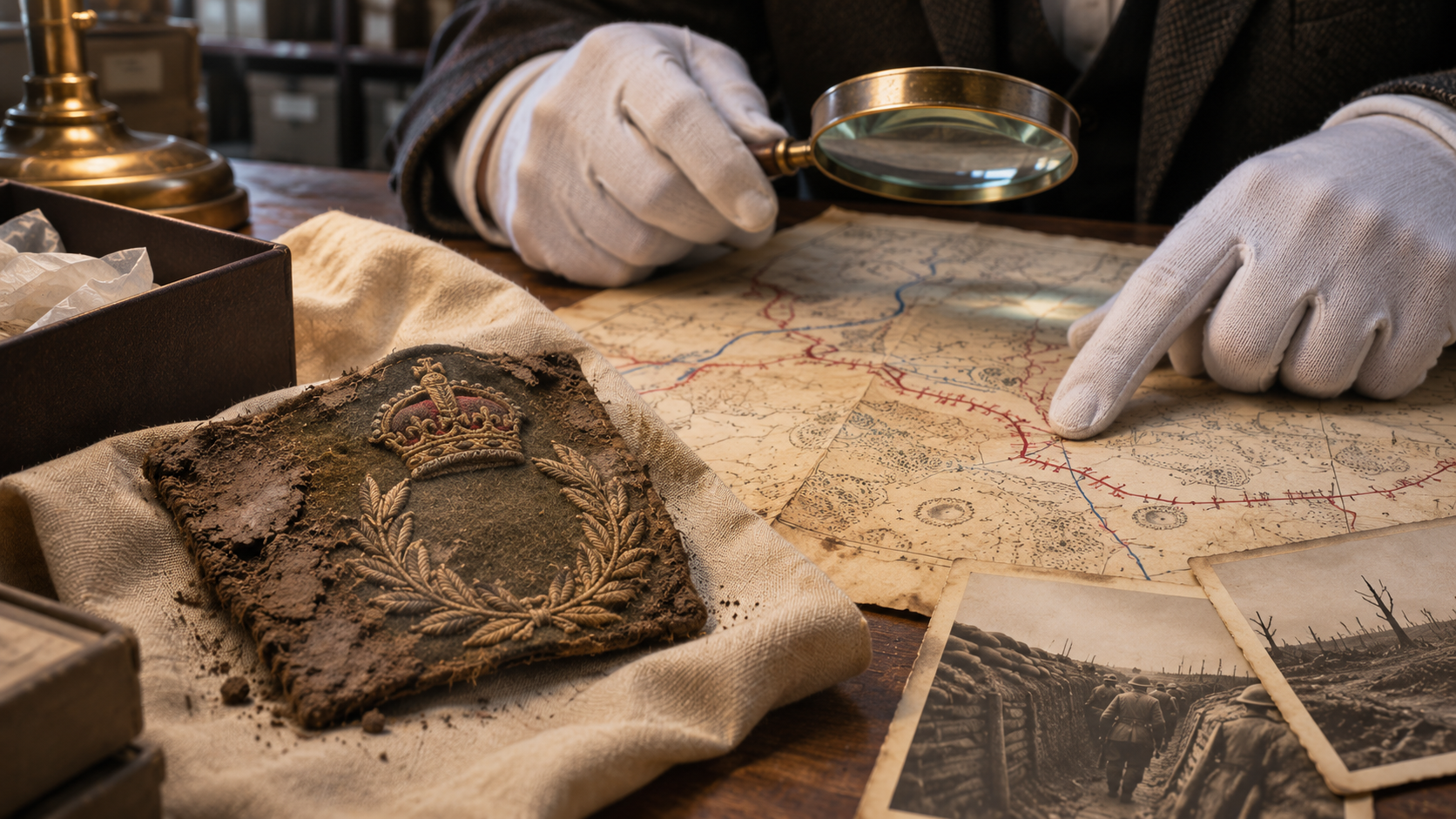
A trench map is especially easy to overread. It captures a particular understanding of a changing battlefield at a particular time. A trench could have different occupants during successive phases of fighting. A wartime place name could refer to a feature that no longer survives on a street plan. Coordinates reconstructed long after an event do not acquire perfect accuracy because a modern computer displays them to several decimal places.
The context in which an object is found can be as important as its identity. A military object recorded with a casualty can have a different evidential value from a similar object found farther away in ground repeatedly disturbed by construction or farming. Recovering material with its associations intact allows investigators to ask questions that an object taken away as a souvenir could never answer.
In Blake’s case, the public record establishes the hospital construction and the recovery near Lens. It also establishes his battalion’s presence in the area. The official account does not say that a particular trench map or piece of equipment identified him. Those are methods available to investigators. They should not be added to his personal story simply because they make good illustrations.
How Much Can a Badge or a Button Tell You?
A regimental insignia may sharply narrow a search. If its connection with a set of remains is secure, it suggests which body of personnel records should receive attention. It may also distinguish a British unit from formations of other armies that fought across the same ground. Sometimes a surviving inscription or personal article offers a more individual lead.
Yet a regimental title can have been worn by thousands of people. Several battalions of one regiment may have served in the same theatre. A man could transfer units, carry a keepsake or possess an object originally issued to a different person. A named item is a stronger clue than a generic button, but investigators still need to ask whether its owner and the person with whom it was recovered were the same.
Consider a hypothetical recovery beside a marked military road. A shoulder title indicates a regiment. Records show that two of its battalions used the road in different months. Looking only at the date of the best-known battle would exclude one battalion before the evidence justified it. A good shortlist preserves plausible alternatives until another piece of evidence actually rules them out. That is slower than assigning the first convincing name and considerably fairer to every family involved.
How Do Researchers Move From a Unit to a Family?
Military records can locate a person within a unit and a period. Casualty information can help identify who died or went missing without an identified grave. Civilian records have a different purpose. Births, marriages and deaths let a genealogist establish relationships between the soldier and people who may still be alive. The JCCC describes building family trees for individuals on a shortlist and, where needed, appealing for relatives.
A service number offers a useful anchor because names recur. Even a familiar name may appear with variant spellings, an initial or a family nickname. Joe Blake’s formal name was Reginald Joseph. Searching only for someone whose first name was Joseph could miss the man his relatives remembered as Uncle Joe. Conversely, a man of the right name and age in a neighbouring village does not become the correct soldier until the records connect him to the unit.
Family research sometimes means working outwards before trying to work down towards the present. A young man who died at twenty may have no children. His parents, siblings and their descendants can still provide routes to a living family. Changes of surname can obscure an obvious relationship in one generation while a marriage record makes it clear in the next. A family tree is therefore an argument supported by documents, rather than a decorative diagram of people with matching names.
The family has an interest quite apart from the investigation. A request for a sample can arrive in a household where the missing person remains vividly remembered or where almost nobody has heard their name. The account of Blake’s burial gives a glimpse of that distinction. His nephew spoke about his uncle and the recognition of a young life. For the research team he was a reference relative. For the family he was part of the relationship the investigation was trying to restore.
What Does DNA Confirm?
DNA comparison asks whether the genetic evidence is consistent with a proposed biological relationship. Historical remains can vary in how much usable material survives. The choice of reference relative matters, as does the kind of genetic information available. Different forms of inheritance provide different degrees of power to support or exclude particular family relationships.
A match does not ordinarily mean that a laboratory has searched a universal list of named First World War soldiers and found the identical record. In cases of this kind a historical hypothesis directs the comparison. If a named soldier belonged to a particular family, a suitably related living person’s sample may support that identification. If findings are incompatible, the investigators may need to revisit a proposed name, a family tree or the suitability of the comparison.
For Joe Blake, the Ministry of Defence says directly that testing coordinated by the JCCC confirmed the identification and that his nephew Bryan supplied the sample that made it possible. It does not specify the genetic markers used, the numerical strength of a match or the complete list of alternatives considered. Those details should remain unknown in an account based on the public record.
The distinction matters because certainty at the end of an investigation can make the path behind it look inevitable. Another casualty found nearby might have no traceable relative available to provide a suitable sample. Another family might yield evidence shared by more than one plausible candidate. A method capable of producing an answer for one man need not produce an answer for the next.
What if the Soldier Already Has an Unknown Grave?
Sometimes the investigation begins with a grave that the Commission has long cared for. New documentary research may suggest that its occupant is a particular missing soldier. The JCCC can assess a case for rededication. That differs from discovering remains at a construction site and arranging a new burial. The evidence and the practical questions are different.
An unknown headstone can already carry partial information about a unit, rank or date. Those details can narrow the field without resolving it. Historical burial and concentration records may help researchers follow a grave from an original location to a cemetery. Where documentation is incomplete, an apparently close geographical match still requires scrutiny. A responsible conclusion may be that the suggested identity remains unproved.
The alternative to official identification is continued commemoration as an unknown service person. That is an honourable outcome where evidence falls short. The cost of a mistaken name is paid twice. One family is told its relative has been found, and another person’s resting place bears the wrong identity. Restraint can be a form of care.
For visitors reading his headstone in years to come, the name may look as though it had always belonged in that cemetery. The six years between discovery and burial will be less visible. That interval records a form of historical work a headstone cannot describe in full.
Why Did the Royal Anglian Regiment Carry Blake’s Coffin?
The Essex Regiment’s lineage continues within the Royal Anglian Regiment. Serving personnel from its 1st Battalion supported Blake’s funeral at Loos British Cemetery Extension. The chaplain conducted the service and a trumpeter from the Band of the Royal Yorkshire Regiment supported the ceremonies. A modern regiment could therefore accompany a soldier of an earlier formation to his grave through a specific historical connection.
The burial date, 22 April 2026, fell on the anniversary of the attack for which the battalion had moved into position in 1917. Blake’s family could not attend. His nephew nevertheless had a part in the eventual ceremony as consequential as that of anyone physically standing beside the grave. Without the family sample, the coffin might have been carried with precisely the same dignity and no name.
The Ministry of Defence also recorded burials of two unidentified soldiers that week, one recovered on the Somme and another found near Arras. Their presence belongs in Blake’s story. It shows what the word identified means in practice. All were entitled to care and burial. For one, a sequence of military history, recovery, family research and biological evidence made it possible to add the name his family had known for more than a century.
