Why the Cenotaph Puts the Last Post After the Silence
Why Does a Ceremony at Eleven in the Morning Begin With an Evening Call?
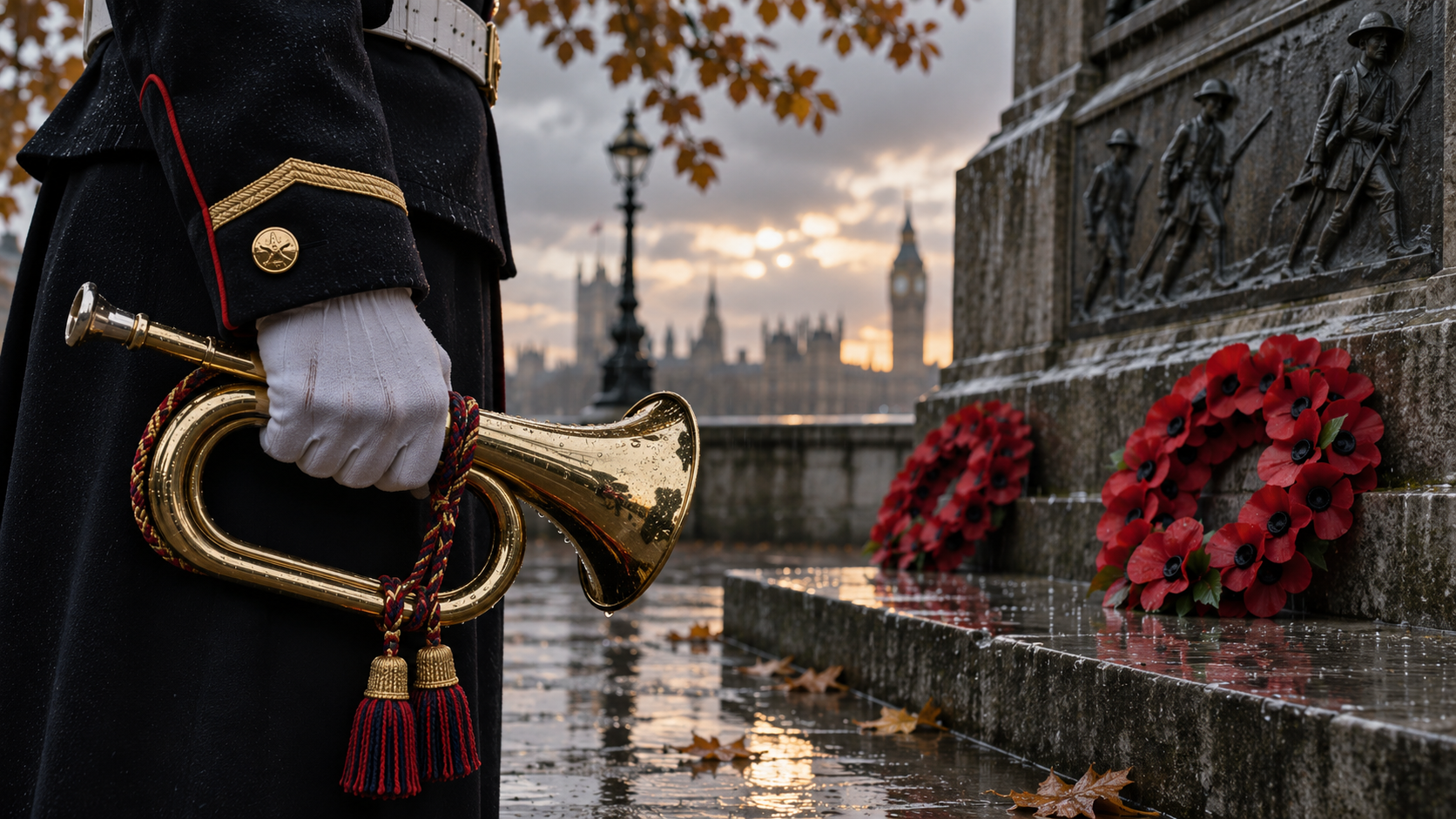
The Last Post once told soldiers that the working day was drawing to a close. At a remembrance ceremony it carries that idea of an ending into public life. A bugler sounds the call, the final note dies away and a crowd falls silent. The people being remembered have finished their service. The people standing at the memorial have something left to do.
In the Royal British Legion’s familiar order for a local act of remembrance, the Last Post precedes the two-minute silence and a second call ends it. The Legion calls that second signal Reveille. Other programmes name the Rouse. There are also ceremonies, including the national service at the Cenotaph, whose order differs. If your memory of a particular 11 November does not fit a simple three-part sequence, your memory may be perfectly good.
What Was the Last Post Originally For?
Before a public-address system could carry instructions across an encampment, a distinctive musical phrase could tell people what was happening beyond their line of sight. The British military tradition associates the Last Post with the evening rounds and the final sentry post. The day’s duties were ending and the night watch was in place. Soldiers hearing the signal did not need someone standing beside them to translate it.
The word post makes more sense if you picture a position occupied by a sentry. A round of the posts had a starting point and a finishing point. First Post and Last Post belonged to that practical vocabulary. The call described an arrangement of people in space and an event in time. Long after most listeners had ceased to know anything about setting a military watch, they could still recognise the sound of a day closing.
Its transfer to funerals draws on that original sense. The soldier’s duty is done. A familiar part of military life can mark the moment the living take their leave of a comrade. There is an economy to using an existing call for this purpose. The musician does not have to invent an account of how the person died, what they believed or what their family ought to feel.
Why Can One Bugle Hold the Attention of a Crowd?
A traditional bugle has no valves. The player produces different notes principally through breath and the vibration of the lips, selecting from the instrument’s natural series of pitches. Military calls make recognisable patterns from that limited material. Their identity lies as much in pacing, repetition and the length of individual notes as in the distance between one pitch and another.
Listen for the spaces within the Last Post. The musician is playing something whose shape many people know well enough to anticipate, yet a held note does not tell an audience exactly when the next breath will come. In a church the sound may hang above the congregation. Outdoors it can disperse almost at once. The musician has to judge the space, while the audience adjusts to hearing individual breaths in a setting usually filled with speech.
This is one reason a solo player can be so effective at a large memorial. A choir or orchestra can surround an audience with sound. A single bugler gives thousands of people one place to direct their attention. Even somebody unable to see the memorial can hear that a common event has begun. The original practical virtue of a military signal survives inside the ceremony.
Why Place Silence Between Two Sounds?
Silence in public is surprisingly hard to organise. Someone at the far end of a square may be unable to see a dignitary lower their head. A written order of service helps only people who have one in their hand. A distinctive call lets people enter a shared interval together. The second signal relieves everyone of having to look at a watch or decide who should move first.
Within that interval there is room for very different private experiences. One person may be thinking about a grandparent whose medals have come out of a drawer. Another may be remembering a recent deployment. A child may have no personal name to attach to the silence and be listening, perhaps for the first time, to a whole street standing still. The ceremony allows all three to take part without asking them to say the same words.
The number of minutes belongs to the tradition of public remembrance after the First World War. The time of day recalls the Armistice taking effect at eleven on 11 November 1918. The Last Post has a longer history. The call did not originate as a composition about that particular morning. Its older associations were available when communities began looking for a way to keep the anniversary together.
Is the Second Call Reveille or the Rouse?
Reveille belongs to the vocabulary of waking troops. The Rouse is a shorter call also associated with getting people up. Ceremonial usage varies between services and countries, and programmes can use Reveille as a familiar name for the signal after the silence. The Royal British Legion’s instructions are a good example of British organisers using that term.
A useful distinction is between the name printed in an order of service, the particular piece of music played and the function it serves. Two organisers may use different labels for the end of remembrance silence. Equally, two different calls can perform a similar ceremonial task. Someone planning a service should agree the actual music with their bugler. Someone attending needs only to follow the sequence at that service.
The contrast between evening and morning gives the ending emotional force. One call closes a day. The other summons people back to activity. For a Christian listener that pattern can suggest resurrection. A listener from another tradition may hear the beginning of ordinary duties again. The calls can support either interpretation without requiring one shared account of what comes after death.
Why Might the Cenotaph Look Different on Television?
A national ceremony has a particular choreography. At the Cenotaph on Remembrance Sunday the beginning of the silence is marked on the hour, traditionally by a gun signal. The Last Post is sounded after the silence. A viewer who then attends a local service at which the bugler plays before the silence has encountered two established arrangements.
The distinction is worth making for anyone introducing a school assembly or putting together a village order of service. Saying that the Last Post always opens every two-minute silence creates an unnecessary contradiction between what children have been told and what they can see on television. Saying what the call marks in this gathering is both more accurate and easier to understand.
Armistice Day itself always falls on 11 November. Remembrance Sunday falls on the Sunday nearest to it. People can therefore attend two services within a few days whose location, participants and sequence differ. A small workplace may keep the silence without a musician at all. The attention given to the dead is available even where the full ceremonial resources of a national memorial are absent.
Why Is the Call Still Played Every Evening in Ypres?
At the Menin Gate in the Belgian city of Ieper, also known as Ypres, local buglers sound the Last Post at eight in the evening. The association responsible for the tribute dates from 1928. The practice in the city was interrupted during German occupation in the Second World War. Its continuation makes remembrance there part of the daily life of a working city.
The setting changes the significance of the sound. The memorial bears the names of missing soldiers who have no known grave. A family reading a name cannot necessarily travel from the inscription to a marked burial place. A ceremony held where those names remain visible offers a location at which loss can be acknowledged without pretending that every individual story has been resolved.
There is also something extraordinary about the hour. Visitors may experience the ceremony once in a lifetime. The people responsible for it must make it happen again tomorrow. Traffic has to stop, a bugler has to be present and the ordinary evening has to make room. The durability of a tradition depends on people prepared to do these small practical things after the anniversary crowds have gone home.
The published order for the national service on 8 November 2026 was explicit. Big Ben’s first stroke signalled eleven, the silence lasted two minutes and the Last Post marked its end before wreaths were laid. Someone who heard that broadcast and heard a different sequence on Wednesday has an unusually clear example of how the same call can frame remembrance in two ways.
What Should You Listen for on 11 November?
Listen to the instant when the final note becomes the first moment of silence. No speaker fills the gap by explaining what you should picture. A signal once used to tell soldiers that the camp had settled for the night now asks a gathering to stand together and give two minutes to the absent. When the next call comes, notice who moves first and how the street slowly returns to its own sounds.
