Did Helena Really Find Jesus’ Cross?
A Pilgrim In Jerusalem Described The Hands That Guarded A Piece Of Wood.
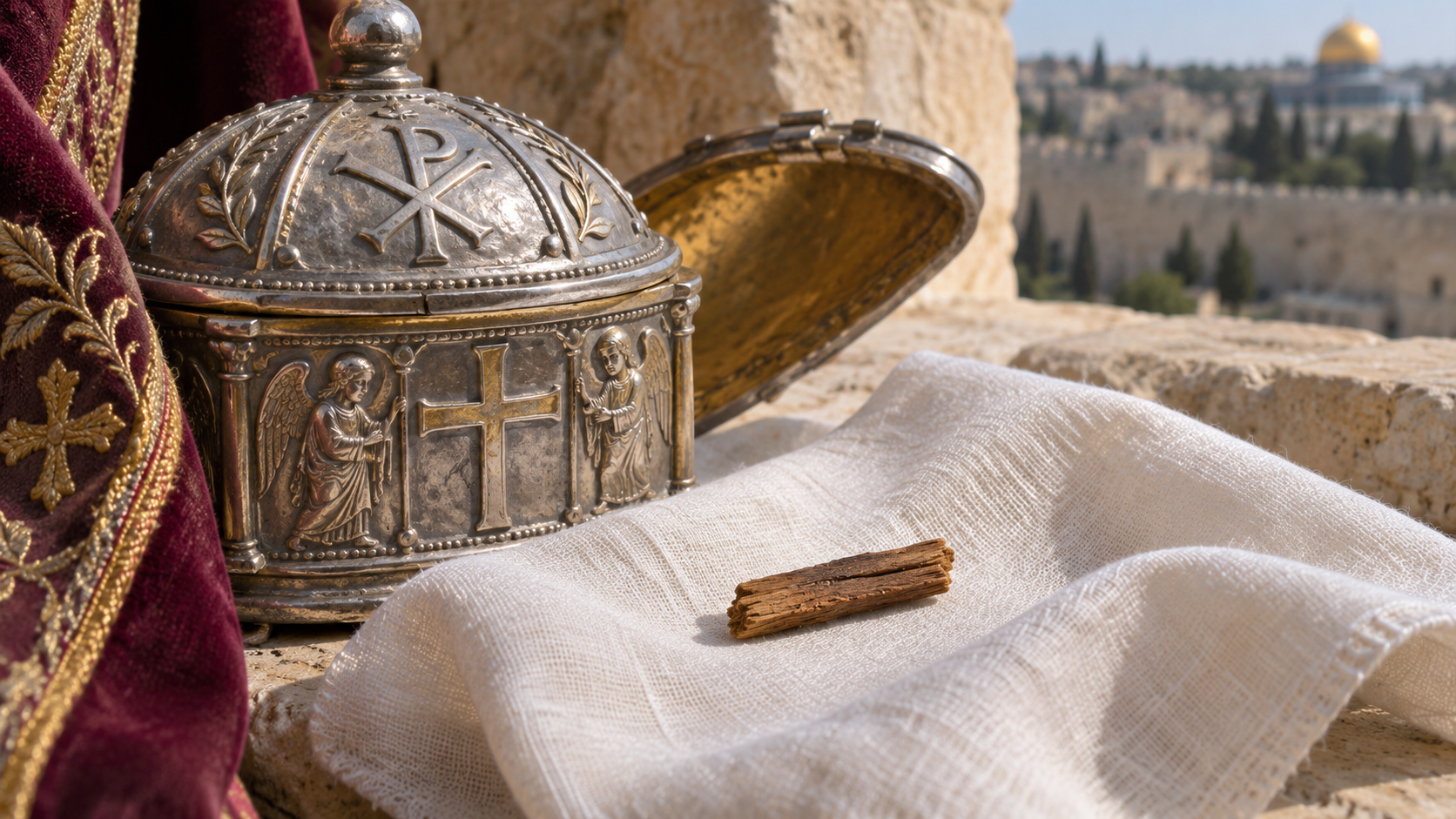
On Good Friday in late fourth-century Jerusalem, a bishop sat with a piece of wood before him. Deacons stood around the table. Worshippers approached individually. A visiting Christian named Egeria explained an extraordinary precaution. Someone, she had been told, had once bitten off a piece of the relic. Now the deacons watched closely. Few surviving sources bring us nearer to what an ancient encounter with the object called the True Cross felt like.
The scene establishes that worshippers in Jerusalem venerated wood they believed came from Jesus’ cross. It leaves nearly three centuries between the crucifixion and the earliest secure references to the relic. No surviving account follows the timber from the execution site into safekeeping. That missing part of the journey matters more to the question of authenticity than the number of fragments later displayed in European churches.
Where the Gospel Narratives Leave the Wood
The Gospel accounts move from the execution to the treatment of Jesus’ body and its burial. Joseph of Arimathea figures prominently because taking responsibility for a body required permission, a place and action before the approaching Sabbath. The cross itself drops out of the narrative. None of the accounts names someone who took the timber home, marked it or left instructions for finding it.
Later Christians wanted to touch places and objects associated with the Passion. The earliest narratives give them considerable reason to remember Golgotha and the tomb. They offer far less help to anyone identifying a particular length of wood. An execution site could retain its location even if every portable object had been removed, reused or destroyed.
When Does Wood From the Cross Enter the Record?
By the middle of the fourth century Cyril of Jerusalem refers to wood of the cross and to pieces circulating beyond the city. He speaks about something he expects a Christian audience to recognise. The references place the relic within public teaching in Jerusalem by his time. They also show that dividing and sharing it was already part of its story.
The distinction between a first surviving mention and an original discovery is crucial here. Cyril could refer briefly to a familiar relic precisely because his listeners needed little explanation. A historian reading over their shoulders cannot infer the circumstances of its discovery from its familiarity to them. We know more about what people believed the wood to be by the middle of the century than about how they first identified it.
Helena, the mother of Constantine, travelled to the Holy Land and became closely associated with the discovery in later accounts. Eusebius, writing relatively close to her lifetime, describes her activities and Constantine’s patronage of holy sites. He gives no corresponding account of Helena identifying the True Cross. Later narratives supply dramatic details, including rival crosses and tests that disclose which one belonged to Jesus. The changing detail is evidence for the development of the discovery story.
What Could Egeria Actually See?
Egeria describes a silver-gilt container, the removal of the wood and an inscription, the bishop’s hands and the movement of the people coming forward. These are details of a ceremony available to an observer. She also passes on the story about the bite. That is a detail reported to her about an earlier visitor. Even within one unusually valuable source, a historian can distinguish what the author describes witnessing from what somebody explained to her.
The arrangements make sense of a problem faced by custodians of relics. Pilgrims had travelled to get close to an object. An arrangement that prevented all contact would have frustrated a purpose of the pilgrimage. Unrestricted handling endangered the object that made the visit worthwhile. The table and the watching deacons created a compromise. Church authorities wanted future pilgrims to encounter what the present pilgrim was allowed to approach.
Later fragments travelled inside reliquaries, containers sometimes far more costly than their contents. A gold or silver setting can preserve a genuine history of people commissioning a gift, carrying it between churches or displaying it on a particular feast. It can also make a small, ordinary-looking splinter legible to someone standing several paces away. The container tells a visitor which object deserves attention.
Could a Laboratory Prove a Fragment Came From Jesus’ Cross?
Radiocarbon dating could help exclude some claims. If a well-chosen sample came from a tree that grew centuries after the crucifixion, the wood could not have supported Jesus. A first-century result would leave many possible trees and many possible uses. The test dates the growth of sampled wood within a range. It does not identify who handled the timber or what it was used for.
Identifying the species could illuminate woodworking choices or rule out an incompatible proposal. Comparing fragments could sometimes reveal that pieces came from different trees. Even a perfect physical match between two fragments would initially establish that they belonged together. To identify the cross of one named prisoner would still require an independent connection to the execution.
Those distinctions leave a substantial history intact. By the fourth century a visitor in Jerusalem could approach an object identified as the wood of the cross, watch a bishop steady it and see deacons guard it. A reader today can recover the order of that encounter almost movement by movement. What happened to the wood in the hours after Jesus died remains beyond the reach of anyone who recorded it for us.
Sources
John — The crucifixion and burial
Cambridge University Press — Egeria’s pilgrimage and the wood of the cross
Cambridge University Press — The development of the discovery tradition
Next Reads
The History of Good Friday and Easter — Trace how Christians came to commemorate the Passion.
How Much Were Judas’ 30 Pieces of Silver Worth? — Follow the betrayal money through Matthew’s account.
Why Forty Matters in the Bible — See how biblical time shaped a season of the Christian calendar.
