What a Wren Has to Do With Boxing Day
The King In The Carol Looks Out On The Day After Christmas.
Listen to the opening of Good King Wenceslas and the Christmas scene begins one day later than many listeners realise. The feast of Stephen falls on 26 December in the Western Christian calendar. That explains why the king looks out on what a British diary calls Boxing Day. The Stephen in the carol is the first Christian martyr remembered in Acts. Wenceslas was a ruler of Bohemia who lived centuries later. The English words sung in churches and school halls arrived later still.
Why bring all three together? It helps to start with what Stephen was doing before anybody threw a stone. His story begins with people whose daily needs were going unmet. So does the carol.
Before Stephen Was a Martyr, Widows Needed Food
Acts describes a dispute within the early community of believers in Jerusalem. Greek-speaking members complained that their widows were being overlooked in the daily distribution. Whatever the arrangements looked like from the centre, food was failing to reach people at one edge of the community. Seven men were chosen in response. Stephen is the first one named.
Stephen subsequently speaks publicly, faces accusations and delivers a long address about Israel’s history. His death by stoning gives him his place in the calendar of martyrs. As he dies he asks forgiveness for those killing him. A young man called Saul stands nearby. Readers who follow the book will meet him again under the name Paul, speaking for the faith whose followers he once helped persecute.
Acts supplies no date of 26 December for the stoning. A feast day is a public appointment for remembrance. It can have an enduring place in a community’s year even where the calendar date of the original event is unknown. Here the positioning creates a remarkable change in tone. One day churches celebrate a birth. The next they remember what happened to someone who committed his life to the child whose birth they have just celebrated.
Why Wenceslas Goes Out Into the Snow
The historical Wenceslas was a tenth-century ruler of Bohemia, remembered as a saint after his violent death. The familiar English carol was published in 1853 with words by John Mason Neale. A medieval ruler and an early Christian martyr meet in a Victorian song because one is imagined acting on the other’s feast. Stephen does not appear as a character and there is no journey to Bethlehem.
Wenceslas sees a poor man collecting fuel. The king asks his page where the man lives and sets out with help. The page becomes cold and exhausted and the king tells him to walk in his footsteps. As a piece of storytelling, the second difficulty does something the first alone could not. A man wealthy enough to offer supplies has to adjust his pace and conduct to the strength of someone actually accompanying him.
The carol has survived in part because people can sing it as an exchange of voices. The page knows where the poor man lives. The king has access to the resources. Neither can simply remain at the window if there is to be a story. Set alongside the selection of seven people in Acts, the shared interest is practical. Recognising need begins the episode. Finding a way to deliver help carries it forward.
Where the Boxes and the Wren Come In
The British name Boxing Day belongs to traditions of Christmas boxes or seasonal gifts associated with service and giving. Historians differ about the route by which particular practices produced the name. The martyr’s story supplies no box, and the holiday’s English name supplies no explanation for Stephen’s death. Several ways of observing a day can survive alongside one another without deriving from a single founding event.
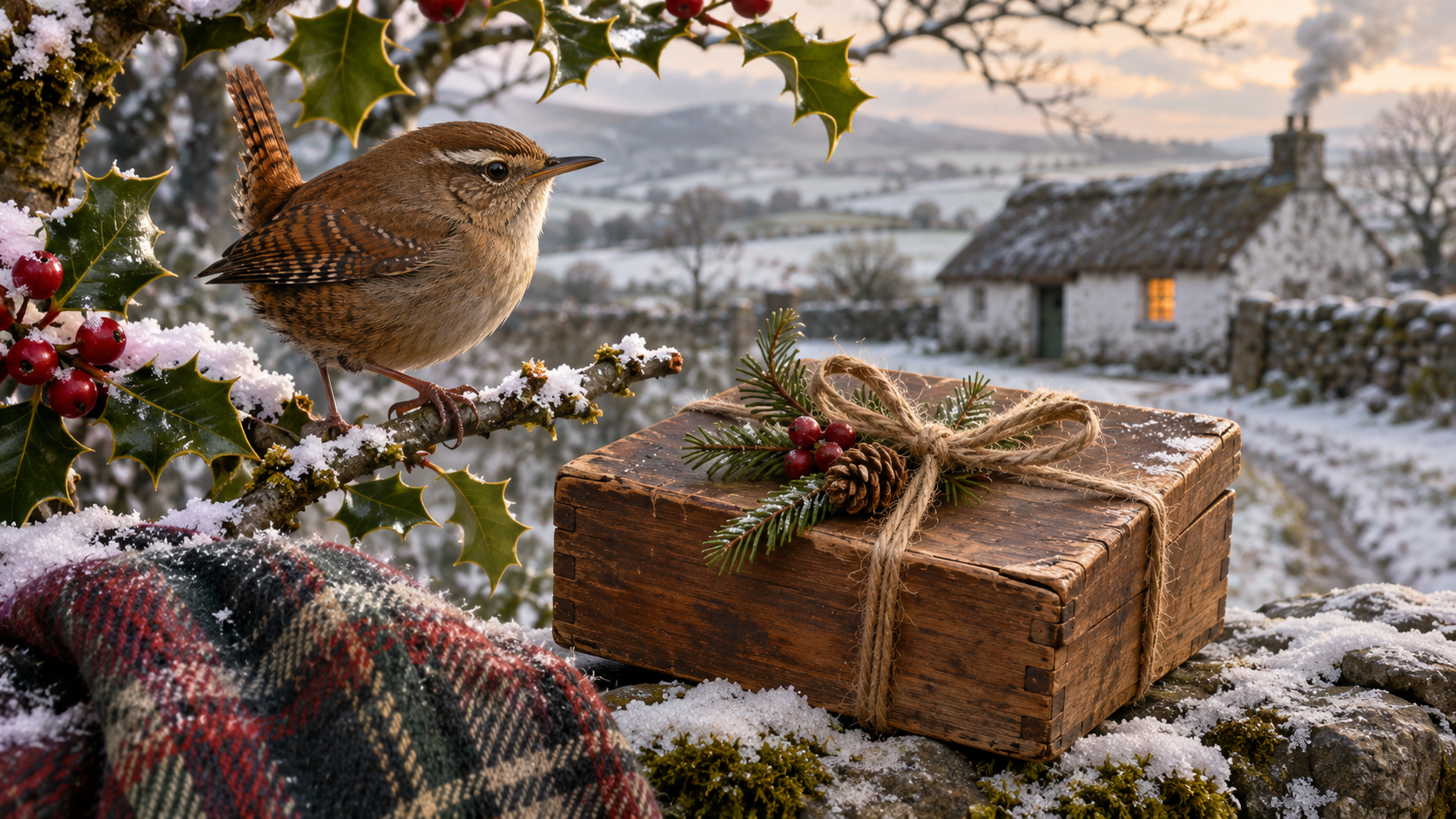
In parts of Ireland, St Stephen’s Day also belonged to the Wren Boys. Groups in disguise visited houses with music and a wren custom that varied locally. Straw costumes survive in museum collections. Held in the hand, a straw hat might seem an unlikely witness to the history of Christian festivals. Seen as something a neighbour wore to another neighbour’s door on a particular December day, it becomes easier to understand.
A church could announce Stephen’s feast in the morning while a household recognised visitors by their music later in the day. Neither observance required everyone to agree on an explanation for the other. Calendars gather local practices as well as prescribing services. The same date can carry a martyr’s name in Ireland, the memory of a Christmas box in England and a Bohemian ruler’s footsteps in an English carol.
The next time the opening verse comes round, listen for the change of viewpoint. The first person the king notices is somebody outdoors gathering what he needs to keep warm. That small act of noticing is the link with Stephen that survives even for a listener who has forgotten whose feast falls the day after Christmas.
Sources
Acts — The distribution of food and the choice of Stephen
Good King Wenceslas — Words and publication history
National Museum of Ireland — A straw hat and the Wren Boys
Next Reads
Why Is It Called Boxing Day? — Explore the Christmas boxes and seasonal gifts behind the British name.
Why Is Christmas on 25 December? — Read the wider history of the date Christians chose for the Nativity.
The History of Good Friday and Easter — Trace how Christians came to commemorate the Passion.
