Noah's Forty Days Were Only Part of the Flood
Genesis Counts The Rain For Forty Days And Keeps Noah Waiting Long Afterwards
Ask how long Noah spent in the ark and forty days is an understandable answer. It is how long the rain falls. Yet by the time the ground is dry enough for the passengers to leave, Genesis has carried them through a sequence of dated events extending across roughly a year. Forty describes a particular stretch of the disaster. Reading it as the length of the entire voyage leaves Noah opening the door into a world still under water.
That difference is a good guide to forty throughout the Bible. It can mark a sustained period of danger, waiting, preparation or testing. The unit matters, as does the person doing the waiting. A scout spends forty days examining a country. A generation spends forty years living with the consequences of what the scouts report. Centuries later Christians made the forty days of Jesus in the wilderness a pattern for Lent. In each case it pays to ask exactly when the counting starts and what happens after it stops.
The Flood Has More Than One Clock
Genesis 7 announces rain for forty days and forty nights. The waters rise, the ark floats and the familiar landmarks disappear. The same chapter gives a longer figure of 150 days for the waters prevailing over the earth. Genesis 8 then supplies dates for the ark coming to rest and for the appearance of the mountain tops. Something can have stopped getting worse long before it is possible to go home.
There is another forty in the account that an abbreviated retelling can easily swallow. After the mountain tops become visible, Noah waits forty days before opening the window and sending out birds. The raven and the dove become ways of testing conditions outside the ark. Further waits of seven days follow. The return of a bird carrying an olive leaf answers one question about the world outside. It is still some time before the family receives the instruction to leave.
These intervals belong to different actions. Adding every number mentioned as if none of the periods could overlap is as misleading as treating all the measurements as alternative answers to one question. A diary might record how long it rained, when the road reopened and the day the family moved back into the house. Nobody would add those figures together without first asking where on the calendar each belonged.
Genesis anchors the account in years of Noah's life. The flood begins in his six hundredth year and the last departure instructions come in the next. The extended wait gives the final command weight. Noah does not take the first sight of a summit as permission to put the animals ashore. For the people inside, the relevant threshold is an earth capable of supporting life again. A neat forty-day voyage would miss the long recession of the waters on which that outcome depends.
Forty Days On Sinai And A Crisis Below
In Exodus 24 Moses enters the cloud on the mountain and remains there forty days and forty nights. From the perspective of the people below, the decisive feature of that interval is an absence. They have seen the leader who brought them out of Egypt go up a mountain. They cannot see what he is doing there, and in Exodus 32 their uncertainty about what has become of him helps precipitate the episode of the golden calf.
The reader has information the waiting people lack. The intervening chapters contain instructions about worship and the sanctuary. While Israel wonders where its mediator is, the narrative has been occupied with how God will dwell among the people. Reading those chapters rapidly can disguise the effect of their placement. The longer the reader attends to instructions from the mountain, the longer the camp has had to wait without hearing them.
Later Moses returns to the mountain after the tablets have been broken. Exodus 34 again describes forty days and nights and a fast. That second period belongs to the renewal of a relationship damaged during the first absence. Saying simply that Moses spent forty days receiving commandments flattens the crisis in between. The recurrence lets a reader measure what has changed for the people below when their leader goes up again.
Deuteronomy's retelling places particular emphasis on Moses' intercession. His time before God is bound up with pleading for the people. A long fast can therefore signify several things depending on where we enter the story. It can accompany revelation, express grief about communal failure and mark the cost of acting as an intermediary. The repeated duration creates the comparison. The narrative setting supplies the meaning.
Why Forty Days In Canaan Cost Forty Years
Numbers 13 sends scouts to examine the land towards which the Israelites have been travelling. Their instructions concern recognisable features of an unfamiliar country. What are the inhabitants like? Are their settlements fortified? What does the soil produce? They return after forty days with fruit and a report. By the time the expedition ends, the people have considerable information. Their crisis concerns what conclusion to draw from it.
A fertile country can also contain formidable opponents. The scouts' accounts set those features beside each other, and disagreement about their significance divides the community. The crowd's fear hardens into a wish to turn back. In Numbers 14 the judgement explicitly links forty days of reconnaissance with forty years in the wilderness, a year corresponding to each day. Here the text explains the exchange of units itself.
That is firmer ground than a general theory that forty always means a period of testing. Testing is certainly part of the larger wilderness story, but Numbers gives this particular period a rule and a cause. The people who rejected the prospect of entering the land will spend their remaining lives outside it, with named exceptions. Children whose future the adults feared for will have a different relationship to the promise.
Think what happens to the emotional scale when days become years. A scout can return from his expedition to the family who saw him off. Forty years is long enough for children to grow up and parents to die. The transformation of the unit turns an expedition's duration into the horizon of a generation. Calling forty a round number conveys very little of the loss the narrator has built into that equation.
Deuteronomy 8 looks back on the wilderness with a further emphasis. Hunger and manna have taught Israel dependence, and prosperity in the land will bring a new danger of forgetting. The narrative anticipates people living in good houses and taking personal credit for the abundance they enjoy. The wilderness years therefore reach into the future. Remembering what it was like to have no settled food supply should change how a prosperous household understands its own success.
A Forty-Day Journey And A Forty-Day Warning
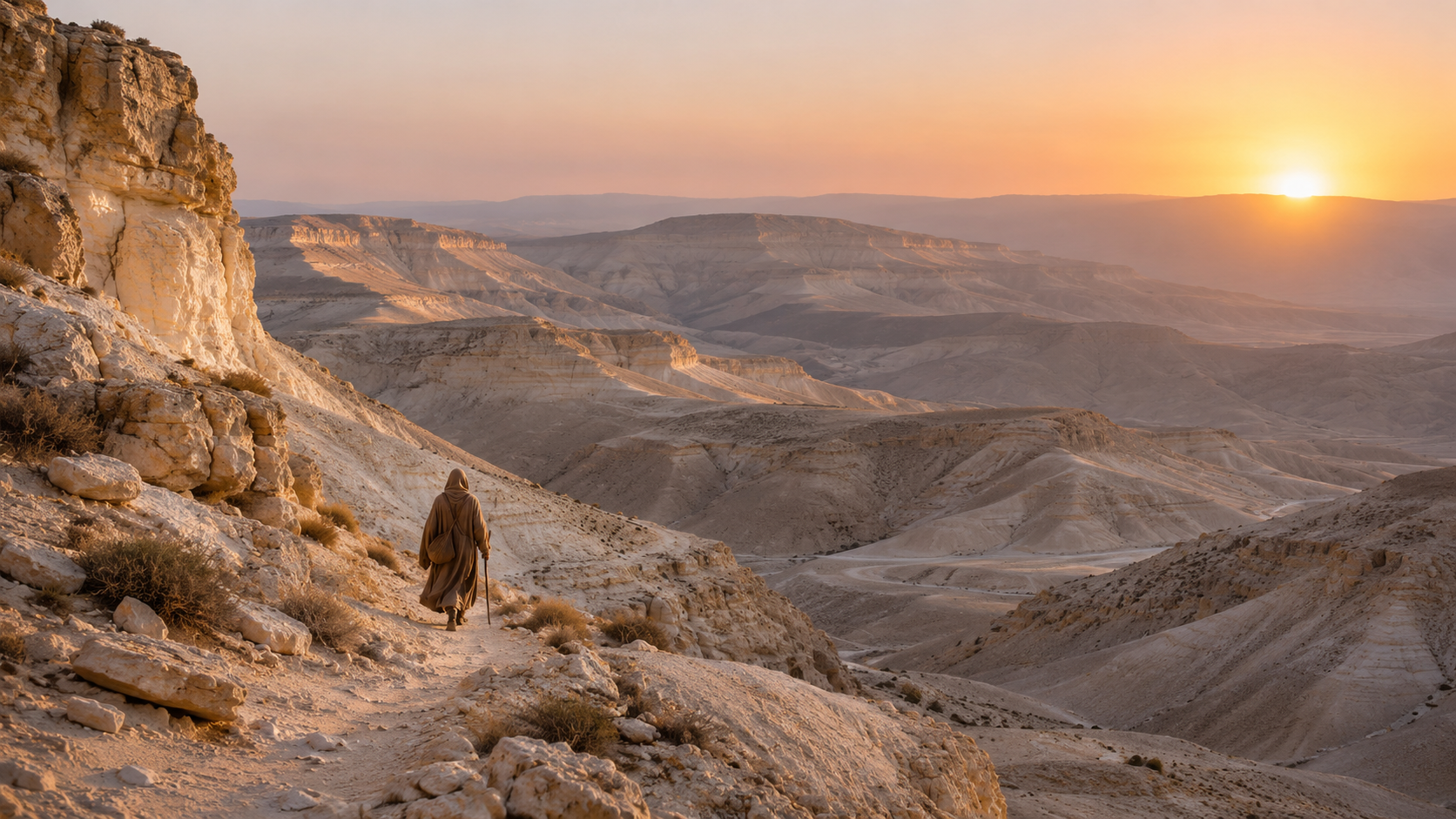
Elijah's journey in 1 Kings 19 gives forty a quieter setting. Frightened and exhausted, the prophet lies down and is given food and water. Sustained by the food, he travels forty days and nights to Horeb, the mountain of God. Remembering Moses can enrich the passage, especially once Elijah reaches the mountain. The physical details also deserve attention on their own. A man at the end of his strength first needs to eat and sleep.
At Horeb his despair does not vanish merely because he has made a journey of the right length. He voices his complaint, encounters God and receives further work to do. The forty days have taken him from one place to another and put him in a setting associated with an earlier prophet. They have guaranteed neither a particular state of mind nor a reward earned by covering the distance.
Jonah announces a quite different forty in Nineveh. In the Hebrew text the city has forty days before its overthrow. The inhabitants respond, and the threatened destruction does not take place. A period offered as a warning can succeed precisely when the predicted event fails to arrive. If the Ninevites had treated forty as an unalterable appointment with disaster, their response would make little narrative sense.
The ending turns the matter back on the messenger. Jonah is angry about the mercy shown to the city. He has delivered words to other people whose implications he finds difficult to bear himself. Compare that with the scouts. In Numbers the crucial decision follows the forty days. In Jonah a decision made within the interval changes what happens at its end. The same quantity of time gives two communities different kinds of responsibility.
Why Jesus Answers The Tempter With Deuteronomy
In Matthew 4 the Spirit leads Jesus into the wilderness following his baptism. He fasts forty days and forty nights. The first temptation then presses on his hunger, challenging him to turn stones into bread. His answer draws on Deuteronomy 8, the passage recalling Israel's hunger and the provision of manna. The link to the wilderness generation is present in the words Jesus chooses to speak.
Two more answers draw on Deuteronomy. One concerns testing God. The other concerns whom to worship. These responses make the earlier book a much more precise guide to the episode than an all-purpose dictionary of biblical numbers. Jesus faces questions about food, protection and authority. He answers through texts originally addressed to a people learning how to live with their dependence on God.
The Gospel writers also tell the episode at different speeds. Mark devotes only a few lines to forty days in the wilderness, mentioning wild animals and the ministry of angels. Matthew and Luke give exchanges between Jesus and the tempter, arranging the final two temptations in different orders. A familiar retelling can borrow Mark's vivid details and Matthew's sequence so effortlessly that the reader no longer knows which emphasis comes from which book.
Acts 1 gives Christians another forty associated with Jesus, this time after the Resurrection. The risen Jesus appears to his followers over forty days and speaks about the kingdom of God. That period stands behind the Christian observance of Ascension Day on the fortieth day of Easter when counted inclusively. A person looking only for hardship in every biblical forty would have difficulty explaining why time spent with the risen Jesus belongs under that heading.
How Lent Acquired Its Forty Days
The Gospels describe Jesus fasting in the wilderness. They do not instruct every Christian congregation to count backwards from Easter and reproduce the fast. Lent grew through the practices of communities preparing to celebrate Easter. Candidates for baptism received instruction, people seeking reconciliation prepared to return to communion, and other Christians joined in a period of prayer, self-examination, fasting and giving.
Jesus' forty days supplied a powerful model for the season. Churches could give their members a shared period in which to practise something they had heard read in the Gospel. That still left decisions about when the period should begin, which days were days of fasting and where the season ended. Different Christian traditions arrived at different arrangements. A biblical model does not automatically generate a universal calendar.
The familiar Western calculation runs from Ash Wednesday through Holy Saturday inclusive. That gives forty-six calendar days. Set aside the six Sundays and forty days remain. Sundays have a distinctive place as celebrations of the Resurrection even within a penitential season. Calling them Sundays of Lent and excluding them from this traditional count of fasting days are perfectly compatible ways to describe them.
There is a further distinction in the modern Roman Catholic liturgy. Lent ends before the evening Mass of the Lord's Supper on Holy Thursday, when the Easter Triduum begins. The forty-day fasting calculation and the formal boundaries of the liturgical season answer different questions. Someone who counts backwards from Easter and someone looking for the start of the Triduum can therefore give different endpoints with good reason.
In the Western calendar for 2027, Ash Wednesday falls on 10 February and Easter Sunday on 28 March. The dates move because Easter moves. The interval gives the period its shape even in a year when the feast comes relatively early. In a household planning a Lenten discipline, the practical question about Sundays may depend on the discipline chosen and the tradition followed. There is no instruction in Matthew that resolves every subsequent custom.
How Venice Gave Quarantine Its Forty
The Italian word quaranta means forty. In Venice ships arriving from affected ports could be required to wait at anchor for forty days before landing. A city whose prosperity depended on the arrival of people and goods had a practical problem. A traveller might appear well on arrival and fall ill later. Holding arrivals apart for a period created an opportunity for illness to become apparent before they mixed with the population.
An important early regulation used a different number. In 1377 Ragusa, now Dubrovnik, required a thirty-day period of separation for arrivals from places affected by plague. Such practices spread and the interval came to be extended to forty. The history of quarantine therefore contains both an earlier documented thirty-day rule and a later forty-day practice that gave the English word its ancestry.
Why precisely forty? Historians have considered practical experience and the cultural familiarity of biblical periods, including the fast of Jesus. The etymology is much firmer than any claim about a port official's religious motive. A word can reliably preserve the length of a waiting period without telling us who chose the duration or what argument carried the decision.
The most revealing feature of the word today is that a quarantine can last fewer or more than forty days. An old administrative interval has become the name for a practice. Lent likewise carries a biblical number into calendars whose details require some explaining. Open Genesis again and the distinction is already there. Forty days can tell you when to stop counting the rain. To know when a person may step outside, you have to keep reading.
Sources
USCCB — Genesis 8 — The receding waters, additional intervals and departure from the ark.
USCCB — Numbers 14 — The explicit correspondence between days of scouting and years in the wilderness.
USCCB — Matthew 4 — The fast and the answers drawn from Deuteronomy.
Church of England — Lent — Baptismal preparation, reconciliation and the wilderness model.
USCCB — What Is Lent? — Roman Catholic observance and the transition to the Triduum.
Emerging Infectious Diseases — Etymologia: Quarantine — The thirty-day Ragusan rule, its later extension and the uncertainty about motive.
Next Reads
The History of Good Friday and Easter: How a Sacred Story Became a Global Season — How the Passion narratives became observances in the Christian year.
Why the Number Three Keeps Appearing in Jesus' Life and the Bible — How to distinguish a biblical count from a number supplied by tradition.
The Abrahamic Religions Explained: How One Ancient Idea of God Changed the World — The Jewish setting from which Christianity emerged.
