Why Some Ancient Bibles Give the Beast's Number as 616
One Letter In An Emperor’s Name Accounts For A Fifty-Point Difference Between Ancient Copies
Subtract fifty from the most notorious number in the Bible and you get a number that also appears in the Bible. Some ancient copies of Revelation give the number of the beast as 616. Long before either number appeared on a cinema screen, Christian readers knew there was a disagreement about what to copy at the end of chapter thirteen.
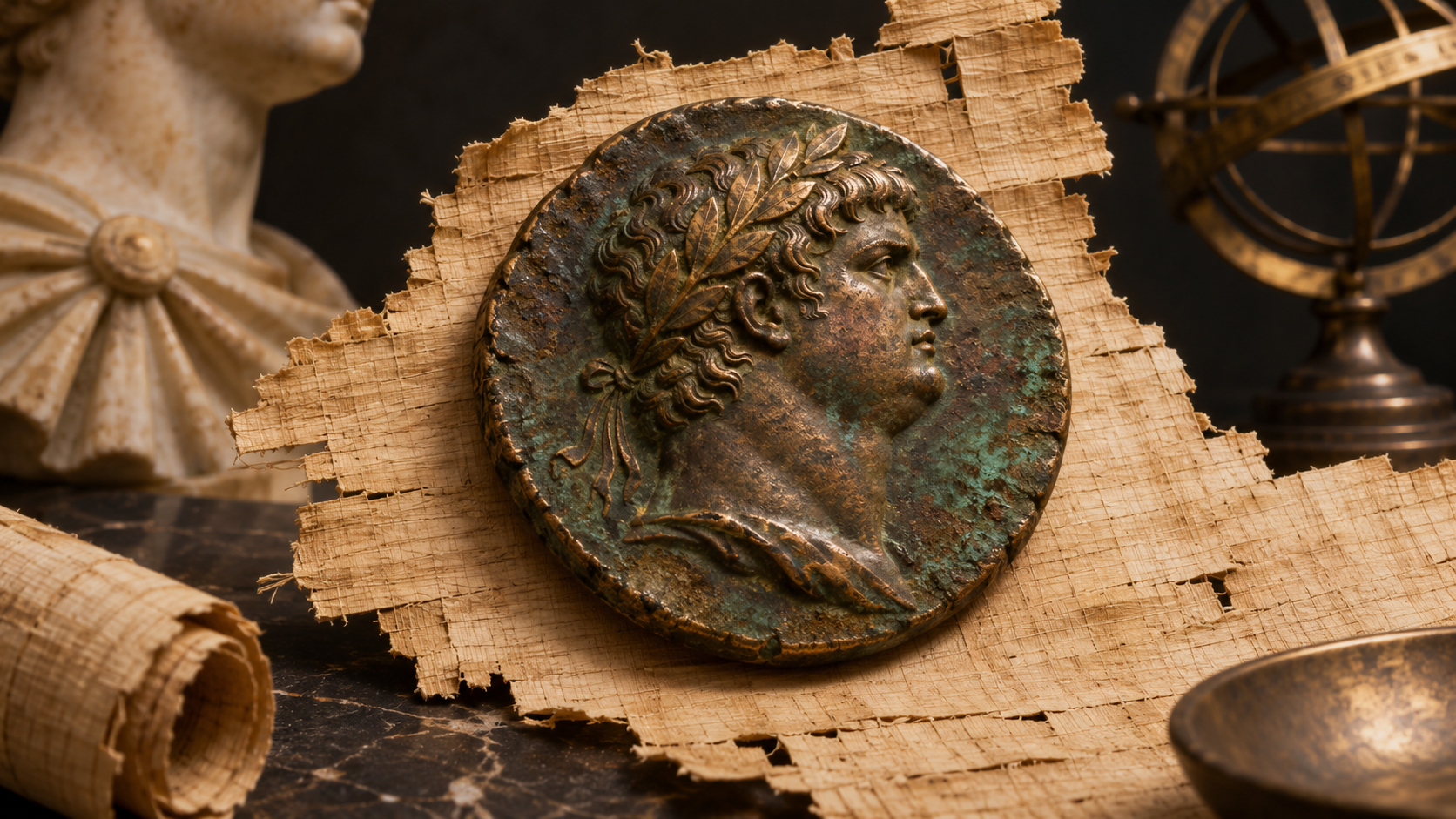
One leading explanation can account for both totals. Write the emperor's name and title in Hebrew letters, using the form Neron Caesar, and their numerical values add up to 666. Use Nero, the form more familiar to a Latin speaker, and the final letter worth fifty disappears. The result is 616. That makes Nero a particularly persuasive historical candidate. It also leaves an uncomfortable question for anyone who thinks the case is closed. How do we know which language, spelling and title the author expected his audience to use?
Before There Is A Number There Is A Market
Revelation 13 introduces a beast rising out of the sea. Its appearance combines features of different animals and its authority derives from a dragon. A second beast emerges from the land and promotes the authority of the first. There are images, demands for worship and a mark imposed on people across divisions of wealth and status. The person trying to understand the number has arrived near the end of a political and religious drama.
The pressure reaches the marketplace. Buying and selling depend on carrying the mark associated with the beast's name or the number of its name. An abstract dispute about worship now bears directly on whether a person can participate in ordinary economic life. A household that needs to sell its produce or buy its dinner cannot easily put the matter aside until the next religious ceremony.
Only then does the writer invite someone with understanding to calculate. The instruction implies that a reader could do something with information available in the author's world. It also directs attention towards a name connected with a person. The Greek wording has prompted discussion of whether it can also suggest a human number. Neither possibility makes the passage an invitation to treat every appearance of the quantity six hundred and sixty-six as a threat.
An ordinary till receipt can total £6.66 without anyone having named a ruler, required an act of worship or restricted a customer's future access to trade. Those details make the biblical episode distinctive. Remove them and the supposed resemblance resides entirely in three printed figures, arranged using a system of numerals quite different from the ones an ancient reader might have seen.
How Letters Could Add Up To A Name
Ancient Greek and Hebrew used letters with numerical values. That made it possible to add the letters in a word or name and express the result as a number. Calculating words in this way is often called gematria, especially when discussing Hebrew or Jewish interpretation. The principle is simple enough to demonstrate. A written name has a total if the reader knows which alphabet and numerical values to apply.
The calculation is much easier in one direction than the other. Give several readers the same spelling and the same alphabet and they should obtain the same sum. Give them only the sum and they can produce different names. Addition discards the order of the letters and tells the solver nothing directly about the length of the original word. Even before spelling variations enter the picture, a number is a poor unique identifier.
Consider the difference between recording a score and reconstructing a game. A final score can confirm whether a proposed sequence of plays is possible. It cannot recover every play that produced it. In Revelation the reader has other clues, including a beast with royal authority, an imperial setting and a focus on worship. Those details are what turn a potentially endless word game into a historical question with better and worse candidates.
Revelation itself moves between languages. In chapter nine the author gives names in Hebrew and Greek for the angel of the abyss. Chapter sixteen introduces a place name in Hebrew. A Greek-speaking author could expect the audience to recognise that another language might matter, or expect a knowledgeable member of a congregation to work through the clue for others. Even so, the instruction in chapter thirteen omits the explicit language label found elsewhere.
The Nero Caesar Calculation, Letter By Letter
Start with the Greek form of the imperial name, Neron, followed by the title Caesar. Represent it in Hebrew letters as נרון קסר. Read Hebrew from right to left. In English transliteration the sequence is NRWN QSR. The W represents the letter waw, used here in writing the vowel sound. Some transliterations use a V for the same letter. Its numerical value in this calculation remains six.
In Neron, the first nun is worth fifty. Resh contributes two hundred. Waw contributes six. The final nun contributes another fifty. Together those four letters make 306. Hebrew writes nun differently at the end of a word, which is why the first and last characters in the name look different on the page. They represent the same letter and have the same value in this reckoning.
For Caesar, qoph is worth one hundred, samekh sixty and resh two hundred. The title therefore contributes 360. Add that to the 306 supplied by Neron and the result is 666. A reader need not assign a special meaning to each six. The hundreds, tens and units are simply the result of adding the letters of a name and title.
Now drop the last nun from Neron. The shorter name contributes 256 while Caesar still contributes 360. The sum becomes 616. Exactly one known difference in the form of the emperor's name produces exactly the distance between two readings of the verse. This is a stronger argument than finding an arbitrary name whose letters happen to produce 666. A second piece of evidence has fallen into place without a wholly new set of rules.
There is nevertheless a choice embedded in every stage. The solver starts with an imperial name familiar in Greek or Latin, writes it in a Semitic alphabet and includes a title. Someone looking only at the English letters of Nero Caesar will never see the intended arithmetic. A modern calculator that repeatedly tries alternative spellings, omits inconvenient initials or adds titles until something fits has reproduced the flexibility of the technique while dispensing with the historical controls.
What The 616 Manuscripts Actually Establish
Around the end of the second century, Irenaeus discussed the disagreement in Against Heresies. He favoured 666, appealing to copies he considered reliable and to testimony concerning people who had known John. He was aware of copies with the lower reading and regarded it as an error. Whatever one makes of his reasoning, the disagreement was already old enough to need attention within early Christianity.
Papyrus 115 is a surviving Greek witness to 616. Its fragmentary condition can make a modern photograph underwhelming to anyone expecting the complete page of a handsome Bible. Small pieces matter because a few legible characters can preserve a reading otherwise known from later copies or reported by a writer with strong opinions about it. The papyrus gives physical evidence that a copyist actually wrote the lower number.
The reading is also found in Codex Ephraemi Rescriptus, a Greek manuscript known to textual scholars by the letter C. Modern editors weigh such witnesses alongside the evidence for 666. They consider relationships among manuscripts, the age and distribution of readings and the likelihood of changes during copying. Counting surviving copies as independent votes would give too much weight to a reading copied many times from a common ancestor.
There are three questions here. Which number did the author write? Why did another reading arise? Who or what did the author mean? Even if a scholar settles on 666 for the first question, a copyist could have produced 616 by accident, adapted the number deliberately to a familiar form of Nero's name, or reproduced an alteration whose reason was already forgotten. The manuscript preserves the reading. It does not preserve the conversation in the copying room.
The difference also changes what it means to call a modern Bible accurate. An edition that prints 666 in the main text and mentions 616 in a footnote can communicate two judgements at once. Its editors have chosen the reading they think most likely to have stood in the earlier text. They have also judged the alternative sufficiently ancient and significant for a reader to see it. A footnote in this case gives access to evidence that a single clean line of print would conceal.
There is a further historical irony. Irenaeus, much closer to the early circulation of Revelation than a modern reader, did not hand down Nero as the known solution. He discussed other candidates and urged caution about confident identifications. His proximity makes his uncertainty evidence worth taking seriously. It does not cancel the linguistic argument for Nero. It does prevent us from claiming that the answer passed down intact from the first congregations.
Why An Emperor Fits The Beast
Revelation addresses churches in Roman Asia. Its visions draw on a world in which rulers, civic institutions and religious honours could be closely connected. The beast can claim worship, exercise power over peoples and survive what appears to be a mortal blow. Later in the book, the imagery of heads, hills and kings invites readers to think about a city and a succession of rulers. Rome is a far more economical starting point for those clues than a distant future administration unknown to the audience.
Nero died in AD 68. Stories that he had survived or would return helped give his memory a political life after his death. A feared ruler who can seem to return provides a possible context for the wounded head that recovers. The image can also describe the resilience of an empire that survives the death of an individual emperor. The two scales of interpretation reinforce one another if a ruler's name stands for the authority of the whole order.
This helps with a common question about dating. If Revelation was written towards the end of the first century, as many scholars think, why encode the name of a dead man? A writer can invoke a previous ruler as a model of what later rulers represent. The possibility is especially strong when stories of that ruler's return have continued to circulate. A Nero interpretation need not settle the date of composition to the precise year of his reign.
A caution runs the other way too. Showing that imperial power fits the imagery does not establish a Roman regulation requiring every shopper to display a particular brand or certificate in order to buy bread. Revelation is a vision full of composite animals, cosmic conflict and startling acts of judgement. Its capacity to expose the connection between allegiance and livelihood does not depend on reading every detail as the text of an actual trading law.
The Best Objections To The Nero Reading
The language switch is the first serious objection. A Greek-speaking listener must recognise the right imperial name, choose a Semitic spelling and perform the arithmetic. That is possible in the author's cultural world. It is also a sequence of decisions for which the verse offers limited direct guidance. If those who first heard the book knew an oral clue, that clue has not survived independently in a form that resolves the dispute.
A second objection is that 616 could have arisen for a reason independent of Nero. P. J. Williams, writing about Papyrus 115, explored the possibility that the written number visually echoed abbreviated designations for Jesus. In a book concerned with imitation and rival claims to authority, visual resemblance might have interested a scribe or reader. The proposal need not displace Nero to demonstrate that the manuscript cannot bear the weight of a mathematical proof.
Irenaeus himself discussed names including Lateinos and Teitan. The first can suggest the Latin or Roman world, the second evokes a different set of associations. Modern readers can propose still more possibilities. An interpretation becomes weaker when it explains only the total, needs an eccentric spelling and says little about the beast's conduct. Nero survives that comparison unusually well because the historical associations and the alternative total each supply a further test.
A popular symbolic reading sees repeated sixes falling short of seven, a number often associated with completion. It can express a theological judgement about the beast's pretensions. As a solution to the instruction to calculate a name, however, it has a weakness. Six hundred and sixty-six is a numerical total. An ancient reader might encounter distinct signs for six hundred, sixty and six. The visual impact of three identical modern digits was never essential to writing the number.
How The Omen Put Three Sixes On A Child
The 1976 film The Omen gave the number an image capable of surviving far beyond the cinema. Robert Thorn searches the scalp of his adopted son Damien and finds a birthmark in the form of three sixes. A frightened parent can see what the audience needs to know. There is no transliteration, calculation or disputed manuscript to slow the recognition.
The film makes a considerable change to the biblical mechanism. Revelation's mark regulates allegiance and participation in economic life. Damien's mark reveals an identity concealed even from the people raising him. That change is exactly what makes the scene work as domestic horror. A father can discover the truth by examining his child's body. To understand the biblical beast, a reader has to examine what happens to a community.
Iron Maiden gave the phrase another public life with the 1982 album and song The Number of the Beast. Spoken biblical language, a repeated refrain and the imagery of heavy metal make the number recognisable by ear. Listeners can join in without accepting a particular account of Revelation or even knowing that some manuscripts give another number. Popular music achieved something an ancient scribe could scarcely have anticipated. It gave one textual reading an exceptionally memorable tune.
Why The Mark Became A Microchip
The connection to modern identification technology begins with a real feature of the text. Revelation imagines a system that can exclude a person from commerce. A society increasingly dependent on machine-readable credentials can readily picture what losing access would mean. Speculation about implanted chips adds a resemblance of location, since the vision places a mark on the hand or forehead. Neither parallel establishes that the author foresaw an electronic device.
One historical case shows how quickly an invented mechanism can acquire the appearance of independent confirmation. Scholarship on the supposed Beast computer in Brussels traces a story about a vast machine tracking people through identifying numbers. It circulated beyond the fictional setting in which audiences encountered it. Once someone repeats an image as a report about a computer that really exists, the resemblance to Revelation can appear much too precise to be accidental. The precision was built into the story from the outset.
A chip can store or communicate an identifier. Whether a person can buy food depends on institutions that decide which credentials to accept and what happens to people who lack them. Return to the passage and that second issue is where its political force lies. The beast has agents, demands worship and punishes dissent through exclusion. For its earliest audience, an emperor's name could put a human face on that power. The most interesting thing about 616 is that it may preserve the moment someone recognised the same face under a slightly different spelling.
Sources
USCCB — Revelation 13 — The beasts, compulsory allegiance, market access and instruction to calculate.
Irenaeus — Against Heresies, Book V, Chapter 30 — Early testimony about the two readings and competing names.
P. J. Williams — P115 and the Number of the Beast — The papyrus, spelling argument and possible alternative explanation.
British Film Institute — The Omen at 40 and the Bloodline of Occult Cinema — The number’s role in the discovery about Damien.
Iron Maiden — The Number of the Beast — The 1982 album and its title track.
Journal of the American Academy of Religion — The Beast Computer of Brussels — How a fictional tracking computer entered modern prophecy culture.
Next Reads
Why the Number Three Keeps Appearing in Jesus' Life and the Bible — How to distinguish a biblical count from a number supplied by tradition.
The Abrahamic Religions Explained: How One Ancient Idea of God Changed the World — The Jewish setting from which Christianity emerged.
The History of Good Friday and Easter: How a Sacred Story Became a Global Season — How the Passion narratives became observances in the Christian year.
