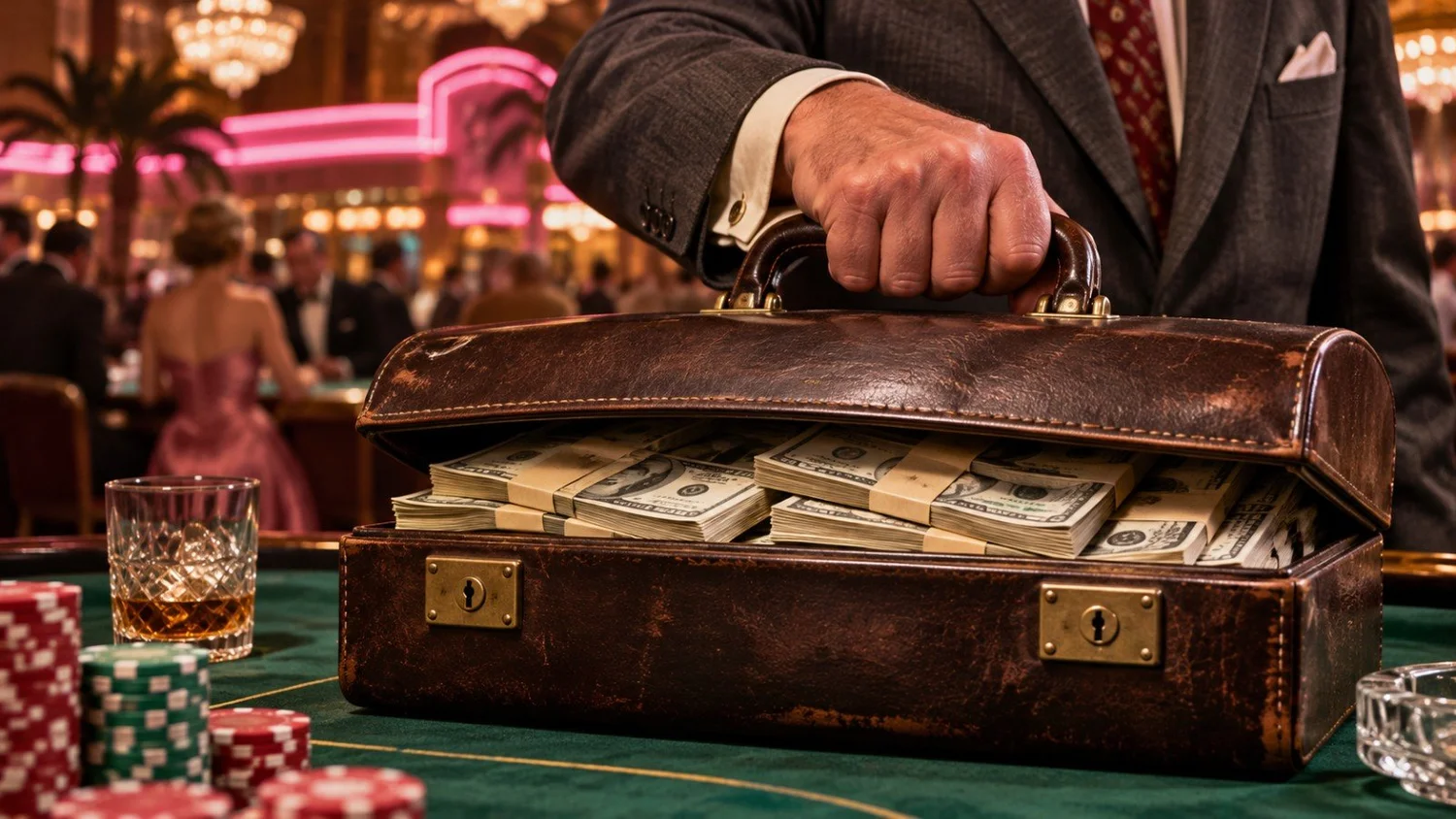
Why Did America's Gangsters Bet Everything on a Desert Railway Town?
In 1940 Las Vegas was a railway stop with a population of about 8,400. Forty years later it was the gambling capital of the world, lined with resorts that drew millions of visitors a year. In between, for roughly four decades, organised crime supplied much of the money, the expertise and the ambition that built the Strip, and took a hidden cut of almost everything that went across its tables.
The Mob did not invent Las Vegas gambling. Nevada had legalised it before any gangster arrived, and the first resort on the Strip was built by a California hotelier. What the syndicates brought was capital that banks would not lend, operators who had spent years running illegal casinos back east, and a business model that made the casino the centre of a luxury resort. In return they took the skim: untaxed cash removed before the count and carried to crime families in New York, Chicago, Cleveland, Kansas City and Milwaukee.
This explainer follows the whole story: why gangsters went to Nevada, what Bugsy Siegel really did at the Flamingo, how the skim worked, how a truck drivers' pension fund became the Mob's bank, and how regulators, corporations and the FBI finally pushed the old families out in the 1980s. It also separates the legend from the record, because Hollywood has blurred both.
The Short Answer
- Nevada made it legal. The state legalised gambling in 1931, giving organised crime something it could not get anywhere else in America: a lawful casino business.
- The Mob supplied the money and the know-how. From the mid-1940s, syndicates from across the country invested in Las Vegas casinos, which banks were unwilling to finance, and installed experienced gambling men to run them.
- Casinos were a cash machine. Hidden owners skimmed untaxed cash from the count rooms and sent it to bosses in other cities for decades.
- The Teamsters bankrolled the boom. From the late 1950s, loans from the union's Central States Pension Fund, steered by Mob-linked figures, financed resorts up and down the Strip.
- Three forces ended it. State regulation, the arrival of corporate owners after Howard Hughes and the Corporate Gaming Act, and federal prosecutions in the late 1970s and 1980s broke the skim. The 1986 murder of Chicago's man in Las Vegas, Tony Spilotro, is generally treated as the end of the era.
A Gambling Town Before the Gangsters Arrived
Gambling had a long and uneven history in Nevada. The state first allowed it in the nineteenth century, banned it in 1910, and watched it carry on in back rooms and speakeasies regardless. On 19 March 1931, in the depths of the Depression, Governor Fred Balzar signed Assembly Bill 98, which made casino gambling legal again. Construction of the Hoover Dam was starting nearby, bringing thousands of workers, and Las Vegas issued its first gaming licences within weeks.
For the next decade, gambling in Las Vegas remained small-scale, concentrated in downtown clubs on Fremont Street and a few roadhouses on the highways out of town. The shift came on 3 April 1941, when the California hotelier Thomas Hull opened El Rancho Vegas on Highway 91, the road to Los Angeles, just outside the city limits. It was the first self-contained hotel-casino on what became the Strip, with a pool, restaurants and showroom alongside the gaming floor. The western-themed Last Frontier followed in October 1942.
The location mattered. By building outside the city, resort owners avoided city taxes and city control. They later helped establish the unincorporated township of Paradise, which is where most of the Strip still sits today. The wartime boom helped too: an army air gunnery school, later Nellis Air Force Base, brought thousands of servicemen into the valley.
None of this required gangsters. But it created an opportunity that the country's criminal syndicates were unusually well placed to exploit.
Why Las Vegas Was So Attractive to Organised Crime
By the end of the Second World War, the big American crime syndicates had decades of experience running illegal gambling. Prohibition had made them rich, and after its repeal in 1933 many turned to casinos, bookmaking and slot machines in places such as northern Kentucky, Ohio, Florida and Louisiana. Those operations were profitable but precarious: they depended on paying off police and politicians, and a new prosecutor could close them overnight.
Nevada offered something different. In Las Vegas, a casino was a licensed, legitimate business. Profits could be banked, buildings could be advertised, and stars could be booked. At the same time, the casino business ran on cash, which made it ideal for both laundering criminal money and quietly taking money out.
The syndicates also had something Las Vegas needed. Conventional banks in the 1940s and 1950s were reluctant to lend money to build casinos. Experienced casino managers, dealers and pit bosses were scarce. Organised crime had both the capital and the people.
Las Vegas also became what the Mob called an "open city". Rather than belonging to a single family, it was territory where any syndicate could invest. Groups from New York, Chicago, Cleveland, Detroit, Kansas City, Milwaukee, Miami, Los Angeles and New England all took pieces of different casinos, and Chicago would become the most dominant.
There was also a lever of control that had nothing to do with buildings. Casinos ran race books, and race books needed instant results from tracks across the country. The racing wire was a Mob-controlled business. In the 1940s, the race wire in Las Vegas was associated with Bugsy Siegel, and casinos that wanted results had to pay. Nevada lawmakers eventually stepped in to require equal access, but the episode showed how the syndicates could make money from Las Vegas without owning a single brick.
Individual mobsters had been visiting Las Vegas since around 1941. The first significant syndicate investment came in 1945, when a group including Meyer Lansky, Benjamin "Bugsy" Siegel, Moe Sedway and Gus Greenbaum bought the El Cortez on Fremont Street. They sold it within a year. They had found a bigger project.
Bugsy Siegel and the Flamingo: What Really Happened
Bugsy Siegel is the name most closely tied to the Mob's arrival in Las Vegas, and his story has been retold so often, most famously in the 1991 film Bugsy, that the legend now obscures the facts.
Siegel grew up in Brooklyn, worked with Meyer Lansky and Charles "Lucky" Luciano, and was one of the founders of the killing squad known as Murder, Inc. In 1937 he moved his bootlegging and gambling interests to the West Coast, where he lived lavishly in Beverly Hills and mixed with Hollywood stars through his friend, the actor George Raft.
The Flamingo was not originally his idea. It began as a project of William "Billy" Wilkerson, the owner of the Hollywood Reporter and several Los Angeles nightclubs, who wanted to build a sophisticated resort modelled on Hollywood glamour rather than cowboy kitsch. When Wilkerson ran short of money, Siegel and his East Coast backers, with Lansky as the syndicate's money man, came in and took over. The name came from Siegel's nickname for his girlfriend, Virginia Hill.
Construction was a disaster of post-war shortages and spiralling costs. A resort first estimated at about $1.2 million cost around $6 million by early 1947. Britannica notes that the overruns involved extensive skimming by Siegel himself, with Hill depositing money in European banks, and that he wrote bad cheques to cover construction bills. To his investors, this looked like theft.
The casino opened on 26 December 1946, before the hotel rooms were finished, with Jimmy Durante headlining and Xavier Cugat's band playing. The popular version says the opening was a washout. The Mob Museum, which has examined the record, says big crowds came on all three opening nights. The real problem was that the casino lost money: the house had a run of bad luck, and with no hotel rooms, winning gamblers left town with the casino's cash. The Flamingo closed early in 1947 and reopened on 1 March as the Fabulous Flamingo, now with its hotel. By May it was reporting a profit.
It was too late for Siegel. On the night of 20 June 1947, as he sat reading a newspaper in the Beverly Hills house he shared with Hill, a gunman fired through the window and killed him. He was 41. The murder has never been solved. The widely held belief is that his partners had him killed because they thought he was not giving them an honest count, although who gave the order remains disputed.
The Flamingo outlived him and still operates today, the oldest continuously operating resort on the Strip. Historians tend to see Siegel's real contribution less as a visionary than as the man who finished a stalled project with Mob money and proved, through his own death, what the syndicates expected from their investments. But the Flamingo did establish something important: the idea of a luxurious casino resort, financed by organised crime, selling glamour to middle-class America.
The 1950s Boom: An Open City on the Strip
Within a few years, the model was everywhere. The 1950s brought a rush of new resorts, and many of them had hidden Mob owners.
The Desert Inn, which opened on 24 April 1950, was a template. Its public face was Wilbur Clark, a genial promoter who had run out of money during construction. The project was rescued by Moe Dalitz, a former bootlegger who led what federal officials called the Cleveland Syndicate. Dalitz's group took a controlling share, while Clark kept his name on the sign but little real power. Frank Sinatra made his Las Vegas debut at the Desert Inn in 1951.
The pattern repeated across the Strip. The Thunderbird was financed through Meyer Lansky and fronted by his brother Jake. The Sands, with its famous Copa Room, was linked to the New Jersey mobster Joseph "Doc" Stacher. The Riviera was associated with Chicago, the Dunes with New England interests, the Fremont downtown with St Louis, the Tropicana with New York's Frank Costello and the Stardust with Chicago. Between 1952 and 1958 the Sahara, Sands, Royal Nevada, Riviera, Dunes, Hacienda, Tropicana and Stardust all opened.
The Mob's investors were not only extracting money. They were competing for customers, and that competition shaped what Las Vegas became. Casinos booked the biggest names in American entertainment to fill their showrooms, kept food and rooms cheap to draw gamblers, and built golf courses and pools. The Rat Pack shows at the Sands became part of national popular culture.
Some of the men behind the casinos also became pillars of the local establishment. Dalitz, who lived in Las Vegas until his death in 1989, built the city's first golf course at the Desert Inn, co-founded the Las Vegas Country Club, and helped develop Sunrise Hospital and the Boulevard Mall. To many residents he was a philanthropist and civic leader. To the FBI he remained a racketeer. Both descriptions were true, which goes to the heart of the Las Vegas story: the city's growth and its criminal money were deeply entangled.
How the Skim Worked
The point of owning a hidden share of a casino was not only the declared profit. It was the skim.
A casino's takings are counted in a secure room, after which revenue is recorded, taxed and distributed to the licensed owners. Skimming meant taking cash before it was counted, or falsifying the count so that the books showed less than the casino had actually won. The missing money was untaxed and invisible to legitimate shareholders. Couriers carried it out of Nevada to the families who held the hidden interests, where it was divided according to each group's share.
The scale of the system was first exposed by accident. On 2 May 1957, the New York boss Frank Costello was shot in the head in the lobby of his Manhattan apartment building. He survived, and told police he had seen and heard nothing. But in his coat pocket detectives found a handwritten note recording gross casino winnings of $651,284, along with slot takings and payments to people identified only by initials. Working with Nevada investigators, they established that the figures matched, exactly, the casino win at the Tropicana during its first 24 days of operation. The Tropicana had opened weeks earlier, presented to the public as the project of Costello's long-time associate "Dandy" Phil Kastel. Nevada's regulators blamed two casino employees they described as rogue.
Methods varied. Count-room staff could pocket cash or understate the drop. Slot revenue could be under-recorded. At the Stardust in the 1970s, a slot manager named Jay Vandermark ran a scheme using rigged scales to weigh coins, which the Mob Museum estimates removed between $7 million and $15 million between 1974 and 1976. Vandermark disappeared in 1976 and his body has never been found.
No one knows how much money the skim removed from Las Vegas over four decades. Prosecutors could prove only the amounts their wiretaps and witnesses captured. What is clear is that the casinos made the Mob far richer than their declared profits suggested, and that the system depended on licensed front men, compliant employees and the threat of violence.
Kefauver, the Black Book and Nevada's First Crackdown
The first serious national scrutiny arrived in 1950. The Senate Special Committee to Investigate Organized Crime in Interstate Commerce, chaired by Senator Estes Kefauver of Tennessee, held 27 hearings in 14 cities, many of them televised. On 15 November 1950 the committee spent a day in the federal courthouse in downtown Las Vegas, questioning witnesses including Moe Dalitz and Nevada's lieutenant governor.
The Las Vegas hearing produced little new information, but it embarrassed the state. Kefauver argued that Nevada could not keep organised crime out of its casinos and proposed a 10 per cent federal tax on gambling, which would have crippled the industry. Nevada's powerful senator, Pat McCarran, killed the idea.
Nevada understood the threat. If it did not police its own casinos, Washington might do it instead. In 1955 the legislature created the Gaming Control Board to investigate and license casino owners. The regulators had a difficult job, and their early efforts had an unintended consequence. Requiring each owner to be licensed pushed the Mob to use clean front men with no criminal records, while the real owners stayed hidden. PBS's history of Las Vegas notes that the licensing law in effect enshrined organised crime rather than removing it.
In 1960 the board tried a different approach. It published the List of Excluded Persons, a set of mugshots and descriptions bound into a black binder and soon known as the Black Book. The first edition named 11 men who were barred from entering any Nevada casino. Casinos that admitted them risked losing their licences. Among the original 11 was Sam Giancana, the boss of the Chicago Outfit, and Marshall Caifano, Chicago's enforcer in Las Vegas.
The Black Book's most famous test came in the summer of 1963. Giancana was discovered staying at the Cal-Neva Lodge at Lake Tahoe, a resort in which Frank Sinatra was the principal licensee and where Giancana was rumoured to be a hidden partner. Nevada's regulators challenged Sinatra, and he surrendered his gaming licences for both the Cal-Neva and his share of the Sands. The state did not restore his licence until 1981. The episode showed that Nevada was prepared to act against even the most famous man in Las Vegas.
The Teamsters' Bank: How a Pension Fund Built the Strip
By the late 1950s, the Mob's problem was no longer finding opportunities but financing them. Banks still would not lend to casinos. The solution came from an unlikely source: the retirement savings of American lorry drivers.
In 1955 the Teamsters union under Jimmy Hoffa set up the Central States, Southeast and Southwest Areas Pension Fund. Unlike most pension funds, which bought government bonds and blue-chip shares, Central States lent heavily for property development, often to associates of union leaders and organised crime. A federal investigation later described the fund as little more than a lending agency for the Mob.
The key figure was Allen Dorfman, an insurance agent and close associate of Hoffa who became the fund's consultant and controlled its lending decisions from the late 1950s. Dorfman was closely connected to the Chicago Outfit. After Hoffa went to prison in 1967, Dorfman's influence over the fund grew.
Teamsters money financed a long list of Las Vegas projects, including the Desert Inn, Stardust, Fremont, Hacienda, Dunes, Circus Circus, Aladdin and Caesars Palace. The union lent Jay Sarno and his partners $10.6 million to build Caesars Palace, and Hoffa attended its grand opening on 5 August 1966. The money also reached beyond the casinos, into Sunrise Hospital and other developments. The UNLV historian Michael Green has said the fund became, in effect, a bank for Las Vegas that underwrote a significant amount of its growth.
For the Mob, a Teamsters loan was more than finance. It was leverage. An owner who borrowed from Central States owed his business to people who expected to be repaid in skim as well as interest.
Howard Hughes, Corporate Money and the Myth of the Clean-Up
One of the most popular stories about Las Vegas is that the eccentric billionaire Howard Hughes drove the Mob out by buying its casinos. The truth is more complicated.
Hughes arrived secretly by train on Thanksgiving 1966 and moved into the top floors of the Desert Inn. When Moe Dalitz asked him to leave because he was occupying rooms reserved for high rollers, Hughes bought the hotel instead, for a reported $13.3 million in 1967. Local officials were so eager to license an industrialist of his stature that the Clark County board held a special midnight meeting to approve him, even though he refused to appear in public or be fingerprinted. Over the next few years he bought the Sands, Castaways, Frontier, Silver Slipper and Landmark, becoming Nevada's largest employer.
Hughes's purchases gave Las Vegas a respectability it had lacked, and they coincided with the legal change that mattered more. Before the late 1960s, every shareholder in a casino had to be licensed, which made ownership by a public company with thousands of shareholders impossible. The Corporate Gaming Act, passed in 1967 and broadened in 1969, removed that requirement by limiting licensing to key executives and large shareholders. Public companies such as Hilton could now raise money on Wall Street and buy or build casinos. The financier Kirk Kerkorian, who bought the Flamingo in 1968 and opened the International in 1969, pointed the way to the era of megaresorts. The former Senate majority leader Harry Reid later called the act the salvation of Las Vegas.
But Hughes did not sweep the Mob out. Geoff Schumacher of the Mob Museum, a Hughes biographer, has said there is plenty of evidence that the Mob kept skimming from casinos even after Hughes bought them, and many other casinos stayed under hidden control. Corporate money gradually changed the economics, because legitimate companies could invest far more than the syndicates could skim. That shift took two more decades to complete, and the Mob's last great Las Vegas operation was still to come.
The Last Stand: Argent, Lefty Rosenthal and Tony Spilotro
In 1974 a San Diego property developer and Vietnam veteran named Allen Glick bought the Stardust and Fremont through his company, Argent Corporation, adding the Hacienda and the casino at the Marina. To finance the deals he borrowed from the Teamsters' Central States fund, initially about $63 million according to the Mob Museum. A later government audit found that between 1972 and 1976 the fund lent about $140 million to Argent and the owners of the Aladdin. Glick always insisted he knew nothing about the skim. But an FBI affidavit later alleged that four organised crime groups had arranged his purchases in exchange for hidden interests in Argent's casinos.
The real power at Argent was Frank "Lefty" Rosenthal, a celebrated sports handicapper and bookmaker from Chicago with long-standing Outfit connections. Rosenthal ran the casinos for Chicago and its partners, but he never obtained a gaming licence. He held a series of titles, including food and beverage director and entertainment director, that he hoped would keep him out of the licensing process. He also pioneered the idea of a sports book inside a casino at the Stardust.
In 1976 Nevada regulators discovered that Rosenthal was running four casinos without a licence. At a hearing chaired by Harry Reid, then head of the Nevada Gaming Commission, he was refused a licence because of his record and reputation. He fought the decision for years, even hosting a television show from the Stardust on which he attacked the regulators.
Chicago's muscle in Las Vegas was Anthony "Tony the Ant" Spilotro, sent from Chicago in 1971 to take over the Outfit's street rackets and protect its casino interests. Spilotro did not stay quiet. He ran loan-sharking and extortion, and his burglary crew, nicknamed the Hole in the Wall Gang because they broke in by drilling through walls and ceilings, robbed homes and businesses across the city. His notoriety brought constant police and FBI attention, which was the last thing the bosses running the skim wanted. When gang members were arrested in a 1981 burglary, one of them, his childhood friend Frank Cullotta, became a government informant.
On 4 October 1982, Rosenthal started his Cadillac Eldorado in a restaurant car park on East Sahara Avenue and it exploded. He survived with burns, apparently because a metal plate under the driver's seat deflected the blast. No one has ever been charged with the bombing. Rosenthal left Las Vegas soon afterwards, and in 1988 Nevada added him to the Black Book.
How the FBI Broke the Skim
The operation that finally broke the Mob's grip began not in Las Vegas but in Kansas City. In the late 1970s, FBI agents there were investigating a local gang war and the Civella crime family. Their wiretaps, part of an investigation known as Operation Strawman, picked up something much bigger: a money pipeline from the casinos. At the Tropicana, the man running the skim was Joe Agosto, who produced the hotel's Folies Bergère show and sent cash to Kansas City's boss Nick Civella and to Chicago, Cleveland and Milwaukee.
The evidence piled up. In June 1978 the FBI sent about 50 agents to Las Vegas with 83 search warrants, raiding Argent's operations. On St Valentine's Day 1979, agents arrested a courier at Kansas City airport carrying $80,000 in skim money. Glick, who by then owed the pension fund $94 million and had fired Rosenthal, was forced out of the casino business in 1979 and became a government witness.
The prosecutions came in two waves. In 1983, Kansas City mobsters including Carl Civella and Carl DeLuna were convicted of skimming about $280,000 from the Tropicana. Then, in January 1986, a federal jury in Kansas City convicted the leadership of the Chicago Outfit, including boss Joseph Aiuppa, his deputy John Cerone, and senior figures Joseph Lombardo and Angelo LaPietra, along with the Cleveland mobster Milton Rockman, of conspiring to skim about $2 million from the Stardust and Fremont. Milwaukee's boss Frank Balistrieri pleaded guilty. Chicago's FBI chief called it the most significant prosecution of organised crime figures in American history.
Tony Spilotro was not among those convicted in Kansas City. He was due to face a retrial on charges arising from the Hole in the Wall Gang when, in June 1986, he and his brother Michael disappeared. On 22 June a farmer found their bodies buried in a shallow grave in a cornfield near Enos, Indiana. They had been beaten to death on 14 June. Mob insiders have since said the killing happened in the Chicago suburbs, not in the cornfield as the film Casino later showed. The Outfit's leaders, it appears, had decided that Spilotro's behaviour had cost them Las Vegas.
Spilotro's death is generally treated as the end of traditional organised crime in Las Vegas. The skim had been exposed, the old bosses were in prison, and Nevada regulators and corporate owners were now firmly in control.
What the Mob Really Left Behind
It would be wrong to say that the Mob built Las Vegas on its own. The state's decision to legalise gambling, federal spending on the Hoover Dam and the war, cheap land, the highway to Los Angeles and later the rise of air travel all mattered. Men without criminal connections built El Rancho Vegas and the Last Frontier before Siegel arrived, and corporate money built most of the city that tourists see today.
But the syndicates shaped Las Vegas at its most important stage. They provided capital when legitimate lenders would not, brought in experienced operators, and established the model of the casino as the heart of an all-in-one resort where the food, the rooms and the entertainment existed to bring gamblers to the tables. Their competition for customers helped make Las Vegas the entertainment capital it became.
The cost was real. The skim stole from legitimate shareholders, from Nevada's tax revenues and, through the Teamsters loans, from the pensions of working people. The era produced murders that remain unsolved, from Siegel in 1947 to Jay Vandermark three decades later. And the ambiguity never quite disappears: men like Moe Dalitz were both racketeers and genuine benefactors to the city.
Las Vegas has since turned its past into an attraction. Oscar Goodman, the lawyer who defended Spilotro and Rosenthal, later became the city's mayor. In February 2012 the city opened the National Museum of Organized Crime and Law Enforcement, better known as the Mob Museum, in the same federal courthouse where the Kefauver Committee held its hearing in 1950. The building that once symbolised Washington's attempt to drive the gangsters out of Las Vegas now sells their story to tourists, which is perhaps the most Las Vegas ending possible.
Timeline: The Mob in Las Vegas
- 1931: Nevada legalises casino gambling.
- 1941: El Rancho Vegas opens, the first resort on the future Strip.
- 1945: Lansky, Siegel and associates buy the El Cortez downtown.
- 1946: Bugsy Siegel's Flamingo opens on 26 December.
- 1947: Siegel is shot dead in Beverly Hills on 20 June.
- 1950: The Desert Inn opens with Cleveland money; the Kefauver Committee holds its Las Vegas hearing on 15 November.
- 1955: Nevada creates the Gaming Control Board; the Teamsters' Central States Pension Fund is established.
- 1957: A note in Frank Costello's pocket reveals the Tropicana's takings.
- 1960: Nevada publishes the Black Book with 11 names.
- 1963: Frank Sinatra gives up his gaming licences after Sam Giancana's stay at the Cal-Neva.
- 1966–67: Howard Hughes arrives and begins buying casinos; the Corporate Gaming Act is passed, then broadened in 1969.
- 1971: Tony Spilotro moves to Las Vegas for the Chicago Outfit.
- 1974: Allen Glick's Argent buys the Stardust and Fremont with Teamsters loans.
- 1976: Nevada refuses Frank Rosenthal a gaming licence.
- 1978–79: FBI raids on Argent; Glick leaves the casino business.
- 1982: Rosenthal survives a car bomb.
- 1983: Kansas City mobsters convicted over the Tropicana skim.
- 1986: Chicago's leaders convicted over the Stardust skim; Tony and Michael Spilotro murdered.
- 2012: The Mob Museum opens in the old federal courthouse.
Sources
- Nevada marks 90th anniversary of legal gambling, The Mob Museum
- My Nevada: 5 Days That Changed the Gaming World, UNLV
- Wilkerson's idea, Bugsy's baby, The Mob Museum
- Separating fact from fiction on the Flamingo Hotel's 75th anniversary, The Mob Museum
- Bugsy Siegel, Encyclopaedia Britannica
- Bugsy Siegel opens Flamingo Hotel, HISTORY
- Open City exhibit, The Mob Museum
- The hit that could have sunk Las Vegas, The Mob Museum
- The Kefauver Committee in Las Vegas, The Mob Museum
- Estes Kefauver and the Black Book, PBS American Experience
- Frank Sinatra's terrible, horrible, no good, very bad year, The Mob Museum
- The Battle for Las Vegas, The Mob Museum digital archive
- Department of Labor's Oversight of the Teamsters' Central States Pension Fund, US GAO (1985)
- How Teamsters loans fuelled Las Vegas growth, Las Vegas Review-Journal
- Howard Hughes in Las Vegas, PBS American Experience
- Vegas Myths Re-Busted: Howard Hughes Ran the Mob Out of Town, Casino.org
- Allen Glick, 1970s owner of Las Vegas casinos skimmed by Mob, has died, The Mob Museum
- Who bombed Frank "Lefty" Rosenthal's car?, The Mob Museum
- Frank Rosenthal, Wikipedia
- Blood Threat (1986 skim trial), TIME
- Chicago Outfit mobster Tony Spilotro and brother Michael murdered 40 years ago this month, The Mob Museum
- Tony Spilotro's Last Act, Desert Companion (Nevada Public Radio)
- Wander through mob history in Las Vegas, Las Vegas Sun
Next Reads
- How the Mafia Became So Powerful in the USA
- The Modern Mafia, Explained: How an Old Protection Racket Became a Global Business Model
- Five Families, The Valachi Papers, Boss of Bosses and Mafia Dynasty: How the American Mafia Built an Empire
- The Godfather: Summary, Analysis, and Why It Matters
- The Sopranos Summary: Power, Family, and Self-Deception
