How Did a Sicilian Immigrant Turn Rival Gangs Into a Corporation?
In the spring of 1931, the Italian-American underworld in New York had spent more than a year killing itself. Two old-world bosses were fighting for the right to rule every Mafia family in the country, and dozens of men had died for it. By the end of that year both bosses were dead, and the man who had arranged their murders had replaced the whole idea of a single ruler with something far more durable: a board of directors.
That man was Charles "Lucky" Luciano. He did not invent the Mafia, which existed in Sicily long before he was born and in American cities before he was grown. What he created was the structure that made the American Mafia last for the rest of the century: the Commission, a national governing body in which the most powerful bosses shared power, settled disputes and approved new leaders instead of shooting their way to the top. The FBI's own history of La Cosa Nostra credits Luciano with running it like a corporation.
This explainer tells the story of Luciano's life, from the streets of the Lower East Side to his death at Naples airport in 1962. It explains how he won the Castellammarese War, how the Commission worked, why it mattered so much, and what was left of his creation after the prosecutions of the 1980s.
The Short Answer
- Who he was: Charles "Lucky" Luciano, born Salvatore Lucania in Sicily in the late 1890s, grew up in New York and became the most powerful figure in American organised crime in the early 1930s.
- How he took power: he arranged the murders of both sides' leaders in the Castellammarese War, Joe Masseria in April 1931 and Salvatore Maranzano in September 1931.
- What he created: instead of crowning himself "boss of bosses", he set up the Commission in 1931, a ruling council of seven bosses from New York, Chicago and Buffalo, with himself as chairman.
- Why it mattered: the Commission replaced constant war with negotiation, made the Mafia a national organisation, and helped it survive the loss of individual bosses for decades.
- What happened to him: Thomas Dewey convicted him in 1936. He was released in 1946, deported to Italy and died there in 1962.
- Its legacy: the Commission became the target of the landmark Mafia Commission Trial of 1985 to 1986, which sent the heads of New York's families to prison for up to 100 years.
From Lercara Friddi to the Lower East Side
Luciano was born Salvatore Lucania in Lercara Friddi, a sulphur-mining town in Sicily. Most sources, including the Mob Museum, give his date of birth as 24 November 1897; Britannica gives 1896. His family emigrated to the United States in 1906 and settled on Manhattan's Lower East Side, one of the most crowded immigrant neighbourhoods in the world.
He left school at 14 and drifted into street crime. As a teenager he ran with the Five Points Gang in Lower Manhattan and ran a protection racket, charging Jewish boys a few cents a week for protection from Italian and Irish gangs. One of the boys he tried to shake down was Meyer Lansky, who refused to pay. Luciano respected his defiance, and the two became partners for life. That friendship mattered. Luciano grew up in a world where Italians, Jews and Irish worked together on the street, and he never shared the old Sicilian bosses' suspicion of outsiders.
His early record was long but strangely light on consequences. Wikipedia counts 25 arrests between 1916 and 1936 for offences including assault, illegal gambling, blackmail and robbery, without a prison term before 1936. In 1923 he was caught in a sting selling heroin to undercover agents, an episode that damaged his standing among his peers.
Prohibition, Rothstein and the Making of a Modern Gangster
Prohibition, which began in 1920, turned street criminals into businessmen. Luciano was recruited as a gunman by Joe Masseria, the most powerful Mafia boss in New York. But his real education came from Arnold Rothstein, the gambler and financier of the Jazz Age underworld, who taught him the bootlegging trade and how to move comfortably in high society. With Rothstein's money, Luciano, Frank Costello and Vito Genovese ran a bootlegging business, and by the mid-1920s, according to the Mob Museum, Luciano was reportedly making millions.
What Luciano learned from Rothstein was that crime could be run like a business: with partners, investors, payoffs to politicians and police, and a preference for profit over pride. In 1929 he attended a gathering of bootleggers and gang leaders in Atlantic City alongside Lansky, Costello and Johnny Torrio, an early attempt to organise the rackets on a national scale.
That October he survived the incident that may have given him his nickname. Three men forced him into a car, beat him, stabbed him and left him for dead; Wikipedia says he was hung from a beam in a Staten Island warehouse. He survived with a lasting scar and a drooping eye, and the attackers were never identified. Whether "Lucky" came from that escape, from his luck at gambling or from people mispronouncing his surname is still unclear.
The Castellammarese War: Old Bosses Against the Young Turks
By 1930 the Italian underworld in New York was split between two powerful bosses. Joe Masseria led one faction. Salvatore Maranzano led the other, built around men from the Sicilian coastal town of Castellammare del Golfo, which gave the conflict its name. Both were what younger gangsters mockingly called "Mustache Petes": traditional Sicilian bosses who had learned their trade in Italy, valued old loyalties and distrusted outsiders.
The war began on 26 February 1930 with the murder of Gaetano Reina, a boss who had switched his allegiance; Wikipedia says Masseria ordered Luciano to arrange it. Over the following year the killings spread across the city. Masseria lost key allies one after another, and the tide turned towards Maranzano.
Underneath the fighting was a generational conflict. Luciano and men like him, Costello, Genovese and their Jewish partners Lansky and Bugsy Siegel, saw the war as bad for business. Every killing brought police attention and cost money. Neither old boss could deliver the profits the younger men wanted.
Luciano made a secret deal with Maranzano. On 15 April 1931 he took Masseria to lunch at the Nuova Villa Tammaro, a restaurant in Coney Island. The two men played cards. Luciano excused himself to go to the bathroom, and gunmen reported to include Albert Anastasia, Vito Genovese, Joe Adonis and Bugsy Siegel walked in and killed Masseria. The Castellammarese War was over.
The Fall of the Boss of Bosses
Maranzano had won. He declared himself capo di tutti i capi, boss of all bosses, and organised New York's Mafia into five families, the structure that still defines it. Luciano took over Masseria's family and became Maranzano's second-in-command.
The arrangement lasted five months. Maranzano expected every family to pay him tribute, which angered the younger bosses. He also came to see Luciano as a threat. By September 1931, according to standard accounts, he had hired the Irish gunman Vincent "Mad Dog" Coll to kill him. Tommy Lucchese warned Luciano.
Luciano struck first. On 10 September 1931 he sent Lucchese and four Jewish gangsters to Maranzano's office in what is now the Helmsley Building in Manhattan. Posing as government agents, they disarmed his bodyguards, then stabbed and shot Maranzano to death. In less than six months Luciano had arranged the killings of both the men who had fought to rule the American Mafia.
Creating the Commission
At this point Luciano could have named himself boss of all bosses. He chose not to. In his view the title itself was the problem: it invited every ambitious rival to try to take it by force, which was exactly what had caused the Castellammarese War.
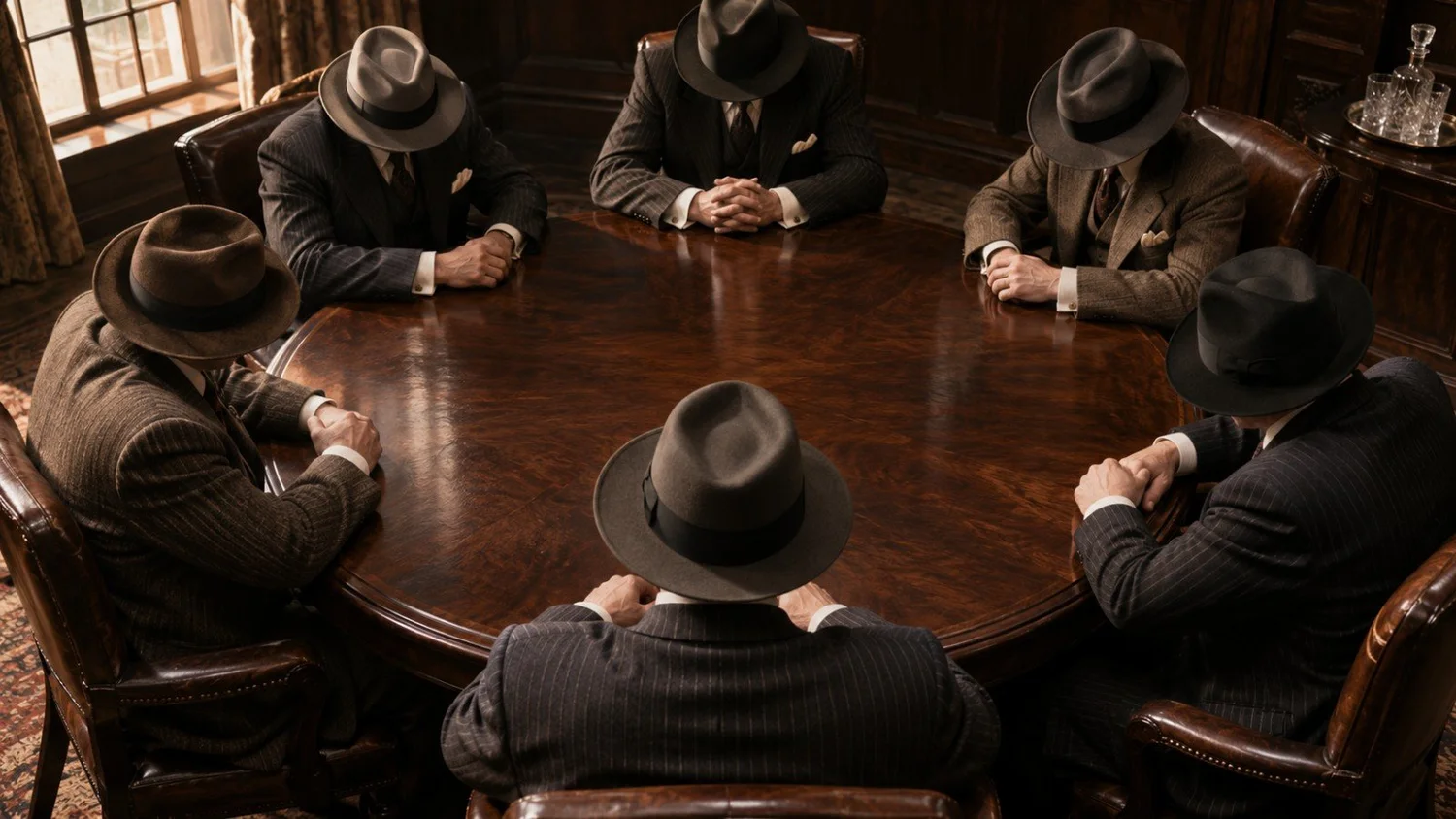
Instead, Luciano called a meeting in Chicago and proposed a new system. The title of boss of bosses was abolished. In its place was the Commission, a governing body that would oversee Mafia activity across the country and settle disputes between families. It had seven original members:
- the bosses of New York's five families: Luciano himself, Vincent Mangano, Tommy Gagliano, Joseph Bonanno and Joe Profaci;
- Al Capone, representing the Chicago Outfit;
- Stefano Magaddino of Buffalo.
Luciano was named chairman, but the chairman was meant to be first among equals rather than a king. The Commission set rules for the families. A new boss had to be approved by the Commission before he could formally take over. Proposed new members needed approval from the other families before being made. The bosses agreed to meet every five years, or whenever trouble between families required it.
The Commission also formalised cooperation across ethnic lines. The Italian Mafia's leaders worked alongside Jewish gangsters, including Lansky, Siegel, Louis "Lepke" Buchalter, Dutch Schultz and Abner "Longie" Zwillman, who took part in some meetings. This wider network of cooperating gangs is often called the National Crime Syndicate, and Wikipedia describes Luciano as its first and only head.
It is worth being precise about what Luciano created. He did not create the Mafia itself, which had deep roots in Sicily and in American cities. He did not create the five-family structure in New York, which Maranzano had set up. What he created was the system of governance that bound the families together and allowed them to coexist. That is why the FBI and many historians call him the father of the modern American Mafia.
The Commission's First Test: Dutch Schultz
The Commission soon showed what it was for. In 1935 Dutch Schultz, the Bronx bootlegger and numbers racketeer, was under pressure from Thomas Dewey, the special prosecutor appointed to fight organised crime in New York. Schultz wanted Dewey killed. He brought the idea to the Commission.
Luciano argued against it. Murdering a prosecutor, he said, would bring down a law enforcement crackdown that would hurt everyone. Schultz said he would kill Dewey anyway and walked out. When Albert Anastasia reported that Schultz had asked him to watch Dewey's apartment building on Fifth Avenue, the Commission ordered Lepke Buchalter to deal with Schultz. On 23 October 1935 Schultz was shot in a tavern in Newark, New Jersey, and died the following day.
The episode captured the Commission's logic. It did not exist to prevent violence. It existed to control violence: to decide when killing served the organisation and when it threatened it. A boss who put his own interests above the group's could be removed by the group.
Thomas Dewey and the Fall of Luciano
The irony is that the prosecutor whose life the Commission saved then turned his attention to Luciano. Dewey's investigators found that organised crime controlled much of New York's prostitution business, and they traced the profits upwards. On 1 February 1936, according to the Manhattan District Attorney's archive, Dewey launched raids on brothels across the city. Several of the women arrested agreed to testify.
Dewey declared Luciano "Public Enemy Number One". Luciano fled to Hot Springs, Arkansas, a well-protected haven for gangsters, but was arrested there and extradited to New York in April 1936. He was charged with 90 counts of compulsory prostitution, later reduced to 62.
The trial ran from 13 May to early June 1936. Dewey's case rested heavily on the testimony of prostitutes and madams, including Florence "Cokey Flo" Brown, and on exposing Luciano as a liar when he took the stand. The jury convicted him on more than 60 counts. Judge Philip McCook sentenced him to 30 to 50 years, the longest sentence ever given for compulsory prostitution, and he was sent to Clinton prison at Dannemora in upstate New York.
The conviction was controversial then and remains so. The charges were unusual for a man of Luciano's stature, and critics have long questioned the reliability of witnesses who were themselves under pressure. But it was the first time a New York Mafia boss of his rank had been convicted of a serious felony, and it made Dewey a national figure. Luciano's organisation carried on. Britannica notes that he continued to rule and issue orders from his cell.
The War Deal, Exile and Havana
The Second World War gave Luciano an unexpected way out. In 1942, after the French liner Normandie caught fire and capsized in New York Harbor, US naval intelligence worried about sabotage and enemy spies on the docks. The Mob controlled much of the waterfront through the longshoremen's unions. Through Luciano's lawyer and Meyer Lansky, the Navy sought his help, in what became known as Operation Underworld. Luciano was moved to a more comfortable prison.
How much Luciano actually contributed has never been settled. A US Navy history says post-war investigations show the Office of Naval Intelligence sought and used his help, but that the extent to which it was useful is unknown. In January 1946 Dewey, by then governor of New York, commuted Luciano's sentence on the condition that he be deported to Italy. He had served about nine and a half years. He sailed in February 1946.
He did not stay away for long. Later that year he travelled secretly to Havana, where he invested in Cuban gambling. In the week of 22 December 1946, Mob leaders from across the United States gathered at the Hotel Nacional for the Havana Conference, reportedly convened by Luciano and organised by Lansky. It was the largest meeting of American bosses in years. But when news of his presence reached Washington, the head of the Federal Bureau of Narcotics, Harry Anslinger, pressed the Cuban government to expel him. Cuba deported him in February 1947, and he arrived in Genoa that April.
Luciano spent the rest of his life in Italy under tight police surveillance, mostly in Naples. American and Italian authorities repeatedly accused him of directing the international heroin trade from there. Britannica states that he continued to direct drug trafficking into the United States. Italian police arrested and questioned him more than once and restricted his movements, but the narcotics accusations were never proved in court.
The Commission Without Luciano
With Luciano in exile, Frank Costello took over his family and the leadership of the Commission. But the system Luciano had built was now tested by men who did not share his preference for peace.
In May 1957 Vito Genovese, Luciano's old partner, had Costello shot. Costello survived, but stepped aside, and the family became known by Genovese's name, as it still is. Luciano, thousands of miles away, was powerless to stop it. That November Genovese called a meeting of bosses at Joseph Barbara's estate in Apalachin, in upstate New York. State police noticed the procession of expensive cars with out-of-state plates and raided it. About 100 mobsters had attended and more than 60 were detained. The Apalachin meeting was a public humiliation, and it pushed J. Edgar Hoover's FBI, which had long played down the Mafia, to launch its Top Hoodlum programme.
The Commission also had to police its own members. In 1963 Joseph Bonanno, one of the original seven, plotted to kill three fellow Commission members, Tommy Lucchese, Carlo Gambino and Stefano Magaddino. The man given the job, Joseph Colombo, revealed the plot to the targets. The Commission forced Bonanno's ally Joseph Magliocco into retirement, and Colombo was rewarded with control of the Profaci family. It was exactly the kind of internal dispute the Commission had been designed to resolve without a war.
That same autumn, the Commission became public knowledge. Joseph Valachi, a soldier in the Genovese family, testified before Senator John McClellan's Senate subcommittee in September and October 1963, the first member to acknowledge publicly that the organisation existed. He popularised its name, Cosa Nostra, "our thing", and described its structure, including the five families and the Commission. The Justice Department told the public that Cosa Nostra was run by a Commission to which leaders in most major cities answered.
Luciano did not live to see the hearings. On 26 January 1962 he collapsed with a heart attack at Capodichino Airport in Naples, where he had gone to meet a film producer about a possible movie of his life. He was 64. The United States had barred him from returning while he was alive, but allowed his body home. He was buried at St John's Cemetery in Queens, and more than 2,000 mourners attended his funeral.
Why the Commission Mattered
The Commission's importance lies in what it changed about how organised crime operated in America.
First, it replaced war with arbitration. Before 1931, power in the underworld passed by murder, and every succession risked a new conflict. The Commission gave bosses a place to settle disputes, divide territory and approve successors, which reduced the kind of open warfare that brought police and press attention.
Second, it turned a set of local gangs into a national organisation. Families in different cities could cooperate on rackets that crossed state lines, share investments and recognise each other's members. This made possible the Mob's spread into gambling, labour unions and later the casinos of Las Vegas, which we explore in how the Mafia made Las Vegas.
Third, it made the organisation more durable than any individual. A boss could be imprisoned, deported or killed, and the structure would carry on. Luciano's own fate proved the point. His conviction in 1936 and deportation in 1946 did not end his family or the Commission. The organisation he designed outlasted him by decades.
Finally, it reflected a business mentality. Luciano's model was closer to a corporation or a cartel than to a Sicilian clan. Profit mattered more than honour, partners were chosen for usefulness rather than birthplace, and violence was a management tool to be used sparingly. That approach is why Time magazine named him in 1998 among the most influential builders and titans of the twentieth century, an uncomfortable distinction for a man whose empire ran on extortion, prostitution and murder.
The Commission Trial: When the Structure Became the Evidence
The Commission's greatest strength turned out to be its weakness. Because it was an organisation with members, rules and decisions, it could be prosecuted as one.
The key tool was the Racketeer Influenced and Corrupt Organizations Act of 1970, known as RICO, which allowed prosecutors to charge the leaders of a criminal enterprise for crimes committed on its behalf. On 25 February 1985, the US Attorney in Manhattan, Rudolph Giuliani, announced indictments against the leaders of New York's families, including Paul Castellano of the Gambino family, the Commission's chairman at the time. The charges included extortion, labour racketeering and murder. Prosecutors alleged that the Commission ran a "concrete club" in which contractors on large New York building projects paid a 2 per cent kickback, and that it had approved the 1979 murder of the Bonanno boss Carmine Galante.
Some defendants never reached the trial. Aniello Dellacroce died of cancer, and Paul Castellano was murdered on 16 December 1985. The Bonanno family's representative was dealt with separately: the family had been expelled from the Commission in the early 1980s after the FBI agent known as Donnie Brasco infiltrated it.
The trial began in September 1986. Much of the evidence came from FBI listening devices planted in mobsters' cars and social clubs. On 19 November 1986 the jury convicted eight defendants, including Anthony "Fat Tony" Salerno of the Genovese family, Carmine Persico of the Colombo family and Anthony Corallo of the Lucchese family. On 13 January 1987 most were sentenced to 100 years in prison. Time called it the "Case of Cases".
The Commission Trial proved that the body Luciano had created to protect the Mafia could be used to prove its existence and convict its leaders. Combined with RICO and the willingness of mobsters to become informers, it began a long decline in the power of the New York families.
Luciano's Legacy
The Commission did not disappear in 1987. Later reporting suggests it continued to exist in reduced form, with the Five Families and Chicago at its core. Joseph Massino, the Bonanno boss who became a government witness, testified that the last known meeting of all the bosses took place in November 1985. Since then, accounts suggest, underbosses and captains have met in secret rather than the bosses themselves.
Luciano's personal legacy is more complicated. He was a killer who arranged the murders of his own bosses, a businessman whose profits came from vice and violence, and an organiser of genius whose system was copied, studied and eventually dismantled by the state. His life shows the two faces of the American Mafia: the ruthlessness that built it and the corporate discipline that let it last.
He also left a lasting mark on how Americans imagine organised crime. The idea of a Mafia run by a council of bosses who sit at a table and vote on life and death, so familiar from novels and films, comes from the real institution Luciano set up in 1931. When the Commission Trial finally convicted its members more than half a century later, prosecutors were in a sense convicting his design.
Luciano once had the power to make himself king of the underworld and chose to make himself chairman instead. That decision, more than any killing he ordered, is why historians still call him the man who organised organised crime.
Timeline: Lucky Luciano and the Commission
- 1897: Salvatore Lucania is born in Lercara Friddi, Sicily (some sources say 1896).
- 1906: His family emigrates to New York.
- 1920: Prohibition begins; Luciano works for Joe Masseria and with Arnold Rothstein.
- 1929: He attends the Atlantic City conference and survives an abduction and stabbing.
- 1930: The Castellammarese War begins with the murder of Gaetano Reina on 26 February.
- 15 April 1931: Masseria is killed in Coney Island; the war ends.
- 10 September 1931: Maranzano is killed in his Manhattan office.
- 1931: Luciano abolishes the boss of bosses title and creates the Commission.
- 1935: The Commission orders the killing of Dutch Schultz.
- 1936: Luciano is convicted of compulsory prostitution and sentenced to 30 to 50 years.
- 1942: Naval intelligence seeks his help in Operation Underworld.
- 1946: His sentence is commuted and he is deported to Italy; the Havana Conference is held in December.
- 1947: Cuba expels him; he settles in Italy.
- 1957: Frank Costello is shot and steps aside; the Apalachin meeting is raided.
- 1962: Luciano dies at Naples airport on 26 January.
- 1963: Joseph Valachi describes Cosa Nostra and the Commission to the US Senate.
- 1985: The heads of New York's families are indicted in the Mafia Commission case.
- 1986–87: Eight defendants are convicted and most are sentenced to 100 years.
Sources
- Lucky Luciano, Wikipedia
- Lucky Luciano, Encyclopaedia Britannica
- Lucky Luciano, The Mob Museum
- History of La Cosa Nostra, FBI
- Castellammarese War, Encyclopaedia Britannica
- Castellammarese War, Wikipedia
- The Commission (American Mafia), Wikipedia
- Five Families, Wikipedia
- When Luciano's luck ran out, The Mob Museum
- Charles "Lucky" Luciano closed case files, NYC Municipal Archives
- Charles "Lucky" Luciano (1897–1962), CALS Encyclopedia of Arkansas
- The Planning of Operation Husky, US Navy
- The mystery of Lucky Luciano's 'invaluable service' to the country, The Mob Museum
- Seventy years ago, Luciano's Havana sojourn was cut short, The Mob Museum
- Valachi hearings, Wikipedia
- Attorney General's statement on organised crime, 25 September 1963, US Department of Justice
- Mafia Commission Trial, Wikipedia
- The bosses of the Mafia Commission were indicted 40 years ago, The Mob Museum
- Major mob busts in US history, HISTORY
Next Reads
- How the Mafia Made Las Vegas: Bugsy Siegel, the Skim and the Fall of the Mob
- Five Families, The Valachi Papers, Boss of Bosses and Mafia Dynasty: How the American Mafia Built an Empire
- How the Mafia Became So Powerful in the USA
- The Modern Mafia, Explained: How an Old Protection Racket Became a Global Business Model
- The Godfather: Summary, Analysis, and Why It Matters
