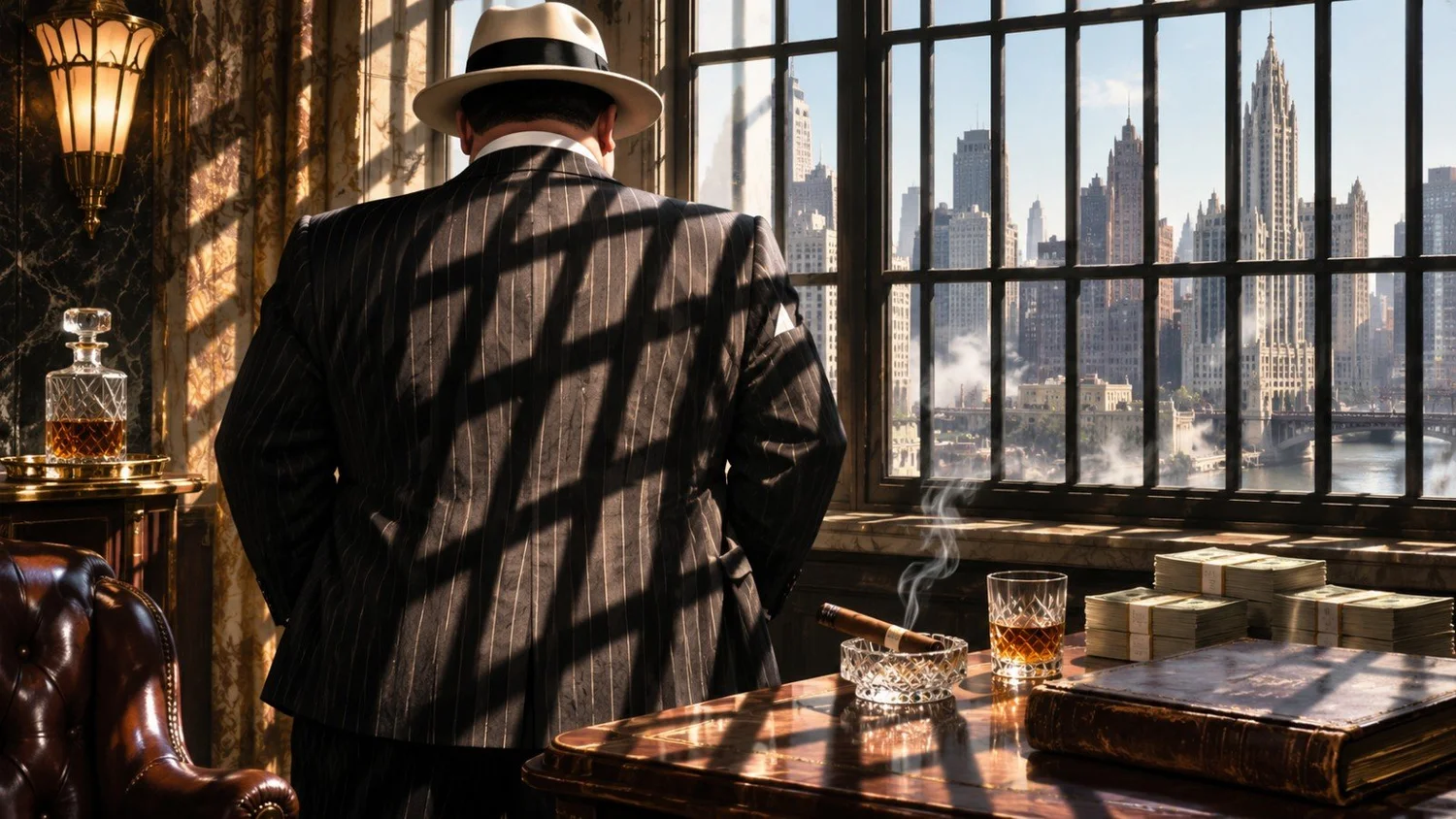
How Did a Brooklyn Bouncer Become the Most Famous Gangster in History?
Al Capone ran Chicago's underworld for only about six years. He took control of the gang that became the Chicago Outfit in 1925, at the age of 26, and was in federal prison by 33. Yet no American criminal has had a longer afterlife. A century later his name is still shorthand for the gangster: the fedora, the cigar, the armoured car, the machine-gun massacre and the bootleg fortune.
The real story is stranger and more instructive than the legend. Capone was a product of Prohibition, a law that turned a nation of drinkers into customers for organised crime. He was a skilled manager and an instinctive publicist who called himself a businessman and courted the press. He was also responsible for a level of violence that eventually turned the public and the federal government against him. In the end he was brought down not by a shoot-out or a murder charge but by accountants, and he died at 48, his mind destroyed by an untreated disease.
This explainer tells the whole story: Capone's rise from Brooklyn to Chicago, the beer wars, the St Valentine's Day Massacre, the tax case that convicted him, his decline at Alcatraz and in Florida, and why he still matters.
The Short Answer
- Who he was: Alphonse Gabriel Capone, born in Brooklyn in 1899 to Italian immigrants, ran the Chicago Outfit from 1925 to 1931 during Prohibition.
- How he made his money: bootlegging, gambling, prostitution and protection rackets, protected by bribes to police and politicians.
- The violence: the Chicago beer wars killed hundreds of people. The St Valentine's Day Massacre of 1929 was widely blamed on Capone, although he was never charged with it.
- His downfall: he was convicted of income tax evasion in October 1931 and sentenced to 11 years in federal prison.
- His end: he served time in Atlanta and at Alcatraz, was released in 1939 suffering from neurosyphilis, and died at his Florida estate in January 1947.
- His legacy: the first celebrity gangster, a template for Hollywood's image of the Mob, and a lasting lesson for prosecutors: follow the money.
Brooklyn, the Five Points and the Scar
Alphonse Gabriel Capone was born in Brooklyn on 17 January 1899, the fourth of nine children of Gabriele Capone, a barber, and his wife Teresa, immigrants from the area around Naples. The family was poor but not destitute, and young Al left school after the sixth grade.
He drifted into the street gangs of Brooklyn and Lower Manhattan, including the Five Points Gang, the same breeding ground that produced Lucky Luciano. There he came under the wing of Johnny Torrio, a calm, calculating racketeer who would become his lifelong mentor. As a teenager Capone worked as a bartender and bouncer at the Harvard Inn, a Coney Island saloon and brothel run by Torrio's associate Frankie Yale.
It was there, during a fight over a woman, that a young hoodlum named Frank Galluccio slashed Capone across the left cheek. The scars gave him the nickname "Scarface", which he disliked. In December 1918 he married Mae Coughlin, shortly after the birth of their son, Albert Francis, known as Sonny.
Chicago and the Birth of the Outfit
Around 1920, Torrio invited Capone to join him in Chicago. Torrio was working for "Big Jim" Colosimo, who ran the city's most profitable brothels and restaurants. The timing was perfect. In January 1920, national Prohibition came into force, banning the manufacture and sale of alcohol across the United States. Colosimo had little interest in bootlegging. Torrio saw a fortune.
On 11 May 1920, Colosimo was shot dead in the lobby of his own restaurant. The killing was never solved; Capone and Frankie Yale have both been suspected. Torrio took over the empire, and Capone became his trusted lieutenant, managing the Four Deuces, Torrio's headquarters in the Levee district.
Torrio's genius was organisation. Rather than fight every rival, he tried to divide Chicago into territories in which each gang could supply beer and liquor without interference. The profits were enormous, and they paid for the protection of police officers, judges and politicians. Capone learned the business from the inside.
In 1924 the Torrio-Capone organisation took over the town government of Cicero, a suburb just outside Chicago's city limits, in an election marked by intimidation at the polls. Capone's brother Frank was shot dead by police during the violence on 1 April 1924. Cicero became Capone's base, beyond the reach of Chicago's reform-minded officials.
The Beer Wars and Capone's Takeover
Torrio's peace did not hold. The North Side Gang, led by the Irish florist and bootlegger Dean O'Banion, resented the Italians' expansion. In November 1924, O'Banion was murdered in his flower shop, almost certainly on Torrio and Capone's orders. His successors, Hymie Weiss and George "Bugs" Moran, swore revenge.
In January 1925 gunmen ambushed Capone's car; he escaped unhurt. Twelve days later Torrio was shot outside his home and badly wounded. He survived, but he had had enough. He handed control of the organisation to Capone and returned to Italy. Capone was 26 and now ran one of the largest criminal enterprises in the United States.
What followed were the Chicago "beer wars", a long struggle between the Capone organisation and its rivals for control of the liquor trade. On 20 September 1926, a convoy of North Side gunmen drove past Capone's headquarters at the Hawthorne Hotel in Cicero and sprayed it with machine-gun fire; according to one historian, around 1,000 rounds were fired. Capone was not hurt. Three weeks later, on 11 October, Hymie Weiss was shot dead outside the North Side gang's headquarters.
The violence reached into the law itself. In April 1926 William McSwiggin, a young assistant state's attorney known as the "hanging prosecutor", was killed by machine-gun fire outside a bar in Cicero while drinking with gangsters. Capone was a prime suspect and was arrested, but he denied involvement, and a grand jury closed its investigation in July 1927 without identifying the killers.
By then Capone was a public figure. He moved his headquarters to a suite at the Metropole Hotel in downtown Chicago, ignoring Torrio's advice to keep a low profile. In 1928 he bought an estate on Palm Island in Biscayne Bay, Miami.
The Businessman Gangster
Capone never thought of himself as a criminal. He liked to say that he was a businessman giving people what they wanted. In a sense, Prohibition had made that argument for him. Millions of ordinary Americans wanted to drink, and the law had handed the supply to people like Capone.
His organisation was vast. Beyond beer and liquor, it ran gambling dens, brothels, nightclubs and rackets that took a cut from legitimate businesses. Estimates of its income vary wildly and should be treated with caution. When the government finally prosecuted Capone, it could prove taxable income of just over $1 million over five years, a tiny fraction of what the Outfit was believed to earn, precisely because he kept so little in his own name.
Unlike most gangsters, Capone enjoyed the spotlight. He gave interviews, posed for photographers, dressed in expensive suits and was cheered at baseball games. During the Depression he sponsored a soup kitchen on South State Street that served free meals to thousands of unemployed Chicagoans every day; on Thanksgiving 1930 it fed 5,000 people. Many saw him as a kind of Robin Hood. Historians have pointed out that the food was often donated, or extracted, from local businesses, and that the kitchen was as much a public relations exercise as an act of charity.
The St Valentine's Day Massacre
The event that made Capone infamous across the world, and ultimately sealed his fate, took place on the morning of Thursday 14 February 1929.
At about 10.30am, a car resembling a police vehicle pulled up outside the SMC Cartage Company garage at 2122 North Clark Street in Lincoln Park. The garage was a front for the bootlegging operation of Bugs Moran's North Side Gang. Several men got out, two of them dressed as police officers. Inside, seven men were waiting, probably for a delivery of liquor: five members of Moran's gang and two associates. The "policemen" lined them up against a wall as if making an arrest, and the gunmen opened fire with Thompson submachine guns and shotguns. Witnesses then saw the uniformed men leading the others out of the garage at gunpoint, as though an arrest had been made.
Moran himself was running late and escaped. Asked who was responsible, he reportedly said that only Capone killed like that. Capone was at his home in Miami and had an unbreakable alibi. He was never even questioned about the killings, and no one was ever tried. Most historians believe the massacre was a Capone operation, although some dispute it, and the identities of the gunmen have never been established.
The massacre was a turning point. The photographs of the bodies shocked the country. Newspapers that had treated Capone as a colourful rogue now demanded action, and the newly elected president, Herbert Hoover, made bringing him down a priority for his administration.
Public Enemy Number One
Capone's legal troubles began to pile up. In March 1929 he was charged with contempt of court for failing to appear before a federal grand jury. That May, after a meeting of gang leaders in Atlantic City, he was arrested in Philadelphia for carrying a concealed weapon. He pleaded guilty, was sentenced to a year, and served his time at Eastern State Penitentiary in relative comfort before being released in March 1930.
A month later, on 23 April 1930, the Chicago Crime Commission published its first list of "public enemies", a roll call of the city's leading criminals. Capone was at the top. The phrase "Public Enemy Number One" followed him for the rest of his life.
The federal government attacked on two fronts. A team of Prohibition agents under Eliot Ness, nicknamed the Untouchables because they could not be bribed, raided Capone's breweries and distilleries. Ness's raids cost Capone money and gave the newspapers dramatic stories. But historians agree that Ness did not bring Capone down, despite the version told in books and in the 1987 film The Untouchables.
Caught by the Taxman
The decisive blow came from the Treasury Department's Bureau of Internal Revenue. In 1927, in a case called United States v. Sullivan, the US Supreme Court had ruled that income from illegal activities was taxable. A bootlegger who did not declare his profits could therefore be prosecuted for tax evasion, even if no one could prove the bootlegging itself.
The problem was evidence. Capone had never filed a tax return, held no bank accounts in his own name and bought nothing under his name. Special Agent Frank Wilson of the Intelligence Unit spent two years building a case from the other direction: tracking Capone's spending on suits, cars, telephone bills and his Palm Island house, and looking for proof of his income. The breakthrough came when Wilson's team found ledgers from a gambling operation that tied Capone to the profits.
In June 1931 Capone was indicted on 22 counts of tax evasion covering 1925 to 1929. He agreed to plead guilty in return for what he believed would be a sentence of about two and a half years and boasted about the deal to the press. Judge James Wilkerson told him that the court was not bound by any bargain, and Capone withdrew his plea.
The trial opened in Chicago in October 1931. Amid fears that Capone's people had got to some of the jurors, the jury was dismissed and a new one assembled. The government charged that Capone had evaded about $215,000 in tax on income of just over $1 million across five years. On 17 October 1931 the jury convicted him on five counts. On 24 November, Wilkerson sentenced him to 11 years in federal prison, a $50,000 fine and $7,692 in court costs, and ordered him to pay the back taxes with interest.
Atlanta, Alcatraz and the Long Decline
Capone began his sentence at the federal penitentiary in Atlanta in May 1932. On arrival, prison doctors diagnosed him with syphilis, which he had probably contracted years earlier while working in brothels. At the time there was no reliable cure.
In Atlanta he managed to keep some privileges and influence. To end that, in August 1934 he was transferred to the new federal prison on Alcatraz Island in San Francisco Bay, designed for the country's most troublesome inmates. There he had no special treatment and little contact with the outside world. As the syphilis attacked his brain, his behaviour became increasingly erratic.
In January 1939 Capone completed his time at Alcatraz and was moved to Terminal Island near Los Angeles to serve a separate one-year sentence for contempt. His wife Mae petitioned for his release. On 16 November 1939, having served seven years, six months and 15 days and paid all his fines and back taxes, he was freed. Johns Hopkins Hospital in Baltimore refused to treat him, but Union Memorial Hospital agreed, and he spent several months there before travelling to Florida in March 1940.
The End at Palm Island
Capone never returned to Chicago or to the Outfit. By the time he left prison, doctors reported, his mental abilities were those of a 12-year-old child. He spent his last years at his Palm Island estate with Mae and their family, fishing, playing cards and sometimes talking to people who were not there. Old associates visited to pay their respects. In 1942 he was treated with penicillin, newly available, which slowed the disease but could not undo the damage.
On 21 January 1947 Capone suffered a stroke. He developed pneumonia and died at home on 25 January 1947, a week after his 48th birthday. He was buried in Chicago at Mount Olivet Cemetery near his father and brother; in 1950 his remains were moved to Mount Carmel Cemetery in Hillside, Illinois.
What Happened to the Outfit
Capone's fall did not end the organisation he had built. Frank Nitti took over as boss around 1932, and the Chicago Outfit went on to become one of the most powerful crime groups in the United States. It took a seat on the national Commission that Lucky Luciano created in 1931, invested heavily in Hollywood rackets and later in Las Vegas casinos, and survived for decades after Prohibition ended in 1933.
That continuity is part of Capone's significance. He was not the founder of organised crime in Chicago, and the Outfit did not depend on him. What he did was run it during its most profitable and violent years, and make it famous. For the story of how Chicago's money went on to shape another city, see our explainer on how the Mafia made Las Vegas, and for the national structure the Outfit joined, our guide to Lucky Luciano and the Commission.
Capone Myths and Facts
Few figures in American history have attracted as much folklore as Capone. Some of the best-known stories are true, some are exaggerated, and some are simply wrong.
Myth: Eliot Ness put Capone in prison
Ness and his Prohibition agents were real, and their raids on breweries and distilleries did cost the Outfit money. But the case that convicted Capone was built by Treasury tax investigators, above all Frank Wilson, using financial records rather than raids. Ness's later memoir and Hollywood's adaptations turned a supporting role into the starring one.
Myth: Capone was convicted of the St Valentine's Day Massacre
He was never charged with the massacre, and nobody was ever tried for it. Capone was in Florida that morning. Most historians believe his organisation carried it out, but the gunmen were never identified in court, and a minority of researchers question whether Capone personally ordered it.
Myth: He was a Robin Hood figure
Capone cultivated that image, and the soup kitchen fed thousands of genuinely hungry people. But his fortune came from an enterprise that relied on intimidation, bribery and murder. One estimate attributes as many as 200 deaths to Capone, directly or through the Outfit, although any such figure is impossible to verify. The Robin Hood story was, at least in part, public relations.
Myth: He liked the name Scarface
He did not. Capone disliked the nickname and was sensitive about the scars. Friends and associates called him Snorky or the Big Fella.
Fact: He was attacked inside Alcatraz
Capone's fame made him a target even in prison. At Alcatraz he was no longer a privileged inmate, and he survived an assault by a fellow prisoner. The years on the Rock, combined with his advancing illness, left him a much diminished figure by the time he was released.
Fact: He served less than his full sentence
Capone was sentenced to 11 years but was released after seven years, six months and 15 days, with time off for good behaviour, once his fines and back taxes had been paid. His deteriorating health made him no longer a threat, and he never returned to criminal life.
Why Al Capone Still Matters
Capone's importance lies less in what he built than in what he revealed and what he changed.
He showed what Prohibition really did. The ban on alcohol was meant to improve American life. Instead it created an enormous illegal market, handed it to gangsters and funded the corruption of police and politicians. Capone's career became one of the strongest arguments for repeal, which came in December 1933, two years after he went to prison.
He became the first celebrity gangster. The Mob Museum describes him as the first true celebrity gangster. Before Capone, crime bosses generally avoided publicity. He sought it, and the press and public responded. His fame turned him into a national symbol, which made him a national target. Later Mafia leaders drew the lesson and kept a much lower profile.
He changed how the government fights organised crime. Capone's conviction proved that a criminal who could not be convicted of violence could be convicted of hiding his money. Following the money became a central weapon against organised crime, from tax prosecutions to the racketeering and money-laundering laws of later decades.
He shaped popular culture. The 1932 film Scarface was loosely based on his life, and Capone-like figures have appeared in films and television ever since, from The Untouchables to Boardwalk Empire. Much of the public's picture of the Mob, the tailored suits, the Tommy guns and the charismatic boss, comes from the image Capone created and Hollywood amplified.
That image carries a warning. Capone's charm and his soup kitchen were real, but so were the bombings, beatings and murders that his business depended on. The man who called himself a businessman ran an enterprise that killed people who got in its way and corrupted a city's institutions. His final years, spent confused and isolated in Florida, were a long way from the legend.
Timeline: The Life of Al Capone
- 17 January 1899: Alphonse Gabriel Capone is born in Brooklyn, New York.
- c. 1917–18: Works at the Harvard Inn in Coney Island and is slashed across the cheek.
- December 1918: Marries Mae Coughlin.
- 1919–20: Joins Johnny Torrio in Chicago; Prohibition begins in January 1920.
- 11 May 1920: Big Jim Colosimo is murdered; Torrio takes over.
- 1924: The Capone organisation takes over Cicero; Dean O'Banion is murdered.
- January 1925: Torrio is shot and hands control to Capone.
- 1926: William McSwiggin is killed; the Hawthorne Hotel is attacked; Hymie Weiss is murdered.
- 1927: The Supreme Court rules that illegal income is taxable.
- 14 February 1929: The St Valentine's Day Massacre.
- May 1929: Capone is jailed in Philadelphia for carrying a gun.
- April 1930: The Chicago Crime Commission names him Public Enemy Number One.
- October 1931: Convicted of tax evasion; sentenced to 11 years in November.
- 1932: Enters Atlanta federal penitentiary.
- 1934: Transferred to Alcatraz.
- 16 November 1939: Released from federal custody.
- 25 January 1947: Dies at his Palm Island home in Florida, aged 48.
Sources
- Al Capone, Encyclopaedia Britannica
- Al Capone, Wikipedia
- Al Capone, FBI famous cases
- Al Capone: The story behind his rise and fall, The Mob Museum
- Iconic Chicago Outfit boss Al Capone died 70 years ago today, The Mob Museum
- 8 Things You Should Know About Al Capone, HISTORY
- The 1929 St. Valentine's Day Massacre: 5 Unsolved Mysteries, HISTORY
- Saint Valentine's Day Massacre, Wikipedia
- Catching Capone, WTTW Chicago Stories
- The Taxman Cometh: U.S. v. Alphonse Capone, US National Archives
- Historical documents relating to Alphonse (Al) Capone, IRS
- Al Capone Trial: 1931, Encyclopedia.com
- Al Capone trial chronology, Famous Trials
- Mobster Al Capone Ran a Soup Kitchen During the Great Depression, HISTORY
- The infectious disease that sprung Al Capone from Alcatraz, PBS NewsHour
- Al Capone in Miami, PBS American Experience
Next Reads
- Lucky Luciano and the Commission: How He Created the Modern Mafia and Why It Mattered
- How the Mafia Made Las Vegas: Bugsy Siegel, the Skim and the Fall of the Mob
- How the Mafia Became So Powerful in the USA
- Five Families, The Valachi Papers, Boss of Bosses and Mafia Dynasty: How the American Mafia Built an Empire
- The Godfather: Summary, Analysis, and Why It Matters
