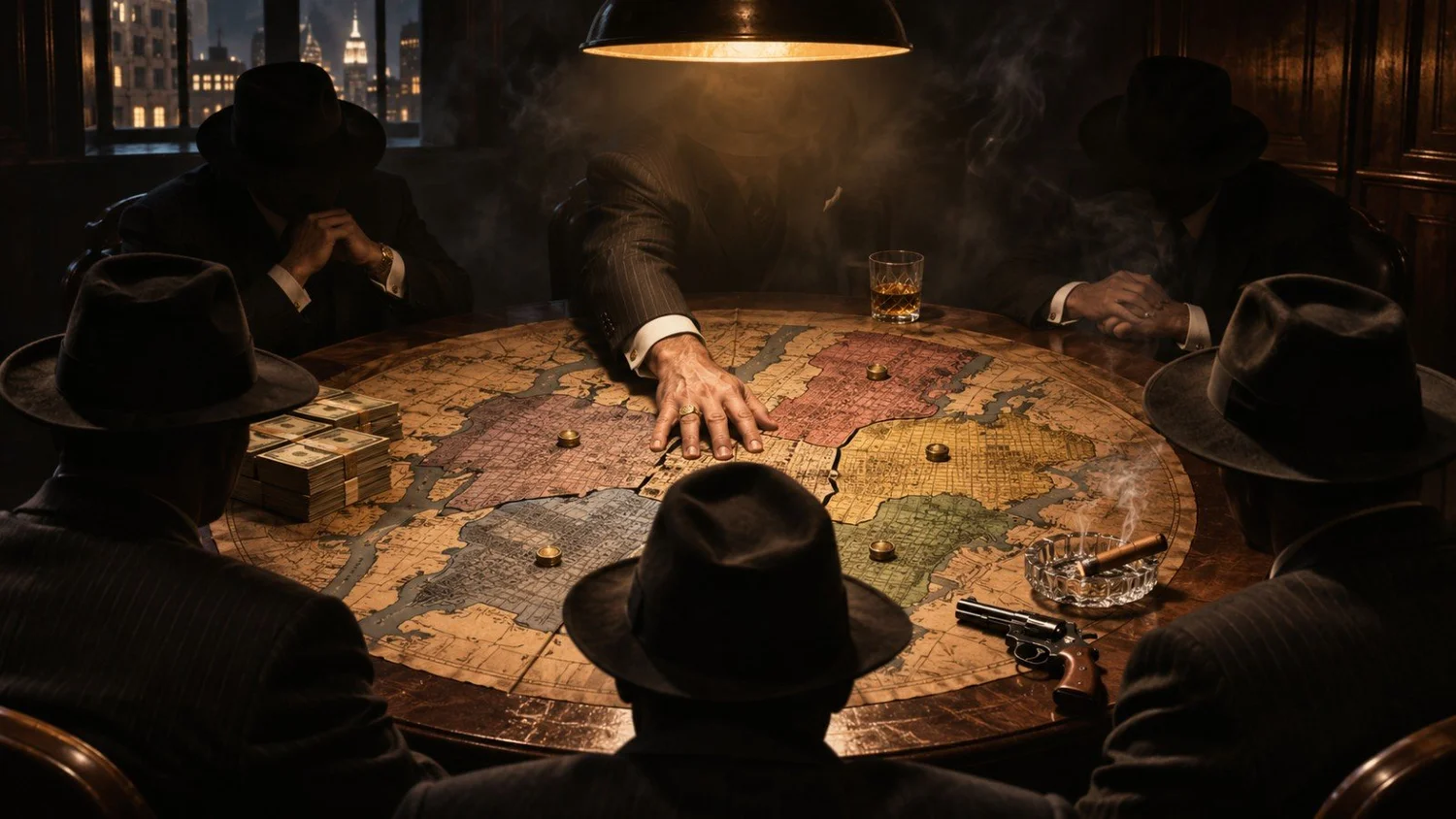
How Five Brooklyn and Manhattan Gangs Became the Most Powerful Crime Network in America
For most of the twentieth century, organised crime in the United States had an address. It was New York, and it was divided between five crime families: the Genovese, Gambino, Lucchese, Bonanno and Colombo. Between them they controlled docks, unions, construction, rubbish collection, gambling, loan sharking and narcotics. Their bosses sat on the national Commission that settled Mafia disputes from coast to coast, and their names became part of American popular culture.
The Five Families were not ancient. They were created in a single year, 1931, out of a gang war, and they took their present names only decades later from the men who ran them. Their rise was built on Prohibition money, political protection and a code of silence. Their decline began when that silence broke, first in a Senate hearing room and then, in the 1980s, in a series of trials that put almost the entire leadership of New York's Mafia in prison.
This explainer tells the story of how the Five Families rose, how each one got its name, the wars and betrayals that shaped them, and what is left of them today.
The Short Answer
- What they are: the five Italian-American Mafia families of New York City, known today as the Bonanno, Colombo, Gambino, Genovese and Lucchese families.
- When they began: 1931, when Salvatore Maranzano reorganised the city's Mafia after the Castellammarese War. Lucky Luciano then had Maranzano killed and set up the Commission.
- Their original names: the Luciano, Mangano, Gagliano, Profaci and Maranzano (soon Bonanno) families.
- Their peak: from the 1930s to the 1970s, when they dominated organised crime in America and sat at the centre of the national Commission.
- Their fall: informers such as Joe Valachi and Sammy Gravano, FBI bugs and the RICO law led to the 1986 Commission Trial and the 1992 conviction of John Gotti.
- Today: smaller and less visible, but still active. Federal prosecutors continue to charge members of all five families.
Before the Families: Prohibition and the Castellammarese War
Italian criminal gangs had operated in New York since the late nineteenth century, preying mainly on fellow immigrants through extortion. Prohibition, which banned alcohol across the United States from 1920 to 1933, transformed them. Bootlegging produced fortunes, and with money came armies of gunmen, bribed police officers and friendly politicians.
By the end of the 1920s, two Sicilian-born bosses were fighting for supremacy over New York's Italian underworld. Joe "the Boss" Masseria led the larger organisation. Salvatore Maranzano led a faction of men from the Sicilian town of Castellammare del Golfo, backed by allied bosses elsewhere. Their struggle, from 1930 to 1931, became known as the Castellammarese War.
The war ended through betrayal. Masseria's own lieutenant, Charles "Lucky" Luciano, arranged his boss's murder, and Masseria was shot dead in a Coney Island restaurant on 15 April 1931. Maranzano emerged as the winner.
1931: Maranzano Draws the Map
Maranzano now set about organising the victors. At a meeting of crime bosses in the spring of 1931 he declared himself capo di tutti i capi, boss of all bosses, and divided New York's Italian gangs into five families, each with a boss, an underboss and captains commanding crews of soldiers.
The five families he created were led by Luciano, Vincent Mangano, Tommy Gagliano, Joseph Profaci and Maranzano himself. Their names would change, but the structure he drew in 1931 has survived for almost a century.
Maranzano did not enjoy his position for long. He grew suspicious of Luciano's ambition and arranged to have him killed. According to some accounts, Tommy Lucchese tipped Luciano off. On 10 September 1931, gunmen posing as government agents walked into Maranzano's office on Park Avenue and killed him.
Luciano then made the decision that defined the families' future. Rather than claim the title of boss of all bosses, he abolished it and created the Commission, a ruling council of bosses that would settle disputes and approve major decisions. The heads of the Five Families sat on it from the start, alongside the bosses of Chicago and Buffalo. We tell that story in full in our explainer on Lucky Luciano and the Commission.
How Each Family Got Its Name
Each family is now named after a boss who ran it in the middle of the twentieth century, at the moment law enforcement began to map it. The names stuck partly because of Joe Valachi's testimony in 1963, when he identified the bosses then in charge: Tommy Lucchese, Vito Genovese, Joseph Colombo, Carlo Gambino and Joe Bonanno.
The Genovese Family
The Genovese family began as Lucky Luciano's family. It was the most powerful of the five for much of its history and was sometimes called the "Ivy League" of the Mob for its discipline and secrecy.
Luciano was jailed in 1936 for running a prostitution ring and later deported to Italy. His acting boss, Vito Genovese, fled to Italy in 1937 to avoid a murder charge, leaving Frank Costello in charge. Costello, known as the "Prime Minister of the Underworld", ran the family through the 1940s and 1950s with an emphasis on gambling and political influence.
Genovese returned and moved against him. In 1957 Costello survived a shooting attempt and stepped aside, and Genovese took control of the family that now bears his name. His reign was short. He was convicted of narcotics conspiracy in 1959 and died in prison in 1969.
In later decades the family was run by Vincent "the Chin" Gigante, who became boss in 1981 while Anthony "Fat Tony" Salerno acted as a public front. Gigante spent years wandering Greenwich Village in his bathrobe and slippers, apparently to persuade investigators that he was mentally ill. The press nicknamed him the "Oddfather". The act eventually failed, and he died in federal prison in 2005.
The Gambino Family
The Gambino family began as Vincent Mangano's. His underboss was Albert Anastasia, the ferocious leader of Murder, Inc., the Mafia's contract killing squad. The two men clashed for years. In April 1951 Mangano disappeared without trace, and his brother Philip was found shot dead. Anastasia, widely believed to be responsible, took over.
Anastasia's own end became one of the most famous scenes in Mafia history. On 25 October 1957, as he relaxed in the barber's chair at the Park Sheraton Hotel in Midtown Manhattan, two masked gunmen burst in and shot him dead. The murder is believed to have been ordered by Vito Genovese and Carlo Gambino, Anastasia's own underboss. The killers have never been conclusively identified.
Carlo Gambino, a quiet and cautious man, became boss and turned the family into the largest and richest in the country. He ruled until his death from natural causes in 1976 and was succeeded by his cousin and brother-in-law, Paul Castellano.
Castellano's reign ended violently. On the evening of 16 December 1985, as he arrived for a meeting at Sparks Steak House in Midtown Manhattan, he and his underboss Thomas Bilotti were shot dead in the street. The murder was organised by John Gotti, a Queens captain who then made himself boss.
Gotti became the most famous gangster since Al Capone. He wore expensive suits, smiled for cameras and was acquitted at several trials, earning the nickname the "Teflon Don". His downfall came when his underboss, Salvatore "Sammy the Bull" Gravano, agreed to testify against him. On 2 April 1992 Gotti was convicted on 13 counts, including ordering the murders of Castellano and Bilotti. He died in prison in 2002.
The Lucchese Family
The Lucchese family began under Tommy Gagliano, who ran it quietly from 1931 until 1951. His successor, Gaetano "Tommy" Lucchese, known as "Three-Finger Brown", gave it its present name. Lucchese built a close alliance with Carlo Gambino, and together they became the dominant force on the Commission in the 1960s.
Under Lucchese and his successors the family specialised in labour racketeering, the garment district, the trucking industry and New York's airports. Its most famous crime was the Lufthansa heist at John F. Kennedy International Airport in December 1978, in which robbers stole more than $5 million in cash and valuables. The story of one of the family's associates, Henry Hill, became the 1985 book Wiseguy and Martin Scorsese's 1990 film Goodfellas.
The Bonanno Family
The Bonanno family was Maranzano's own. After his murder, it passed to Joseph Bonanno, then only 26, who ran it for more than three decades. Bonanno, nicknamed "Joe Bananas", had ambitions beyond his own family.
In the early 1960s he conspired with Joseph Magliocco, the new boss of the Profaci family, to kill rival Commission members, including Carlo Gambino and Tommy Lucchese. The plot was exposed, and Bonanno was summoned before the Commission. He disappeared from 1964 to 1966, setting off a struggle within his family known as the Banana War. It ended in 1968, when Bonanno retired to Arizona. He later wrote an autobiography and died in 2002.
The family was weakened further in the 1970s. Carmine Galante, who had taken control, was accused of trying to dominate the heroin trade at the expense of other families. On 12 July 1979 he was shot dead while eating lunch in the garden of a restaurant in Bushwick, Brooklyn, a killing that authorities believed the Commission had approved.
In the same period, an FBI agent, Joseph Pistone, spent around six years undercover inside the Bonanno family under the name Donnie Brasco. His evidence led to many convictions and so embarrassed the family that the Commission stripped it of its seat for a time. Decades later the Bonanno family produced another first. Its boss, Joseph Massino, convicted in 2004, became the first boss of a New York family to turn government informant.
The Colombo Family
The Colombo family began as the Profaci family. Joseph Profaci, an olive oil importer known as the "Olive Oil King", ran it for three decades from 1931, a remarkably long reign. His greed provoked a revolt. In 1961 the brothers Larry, Albert and Joe "Crazy Joe" Gallo kidnapped four senior members of the family to demand a fairer share of the profits, setting off the first of three Colombo wars.
Profaci died of cancer in 1962, and his brother-in-law Joseph Magliocco took over. It was Magliocco who joined Bonanno's plot against the other bosses, and he chose one of his men, Joseph Colombo, to carry out the murders. Colombo instead revealed the plot to the intended victims. As a reward, the Commission forced Magliocco out and gave Colombo the family, which now bears his name.
Colombo was an unusual boss. He founded the Italian-American Civil Rights League, which campaigned against the stereotyping of Italian Americans and held mass rallies in New York. On 28 June 1971, at a League rally in Columbus Circle, he was shot three times. The gunman was shot dead at the scene. Colombo was left paralysed and died in 1978. Joe Gallo was suspected of involvement and was himself shot dead in a Little Italy restaurant in 1972.
Carmine "the Snake" Persico eventually took control. He was convicted in the Commission Trial and spent the rest of his life in prison, still regarded as boss, until his death in 2019. In 1991, when his acting boss Victor Orena tried to seize power, the family split into factions and fought the third and bloodiest Colombo war.
How a Family Is Organised
Each of the Five Families was built on the same model, and the model explains why they lasted. At the top sits the boss, who takes a share of almost everything the family earns. Below him is the underboss, his deputy and usual successor, and the consigliere, an adviser who settles disputes within the family.
The family is divided into crews, each led by a captain or caporegime. The captains command the soldiers, the formally initiated or "made" members. Around them is a much larger circle of associates: people who work with the family, earn for it and sometimes kill for it, but are not members. Many of the most notorious figures in Mob history, including Henry Hill, were associates rather than made men.
Becoming a made member required a ceremony. Valachi described his own initiation to the Senate in 1963: he burned a piece of paper in his hands while swearing the oath, a symbol of the fate awaiting anyone who betrayed the family. Membership was traditionally restricted to men of Italian descent.
The layers served a purpose. Orders passed down through intermediaries, so that soldiers rarely dealt with the boss directly. That insulation made it extremely hard to convict the men at the top, until prosecutors found a law designed to reach them.
The Golden Age: How the Families Made Money
From the 1930s to the 1970s, the Five Families were at the height of their power. When Prohibition ended in 1933, they moved into new businesses. Illegal gambling, from numbers rackets to bookmaking, provided steady income. Loan sharking turned that income into more money. Labour racketeering gave them control of unions, and through the unions, influence over whole industries.
In New York they took a cut of the waterfront, the garment district, the Fulton Fish Market, rubbish collection and construction. Contractors who wanted to pour concrete on large building projects often had to pay a share to the families. Some families, despite official disapproval of drug dealing, became deeply involved in heroin trafficking.
All this rested on three foundations: violence or the threat of it, corrupt protection from police and politicians, and omertà, the code of silence that forbade members from cooperating with the authorities. For decades that silence held, and the FBI's director, J. Edgar Hoover, publicly played down the existence of a national Mafia.
The Cracks Appear: Apalachin and Valachi
The first public crack came in November 1957. Vito Genovese, having just taken over his family and arranged Anastasia's murder, called a national meeting of Mafia leaders at the home of Joseph Barbara in the village of Apalachin in upstate New York. On 14 November, local state police sergeant Edgar Croswell noticed the unusual traffic and set up a roadblock. Mobsters fled into the woods. Police identified dozens of men, including Profaci, Genovese, Bonanno and Castellano.
The raid made it impossible to deny that a national network existed. The FBI launched its "Top Hoodlum" programme to investigate organised crime.
The second crack came in 1963. Joe Valachi, a Genovese family soldier serving a prison sentence for drug trafficking, became convinced that his boss, also in prison, had ordered his murder. He agreed to cooperate, and in October 1963 he testified on television before a Senate committee led by Senator John McClellan. Valachi described initiation rituals, the chain of command, the Commission and the Five Families. He said members called the organisation Cosa Nostra, "our thing", and that "Mafia" was an outsiders' word. It was the first time a member had publicly confirmed what the families were.
The Fall: RICO and the Commission Trial
The weapon that eventually broke the families was a law passed in 1970: the Racketeer Influenced and Corrupt Organizations Act, known as RICO. It allowed prosecutors to charge the leaders of a criminal enterprise for a pattern of crimes committed on its behalf, even if the bosses had never personally carried them out.
For years prosecutors barely used it against the Mafia. In the early 1980s that changed. FBI agents planted bugs in Mafia social clubs, cars and homes, recording bosses discussing their business. In February 1985, Rudy Giuliani, then the US Attorney in Manhattan, announced the indictment of the leaders of all Five Families as members of the Commission.
The Mafia Commission Trial was a landmark. On 19 November 1986, the jury convicted eight defendants, including the bosses or acting bosses of the Genovese, Lucchese and Colombo families. In January 1987 most were sentenced to 100 years in prison, the maximum under the law. Castellano, the Gambino boss, would have been a defendant, but he had been murdered outside Sparks Steak House before the trial began.
The Commission Trial was followed by a wave of prosecutions. Gravano's testimony convicted Gotti in 1992. Gigante was convicted in 1997. Massino's decision to cooperate in the 2000s exposed the secrets of the Bonanno family. In January 2011 the FBI carried out what it called the largest coordinated organised crime takedown in its history, charging 127 people, including members of all Five Families.
The Five Families Today
The Five Families still exist. They are smaller, older and far less visible than at their height. The last murder of a New York boss came in 2019, when the Gambino family's reputed leader, Frank Cali, was shot dead outside his home on Staten Island, the first such killing since Castellano's in 1985.
Federal prosecutors continue to bring cases against members of all five families, usually for gambling, extortion, loan sharking and fraud. In October 2025, prosecutors in Brooklyn charged associates of the Bonanno, Gambino, Genovese and Lucchese families in a case involving rigged high-stakes poker games that also implicated figures from professional basketball. The case suggested that the families now cooperate more than they once did, pooling resources rather than guarding separate territories.
The Genovese family is widely described as the strongest of the five today, a reputation built on discipline and secrecy that dates back to Luciano and Costello.
Why the Five Families Mattered
They turned crime into an institution. Before 1931, Italian-American organised crime was a collection of rival gangs. The Five Families gave it a permanent structure, with ranks, rules and succession. That structure is why they outlived their founders by generations.
They shaped New York's economy. For decades, the families took a cut of industries that ordinary New Yorkers depended on, raising prices from rubbish collection to construction. Reformers spent years removing them from the waterfront, the fish market and the carting industry.
They changed American law enforcement. The effort to defeat them produced the modern tools of organised crime prosecution: wiretaps and bugs, witness protection, and above all RICO, which is now used against drug cartels, street gangs and corrupt businesses.
They became a cultural myth. From The Godfather to Goodfellas and The Sopranos, much of the world's image of the Mafia comes from the Five Families. That image often makes their members look honourable and glamorous. The historical record is grimmer: murder, intimidation, corruption and betrayal, often of each other.
Timeline: The Rise and Fall of the Five Families
- 1920: Prohibition begins, creating vast profits for bootleggers.
- 1930–31: The Castellammarese War between Masseria and Maranzano.
- 15 April 1931: Joe Masseria is murdered.
- Spring 1931: Maranzano organises New York's Mafia into five families.
- 10 September 1931: Maranzano is murdered; Luciano creates the Commission.
- 1951: Vincent Mangano disappears; Albert Anastasia takes over his family.
- 1957: Anastasia is murdered; Genovese and Gambino take control of their families; the Apalachin meeting is raided.
- 1961: The first Colombo war begins with the Gallo brothers' revolt.
- 1963: Joe Valachi testifies before the Senate.
- 1964–68: The Banana War within the Bonanno family.
- 1970: Congress passes the RICO Act.
- 1971: Joseph Colombo is shot at a rally in Columbus Circle.
- 1979: Carmine Galante is murdered in Brooklyn.
- 1985: The Commission indictments; Paul Castellano is murdered and John Gotti takes over.
- 1986–87: The Commission Trial convicts eight defendants; most receive 100 years.
- 1992: John Gotti is convicted after Sammy Gravano testifies.
- 2004: Bonanno boss Joseph Massino is convicted and later becomes an informant.
- 2011: The FBI charges 127 people in its largest coordinated Mafia takedown.
- 2025: Four families are named in a federal poker-rigging case.
Sources
- Five Families, Encyclopaedia Britannica
- Five Families, Wikipedia
- History of La Cosa Nostra, FBI
- Who Were the Mafia's Five Families?, HISTORY
- The Five Families of the New York Mafia, Biography
- Colombo crime family, Encyclopaedia Britannica
- Gangland Graveyard: The Five Families, PBS Secrets of the Dead
- Apalachin meeting, Wikipedia
- Using Intel to Stop the Mob, Part 2, FBI
- Mafia Commission Trial, Wikipedia
- The bosses of the Mafia Commission were indicted 40 years ago, The Mob Museum
- Major Mob Busts in US History, HISTORY
- John Gotti, FBI famous cases
- Paul Castellano murdered outside Manhattan steakhouse, The Mob Museum
- Mafia Takedown: Largest Coordinated Arrest in FBI History, FBI
- NBA gambling scandal shows La Cosa Nostra still alive, NBC News
- History of the Commission, UPI archive
Next Reads
- Lucky Luciano and the Commission: How He Created the Modern Mafia and Why It Mattered
- Al Capone: The Rise, Rule and Fall of America's Most Famous Gangster
- How the Mafia Made Las Vegas: Bugsy Siegel, the Skim and the Fall of the Mob
- Five Families, The Valachi Papers, Boss of Bosses and Mafia Dynasty: How the American Mafia Built an Empire
- The Modern Mafia, Explained: How an Old Protection Racket Became a Global Business Model
