Francis Left His Reader a Purpose and His Editor a Choice.
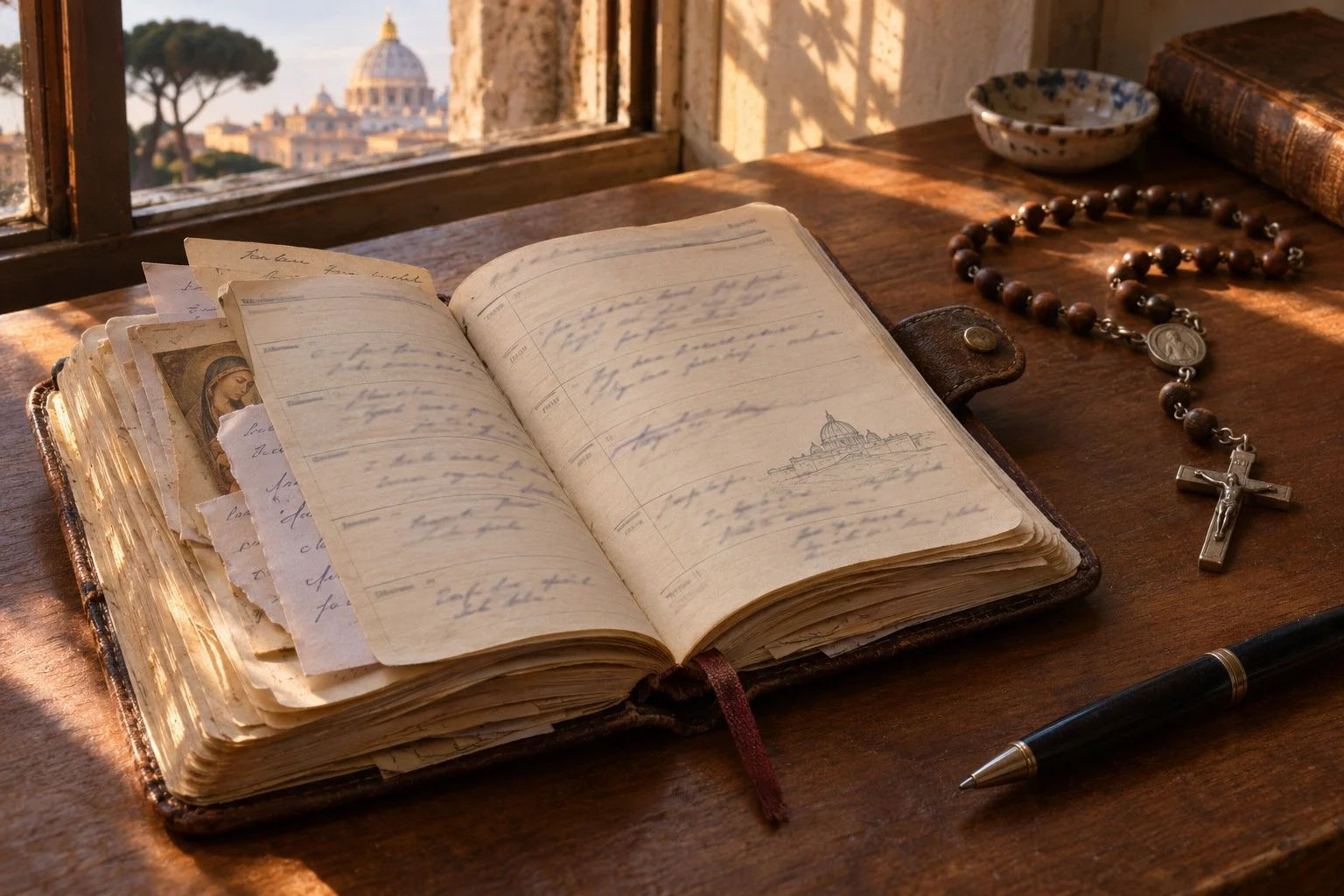
One of the strangest dates in Pope Francis’s diary is 21 July 2013. That is when he made a note about being elected pope on 13 March. The world had known for four months. Jorge Mario Bergoglio evidently felt no obligation to keep his appointment book up to date for a future biographer. Yet this is the document people are now opening in search of the man behind one of the most closely watched offices on earth.
Who decided what they could read? Cardinal Víctor Manuel Fernández selected the passages and arranged them by subject. Francis had pointed him towards the papers and given him a purpose for using them. After Francis died, Pope Leo XIV recovered the material and supported publication with Fernández’s commentary. Each man made a different decision. The one that most directly shaped what appeared on the page belonged to the cardinal.
An Unfinished Conversation at Santa Marta
Fernández says he discovered the diary during a conversation about what should happen if Francis permanently lost consciousness. They were at the pope’s desk at Casa Santa Marta. A secretary was in the next room. The proposed document about incapacity came to nothing, but Francis showed his visitor where he kept three documents and an appointment book. Looking inside the book, Fernández realised what it was being used for. He had no opportunity then to read the entries.
One word stayed with him: “edification”. Fernández readily acknowledges that he cannot reconstruct everything Francis said that afternoon. He understood the request to mean that, when the time came, others should judge which writings might do readers some spiritual good. A historian would dearly like a written instruction specifying what could be printed. The cardinal offers the recollection of a conversation with a friend. Its imprecision matters because it left him with real discretion.
Francis died on 21 April 2025. For a time after Leo’s election, Fernández held back from raising the subject. Eventually the possibility that the papers might disappear weighed more heavily. He told Leo what he remembered. In Fernández’s account, the new pope found the box two days later and sent it to him. Leo’s part in the story was decisive even before questions of publication arose. A man knew what the papers meant, another man could find them, and it took a conversation between the two to bring those things together.
What the Cardinal Left Out
A reminder to visit the dentist gives a fair idea of the first category of omissions. Appointments and practical notes belonged in the original planner because Francis needed them. Fernández judged that some offered little to someone reading about his spiritual life. He also omitted repetitions and private passages concerning people still alive. Readers may disagree with a choice made on Francis’s behalf, but there is a discernible principle here: the pope could entrust another person with his own confidences without giving him unrestricted permission to publish someone else’s.
A harder case concerns entries in unfamiliar signs. Fernández interpreted them as an indication that Francis wanted certain things to remain private. That is the editor’s judgement about the marks. No public key accompanies them, and the published account gives readers no grounds for guessing at the missing words. In a book marketed on its intimacy, there is something unusually apt about an author’s handwriting retaining the power to keep a confidence.
The cardinal did include material that made him hesitate. Francis described experiences of divine tenderness, fear that he might do harm in his office, and encounters he understood in religious terms as confrontations with the devil. Fernández had known him well and says the private vocabulary of those experiences still surprised him. Intimacy alone, then, was never his test for exclusion. Some of the passages hardest for a friend to publish were precisely the ones he thought might help a stranger.
What Changes When a Diary Is Arranged by Subject?
The entries cover 20 December 1992 to 18 August 2024. At the beginning Bergoglio was an auxiliary bishop in Buenos Aires. By the end he had been pope for more than eleven years. Placing reflections from across that span beside one another allows a reader to recognise a recurring anxiety or form of prayer. It also changes the sort of question the volume can answer. A passage about fear gains a different significance alongside another about fear than it would between two ordinary appointments.
Consider the spiritual crisis Francis recorded in 2021 and 2022. A thematic reading places it in the company of earlier doubts and later consolations. A chronological reading would ask how long the silences lasted, what else occupied the intervening pages and when the language began to change. Those are legitimate questions about a diary. This edition gives the reader better tools for the first inquiry than for the second.
There are two voices to listen for as a result. Francis describes an experience. Fernández explains why he thinks it mattered. The distinction counts most when a passage seems startling. A reader can take seriously what a believer wrote about encountering evil, consider the theological meaning his editor gives it, and still recognise that these are different kinds of testimony. The book’s English publisher names Fernández as its author. That credit is a useful guide to what one actually holds.
Why Leo Wanted the Commentary
Fernández says Leo thought isolated passages might confuse people who had never known Francis. A friend can supply context for an obscure reference or explain how a remark fits a life. Friendship also shapes which traits look most revealing. Someone looking for an account of how a pope governed will have different priorities from someone who hopes to learn how he prayed. Neither reader needs to pretend that selection is neutral to find the volume worthwhile.
Published on 24 November 2026 in five languages, the book gives a vast audience access to notes once kept in a black-covered planner. For anyone drawn to the difference between private conviction and public faith, the July entry about the March election is a good place to begin. It records the event that changed how everyone else addressed Bergoglio. Its date preserves something rarer: a trace of the pace at which he chose to address it himself.
Sources
Vatican News — Cardinal Fernández on Francis’s diary — The editor’s first-hand account of the conversation, the box, the omissions and Leo’s involvement.
Vatican News — Humanity, fears, thirst for God, temptations — Published entries, the physical planner and the international release.
Penguin Random House — The Private Diary of Pope Francis — The English edition’s authorship, dates and scope.
Next Reads
Communion Summary and Analysis — A second account of the distance between a public figure’s religious identity and the experience of belief.
Conclave Explained — How a novelist uses the privacy of a papal election to explore conscience and doubt.
Marco Rubio Meets Pope Leo XIV — The diplomatic responsibilities facing the successor who helped recover Francis’s papers.
