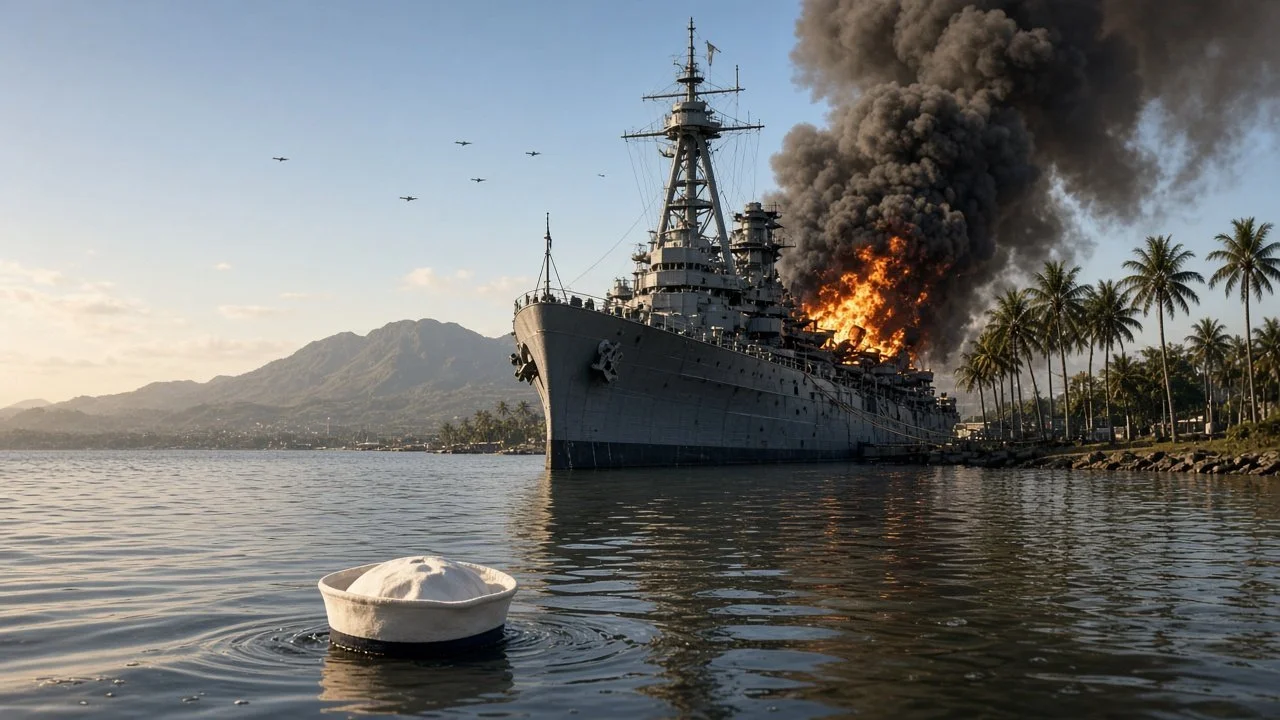
At 7.48 On A Sunday Morning In Hawaii, The War America Had Tried To Avoid Arrived From The Sky.
On 7 December 1941, 353 Japanese aircraft launched from six carriers struck the United States Pacific Fleet at Pearl Harbor on the Hawaiian island of Oahu. In roughly 90 minutes they killed 2,403 Americans, wounded 1,178 more, damaged or destroyed 21 ships, including all eight battleships in the harbour, and wrecked 188 aircraft, most of them on the ground. The next day, President Franklin D. Roosevelt called it "a date which will live in infamy", and Congress declared war on Japan within hours. Four days later, Germany and Italy declared war on the United States, and a European war and an Asian war became a single global conflict. Eighty-five years on, the attack is often told as a bolt from a clear sky. The record shows something more uncomfortable: a war that both governments had seen coming for months, a series of warnings that never quite connected, and a tactical triumph for Japan that turned into a strategic disaster.
Why Did Japan Attack Pearl Harbor?
The short answer is oil, China and time. Japan had been at war with China since 1937, and by 1941 its army was bogged down there. The United States backed China with loans and supplies and, from 1940, began restricting exports to Japan of materials useful in war. In July 1941, after Japanese troops moved into southern French Indochina, Washington froze Japanese assets and imposed an embargo on oil. Britain and the Dutch government in exile followed suit. Japan imported most of its oil, much of it from the United States, and its navy calculated that it could not keep fighting for long without new supplies.
That left Tokyo with a stark choice. It could accept American terms, which by late November meant withdrawing from China and Indochina, or it could seize the oil, rubber and tin of Southeast Asia, above all the Dutch East Indies, now Indonesia, by force. The second option risked war with Britain and the Netherlands, and almost certainly with the United States, whose Pacific Fleet had been based at Pearl Harbor since 1940 precisely to deter such a move.
Admiral Isoroku Yamamoto, commander of Japan's Combined Fleet, argued that if war was coming, Japan should strike the American fleet first and hard. He had lived in the United States, had studied at Harvard and understood its industrial power better than most of his colleagues. His bet was not that Japan could defeat America in a long war, but that a crippling opening blow would buy six months to a year in which Japan could seize its southern empire and dig in, perhaps leaving Washington willing to negotiate rather than fight its way back across the Pacific.
How Was the Attack Planned?
Planning began early in 1941. Japanese naval aviators drew on the British raid on the Italian fleet at Taranto in November 1940, which had shown that torpedo bombers could sink battleships in a shallow harbour. Pearl Harbor was only about 12 metres deep, too shallow for ordinary aerial torpedoes, so Japanese engineers fitted wooden fins to theirs to stop them diving into the mud. A naval intelligence officer working under cover at the Japanese consulate in Honolulu, Takeo Yoshikawa, sent back reports on which ships were in harbour and when.
The order for the assault was issued on 5 November 1941. The strike force, known as the Kido Butai, assembled in the remote Kuril Islands north of Japan and sailed from Hitokappu Bay on 26 November: six aircraft carriers, the Akagi, Kaga, Soryu, Hiryu, Shokaku and Zuikaku, escorted by two battleships, three cruisers, 11 destroyers and a fleet of oil tankers. It took a northerly route across the empty winter Pacific, under strict radio silence, commanded by Vice Admiral Chuichi Nagumo. Its commanders were told they could be recalled if the talks in Washington succeeded. They did not.
At the same time, five Japanese submarines each carried a two-man midget submarine towards Oahu. The plan was for these to slip into the harbour and add torpedoes to the air attack.
Did America Have Any Warning?
It had several, and that is why the attack remains so controversial. American codebreakers had cracked Japan's top diplomatic cipher, known as Purple, and were reading messages between Tokyo and its embassy in Washington. Those intercepts made clear that Japan was preparing for war, but they did not name Pearl Harbor as a target. Most American planners expected the first blow to fall on the Philippines, Malaya or Thailand, thousands of miles to the west.
On 27 November, the Navy sent Admiral Husband E. Kimmel, the Pacific Fleet commander, a message that began: "This dispatch is to be considered a war warning." The Army warned Lieutenant General Walter C. Short, who commanded its forces in Hawaii, that "hostile action is possible at any moment". Short's main response was to guard against sabotage, which meant parking aircraft wingtip to wingtip so they could be watched, making them an easy target from the air. Kimmel did not extend long-range air patrols to the north, the most likely direction of a carrier attack. Most of the fleet stayed moored in the harbour, and many sailors had weekend shore leave.
Early on Sunday 7 December, Washington decoded instructions telling Japan's envoys to deliver a final message to the Secretary of State, Cordell Hull, at exactly 1pm Washington time, which was 7.30am in Hawaii. General George Marshall, the Army chief of staff, realised the timing mattered and sent a fresh warning to Hawaii. To avoid interception he sent it by commercial telegram rather than telephone. It arrived after the bombs had fallen.
The Morning of 7 December 1941: A Timeline
All times below are Hawaii time. Hawaii was then 10 and a half hours behind Greenwich Mean Time, so 7.48am in Honolulu was 6.18pm GMT, and early evening in Britain.
- About 3.42am: the minesweeper USS Condor spots a periscope near the harbour entrance and alerts the destroyer USS Ward.
- 6.00am: more than 200 miles north of Oahu, the first wave begins taking off from the Japanese carriers.
- 6.37am: USS Ward fires on and sinks a midget submarine near the harbour entrance. These are the first American shots of the Pacific war. Ward's report reaches headquarters, but officers wait for confirmation.
- Just after 7am: two Army privates at the Opana radar station on Oahu's north shore, George Elliott and Joseph Lockard, see the largest formation they have ever seen on their screen. The duty officer at the information centre, Lieutenant Kermit Tyler, assumes it is a flight of American B-17 bombers due from California and tells them not to worry.
- 7.48am: the attack begins. Japanese aircraft strike the air bases at Kaneohe, Wheeler, Hickam and Ford Island to stop American fighters getting airborne. The strike leader, Commander Mitsuo Fuchida, signals "Tora! Tora! Tora!" to tell the fleet that surprise has been achieved.
- About 7.55am: torpedo bombers and high-level bombers hit Battleship Row, the line of battleships moored beside Ford Island.
- About 8.10am: an armour-piercing bomb penetrates the USS Arizona and detonates her forward ammunition magazine. The ship explodes and sinks within minutes. 1,177 of her crew are killed, nearly half of all the Americans who died that day.
- Around 8am to 8.15am: the USS Oklahoma, hit by several torpedoes, rolls over and capsizes, trapping hundreds of men inside her hull. 429 of her crew die.
- About 8.50am: the second wave arrives and attacks the airfields and the ships again. The battleship USS Nevada, the only one to get under way, is targeted as she heads for the harbour mouth and is deliberately run aground so she does not sink in the channel and block it.
- Shortly after 9am: the last Japanese aircraft turn back towards their carriers. Behind them, the harbour is covered in burning oil.
- About 2.20pm Washington time (8.50am in Hawaii): Japan's ambassador, Kichisaburo Nomura, and special envoy Saburo Kurusu deliver Japan's message to Hull, more than an hour after the attack began. It breaks off negotiations but does not declare war.
What Did the Attack Destroy, and What Did It Miss?
The toll was devastating. Of the eight battleships in harbour, all were damaged and four were sunk. In total, 21 American ships were sunk or damaged. Of about 400 American aircraft in Hawaii, 188 were destroyed and 159 damaged. Of the 2,403 Americans killed, 2,008 were sailors, 218 were soldiers and airmen, 109 were Marines and 68 were civilians, some of them killed by American anti-aircraft shells falling back on Honolulu. Many of the dead were teenagers or men in their early twenties, junior sailors who slept aboard ship while officers lived ashore. Japan lost 29 aircraft, five midget submarines and 64 men. One submariner, Ensign Kazuo Sakamaki, was captured when his midget submarine ran aground, making him the first Japanese prisoner of war taken by the United States.
But the most important targets were not there, or were not hit. The Pacific Fleet's three aircraft carriers were at sea or on the US mainland. In the months that followed, carriers rather than battleships would decide the war in the Pacific. Japan also left untouched the base's repair yards, dry docks, submarine base and huge oil tank farm. Had those fuel tanks burnt, the fleet might have had to withdraw to California.
Fuchida and others later claimed they had urged Nagumo to launch a third strike against those facilities. Some historians doubt how hard that case was pressed, and a third wave would have meant landing aircraft in darkness while American carriers were still unaccounted for. Nagumo withdrew. Because the harbour was shallow, the Navy was able to raise most of the sunken and damaged ships. All the battleships except the Arizona, the Oklahoma and the Utah, an old ship used for target practice, eventually returned to service, and several fought at the Battle of Surigao Strait in 1944.
The Acts of Courage That Morning
Fifteen Medals of Honor were awarded for actions at Pearl Harbor, many of them posthumously. Among the best known is Doris "Dorie" Miller, a mess attendant on the USS West Virginia. At a time when the Navy allowed Black sailors only to serve as cooks and stewards, he helped carry his mortally wounded captain to shelter and then manned an anti-aircraft machine gun he had never been trained to use. He became the first Black American to receive the Navy Cross, and in 2020 the Navy announced that a future aircraft carrier would be named after him.
Civilians also died at their posts. Three Honolulu firefighters were killed and several more were wounded responding to fires at Hickam Field, the only firefighters on American soil ever attacked by a foreign power. A handful of US Army Air Forces pilots managed to take off from Haleiwa and Wheeler during the raid and were credited with shooting down Japanese aircraft.
How the United States Went to War
Roosevelt heard the news by telephone early in the afternoon in Washington. At about 5pm he dictated to his secretary, Grace Tully, a short request to Congress for a declaration of war. According to the US National Archives, the first draft called 7 December "a date which will live in world history". Roosevelt crossed out "world history" and wrote "infamy".
At 12.30pm on Monday 8 December, he addressed a joint session of Congress, broadcast live by radio to the nation. The speech lasted about seven minutes. It listed the other places Japan had attacked in the same 24 hours, including Malaya, Hong Kong, Guam, the Philippines, Wake Island and Midway, and asked Congress to declare that a state of war had existed since "the unprovoked and dastardly attack by Japan". The Senate voted 82 to 0. In the House the vote was 388 to 1. The only vote against came from Jeannette Rankin of Montana, a pacifist who had also opposed America's entry into the First World War. Roosevelt signed the declaration that afternoon.
Britain moved even faster. Japanese forces had landed in Malaya and attacked Hong Kong at almost the same time as the raid on Hawaii, and Winston Churchill had promised to declare war on Japan "within the hour" of an attack on the United States. Britain declared war on Japan on 8 December, several hours before Congress voted. In his memoirs Churchill later recalled his feeling that night, after years of hoping America would join the fight: "So we had won after all!"
Three days later, on 11 December, Adolf Hitler declared war on the United States, even though Germany's treaty with Japan only obliged it to help if Japan was attacked, not if Japan attacked first. Italy did the same. Congress answered with declarations of war against both that afternoon. Hitler's decision settled the question that had divided Americans for two years: the United States was now at war in Europe as well as in the Pacific, and Roosevelt and Churchill soon agreed to concentrate first on defeating Germany. Our counterfactual on what might have happened if Japan had never attacked Pearl Harbor explores how differently that war might have unfolded.
Who Was Blamed?
Within weeks, a presidential commission led by Supreme Court Justice Owen Roberts blamed Kimmel and Short for failing to prepare adequately, and both were relieved of command and retired at reduced rank. Later inquiries, including a joint congressional investigation in 1945 and 1946, spread the blame more widely, to Washington's failure to share intelligence and to the confused chain of command between the Army and Navy in Hawaii. In 1999 the US Senate passed a non-binding resolution saying the two men had been denied vital information and calling for their ranks to be restored after their deaths, but no president has acted on it.
The attack sits high on any list of the biggest intelligence failures in modern history, because the signals were there. The trouble was that they were scattered across different agencies, buried in a mass of other information, and interpreted through the assumption that Japan would not dare to strike so far from home.
Did Roosevelt Know Pearl Harbor Would Be Attacked?
This is the most persistent myth about 7 December. The theory holds that Roosevelt knew the attack was coming and let it happen to drag a reluctant nation into the war. Mainstream historians reject it. The decrypted diplomatic messages showed that war was imminent, but not where Japan would strike, and the Japanese fleet kept radio silence on its way to Hawaii. American commanders expected an attack in Southeast Asia, and Washington's warnings to Hawaii focused on sabotage and on attacks elsewhere. Roosevelt certainly wanted to help Britain and was pushing the limits of neutrality in the Atlantic. That is a long way from knowingly sacrificing much of his own fleet, and no document has ever shown that he did.
The Darker Consequence at Home
The attack also led to one of the worst civil liberties abuses in American history. Within hours, the FBI and military police in Hawaii were detaining Japanese-American community leaders. On 19 February 1942, Roosevelt signed Executive Order 9066, which led to more than 110,000 people of Japanese descent on the West Coast, most of them American citizens, being forced from their homes into remote camps. In Hawaii itself, where people of Japanese ancestry made up more than a third of the population and were essential to the economy, fewer than 2,000 were interned. In 1988, President Ronald Reagan signed the Civil Liberties Act, which formally apologised and paid compensation to surviving internees.
Pearl Harbor at 85: How the Anniversary Is Being Marked
The 85th anniversary falls on Monday 7 December 2026. The National Park Service will hold its main commemoration at Pearl Harbor National Memorial from 7.50am to 9am Hawaii time, which is 5.50pm to 7pm in the UK and 12.50pm to 2pm on the US East Coast, under the theme "Courage of Commitment". The programme is timed to the minute of the attack. The NPS says the main ceremony will be livestreamed. Other events include a ceremony at the USS Utah Memorial on 6 December, a ceremony at the USS Oklahoma Memorial on the afternoon of 7 December, and the Blackened Canteen ceremony on the Arizona Memorial on 8 December, a reconciliation ritual in which American and Japanese participants pour whiskey into the water. The Ford Island ceremonies require military or government access.
This anniversary will be one of the last with any survivors still alive. Freeman Johnson, a 106-year-old who had been below deck on the cruiser USS St Louis that morning and the oldest known survivor, died at his home in Massachusetts on 14 November 2026. Gebhard Galle, 105, who had been aboard the USS Nevada when a torpedo struck her, died the same day at his home in Washington state. Reports put the number of known survivors still living at 10 or 11, all of them over 100. David Russell, 106, of Albany, Oregon, the last living survivor of the USS Oklahoma, is now believed to be the oldest.
The USS Arizona still lies where she sank, with more than 900 of her crew entombed inside. Small drops of oil still rise from her hull to the surface, a sight visitors sometimes call the ship's "black tears". The white memorial built across her in 1962 is one of the most visited places in Hawaii. Since 1994, 7 December has been National Pearl Harbor Remembrance Day in the United States.
Why Pearl Harbor Still Matters
Japan won the morning and lost the war. The raid sank ships that could be raised, missed the carriers and fuel that mattered most, and united a divided country behind a war it had spent two years trying to stay out of. Six months later, at the Battle of Midway, American carriers sank four of the six Japanese carriers that had attacked Hawaii. Yamamoto's gamble had bought almost exactly the window he predicted, and no more. Eighty-five years on, the lesson that historians keep returning to is not that the attack was unforeseeable, but that the warnings were there and no one put them together in time.
Sources
- National Park Service — Media Invited to Attend and Cover 85th Anniversary Commemoration Events at Pearl Harbor National Memorial — Dates, times, theme and livestream of the 2026 commemoration events.
- US National Archives — Joint Address to Congress Leading to a Declaration of War Against Japan (1941) — The "Day of Infamy" speech transcript, the "world history" draft change, timings on 8 December and the congressional votes.
- Encyclopaedia Britannica — Pearl Harbor attack — Background to the oil embargo, the 5 November order, the 27 November war warnings, Marshall's telegram, the Ward and radar warnings, timings and casualty totals.
- Wikipedia — Attack on Pearl Harbor — Cross-check of the strike force, timeline, US casualty breakdown, aircraft losses, Japanese losses, ship-by-ship damage and aftermath (with links to Naval History and Heritage Command records).
- US House of Representatives: History, Art & Archives — The Declaration of War Against Japan — Jeannette Rankin's lone vote against the war in the House.
- AP News — Freeman Johnson, the oldest of the dwindling number of Pearl Harbor survivors, dies at 106 and The Guardian — Freeman Johnson, oldest survivor of Pearl Harbor attack, dies aged 106 — Johnson's death and the number of surviving veterans.
- KDRV — Albany veteran, 106, recognized as oldest Pearl Harbor survivor — David Russell as the believed oldest survivor and last USS Oklahoma survivor.
- Stars and Stripes on X, 19 November 2026 and KRCG 13 on X, 19 November 2026 — The death of USS Nevada survivor Gebhard Galle, 105, on the same day as Freeman Johnson.
Next Reads
- What If Japan Never Attacked Pearl Harbor? How World War II – and the World After – Might Have Changed — The counterfactual: how the war might have unfolded without 7 December.
- The Biggest Intelligence Failures In Modern History Ranked — Where Pearl Harbor sits alongside 9/11, Yom Kippur and Iraq.
- FDR vs Truman Decisions: What Might Have Changed if Roosevelt Lived Past April 1945 — The president who led America into the war, and the one who ended it.
