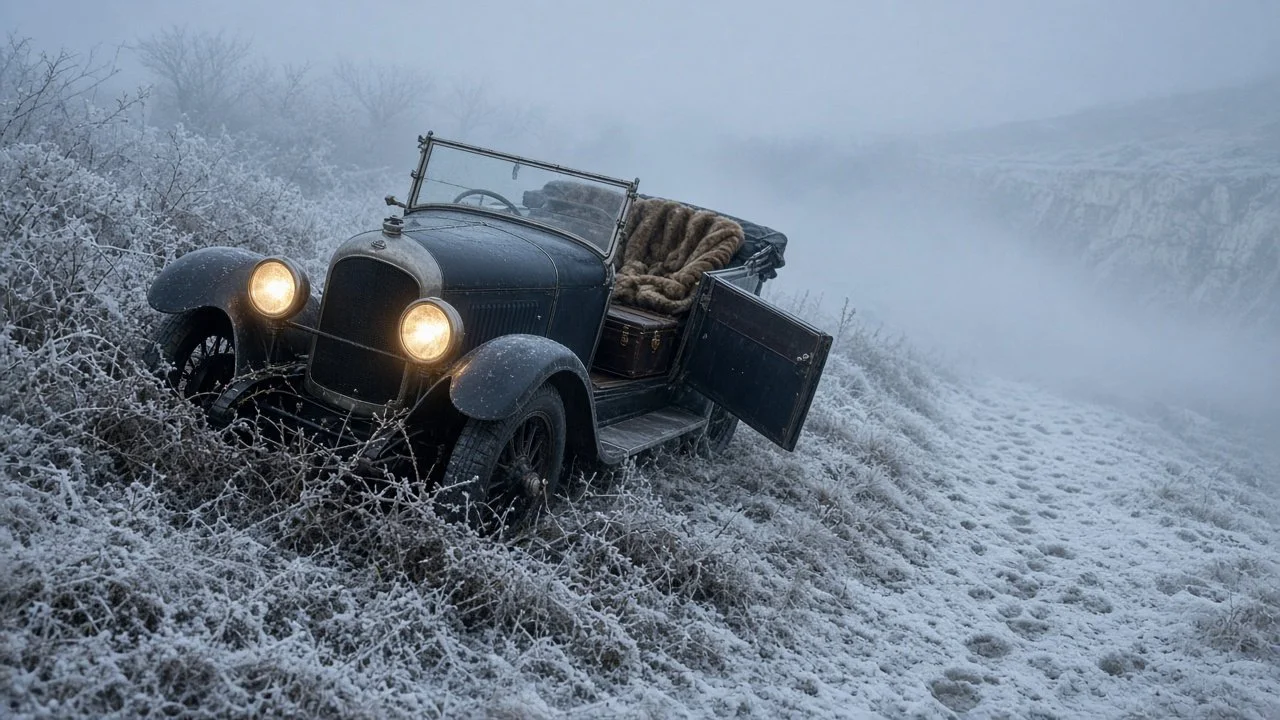
On The Night Of 3 December 1926, The World's Most Famous Crime Writer Drove Into The Dark And Vanished.
At about 11 o'clock on the morning of Saturday 4 December 1926, Surrey police were told that a Morris car had been found abandoned at Newlands Corner, a beauty spot on the Downs near Guildford. It had run off the road and come to rest in bushes on a slope above a chalk pit, its headlights still burning. Inside were a fur coat, a case of clothes and a driving licence belonging to Mrs Agatha Christie of Sunningdale. For the next 11 days Britain hunted for the author of The Murder of Roger Ackroyd, dead or alive. She was alive, and on 14 December she was identified at a spa hotel in Harrogate, staying under the surname of her husband's lover. A hundred years on, the documented facts are clearer than most people realise. What remains genuinely unknown is why she went, and how much of it she meant.
What Happened on 3 December 1926?
By December 1926, Agatha Christie was 36, famous and deeply unhappy. She lived with her husband, Colonel Archibald "Archie" Christie, a former Royal Flying Corps pilot turned City businessman, and their seven-year-old daughter Rosalind, in a large house in Sunningdale, Berkshire, which they had named Styles after her first novel. Archie had told her that summer that he had fallen in love with another woman, Nancy Neele, and wanted a divorce. On Friday 3 December, after a quarrel that morning, he left for the weekend. He was going to stay with friends near Godalming in Surrey, and Nancy Neele was among the guests.
Late that evening Agatha went upstairs, kissed her sleeping daughter goodnight and drove away from Styles in her Morris Cowley. She left a letter for her secretary, Charlotte Fisher, and another for Archie, which he later burnt after reading. She also posted a letter to Archie's brother, Campbell Christie, saying she was going to a spa in Yorkshire. That letter would become the most important clue in the case, and for several days it was almost entirely ignored.
A Bereavement, a Breakdown and a Bestseller
The months before the disappearance explain much of what followed. Christie's mother, Clara, to whom she was devoted, died in April 1926. Archie did not attend the funeral, and the death strained the marriage almost to breaking point. Christie later wrote that by the end of the year she was "at the beginning of a nervous breakdown".
At the same time, her career was taking off. The Murder of Roger Ackroyd, published that year, had made her a celebrity. Its famous twist, in which the narrator himself turns out to be the killer, had caused a sensation, and readers either applauded or accused her of cheating. You can read how that solution works in our explainer on The Murder of Roger Ackroyd's ending and the ten missing minutes. She had a new contract with the publisher William Collins, her photograph was in the Daily Mail, and money from an earlier serial had paid for the very car she drove away in. The most watched crime writer in Britain was about to become the subject of the biggest real-life mystery of her career.
The Abandoned Car at Newlands Corner
The most reliable record of the first hours of the case is a letter that Surrey's Deputy Chief Constable, William Kenward, wrote to the Home Office on 9 February 1927, now held by the National Archives. The letter sat among Home Office papers for more than half a century and drew wide attention only in 1999, when the Guardian reported on the files alongside a new book about the case, which is why many older retellings miss it. Kenward said that the car had been found "half-way down a grassy slope well off the main road with its bonnet buried in some bushes, as if it had got out of control". Its headlights were still on when it was found early on 4 December.
Kenward learnt that Christie had left home late on the Friday "under rather unusual circumstances", that she had been very depressed, and that she had kissed her daughter before leaving. He also interviewed a man named McAlister, who said that at 6.20am that Saturday he had helped a woman matching her description to start the engine of a car. McAlister described her as "very sparsely dressed for such an inclement morning" and said she "appeared strange in her manner".
That witness account matters, because it suggests Christie was still with the car, and still behaving oddly, in the early hours of Saturday morning. To Kenward, the scene pointed to one of three possibilities: that she was wandering with memory loss across the Downs, that she had fallen into one of the overgrown gravel pits in the area and was lying injured, or, as had been "strongly suggested to the police", that she was the victim of a serious crime.
How Big Was the Search for Agatha Christie?
The popular version of the story describes a vast manhunt, with more than 1,000 police officers, up to 15,000 volunteers, bloodhounds and aeroplanes. Those numbers appeared in the press at the time and are still repeated today. Estimates of the volunteers who turned out on the biggest search day, Sunday 12 December, range from 2,000 in the Times to 15,000 in some other papers. The Westminster Gazette reported that around 300 police officers and special constables had taken part in one search in Surrey. The Silent Pool, a spring-fed lake near Newlands Corner, was dragged in case she had drowned.
Kenward's own account is far more modest, and it was written to answer criticism. He said that he and seven or eight regular officers, with special constables and civilian volunteers, searched the Downs on 4, 5 and 6 December. Only on two occasions did he bring in about three dozen regular police from quiet country districts, to make a systematic search. He told the Home Office that the number of police said to have been involved had been "greatly exaggerated", that the Metropolitan Police had not been called in, and that the aeroplanes "said to have taken part in the search are nothing to do with the police". The total cost of the search, he said, was about £25, mostly for transport and refreshments. Archie, asked to contribute, refused, saying it was "entirely a police matter".
Kenward had reason to play the scale down. The letter was prepared to help the Home Secretary answer a question from the Labour MP Neil Maclean in the House of Commons on 25 February 1927, at a time when there was anger that police time and money had been wasted on a woman who turned out to be safe. The truth probably lies between the newspapers' figures and the police chief's. What is clear is that the huge crowds were largely volunteers drawn by the press coverage, and that the search became a public spectacle as much as a police operation.
It was also a story that crossed counties. Christie had disappeared from Berkshire, but her car was found in Surrey, and the two forces took different views. Berkshire's Superintendent Goddard was reported to believe she was alive and would return once she had worked out her troubles. Kenward, for much of the search, believed she was dead and that her body lay near Newlands Corner.
Conan Doyle, Dorothy L. Sayers and the Detective Novelists
The disappearance of a crime writer drew in crime writers. Sir Arthur Conan Doyle, the creator of Sherlock Holmes and a committed spiritualist, obtained one of Christie's gloves and gave it to a medium, Horace Leaf. According to Doyle, Leaf said that its owner was "half dazed and half purposeful", that she was not dead as many believed, and that she would be heard of the following Wednesday. Doyle later presented the result as evidence that the police should use mediums.
Dorothy L. Sayers, the creator of Lord Peter Wimsey, visited Newlands Corner and joined the search. She rejected loss of memory, foul play and suicide, and argued for "a voluntary disappearance", pointing out that a skilful writer of detective stories would know exactly how to stage something puzzling. Edgar Wallace was blunter, describing it in the Daily Mail as "a typical case of 'mental reprisal' on somebody who has hurt her".
Why Archie Christie Came Under Suspicion
As the days passed without a body, suspicion turned on the husband. The police had learnt of the quarrel, and journalists suspected him of either killing his wife or driving her to suicide. Archie, anxious to keep his affair out of the papers, made matters worse. On 10 December he gave an interview to the Daily Mail in which he suggested his wife might have disappeared deliberately. "My wife had discussed the possibility of disappearing at will," he said, adding that he personally felt that was what had happened. He also insisted there had been no row or "tiff" between them on the Friday morning, a denial that contradicted what the police already knew.
There was never any evidence that Archie had harmed his wife, and he was never charged with anything. But his evasions fed the story, and the image of a husband under suspicion became one of the reasons the case has fascinated crime writers ever since.
The Clue in the Post
Campbell Christie's letter should have ended the mystery within days. Agatha had written it on the Friday and posted it in London on the Saturday morning, saying she was going to a Yorkshire spa. Campbell did not immediately connect it with her disappearance, and when he did, the letter itself had been mislaid and only the envelope was passed on.
The press learnt of the letter on 7 December and reporters checked hotels in Harrogate, the best-known spa town in Yorkshire. They found no Mrs Christie registered anywhere. The reason was simple. She had not used her own name.
Mrs Teresa Neele of Cape Town
On the evening of Saturday 4 December, a woman arrived by taxi at the Swan Hydropathic Hotel in Harrogate, now the Old Swan Hotel. She had almost no luggage and said she had recently come from South Africa. She signed the register as Mrs Teresa Neele, using the surname of her husband's lover, and took a good first-floor room at seven guineas a week. The hotel manager, a Mr W. Taylor, later recalled that she seemed to have as much money as she wanted.
What followed is one of the strangest parts of the story, and much of it comes from hotel staff and guests interviewed after she was found, as gathered by the historian Lucy Worsley. "Mrs Neele" ate in the dining room, danced in the evenings, played billiards and sang. One guest remembered that she did the Charleston, "but not very well". She went shopping for a new hat, coat, evening shoes and toiletries, and borrowed novels of "sensation and mystery" from a lending library on Parliament Street. A chambermaid noted that on Sunday, while the Surrey Downs were being searched for her body, she slept until 10am and had breakfast in bed. When a fellow guest noticed that she had left the price tag on a new shawl and asked if that was all she was worth, she replied that she thought she was worth more.
She read about the hunt for Mrs Christie in the newspapers. One guest later recalled her saying that "Mrs Christie is a very elusive person". By the middle of the week, some at the hotel suspected who she was. The manager's wife told her husband she believed the guest was Mrs Christie, and he dismissed the idea as absurd.
How Agatha Christie Was Found
It was the hotel's musicians who acted. Two members of the resident dance band, Bob Tappin and Bob Leeming, reported their suspicions to the police. Yorkshire officers contacted their colleagues in Surrey, and Archie travelled to Harrogate on 14 December. He waited in the hotel while his wife came down to dinner, reportedly after keeping him waiting while she changed into her evening dress, and identified her.
Archie then gave a statement to the press saying that his wife had suffered a complete loss of memory and did not know who she was. The next day, 15 December, the couple left the hotel through a crowd of reporters and travelled to Abney Hall in Cheadle, Cheshire, the home of Agatha's sister Madge. There, two doctors examined her and issued a statement that she was suffering from loss of memory. That diagnosis became the family's official explanation for decades.
The Daily Mail was unconvinced. Before she was found, it had already suggested in an editorial that if she was alive, she was inflicting anxiety on her relatives and expense on the public in "a heartless practical joke". Once she was safe, much of the public suspected exactly that.
What Agatha Christie Said Herself
It is often said that Christie never spoke about the disappearance, and her Autobiography, published in 1977, the year after her death, does pass over it in silence. But she did give an account. In 1928, in an interview with the Daily Mail, she said she had left home in a state of nervous strain, that her car had crashed and she had struck her head, and that afterwards "for 24 hours I wandered in a dream and then found myself in Harrogate as a well-contented and perfectly happy woman who believed she had just come from South Africa".
Lucy Worsley, in her 2022 biography, pieced together further statements Christie made about that night. In them, Christie described driving aimlessly with "the vague idea of ending everything", going to the river at Maidenhead and thinking about jumping in, but realising that she could swim too well to drown. She said she then drove to Newlands Corner, turned the car off the road towards the quarry, let go of the wheel and hit her head when the car stopped suddenly. She remembered arriving at a large station and being surprised to learn it was Waterloo, and said that by then she had become, in her mind, Mrs Teresa Neele of South Africa. "I just wanted my life to end," she said.
Those words do not settle the question, because Christie wrote fiction for a living, and her account of memory loss sounds like one of her own plots. But they are her testimony, and they describe a woman in crisis rather than a woman plotting.
The Theories, and the Evidence for Each
Five main explanations have been offered over the past century. They are not all mutually exclusive.
Amnesia After a Car Accident
This was the official family version, backed by the two doctors at Abney Hall and by Christie's own 1928 account. The car had clearly left the road, and she said she struck her head. Against it is the fact that she organised a train journey, chose a false name with an obvious meaning and lived an orderly social life for 10 days, which seems a lot to ask of simple concussion.
A Dissociative Fugue Brought On by Trauma
The biographer Andrew Norman has argued that Christie was in a fugue state, sometimes called psychogenic amnesia, a rare condition in which severe stress or depression leads someone to lose their sense of identity and adopt a new one. He pointed to her new persona and her failure to recognise herself in newspaper photographs, and has said he believes she was suicidal. Worsley takes a similar view, arguing that the one thing that can be said for certain is that Christie suffered a distressing episode of mental illness brought on by her mother's death and the collapse of her marriage. This explanation fits her own account, but no diagnosis can be confirmed a century later.
A Plan to Embarrass Her Husband
The journalist Jared Cade, in Agatha Christie and the Eleven Missing Days, first published in 1998, argued that Christie staged the disappearance to wreck Archie's weekend with Nancy Neele and bring the police to his door. Cade drew on accounts from the family of Nan Watts, a friend of Christie's who he said knew of the plan. The letter to Campbell Christie, sent so that her family would not be unduly alarmed, and the choice of the name Neele both fit this theory. But it relies heavily on second-hand family testimony, and critics including Worsley have argued that it does not take Christie's own account of her suffering seriously.
A Publicity Stunt
Many at the time believed the disappearance was a stunt to sell books, and sales did rise. On 11 December the Daily Telegraph carried an advertisement for a serialisation of The Murder on the Links, billing her as "Agatha Christie the Missing Novelist". That wording came from her publishers, not from Christie. There is no evidence that she planned the episode for publicity. The coverage made her more famous, but it also made her the target of public anger over the cost of the search, which is hardly the outcome a calculated stunt would aim for.
A Suicide Attempt
Christie's own later statements describe thoughts of ending her life, the river at Maidenhead and the decision to let the car run towards the quarry. On that reading, the disappearance began as a suicide attempt and became something else after the crash. This is not a separate theory so much as the starting point for the fugue explanation.
What Is Documented, and What Is Not
After a hundred years, it helps to separate the facts from the theories.
- Documented: Christie left Styles late on 3 December 1926 after a quarrel with Archie, who wanted a divorce to be with Nancy Neele.
- Documented: her car was found off the road at Newlands Corner on the morning of 4 December, with its lights on and her coat, case and licence inside.
- Documented: she posted a letter to Campbell Christie saying she was going to a Yorkshire spa.
- Documented: she checked into the Swan Hydropathic Hotel in Harrogate as Mrs Teresa Neele on 4 December, and was identified there by her husband on 14 December.
- Documented: the doctors who examined her said she had lost her memory, and Christie later gave her own account of memory loss.
- Disputed: the scale of the search, which the police said was far smaller than newspapers claimed.
- Theory: whether she was genuinely in a fugue state, deliberately punishing Archie, or some mixture of both.
- Unknown: exactly how she travelled from Newlands Corner to London on the Saturday morning, and what she was thinking when she chose the name Neele.
What Happened Next
Agatha and Archie Christie divorced in 1928. She kept his surname, under which she had become famous, and she needed her writing to support herself and Rosalind. In 1930 she married the archaeologist Max Mallowan, to whom she stayed married for the rest of her life. She went on to become one of the best-selling novelists in history.
Her fiction sometimes seems to brush against those 11 days. In Unfinished Portrait, a 1934 novel published under the pen name Mary Westmacott, a woman called Celia suffers a breakdown when her marriage collapses, and Norman has read it as autobiographical. Trains, false identities and hotels where nobody is quite who they claim to be run through her later work, from the snowbound sleeping car of Murder on the Orient Express onwards, although any link to her own experience is interpretation rather than fact. The disappearance itself has been fictionalised many times, notably in the 1979 film Agatha, which, Worsley notes, went so far as to present her as plotting against Nancy Neele.
Marking the Centenary in Harrogate
The town where she was found is marking the anniversary. A new exhibition, Agatha Christie: A Harrogate Mystery, opened to the public at the Royal Pump Room Museum on Saturday 28 November 2026, the day after a launch evening there. It uses newspaper reports and objects from the museum's collection to reconstruct the role of 1920s Harrogate in the mystery, and includes an original costume from ITV's Agatha Christie adaptations and a trail of 11 hidden Christie book titles. Culture North Yorkshire lists it as open from Tuesday to Sunday, 9.30am to 4.30pm, until Sunday 6 June 2027, a closing date The Northern Guide also gives, although the Harrogate Advertiser's listing says May 2027, so check before travelling. The centenary of the disappearance itself falls on Thursday 3 December 2026.
The Mystery That Was Never Really a Whodunnit
The case of the missing novelist was never a murder, and the question of where she went was answered within 11 days. The enduring mystery is the one Christie never fully explained: whether a grieving, betrayed woman lost herself for a while, or chose to disappear and then could not find a way back. The evidence suggests real distress, and her own words describe it. A century on, the most honest answer is that she probably experienced something closer to the first, and that the press, the police and her readers have preferred the second ever since, because it reads like one of her books.
If you've been affected by any of the themes in this article, in the UK and Ireland you can contact Samaritans on 116 123, and in the US you can call or text the 988 Suicide & Crisis Lifeline.
Sources
- Police report on the disappearance of Agatha Christie (The National Archives, HO 45/25904) — Deputy Chief Constable Kenward's letter to the Home Office of 9 February 1927: the car, the McAlister sighting, the search, the £25 cost and Archie's refusal to pay.
- 'I just wanted my life to end': the mystery of Agatha Christie's disappearance (Lucy Worsley, The Guardian, 27 Aug 2022) — Christie's own statements, the Harrogate hotel testimony, Archie's Daily Mail interview, the Telegraph advert and the Daily Mail editorial.
- The mystery of the crime writer, an affair, the policeman and 11 missing days (The Guardian, 30 Jan 1999) — the Home Office papers, Sayers's verdict, Conan Doyle and Horace Leaf, Jared Cade's theory and Christie's 1928 account.
- The Mysterious Disappearance of Agatha Christie (HistoryExtra) — Bob Tappin's recognition, Andrew Norman's fugue argument and Unfinished Portrait.
- The original Gone Girl: Agatha Christie's mysterious disappearance (The Independent) — press estimates of volunteers, Sayers at the scene and Edgar Wallace's "mental reprisal" comment.
- Harrogate event to mark 100th anniversary of Agatha Christie mystery (Harrogate Advertiser) — the Royal Pump Room Museum exhibition from 28 November 2026.
- Agatha Christie: A Harrogate Mystery (Culture North Yorkshire) — exhibition dates, opening hours and contents.
- The Curious Case of Agatha Christie: New Harrogate exhibition revisits 100-year-old mystery (The Northern Guide) — opening and closing dates and the 27 November launch event.
Next Reads
- The Murder of Roger Ackroyd Ending Explained: Who Killed Ackroyd, the Ten Missing Minutes and Christie's Most Famous Twist — the 1926 novel that made her famous months before she vanished.
- Murder on the Orient Express Explained — Christie's most famous train mystery, explained.
- The World's Most Mysterious Disappearances — more vanishings that baffled investigators.
