Why Did So Many People Die Inside a Club That Had Several Ways Out?
On the night of Saturday 28 November 1942, more than 1,000 people were packed into the Cocoanut Grove, the most fashionable nightclub in Boston. The building was licensed for about 460. At around 10.15pm a fire started in the basement bar, and in the space of a few minutes it raced up a staircase, across the ceilings and through every room in the club. By the time it was out, 492 people were dead, according to the figure most histories use. It remains the deadliest nightclub fire on record and the second-deadliest single-building fire in American history.
The Cocoanut Grove had doors. It had a main entrance, side doors, service corridors and windows. What killed so many people was not a lack of exits on paper but the way those exits actually worked on the night: a single revolving door at the front, doors that were bolted, bricked up or hidden behind drapes, and doors that opened inwards against a crowd pushing outwards. Those failures, and what the city, the courts and the doctors of Boston did afterwards, are why the fire still shapes rules in buildings far beyond Massachusetts.
This explainer sets out what the club was, how the fire started and spread, why the exits failed, who died, how the hospitals responded, what happened to the owner in court and what changed. It draws on the National Archives, the Boston Fire Historical Society, the Boston Public Library, the Massachusetts Supreme Judicial Court's judgment in the owner's appeal, Mass General Brigham's own history of the night, and other accounts listed at the end. Where those sources disagree on numbers, the article says so.
What Was the Cocoanut Grove?
The club opened in 1927 at 17 Piedmont Street in what is now Bay Village, close to Park Square in central Boston. It was founded by two orchestra leaders, Mickey Alpert and Jacques Renard, and during Prohibition it worked as a speakeasy with a reputation for gangland customers. In 1931 it was bought by Charles "King" Solomon, a well-known Boston bootlegger, who owned it until he was shot dead at another club in 1933. Ownership then passed to his lawyer, Barnett "Barney" Welansky.
Under Welansky the Grove became the place to be seen. Wikipedia's account, drawing on later histories, says he boasted privately of connections to organised crime and to the city's mayor, Maurice Tobin, and that he ran the business cheaply, hiring teenage busboys on low wages. The National Archives account notes that he renovated and expanded the club without following building standards or obtaining the proper permits. The Boston Fire Historical Society points out that, legally, the Grove was a "restaurant and supper club", because nightclubs did not officially exist as a category in Boston at the time.
A building made to look like the tropics
The club was a converted complex of garage and warehouse buildings. Accounts describe it as a single storey with a basement. On the ground floor were the main dining room and dance floor with a bandstand, a separate Caricature Bar, and a brand-new Broadway Lounge that had opened only about a week earlier, with its own entrance on Broadway. The dining room even had a roof that could be rolled back on warm nights. Below, reached by a narrow staircase from the entrance foyer, was the Melody Lounge, a low, dark basement bar.
The decoration followed a "South Seas" theme. Walls were covered in leatherette, rattan and bamboo. Artificial palm trees stood in the rooms, with light fittings shaped like coconuts. Heavy draperies hung from the walls and dark blue satin was stretched across the ceilings. In the Melody Lounge, the Supreme Judicial Court later recorded, there was a false cloth ceiling and an artificial palm decorated with "cocoanut husks". Almost all of it would burn.
The court's judgment gives the scale of the place: about 9,763 square feet on the main floor and about 1,895 square feet in the Melody Lounge, which was reached by about 15 steps. The basement bar's only public way out was that staircase, about four feet wide, up to the foyer.
Why Was the Club So Full That Night?
Several things came together. It was the Saturday of the first Thanksgiving weekend since the United States had entered the Second World War, and Boston was full of servicemen on leave. That afternoon, at Fenway Park, Holy Cross had beaten Boston College in a college football upset. Boston College had planned a victory party at the Grove; it was cancelled, but many people who had been at the game went to the club anyway. Mayor Tobin, a Boston College supporter, had been expected and did not go.
Estimates of the crowd vary. Most sources say more than 1,000 people were inside, more than twice the licensed capacity of 460. Britannica gives a slightly different breakdown of more than 800 customers plus 123 entertainers and staff. At Welansky's trial, the owner himself testified that the club's "reasonable capacity" was 650, not counting the new lounge. Witness estimates recorded in the court judgment put between 250 and 400 people in the Melody Lounge alone.
Welansky was not there. He had been taken ill in mid-November and was in Massachusetts General Hospital. The court records that he testified he "knew it would be all right" to leave the club in the hands of his staff.
How Did the Fire Start?
The fire began at about 10.15pm in a corner of the Melody Lounge. The best-known account goes like this. A customer, possibly a young soldier, had unscrewed a light bulb above a corner seat to give himself and his companion some privacy. A bartender sent a 16-year-old busboy, Stanley Tomaszewski, to put it back. The corner was dark, so Tomaszewski climbed on a chair and struck a match to find the socket. He tightened the bulb and put the match out. Moments later, people saw flames in the fabric palm fronds above.
That story attached itself to Tomaszewski for the rest of his life, but it was never established that he caused the fire. Boston's fire commissioner, William Arthur Reilly, found no evidence that the busboy's match started it, and his report listed the cause as unknown. The Boston Public Library and CBS News both describe the cause as officially undetermined to this day. Tomaszewski was cleared, but according to Wikipedia he was ostracised for years afterwards. History.com quotes him saying in 1972 that he had been "spit on, called every name in the book and threatened".
The competing theories
Investigators and historians have put forward other explanations, none of them proven:
- Faulty wiring. Several sources, including the Boston Fire Historical Society and Britannica, mention suspicions about unlicensed or substandard electrical work.
- Methyl chloride. Because the wartime refrigerant Freon was in short supply, the club's air-conditioning may have used methyl chloride, a flammable gas. A former Boston firefighter, Charles Kenney, argued in the 1990s that a leak could explain how fast the fire spread. Wikipedia notes a problem with the theory: methyl chloride is heavier than air, while this fire started near the ceiling.
- Gases above the false ceiling. Wikipedia reports that the fire department's own report attributed the rapid spread partly to a build-up of carbon monoxide above the false ceiling.
What every account agrees on is the speed. Whatever lit the first flame, the decorations and the room did the rest.
How Did the Fire Spread So Fast?
Staff tried to beat out the flames and throw water and soda from bottles. When someone pulled at the burning palm, the cloth ceiling above opened up and the fire ran across it. It reached the staircase, which, as the Associated Press later put it, "acted as a chimney", and a ball of flame and hot gas rushed up into the foyer at the front of the club.
From the foyer the fire moved into the Caricature Bar, the main dining room and finally the new Broadway Lounge. The lights failed early, leaving people in the dark among smoke and burning fabric. Accounts of the timing differ: Wikipedia and the Boston Public Library say the club was engulfed within about five minutes, the National Archives says eight, and Boston.com says under 15. All of them describe a fire that left most people inside very little time to get out.
The fire brigade's response
By coincidence, firefighters were already nearby. The Boston Fire Historical Society records that at about 10.15pm a fire alarm box at Stuart and Carver Streets had been pulled for a car fire, and crews there saw smoke coming from the Grove. A second box was pulled at 10.20pm. The second alarm was skipped altogether and a third was sounded at 10.23pm, with a fourth at 10.24pm and a fifth at 11.02pm. Britannica says 26 fire engines and 187 firefighters attended. At 10.45pm, according to the National Archives, the Boston Navy Yard received a request from the police for help.
Why Did the Exits Fail?
This is the heart of the disaster, and the part that changed the law.
The revolving door
The club's main public entrance on Piedmont Street was a single revolving door. Revolving doors were popular because they kept out draughts and controlled the flow of people, but they can only move a few people at a time and only when people push in the same direction. As the crowd surged from the foyer, the door jammed. The court judgment records that it was eventually "burst out". Many of the dead were later found piled behind it.
Doors that were locked, hidden or blocked
The other exits were not much better. Sources describe side doors that were bolted shut. At the top of the Melody Lounge stairs, a door fitted with a panic bar had been secured with a key lock or bolt, so it could not be opened from inside. One exit had been bricked up and a plate-glass window had been boarded over. Some doors were concealed behind drapes, and the National Archives says none of the exits were marked. Many people at the time suspected the locks were there to stop customers leaving without paying their bills.
Doors that opened the wrong way
In the new Broadway Lounge, the doors opened inwards. When a crowd is pressing against a door, an inward-opening door cannot be pulled open. Wikipedia reports that officials later testified that outward-swinging doors could have saved at least 300 lives.
Some people did get out through service corridors, the kitchen and windows. The Boston Public Library records that five people survived by sheltering in a walk-in refrigerator. The band leader Mickey Alpert escaped through a basement window. But for hundreds of others, the ways out either did not open or could not be found in the dark.
Who Died in the Cocoanut Grove Fire?
The death toll most often given is 492, used by the National Archives, Mass General Brigham, CBS News and many other accounts. The City of Boston, Britannica and the memorial committee use 490, and the memorial plaque in the pavement near the site speaks of "more than 490". The Boston Fire Historical Society says 490 was the fire commissioner's final count, while Britannica says a later historical review found two victims had been counted twice. The difference is small, but it is a reminder that even the basic numbers of a disaster can be uncertain decades later.
Most of the victims died from smoke, toxic gases and burns. The Boston Fire Historical Society notes that many died of fluid on the lungs. The injured figures vary even more, depending on what is being counted: the Boston Fire Historical Society gives 166 people who were treated in hospital and later released, while other accounts say only around 130 of the burns victims taken to hospital survived.
The dead included servicemen on leave. A US Navy board of investigation, whose records are held by the National Archives, found that 39 of them were Navy, Coast Guard and Marine personnel. Britannica gives a higher figure for all services combined.
Buck Jones
The most famous victim was Buck Jones, a star of Hollywood westerns. He was at the club with his agent and producer, Scott R. Dunlap. Accounts differ on the details, but according to Wikipedia and the Boston Fire Historical Society he was found under a table, badly hurt, and died in Massachusetts General Hospital two days later. Dunlap survived.
There were acts of courage too. Wikipedia records that Clifford Johnson, a Coast Guardsman, went back into the burning building at least four times. He suffered third-degree burns over more than half his body and survived.
How Did Boston's Hospitals Cope?
Boston was, in one grim sense, ready. A week earlier the city had held a civil defence drill simulating a mass-casualty emergency, and Massachusetts General had been researching wartime burns treatment. Taxis, newspaper delivery vans and military vehicles carried the injured. A temporary morgue was set up in a garage nearby.
Boston City Hospital received about 300 victims in roughly an hour, around one every 11 seconds, a rate the Boston Fire Historical Society says was higher than anything recorded in London during the Blitz. Massachusetts General Hospital received 114. Mass General Brigham's own history says that at one point a casualty arrived about every 50 seconds. Many were already dead. By the Sunday morning, 39 of the 114 brought to Massachusetts General were still alive.
There was no organised civilian triage system at the time, so doctors and nurses spent precious minutes on people who could not be saved. Wikipedia reports that no survivor was charged for their treatment and that the Red Cross gave aid to families.
How Did the Fire Change Medicine?
For all its horror, the Cocoanut Grove fire became one of the most important events in the history of burns treatment and trauma care, largely because doctors in Boston had been preparing for exactly this kind of emergency.
A new way of treating burns
At Massachusetts General Hospital, the surgeon Oliver Cope had spent about two years researching burns, with federal funding that increased after Pearl Harbor. The standard treatment at the time involved scrubbing burns and coating them with tannic acid. Cope's team abandoned that. Mass General Brigham's account says they used gauze with soft ointment and pressure bandages, strict sterile technique, and plasma, blood and saline to treat shock. Smithsonian credits the plastic surgeon Bradford Cannon with part of this work; most accounts give Cope the lead. Cope and his colleague Francis Moore later developed one of the first formulas for calculating how much fluid a burns patient needs according to how much of the body is burned. Cope's lesson, as quoted by Mass General Brigham, was simple: "The importance of anticipating a disaster cannot be overemphasized."
Blood, plasma and penicillin
Massachusetts General had set up a blood bank earlier that year. According to Wikipedia, the two main hospitals used hundreds of units of plasma that night, and around 1,200 donors later gave more than 3,800 units.
The fire is also linked to one of the earliest civilian uses of penicillin. Harvard Magazine's profile of the surgeon Champ Lyons says the government released all the penicillin it could spare, less than a litre, for 13 burns patients at Massachusetts General. Lyons found the dose too low and added a sulfa drug, so it was impossible to say exactly how much the penicillin achieved. Even so, the episode helped show what the new drug could do, and Lyons went on to lead the Army's penicillin work.
Grief and trauma
The psychiatrist Erich Lindemann studied survivors and bereaved relatives, and in 1944 published "Symptomatology and Management of Acute Grief" in the American Journal of Psychiatry. Based on 101 patients, it described grief as a recognisable syndrome with physical distress, preoccupation with the dead, guilt, hostility and the loss of normal patterns of behaviour, and it introduced the idea of "grief work". Another psychiatrist, Alexandra Adler, studied hundreds of survivors and wrote some of the earliest detailed papers on what would later be called post-traumatic stress.
What Happened to the Owner?
Fire Commissioner Reilly opened his investigation the morning after the fire, and the Navy convened its own board within 24 hours. A grand jury indicted ten people, including Welansky, a fire lieutenant, a police captain, a building inspector and people connected with the club's construction. Almost all of the others were acquitted or saw their cases collapse, according to the National Archives and the Boston Public Library.
Welansky was convicted on 10 April 1943 on 19 counts of manslaughter, the 19 victims chosen to represent all the dead. He was sentenced to 12 to 15 years in prison. On appeal, the Supreme Judicial Court of Massachusetts upheld the conviction on 5 June 1944. The judgment is known for how it defined "wanton or reckless" conduct: an intentional failure to take care, in disregard of the probable harm to others. The court said the prosecution did not need to prove that Welansky caused the fire; what mattered was how he had run the building and its exits. In one of its best-known lines, Justice Lummus wrote: "A man may be reckless within the meaning of the law although he himself thought he was careful."
Welansky did not serve his full sentence. In late 1946, Maurice Tobin, by then governor of Massachusetts, pardoned him when he was seriously ill with cancer. He had served between three and a half and nearly four years, depending on the source, and died within weeks of his release.
What Changed After the Cocoanut Grove Fire?
Reilly's report recommended automatic sprinklers, panic locks, illuminated exit signs with their own power supply, better exits from places of assembly and a ban on flammable decorations. Boston closed its nightclubs and theatres for a week, and the new rules, according to Wikipedia, became a basis for codes adopted far more widely.
The most visible change is in revolving doors. After the fire, revolving doors in public buildings had to be flanked by ordinary hinged doors that open outwards, or be able to fold flat in an emergency. Today's NFPA 101 Life Safety Code, the American fire-safety standard that grew out of an earlier exits code, still requires swinging doors beside revolving doors and wings that can collapse. Other rules that trace back to the Grove include clearly marked exits that cannot be locked from the inside, emergency lighting and bans on inward-opening exit doors and flammable fabrics.
The lessons did not end in 1942. On 20 February 2003, pyrotechnics at a concert at The Station nightclub in West Warwick, Rhode Island, set fire to foam soundproofing. One hundred people died, and once again there were no sprinklers. In 2004 Massachusetts passed a law requiring sprinklers in nightclubs and similar venues holding 100 or more people, and the national codes lowered their own thresholds.
How Is the Fire Remembered?
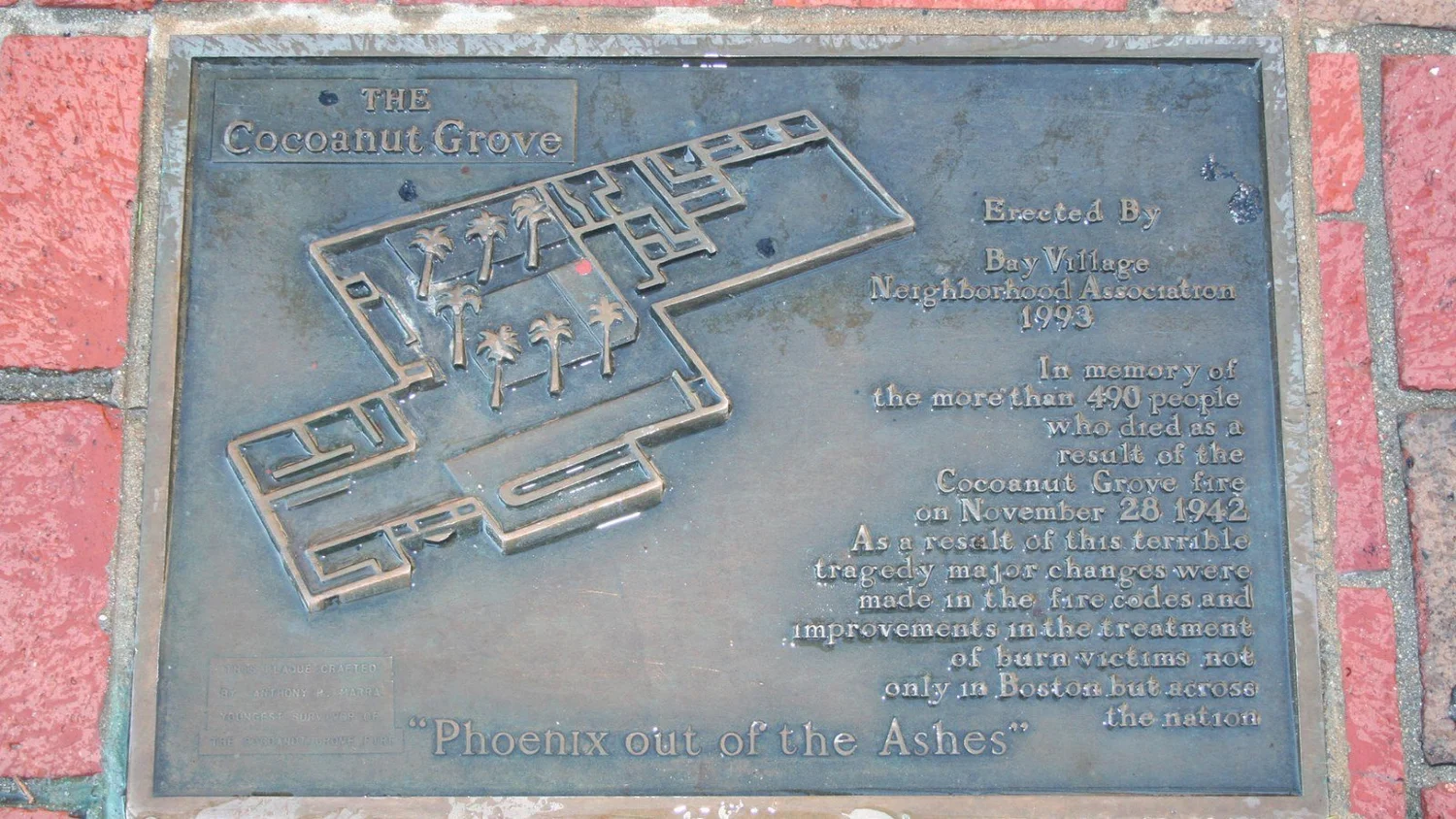
In 1993 a bronze plaque was set into the pavement near the site, made by Anthony Marra, who had been the youngest survivor. It carries a plan of the club with palm trees and the words "Phoenix out of the Ashes". The plaque was moved about a block in the 2010s when the area was redeveloped, and a side street was renamed Cocoanut Grove Lane in 2013. A larger memorial in Statler Park, designed by the artists RE:site with names of the victims, has been funded by the City of Boston; the city's own page, updated in 2026, describes it as still being fabricated.
The last known survivors lived into the 2020s. The Boston Fire Historical Society records that Joyce Spector Mekelburg died in April 2024 at the age of 100.
Where the Accounts Disagree
- Death toll: 492 in most histories; 490 in City of Boston, Britannica and memorial sources; the plaque says "more than 490". The sources explain the difference in different ways.
- Injured: from around 130 to 166, depending on whether the count is survivors of hospital admission or people treated and released.
- Capacity and crowd: licensed for about 460 (Smithsonian says 600; Welansky claimed 650); most sources say more than 1,000 were inside.
- Speed: engulfed in five, eight or under 15 minutes, depending on the account.
- Cause: officially undetermined. The busboy's match, faulty wiring and methyl chloride have all been suggested; none is proven.
- Time served: about three and a half years in some sources, nearly four in others.
Conclusion: A Building That Trapped Its Guests
The Cocoanut Grove fire is remembered because it was so preventable. No single failure killed 492 people. It was the combination: a crowd twice the legal limit, a basement bar with one narrow staircase, ceilings and walls covered in fabric, a revolving front door, and side doors that were locked, hidden or swung the wrong way. The busboy who struck a match became the face of the disaster, but the court that upheld Welansky's conviction placed the responsibility where the evidence pointed: on the man who ran the building.
What came after is the other half of the story. Boston's doctors changed the way burns are treated, gave the world early evidence for penicillin and wrote the first modern account of grief. Fire officials rewrote the rules on exits, doors and decorations. Anyone who has walked through a revolving door with an ordinary door beside it, or seen a lit exit sign above a nightclub door, has seen the Cocoanut Grove's legacy.
Sources
- National Archives, Prologue: "The Cocoanut Grove Fire" (Daniel J. Fleming, 2017)
- Boston Fire Historical Society: The Story of the Cocoanut Grove Fire
- Boston Public Library research guide: Cocoanut Grove fire
- Commonwealth v. Welansky, 316 Mass. 383 (1944)
- Mass General Research Institute: How the Cocoanut Grove fire changed burn care
- Mass General Research Institute: Cocoanut Grove survivors and Erich Lindemann's study of grief
- Harvard Magazine: Champ Lyons and penicillin
- Smithsonian: Three medical breakthroughs traced back to the Cocoanut Grove fire
- City of Boston: Cocoanut Grove Memorial
- CBS News / Associated Press: Cocoanut Grove fire, 75 years on
- Boston.com: The Cocoanut Grove fire, 75 years later
- Consulting-Specifying Engineer: Assembly occupancy fires that wrote NFPA 101
- History.com: The tragic story of America's deadliest nightclub fire
- Britannica: Cocoanut Grove fire
- Wikipedia: Cocoanut Grove fire (secondary)
Next Reads
- The Summerland Fire Explained: How 50 People Died at the Isle of Man Leisure Centre in 1973
- The King's Cross Fire Explained: How a Dropped Match Killed 31 People on the London Underground in 1987
- The Bradford City Fire Explained: How 56 People Died at Valley Parade in 1985 and What Changed
- The Lakanal House Fire Explained: How Six People Died in a Camberwell Tower Block in 2009 and the Warning Before Grenfell
- The Hindenburg Disaster Explained: What Happened at Lakehurst in 1937 and What Caused the Fire
