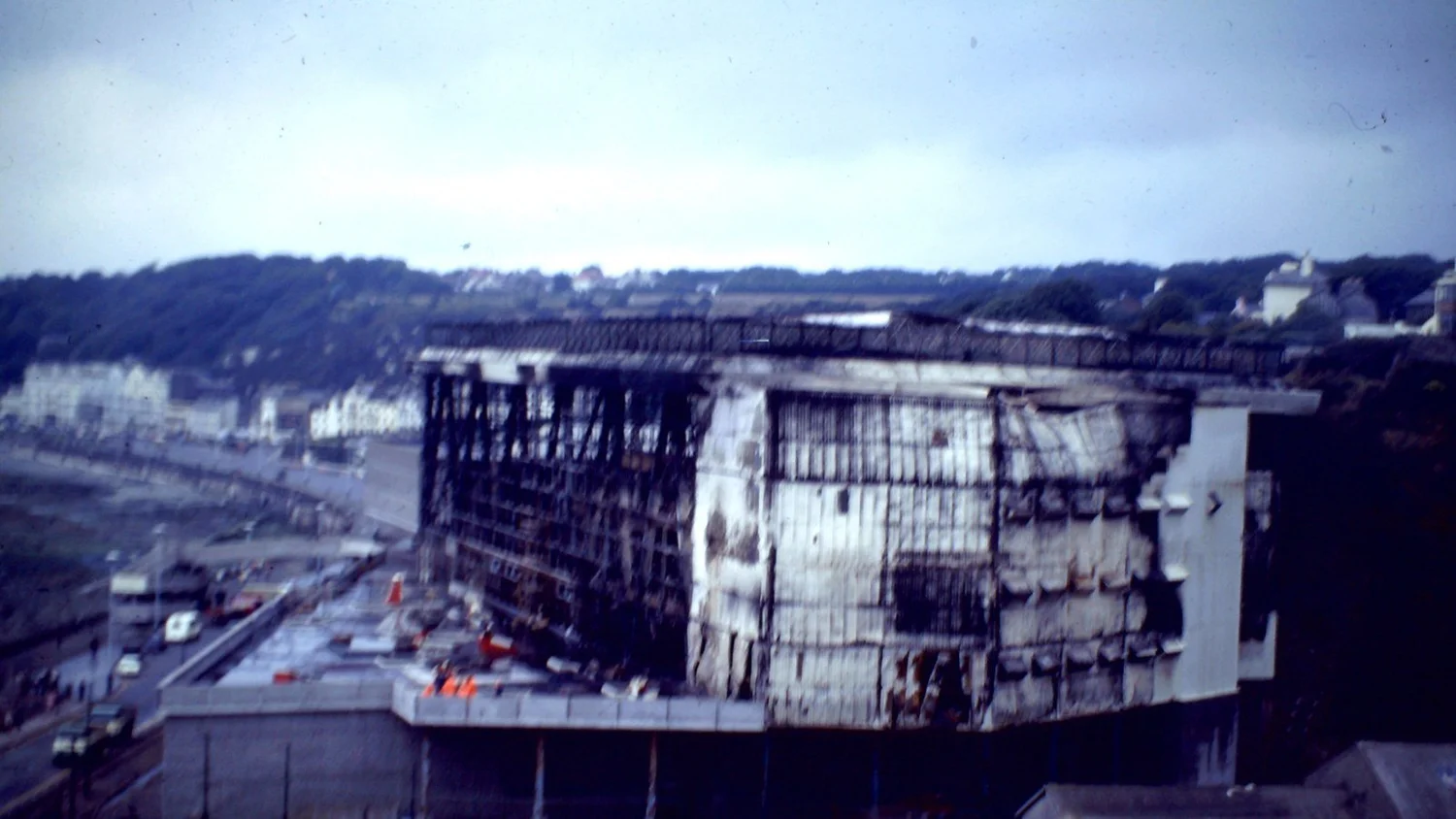
Why Did a Building Full of Holidaymakers Burn in Minutes?
On the evening of Thursday 2 August 1973, at the height of the summer season, fire broke out at Summerland, a vast new indoor leisure centre on the seafront in Douglas, the capital of the Isle of Man. About 3,000 people were inside, many of them families on holiday. Within the hour the building had been gutted. Fifty people died, 11 of them under the age of 20, and around 80 more were seriously injured.
The fire began outside, in a small disused kiosk on a crazy-golf terrace beside the building. That it spread at all was the result of what Summerland was made of. Its walls and roof used materials that burned, melted or let fire travel unseen behind them, several of them approved in spite of the island's own fire rules. Once the flames were inside, the delay in calling the fire brigade, the lack of any alarm and exits that were locked or chained turned a fire into a mass-casualty disaster.
It remains one of the worst peacetime fire disasters in the British Isles since the Second World War, and more than 50 years later, survivors and families are still in the courts. This explainer sets out what Summerland was, what happened that night, what the official inquiry found and what has happened since, drawing on parliamentary records, an academic study of the disaster that quotes the 1974 inquiry report at length, anniversary reporting and coverage of the recent legal challenge. Where the sources disagree, we say so.
What Was Summerland?
Summerland was built to solve a problem familiar to every British seaside resort: the weather. The Isle of Man's tourist trade depended on summer visitors from across the Irish Sea, and a large covered entertainment centre would let them enjoy the seafront whatever the sky was doing. The complex stood at the northern end of the Douglas promenade, against the cliff below Summer Hill, and was linked to an existing swimming centre, the Aquadrome.
It opened in the summer of 1971. Most accounts give May 1971; an academic study of the fire, hosted by the University of Birmingham, says it opened in July, more than two years behind schedule. Later accounts put its cost at about £2 million and describe it as covering around three and a half acres, with space for up to 10,000 people, although the same academic study notes that no official capacity figure was ever set.
The site and building were owned by Douglas Corporation, the town's council. The operator was the hotel and leisure group Trust House Forte, which signed a 21-year tenancy in December 1970, according to the academic study. Inside were several floors of terraces and entertainment, including bars, a restaurant, an amusement arcade and a solarium, beneath a vast transparent roof designed to let in daylight and give the feel of an outdoor resort under cover.
Who designed it?
The principal architect was James Lomas, of Douglas. Working drawings and much of the fitting-out were the work of associate architects, Gillinson, Barnett and Partners of Leeds, according to the academic study and ITV News. Accounts of the inquiry describe a lack of coordination between the two practices, and the inquiry itself was critical of how many decisions were left to junior staff.
What Was Summerland Made Of, and Why Did It Matter?
Three materials lie at the heart of the disaster.
- Oroglas. Much of the roof and the great seaward wall facing the promenade were glazed not with glass but with Oroglas, an acrylic sheet. It was light, cheap and transparent, which made the building's sunny interior possible. According to the academic study, the panels were expected to soften and fall out harmlessly in a fire, venting heat and smoke. In practice, acrylic burns, and burning pieces fell on to the people below.
- Colour Galbestos. To cut costs, parts of the outer walls, including the eastern side and a section of the promenade wall, were clad in Colour Galbestos, a coated steel sheeting. The academic study records that it did not meet the island's building bye-law requiring external walls to be non-combustible and fire-resistant, and that the bye-law was waived for both Galbestos and Oroglas.
- Decalin. Behind the Galbestos, the inside of the wall was lined with Decalin, a fibreboard. Between the two was an air gap. The inquiry, as quoted in the academic study, said the Decalin lining “may well have been the biggest structural contribution to the disaster”.
There were no sprinklers. According to the academic study, the island's Chief Fire Officer was never shown the revised plans that substituted Galbestos for the walls originally proposed.
Analysis: in the early 1970s, plastics were being welcomed into architecture as modern, bright and economical. Summerland showed what could happen when that enthusiasm ran ahead of an understanding of how the materials behaved in a fire, and when the rules meant to catch the problem were waived one decision at a time.
What Happened on the Night of the Fire?
A fire in the kiosk
At about 7.30pm, three boys were smoking in the disused fibreglass kiosk on the crazy-golf terrace outside the eastern wall of the building. A discarded match or cigarette set the kiosk alight. The academic study describes the kiosk standing less than a yard from the outer wall. Accounts differ on the boys' ages. The Designing Buildings Wiki gives them as 12, 12 and 14, while the academic study says the first police descriptions of boys of about 15 were later revised, and that police were for a time unsure how many boys there had been. They were not publicly identified in any of the sources we consulted, and nobody suggested they had meant to cause the fire.
The boys later appeared in court in connection with damage to the kiosk's lock and were fined small sums, according to Wikipedia and the Designing Buildings Wiki. Neither the inquiry nor any later process held them responsible for the disaster, and the inquiry's focus, as the rest of this article shows, was on the building.
Behind the wall
The burning kiosk collapsed against the Galbestos cladding. The steel sheet did not stop the heat. Fire got into the gap between the cladding and the Decalin lining and spread there, hidden, before breaking through into the amusement arcade inside, according to ITV News and Wikipedia. From there it reached the acrylic roof and walls.
When it emerged, it moved with a speed that witnesses struggled to describe. The inquiry found that the roof burned out in about 10 minutes, ITV News reported. The island's Chief Fire Officer, Cyril Pearson, is quoted in the academic study as saying that “in somewhere between three and eight minutes the whole bloody place was ablaze”. Burning sheets of acrylic fell from their frames on to the floors below.
The missing alarm and the late call
No fire alarm sounded, according to ITV News and the academic study. Staff tried to tackle the fire themselves, and the fire brigade was not called for more than 20 minutes after it was discovered. The inquiry, as quoted in the academic study, put the delay at 21 minutes and called it “of cardinal importance”. The first 999 call was made at 8.01pm, the study records. Wikipedia notes that the alarm was first raised from outside, by a taxi driver and by the captain of a ship offshore who radioed the coastguard.
ITV News's timeline records flames visible inside the building at about 8pm and the first fire engine arriving at 8.07pm. Almost the whole of the island's fire service was eventually sent. The fire was brought under control at about 9.10pm, and the first bodies were recovered shortly before 11pm.
Chained doors and separated families
Inside, thousands of people tried to get out at once. According to the academic study, several emergency exits were chained or locked: doors at the solarium were fastened, glass doors at the Aquadrome were locked and had to be broken down, and a door on the north-east service stair was chained and padlocked. The study records that Pearson had written to warn about exits being “chained and padlocked” in April 1973, four months earlier. Trust House Forte denied any illegal locking.
Many families had split up across the different floors, with parents in the bars or the restaurant and children elsewhere in the building, and people tried to go up or across to find each other rather than head straight out. The inquiry was critical of the open “flying staircase” as a means of escape. Some families could not trace their relatives until the next day, the academic study records.
How Many People Died?
Fifty people died: 48 on the night and two later in hospital. That is the figure used by the National Fire Chiefs Council, by ITV News and in the 2023 House of Commons debate marking the 50th anniversary. Eleven of the dead were under 20.
Other figures circulate. Early reports gave 51, and later accounts have used 49, 51 and 53. Wikipedia explains that the provisional count was revised, and that one list compiled on the island left out a victim who died in hospital in Scotland. The academic study explicitly rejects the higher totals. We use 50, the number named on the memorial and in the official commemorations.
Injury figures vary too. Around 80 people were seriously injured, according to ITV News and the Commons debate. The academic study counts 102 injured, of whom 32 were admitted to hospital.
What Did the Commission of Inquiry Find?
The Lieutenant Governor of the Isle of Man appointed a Commission of Inquiry on 3 September 1973. According to the academic study, it was chaired by the High Court judge Mr Justice Cantley, sitting with an inspector from the Home Office fire service inspectorate and a professor from the University of Manchester Institute of Science and Technology. It heard evidence from 91 witnesses over 49 days between November 1973 and February 1974, and its report was published in May 1974.
The building and the evacuation
The Commission found that the deaths resulted from the extremely rapid development of the fire and from an evacuation that was, in its words as quoted in the academic study, “delayed, unorganised and difficult”. It found that neither Oroglas nor Colour Galbestos complied with the island's fire rules, a point repeated in ITV News's account and in the 2023 Commons debate. It described the decision to waive the bye-law for Galbestos as “an error of judgment although… an understandable one”.
No villains
Its most quoted conclusion was that there were no villains. It attributed the disaster to a series of human errors and failures of communication among the people and bodies responsible for designing, approving and running the building, rather than to any one person's wrongdoing, ITV News reported. It found that too many decisions had been taken at a junior level, that the Chief Fire Officer had not been consulted on the change of cladding, and that the operator had been entitled to rely on its architects. It made 34 recommendations.
No criminal charges followed, ITV News reported. Inquests about a year after the fire returned verdicts of misadventure.
Analysis: to many survivors and relatives, “no villains” sounded like no responsibility. That gap between a finding of shared, systemic failure and a sense that nobody was held to account is the thread that runs through the campaign that continues today.
What Changed After Summerland?
The UK government watched the inquiry closely. In October 1973 the Environment Minister, Paul Channon, told the Commons it would be “premature” to issue advice on plastics in buildings before the inquiry reported. In a written answer on 9 July 1974, the Home Secretary, Roy Jenkins, said that Tynwald would give the report “the most careful and urgent attention” and that new fire legislation for the island was being prepared. He said the Central Fire Brigades Advisory Councils would consider the lessons for Great Britain, and that ministers were considering amendments to the building regulations.
Summerland is widely cited, including by the Designing Buildings Wiki and the National Fire Chiefs Council, as a turning point in how the UK and the Isle of Man thought about combustible materials, means of escape and fire safety in large public buildings. We have not been able to verify the specific regulations changed as a direct result, and so do not list them.
Analysis: several of Summerland's themes recurred in later British fires: combustible cladding with a cavity behind it, a hidden route for fire, an alarm raised late, and a chain of approvals in which nobody saw the whole picture. The King's Cross fire and the Bradford City fire each produced their own inquiries and reforms.
What Happened to the Site?
The burnt-out remains were demolished in 1975. A smaller replacement was built on the site and reopened in 1978, according to Wikipedia. It closed in 2004, and demolition began in 2006, with one wall left standing to support the cliff behind. ITV News reported in 2025 that the government still owned the land and was marketing it for development.
How Is Summerland Remembered?
An early memorial on the island gave no death toll. In 2013, on the 40th anniversary, a memorial listing the names of all 50 people who died was unveiled in the Kaye Memorial Garden, close to the site, according to Wikipedia.
The 50th anniversary in 2023 brought the largest commemorations so far. On 18 July 2023 the island's Chief Minister, Alfred Cannan, made a formal apology, telling the island's parliament: “I am sorry. Sorry for the pain and suffering felt by everyone affected by the fire,” ITV News reported. A national service of remembrance was held at St George's Church in Douglas on 30 July, with a book of commemoration naming the 50. On 2 August itself there was a government service at the Kaye Memorial Garden, a survivors' vigil at the site at 7pm and an exhibition on the promenade. That July, MPs at Westminster held a debate marking the anniversary.
Why Are Families Still Fighting Over Summerland?
For survivors and relatives, the 1974 report and the misadventure verdicts were never the end of the story. Campaigners from the Justice for Summerland group have argued that the original process did not fully examine who was responsible.
- March 2025: lawyers acting for the campaign applied for new inquests into the deaths.
- 16 May 2025: the Isle of Man's Attorney General, Walter Wannenburgh, refused, finding no new evidence that would justify reopening them and saying that speculation alone did not amount to grounds, Manx Radio reported.
- May 2026: a survivor, Jackie Hallam, brought a judicial review of that decision, heard over two days in Douglas, ITV News reported.
- 30 July 2026: the First Deemster, Andrew Corlett, dismissed the challenge, finding no legal error in the Attorney General's decision and describing misadventure as a proper verdict, according to ITV News and Manx.News. The families said they would seek permission to appeal.
We have found no reported outcome of that application as of late November 2026. This section will be updated if the courts rule on it.
Why Do Some Accounts Differ?
- Deaths: 50 is the figure used by the memorial, the National Fire Chiefs Council and the 2023 Commons debate. Totals of 49, 51 and 53 appear in older or provisional accounts.
- Injuries: “around 80” seriously injured in most reporting; 102 injured, 32 admitted to hospital, in the academic study.
- Opening date: most accounts say May 1971; the academic study says July 1971.
- Capacity: “up to 10,000” is widely repeated, but the academic study says no official figure was set.
- The boys' ages: given as 12, 12 and 14 in one account; early police descriptions differed.
- Who returned the misadventure verdict: some reporting attributes it to the 1974 Commission. ITV News's 2026 coverage attributes it to the inquests about a year after the fire, which is how we describe it.
Why Does Summerland Still Matter?
- Materials matter more than appearances. A bright, modern building made of transparent plastic and coated steel was also a building that could burn from end to end in minutes.
- Waivers add up. Each exemption from the fire rules may have seemed reasonable on its own. Together, they removed the protections the rules were there to provide.
- Minutes decide outcomes. A 21-minute delay in calling the fire brigade, no alarm and locked exits meant that people had far less time than the fire allowed.
- Accountability is part of recovery. More than half a century on, the survivors' campaign shows how long the question of responsibility can stay open when people feel it was never answered.
Conclusion
Summerland was meant to be the Isle of Man's answer to the British summer: a sunlit indoor resort where holidaymakers could forget the rain. On 2 August 1973 a fire started by a dropped match or cigarette in a disused kiosk found its way behind a steel wall, into a fibreboard lining and up into an acrylic roof, and within minutes the building was alight. With no alarm, a late call to the fire brigade and exits chained shut, 50 people died. The inquiry found no villains, only errors, and its 34 recommendations helped change how fire risk in public buildings is understood. For the families who are still in court, the question it left behind, who was responsible, has never gone away.
Sources
- Hansard: Summerland Fire, written answer, 9 July 1974
- Hansard: Building Materials (Safety), written answer, 16 October 1973
- House of Commons debate: Summerland Fire, 50th Anniversary, July 2023 (Parallel Parliament transcript)
- University of Birmingham: academic study of the Summerland fire, chapter 2 (PDF)
- University of Birmingham: academic study of the Summerland fire, chapter 3 (PDF)
- University of Birmingham: academic study of the Summerland fire, chapter 5 (PDF)
- University of Birmingham: academic study of the Summerland fire, chapter 6 (PDF)
- ITV News: Summerland 50th anniversary, what happened and why does it matter?
- ITV News: Who is responsible for the Summerland disaster? (2 August 2023)
- ITV News: Isle of Man marks 50 years since the Summerland disaster (2 August 2023)
- ITV News: Summerland fire victims finally receive apology (18 July 2023)
- ITV News: National service of remembrance for the 50th anniversary (26 July 2023)
- Manx Radio: Attorney General rejects call for new inquests into Summerland tragedy (May 2025)
- ITV News: Campaigners begin legal challenge to reopen inquests (20 May 2026)
- ITV News: High Court rejects bid for new inquests into Summerland fire deaths (30 July 2026)
- Manx.News: report on the 30 July 2026 High Court ruling
- National Fire Chiefs Council: NFCC reflects on 50th anniversary of Summerland tragedy
- Designing Buildings Wiki: Summerland disaster
- Wikipedia: Summerland disaster (secondary)
Next Reads
- The King's Cross Fire Explained: How a Dropped Match Killed 31 People on the London Underground in 1987
- The Bradford City Fire Explained: How 56 People Died at Valley Parade in 1985 and What Changed
- The Marchioness Disaster Explained: How 51 People Died on the Thames in 1989 and Why Families Fought a Decade for an Inquiry
- The Kegworth Air Disaster Explained: Why Flight 92 Shut Down Its Only Working Engine and Crashed on the M1 in 1989
- The Zeebrugge Ferry Disaster Explained: Why the Herald of Free Enterprise Capsized in 1987 and No One Was Convicted
- The Clapham Junction Rail Crash Explained: How One Loose Wire Killed 35 People in 1988
