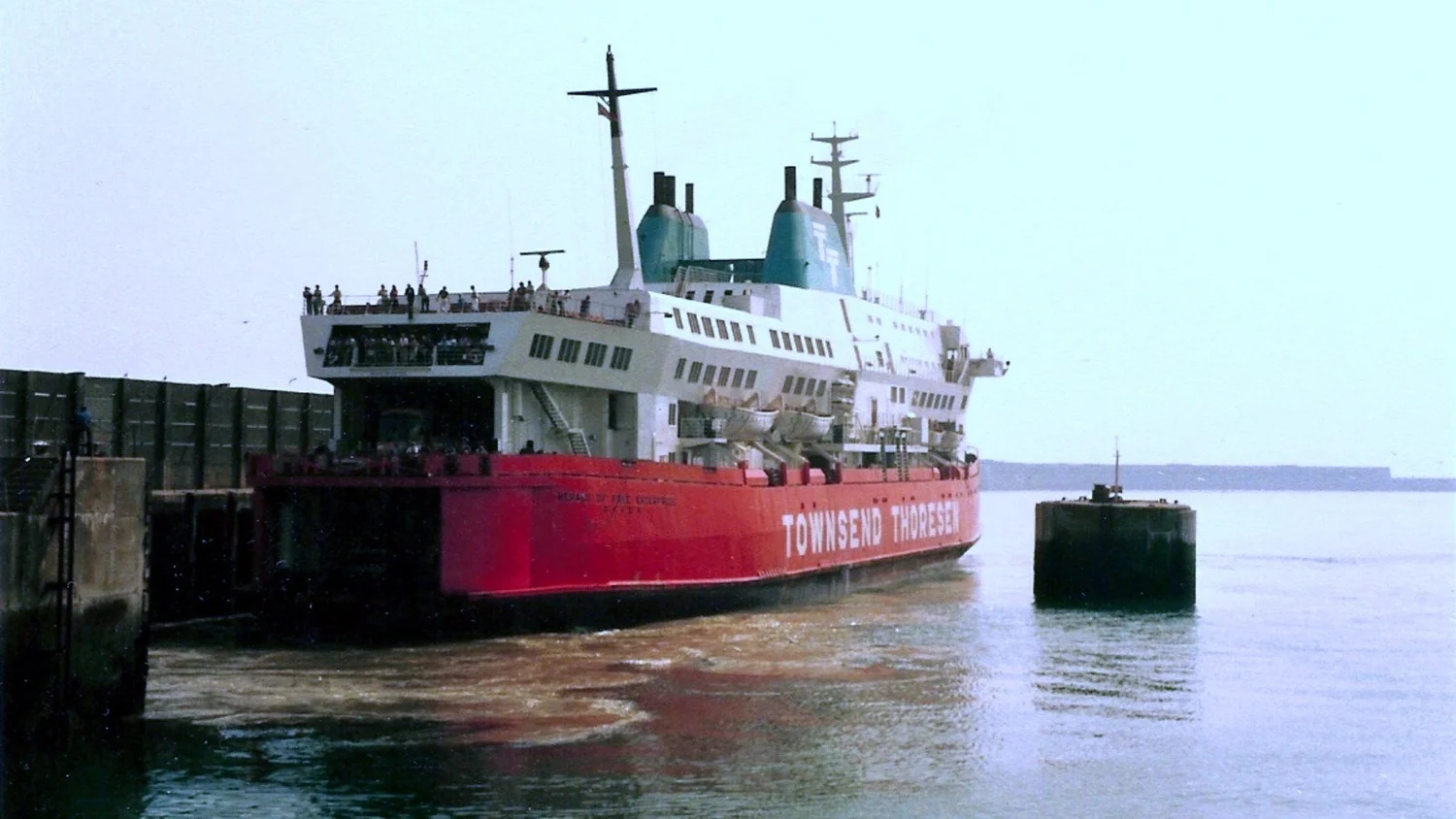
Why Did a Ferry Leave Harbour With Its Bow Doors Wide Open?
On the evening of Friday 6 March 1987, the cross-Channel ferry Herald of Free Enterprise left its berth in the Belgian port of Zeebrugge, bound for Dover. Its inner and outer bow doors, the huge doors through which cars and lorries drive on and off, were still open. Within minutes of clearing the harbour wall, the sea was pouring onto the open vehicle deck. The ship rolled over onto its side in shallow water less than a mile from the harbour entrance. A total of 193 people died: 155 passengers and 38 crew.
The disaster was not caused by a storm, a collision or a mechanical failure. The weather was calm. The ship was sound. A member of the crew whose job was to shut the doors had fallen asleep, and nothing in the way the ship or the company was run made sure anyone noticed. The official inquiry concluded that, from top to bottom, the company running the ferry had been infected with "the disease of sloppiness".
This explainer sets out what happened that night, why the doors were open, what the formal investigation found about the crew and the company, why a manslaughter prosecution collapsed without a single conviction, and how the disaster changed shipping safety and English law. It draws on the official Department of Transport inquiry report, Parliamentary records, the London Gazette, Crown Prosecution Service guidance and contemporary and anniversary reporting, and notes where accounts differ.
What Happened on 6 March 1987?
The Herald of Free Enterprise was a roll-on roll-off car and passenger ferry, built in 1980 by Schichau Unterweser in Bremerhaven, Germany. She and her two sister ships were designed for the short Dover to Calais crossing. That night she was working the longer route between Zeebrugge and Dover.
According to the formal investigation, she was carrying about 459 passengers and 80 crew, along with 81 cars, 47 freight vehicles and three other vehicles. Several accounts, including Kent Online's anniversary coverage, say many passengers were travelling on a cheap day-trip offer promoted by The Sun newspaper.
The timeline
- 18.05 GMT: the Herald left No. 12 berth in Zeebrugge's inner harbour, according to the inquiry report. GMT was also UK time that evening, so in Belgium it was 7.05pm.
- 18.24 GMT: she passed the outer mole, the breakwater at the harbour mouth, and began to pick up speed.
- About 18.28 GMT: roughly four minutes later, she capsized, less than seven cables (about 1.3km) from the harbour entrance.
Some later accounts say the ship went over in around 90 seconds. The inquiry's own timeline puts the capsize about four minutes after the Herald passed the mole, so "within minutes" is the safest description.
Why she did not sink completely
The Herald rolled onto her port side. The inquiry report says she was prevented from sinking completely "by reason only that her port side took the ground in shallow water". Her starboard side was left above the surface.
Why Were the Bow Doors Open?
The immediate cause, set out in the formal investigation and accepted in Parliament, was simple. The inner and outer bow doors were open when the ship went to sea, and water flooded onto the vehicle deck.
The assistant bosun
The assistant bosun, Mark Stanley, accepted that it was his duty to close the bow doors. The inquiry found that he had gone to his cabin, fallen asleep and did not hear the call for "Harbour Stations" as the ship prepared to leave. He later helped to rescue passengers. The court did not suspend his certificate.
The chief officer
The chief officer, Leslie Sabel, was responsible for making sure the loading deck was clear and the doors were shut. The court found that he had been "seriously negligent" in failing to make sure the doors were closed. His certificate was suspended for two years.
The captain
The master that night was Captain David Lewry. There was no indicator on the bridge to show whether the bow doors were open or shut. The court found that Captain Lewry "must accept personal responsibility" for taking the ship to sea with the doors open and that he had been "seriously negligent". His certificate was suspended for one year.
The inquiry's findings were about professional fault, not criminal guilt. The criminal case, which ended without any conviction, is described below.
Why Did the Ship Go Down So Fast?
Open doors alone do not explain why the sea came in so quickly. The inquiry pointed to two more factors.
Trimmed by the head
The loading ramp at Zeebrugge's berth served only one level, unlike the double-deck ramps at Dover and Calais that the Herald was built for. So that the ramp could reach the upper vehicle deck, the crew filled ballast tanks to make her sit lower at the bow. When she left, she was still trimmed by the head, by about 0.8 metres on the court's figure. The inquiry also found that she was probably overloaded, but it concluded that this was not a cause of the disaster.
Picking up speed
After the Herald passed the mole, the captain set the engines for faster running and the ship accelerated from about 14 knots towards 18. As she gathered speed with her bow low in the water, water came in over the bow spade and through the open doors.
What Did the Inquiry Find About the Company?
The formal investigation, held under the Merchant Shipping Act 1894 and presided over by Mr Justice Sheen, reported in July 1987. Its most quoted finding was not about the crew at all. In paragraph 14.1 of the report, the court said the "underlying or cardinal faults lay higher up in the Company", and that the Board of Directors "did not appreciate their responsibility for the safe management of their ships". It added:
"From top to bottom the body corporate was infected with the disease of sloppiness."
The court found that the failure of shore management to give "proper and clear directions" was a contributory cause of the disaster. It said it was "singularly unimpressed" by the company's operations director and its technical director. It also recorded counsel's description of an "abject abdication of responsibility" in connection with one senior manager.
The memos about indicator lights
The most damaging evidence was a paper trail showing that the company's own captains had asked for exactly the safeguard that would have warned the bridge about open doors.
- On 28 June 1985, nearly two years before the disaster, a master, Captain Blowers, sent a memo proposing indicator lights on the bridge to show whether the bow and stern doors were shut. The reply said the idea would be passed to the company's "think-tank".
- Managers' written responses included: "Do they need an indicator to tell them whether the deck storekeeper is awake and sober?" Another manager wrote: "Nice but don't we already pay someone!"
- In May 1986, another master, Captain Kirby, asked for the doors' "Open/closed indication to be duplicated on bridge".
- On 21 October 1986, a manager wrote that "the Bridge indication is a 'no go'".
The court said that if the 1985 proposal had been given the serious consideration it deserved, it "might well have" prevented the disaster. After the capsize, indicator lights were fitted across the fleet within days.
The "disease of sloppiness" line is often misremembered, and so is the memo. It is commonly quoted as "Do they need a light to tell them..." The exact wording, from the inquiry report, is the version above.
Who Owned the Ship?
The Herald sailed in the colours of Townsend Thoresen. The inquiry report says she was owned by Townsend Car Ferries Limited, a subsidiary of P&O. P&O had completed its takeover of European Ferries, Townsend Thoresen's parent group, only weeks earlier, in January 1987. The company later prosecuted was P&O European Ferries (Dover) Ltd.
What Did the Government Do?
On 24 July 1987, the Transport Secretary, Paul Channon, made a statement to the Commons on the inquiry's findings. He told MPs that 350 people had been rescued and at least 188 had died, the figure confirmed at the time. He also said the court had found that "no statutory offence has been committed" under the shipping legislation it was applying.
Channon announced a package of measures:
- consultation on making indicator lights for doors, closed-circuit television on car decks and better emergency lighting compulsory on all roll-on roll-off passenger ships using UK ports;
- a new criminal offence of taking a ship to sea with its bow doors open;
- an extra £1 million for research into the stability of ro-ro ferries;
- boarding cards for passengers, so that ships could not sail overloaded without anyone knowing how many people were on board.
The MP Dick Douglas read the "disease of sloppiness" passage into the record during the same debate.
What Did the Inquest Decide?
The inquest into the deaths was held at Dover Town Hall and ended on 8 October 1987. The jury returned verdicts of unlawful killing for 187 of the victims, according to Kent Online's reporting. A woman who died later received an open verdict, and a baby who was buried in Germany was not part of the inquest.
Those verdicts meant a jury had found the victims had been killed unlawfully. That opened the way to a criminal prosecution.
Why Was No One Convicted?
P&O European Ferries (Dover) Ltd and seven individuals went on trial for manslaughter at the Old Bailey in September 1990. Within weeks the case had collapsed. LBC and IRN radio reported the collapse on 19 October 1990, and all the defendants were acquitted.
The "controlling mind" problem
The trial judge, Mr Justice Turner, directed the jury to acquit the company. The reason was a principle of English law known as identification. Under the law as it then stood, a company could be convicted of manslaughter only if a senior individual who could be said to embody the company, its "directing" or "controlling" mind, was personally guilty of the offence. The judge found that no such individual could be shown to be guilty, so the case against the company failed too.
The case is reported as R v P&O European Ferries (Dover) Ltd (1991) 93 Cr App R 72. The Crown Prosecution Service still cites it in its guidance as an example of the identification principle. On 11 December 1990 the Attorney General decided that there was no point of law that justified a reference to the Court of Appeal, as he later told Parliament.
Every defendant in the trial was acquitted, and nothing in this article suggests that any of them was guilty of a criminal offence.
Analysis: the gap the case exposed
Analysis: The trial exposed a gap that the inquiry had already pointed to. Sheen's court found that the deepest faults lay in the company's management, spread across many people and many decisions. But the criminal law could only reach a company through a single guilty individual at the top. The more diffuse the failure, the harder it was to prosecute. The larger and more layered the company, the more that was true.
How Did Zeebrugge Change the Law?
The collapse of the P&O trial became one of the central examples in a long campaign for a new offence of corporate manslaughter.
In 1996 the Law Commission, in its report on involuntary manslaughter (Law Com 237), proposed a new offence of "corporate killing". It took more than a decade to reach the statute book. The Corporate Manslaughter and Corporate Homicide Act 2007 came into force on 6 April 2008. Under it, an organisation can be convicted if the way its activities are managed or organised causes a death and amounts to a gross breach of a duty of care, and a substantial part of that failure lies in the way senior management ran things. No single guilty "controlling mind" is required.
The Act's official Explanatory Notes describe the old identification problem without naming any disaster. Kent Online's anniversary coverage says the Zeebrugge prosecution "paved the way" for the change, and the CPS still uses the P&O case to explain why the old rule failed.
What Changed at Sea?
Bridge indicator lights for bow doors were fitted across the fleet within days of the capsize, and the government moved to require door indicators and car-deck CCTV on ro-ro passenger ships using UK ports.
The wider lesson, that safety depends on how a company is managed and not just on the crew on watch, fed into international rules. The International Maritime Organization adopted the International Safety Management (ISM) Code in 1993. It became mandatory on 1 July 1998, through amendments to the Safety of Life at Sea (SOLAS) convention. The code requires shipping companies to run a documented safety management system, with clear lines of responsibility between ship and shore. The UK P&I Club, a leading marine insurer, links the code's origins to the Herald disaster. The IMO's own page on the code does not name it.
Who Were the Heroes of the Rescue?
History UK's account says the Belgian navy, the coastguard and a nearby ferry joined the rescue effort.
A supplement to the London Gazette published on 31 December 1987 recorded the bravery awards for "the hazardous rescue operations":
- George Medal: Andrew Parker, a passenger, an assistant bank manager.
- George Medal (posthumous): Michael Skippen, the ship's head waiter.
- Queen's Gallantry Medal: Leigh Cornelius, Stephen Homewood, William Walker and Thomas Wilson.
History UK describes a 6ft 4in banker who made himself into a "human bridge" across a gap for more than half an hour so that more than 20 people could climb across him to safety. That account does not name him.
How Is Zeebrugge Remembered?
In Dover, St Mary the Virgin church has a memorial window and the ship's bell. A service is held there each year on the anniversary, organised with the Sailors' Society. At the 35th anniversary service in 2022, the names of the dead were read aloud. In 2023 there was a service in Clock Tower Square and a display at St Mary's. On 6 March 2025 the rail and maritime union RMT marked the 38th anniversary with a tribute to all 193 who died.
The 40th anniversary falls on 6 March 2027.
Why Does the Death Toll Vary?
Readers will find different figures in different sources.
- 188: the inquiry, reporting in 1987, said "not less than" 150 passengers and 38 crew had died. Channon gave the House of Commons the figure of at least 188 in July 1987.
- 193: the figure used now by the Marine Accident Investigation Branch page that hosts the report, by memorial services and by most reporting. It counts 155 passengers and 38 crew. The MAIB page itself notes that the report details 188 confirmed fatalities.
We use 193 throughout, as the commemorations do.
What Questions Remain?
- Accountability. An inquiry found the company sloppy from top to bottom, and an inquest jury found unlawful killing, yet the criminal courts convicted no one. That outcome is the reason the law changed.
- Whether the 2007 Act works. It removed the "controlling mind" barrier. Whether it can reach failures spread across the management of a very large company is the test Zeebrugge set for it.
- Safety culture. Analysis: the ISM Code requires the kind of management system the inquiry found missing, but a written system is only as good as the culture behind it.
Conclusion
The Herald of Free Enterprise did not hit anything. She sailed out of Zeebrugge on a calm night with her bow doors open because the man meant to close them was asleep, the officer meant to make sure did not, the captain had no way of seeing, and the company had dismissed its own captains' requests for a warning light as unnecessary. Within minutes 193 people were dead. Sheen's inquiry put the blame where it belonged, on a company infected with "the disease of sloppiness". But the criminal law of the day could not reach a failure spread across a corporate hierarchy, and the manslaughter trial collapsed without a conviction. It took two more decades for Parliament to create a corporate manslaughter offence that could. Zeebrugge's legacy is in that law, in the safety management rules every ship must now follow, and in the bell that hangs in a Dover church.
Sources
- Department of Transport: mv Herald of Free Enterprise, Report of Court No. 8074, Formal Investigation (Mr Justice Sheen, 1987), via GOV.UK
- GOV.UK / Marine Accident Investigation Branch: Flooding and subsequent capsize of ro-ro passenger ferry Herald of Free Enterprise, with loss of 193 lives
- Hansard: Herald of Free Enterprise, House of Commons, 24 July 1987
- Hansard: Zeebrugge ferry disaster, written answer, 22 March 1991
- legislation.gov.uk: Corporate Manslaughter and Corporate Homicide Act 2007, Explanatory Notes (Background)
- Crown Prosecution Service: Corporate Manslaughter legal guidance
- The London Gazette, issue 51183, supplement (31 December 1987)
- International Maritime Organization: The International Safety Management (ISM) Code
- UK P&I Club: The capsizing of the Herald of Free Enterprise (2022)
- Learning on Screen (LBC/IRN archive): Herald of Free Enterprise trial collapses (19 October 1990)
- RTÉ Archives: Zeebrugge ferry disaster trial
- Commercial Motor archive: In brief (24 January 1987)
- Kent Online: 30th anniversary of Zeebrugge disaster marked (6 March 2017)
- Kent Online: 35th anniversary of the Zeebrugge disaster (March 2022)
- Kent Online: Anniversary of Herald of Free Enterprise tragedy (6 March 2023)
- A Church Near You (St Mary's, Dover): Service commemorates 35th anniversary of the Zeebrugge disaster
- RMT: RMT remembers those lost in Herald of Free Enterprise disaster (6 March 2025)
- History UK: The sinking of the Zeebrugge ferry
- Wikipedia: MS Herald of Free Enterprise
Next Reads
- The Clapham Junction Rail Crash Explained: How One Loose Wire Killed 35 People in 1988
- The Hillsborough Disaster Explained: What Happened in 1989, the Cover-Up and the 27-Year Fight for the Truth
- The King's Cross Fire Explained: How a Dropped Match Killed 31 People on the London Underground in 1987
- The Piper Alpha Disaster Explained: What Went Wrong on the North Sea Platform and What Changed After 167 Died
- The Aberfan Disaster Explained: What Happened in 1966, Who Was to Blame and Why It Still Matters
- The Heysel Disaster Explained: What Happened in Brussels in 1985, Before You Watch Heysel 85
