Why Did a Mountain of Coal Waste Fall on a Village School?
At 9.15am on Friday 21 October 1966, a colliery spoil tip on the hillside above Aberfan, a mining village near Merthyr Tydfil in south Wales, collapsed and poured down the slope as a wave of black slurry. It buried Pantglas Junior School, where lessons had just begun after morning assembly, along with part of the neighbouring secondary school and a row of houses. In all, 144 people died. One hundred and sixteen of them were children, most aged between seven and ten. One hundred and nine of those children died inside the junior school.
The tip was owned and run by the National Coal Board, the state-owned body that ran Britain's coal industry. A tribunal of inquiry later concluded that the disaster could and should have been prevented, that the warning signs had been there for years and that "blame for the disaster rests upon the National Coal Board". Yet nobody was prosecuted, nobody was sacked and the man who ran the board kept his job. The community was then made to help pay for removing the tips that had killed its children.
Last month, on 21 October 2026, Wales marked the 60th anniversary, with organisations across the country invited to fall silent at 9.15am. This explainer sets out what happened that morning, why the tip collapsed, what the inquiry found, how the disaster fund was treated and what has changed since. It draws on the parliamentary record, the British Geological Survey, the tribunal's published conclusions, research on survivors and recent reporting, and notes where accounts differ.
What Happened at Aberfan on 21 October 1966?
Aberfan sits in the Taff valley below the Merthyr Vale colliery. For decades, waste rock and coal debris from the pit had been carried up the mountainside behind the village and dumped in large heaps. By 1966 there were seven tips on the slope. Only one, Tip 7, was still in use.
According to the British Geological Survey, Tip 7 had started to move before 7am that day. Workmen on top of the tip saw that it had slumped.
At about 9.15am, the saturated base of the tip gave way. The British Geological Survey puts the volume of material that broke away at 107,000 cubic metres of black slurry. It flowed down the hillside and reached Aberfan Road and the school. Weeks of heavy rain had soaked the hillside in the run-up to the slide. The survey records that it destroyed 18 houses, Pantglas Junior School and part of the secondary school.
The children had arrived at school a few minutes earlier and had just returned to their classrooms after morning assembly.
The rescue
Miners from the colliery, parents and neighbours were the first to dig. Within hours they were joined by miners from other pits, emergency services and volunteers who travelled from across south Wales and beyond. They dug with shovels and their hands, passing debris back along human chains.
The British Geological Survey notes that the last child to be brought out alive was rescued at 11am, less than two hours after the slide. After that, the rescuers found only bodies. The work of recovering them went on for days.
How Many People Died?
The death toll was 144: 116 children and 28 adults. The British Geological Survey records that 109 of the children died in Pantglas Junior School and that five of the adults were teachers at the school.
The loss fell on a single small community. Almost every family in Aberfan lost a child, a relative, a neighbour or a friend. The village lost much of a generation of its children in a single morning.
Many of the dead were buried together in rows of graves at Bryntaf Cemetery on the hillside above the village, after a mass funeral on 27 October 1966. The white arches over those graves have become one of the best-known memorials in Wales.
Why Did Tip 7 Collapse?
The physical cause was water. Tip 7 had been started in 1958 and was built partly over springs, which had been shown on maps of the area for many years. Waste was tipped on top of the springs and on top of a stream bed, and some of the waste dumped there in the 1960s was fine material known as tailings, which holds water and turns to slurry when saturated.
After a long spell of rain, water built up inside the base of the tip until it could no longer hold its own weight. Engineers describe what happened as a flowslide: a mass of saturated material that suddenly liquefies and moves at speed. Once it started to move, the slurry behaved more like a fluid than a landslide of rock, which is why it travelled so far down the slope and into the village.
It had happened before
The tips above Aberfan were not new to slips. According to the British Academy's account of the evidence, written by the political scientist Iain McLean, who studied the disaster for years, Tip 4 slid in November 1944. Tip 7 itself had moved in 1963. At the inquiry, the National Coal Board denied that the 1963 slide had happened.
There had also been direct warnings about the school. The tribunal quoted a complaint by Merthyr council about "Danger from Coal Slurry being tipped at the rear of the Pantglas Schools". The Smithsonian magazine, in its account of the disaster, quotes a June 1963 letter in which an engineer wrote: "I regard it as extremely serious as the slurry is so fluid and the gradient so steep". Correspondence between the council and the Coal Board about the tips continued into 1964. The tipping continued.
What Did the Davies Tribunal Find?
Within days of the disaster, the government appointed a tribunal of inquiry under the Tribunals of Inquiry (Evidence) Act 1921, chaired by a Welsh judge, Lord Justice Edmund Davies. According to the government's published summary of the inquiry, it sat for 76 days, heard 136 witnesses and examined 300 exhibits. Its hearings ended on 28 April 1967, and its report was published on 3 August 1967.
The tribunal's conclusions were damning. It described the story of the tips as "a terrifying tale of bungling ineptitude by many men", and found that the disaster could and should have been prevented. It said those responsible were "not villains but decent men, led astray by foolishness or by ignorance or by both in combination".
When MPs debated the report in October 1967, the Secretary of State for Wales, Cledwyn Hughes, quoted its central finding: "Blame for the disaster rests upon the National Coal Board." Accounts of the report say the tribunal found that the board had no proper policy for tip safety and that warnings had been ignored.
The government's published summary records that the National Coal Board's chairman, Lord Robens, conceded late in the inquiry that the board had been at fault. Earlier, both Lord Robens and the board had argued that the disaster was caused by an unknown spring that could not have been foreseen, a claim the tribunal rejected because the springs had long been known.
Was Anyone Held Responsible?
No one was prosecuted. In the October 1967 debate, Cledwyn Hughes told the Commons that the Attorney General had concluded that the facts "did not justify the institution of criminal proceedings". He said Coal Board staff named in the report who were still employed by the board "have been moved to other work". Accounts of the disaster agree that nobody lost their job.
Lord Robens
Lord Robens offered his resignation to the Minister of Power, Richard Marsh. Marsh refused it. In his letter, read into the parliamentary record, he wrote: "Nor do I consider that the conclusions of the Tribunal are of a kind which call for your resignation." Robens stayed in charge of the National Coal Board until 1971.
Analysis: Iain McLean, writing for the British Academy, describes the resignation offer as "bogus". He argues that Lord Robens had seen the report in advance and had the wording of the exchange of letters changed. This is McLean's interpretation of the documents rather than a finding of the tribunal.
What Happened to the Disaster Fund?
Donations poured in from across Britain and the world after the disaster. The Aberfan Disaster Fund raised about £1.75 million, a vast sum at the time. How that money was treated became a second scandal.
The fund was regulated by the Charity Commission. According to Iain McLean's account for the British Academy, the commission tried to stop the trustees from paying for the memorial garden and cemetery memorial, and from making payments to bereaved parents unless it could be shown that they had been "close" to their children. The trustees defied it.
Paying for the tips
The most bitter decision concerned the remaining tips above the village. Residents were terrified that they could slide again and wanted them removed. The Coal Board was reluctant to pay the full cost, and the government pressed the fund to contribute. In 1968 the trustees agreed to hand over £150,000 from the disaster fund towards the cost of removing the tips. McLean has argued that this was not a lawful use of charitable money.
In the 1967 Commons debate, the Liberal MP Emlyn Hooson had said that removing the tips at a cost of about £3 million would be "a small but fair price to pay". Accounts of the removal put its final cost far lower, at about £850,000, shared between the fund, the Coal Board and the government.
The money returned
It took three decades for the payment to be acknowledged as wrong. On 31 July 1997, the new Labour government's Secretary of State for Wales, Ron Davies, announced a grant of £150,000 to the Aberfan Memorial Charity. In a written answer to Parliament, he said there "should have been no requirement in the first place" for the fund to contribute to tip removal. The sum was the original amount, with no allowance for inflation.
In early 2007 the Welsh Government went further, giving £2 million to Aberfan charities: £1.5 million to the Aberfan Memorial Charity and £500,000 to an education charity for young people in the village. Welcoming the announcement, Iain McLean said: "After forty years, a long-standing injustice has been righted."
What Changed After Aberfan?
The disaster led directly to new law. The Mines and Quarries (Tips) Act 1969, which received Royal Assent on 27 March 1969, did two things. Part I set safety duties for tips at working mines and quarries, so that active tips had to be designed, inspected and managed to stop them becoming unstable. Those provisions have since been replaced by later mining regulations.
Part II, which is still in force, gave local authorities powers over disused tips. Councils can demand information and enter land, serve notices requiring owners to carry out remedial work, do the work themselves and recover the costs, and pay grants for it. For the first time, the law treated a spoil heap as something that could kill.
Aberfan also changed how disasters are handled in Britain. It was one of the first major events in which the psychological effects on survivors and the bereaved were studied seriously, and it shaped later thinking about how communities recover from mass tragedy.
The lasting effect on survivors
A study published in the British Journal of Psychiatry in 2003, 33 years after the disaster, compared 41 survivors with 72 people of similar age who had not been involved. It found that 46% of the survivors had experienced post-traumatic stress disorder at some point in their lives, compared with 20% of the comparison group. Twenty-nine per cent still met the criteria for PTSD at the time of the study. The researchers did not find a significantly raised risk of anxiety, depression or substance misuse.
Are Coal Tips in Wales Still a Danger?
Yes, which is why Aberfan is not only history. Wales is left with thousands of spoil heaps from its mining past. When the Senedd passed new legislation in July 2025, the Welsh Government said there were 2,573 disused coal tips in Wales, mainly in the south Wales valleys, and an estimated 20,000 other disused tips.
The issue returned to the headlines in February 2020, when a coal tip at Tylorstown in the Rhondda Fach slipped during storms Ciara and Dennis. The Welsh Government has described it as a major landslide, and it showed how heavy rainfall can destabilise old tips.
The Disused Mine and Quarry Tips (Wales) Act 2025, which received Royal Assent on 11 September 2025, creates a new body, the Disused Tips Authority for Wales, which the Welsh Government says will be formally established on 1 April 2027. It will assess, register and monitor disused tips, inspect the highest-risk ones and have powers to require landowners to carry out work or do it itself. The Deputy First Minister, Huw Irranca-Davies, said the legislation "represents a crucial step forward in protecting Welsh communities".
How Is Aberfan Remembered?
Queen Elizabeth II visited Aberfan on 29 October 1966, eight days after the disaster. Prince Philip and Lord Snowdon had gone to the village much sooner. The delay is widely reported to have been one of the Queen's greatest regrets, though that comes from people close to her rather than from the Queen herself. She returned to Aberfan several times over the following decades, and in 2012 opened Ynysowen Community Primary School, which serves the village. The events were dramatised in the third series of Netflix's The Crown.
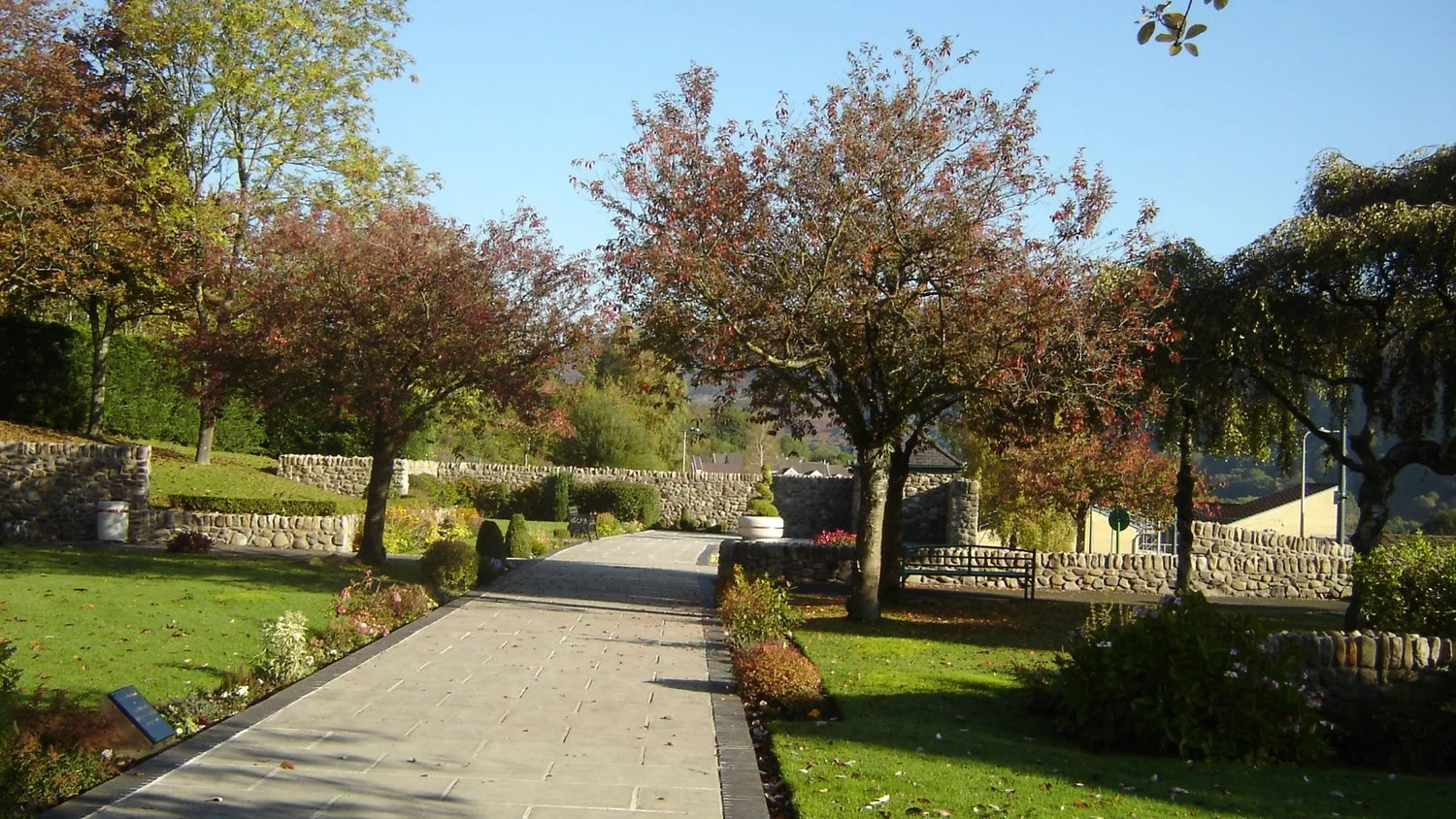
The site of Pantglas Junior School is now a memorial garden. The cemetery on the hillside, with its row of white arches, is visited by people from across the world.
The 60th anniversary
The 50th anniversary in 2016 was marked with a minute's silence across Wales at 9.15am. For the 60th anniversary this year, the Welsh Government again invited organisations to fall silent at 9.15am on 21 October. The First Minister, Rhun ap Iorwerth, said: "The tragedy of Aberfan continues to echo down the decades."
Merthyr Tydfil council held a service at Aberfan Cemetery at 9.15am, and an exhibition of the photographer Chuck Rapoport's pictures of the village was shown at Cyfarthfa Castle. According to Nation.Cymru, the King, Queen Camilla and the Prince of Wales visited the memorial garden, laid wreaths and met survivors and bereaved families. The Prince unveiled a new memorial sculpture, the Aberfan Memorial Tree. The King told them: "We have heard stories of heartbreak, but also of heroism."
Why Does Aberfan Still Matter?
Analysis: Aberfan endures because it combined the worst possible loss with the clearest possible responsibility. The tribunal did not find an act of God or an unforeseeable accident. It found that a public body had piled waste on known springs above a school, ignored complaints and previous slips, and then tried to blame an unknown spring. The response afterwards compounded the injury: no one was prosecuted, the chairman's resignation was refused, and the village's own charity money was used to clean up the Coal Board's tips.
It also set a pattern that recurs in later British disasters, from Hillsborough to Grenfell Tower. Bereaved families warned that they had not been listened to, official bodies resisted blame, and the truth was acknowledged only slowly. The repayment of the £150,000, 31 years later and without interest, became a symbol of how long that acknowledgement can take.
And it remains a practical warning. The coal industry in south Wales has gone, but its tips have not, and a wetter climate puts more water into them. The new tips authority, more than half a century after the 1969 Act, is a sign that the problem Aberfan exposed was never fully solved.
What Questions Remain?
- How many survivors there were. Figures for surviving pupils vary between accounts, partly because sources define "survivor" differently, and no single official count is widely cited.
- The full extent of the warnings. The tribunal quoted the council's complaints, but historians continue to debate how far the danger was understood at different levels of the Coal Board before 1966.
- Whether the new tips regime will work. The Disused Tips Authority for Wales will not be fully established until April 2027, and the cost of making thousands of tips safe will run for years.
Conclusion
The Aberfan disaster was caused by a coal tip built on springs above a village school, in a wet autumn, by an organisation that had been warned and had seen its tips slide before. On 21 October 1966 it killed 144 people, 116 of them children. The Davies Tribunal put the blame squarely on the National Coal Board and called the story one of bungling ineptitude, but nobody was prosecuted or dismissed, and the bereaved community was made to pay towards removing the remaining tips. It took until 1997 for that money to be returned and until 2007 for the wider injustice to be acknowledged. Sixty years on, Aberfan is remembered at 9.15am each anniversary, and its lesson about who is listened to, and who is believed, has not lost its force.
Sources
- British Geological Survey: The Aberfan disaster
- Hansard: House of Commons debate on the Aberfan disaster tribunal report, 26 October 1967
- GOV.UK: Inquiries summary, the Aberfan disaster, 21 October 1966 (PDF)
- Hansard: Written answer on Aberfan, 31 July 1997
- British Academy: Lessons from the Aberfan disaster and its aftermath (Iain McLean)
- University of Oxford Department of Politics: Aberfan funding announcement (2007)
- legislation.gov.uk: Mines and Quarries (Tips) Act 1969
- British Journal of Psychiatry: Aberfan survivors 33 years on (2003)
- Welsh Government: Senedd passes legislation to ensure safety of tips from Wales's mining past (15 July 2025)
- Welsh Government: Disused Mine and Quarry Tips (Wales) Act 2025
- Merthyr Tydfil County Borough Council: 60th anniversary commemorative events
- Nation.Cymru: Aberfan will always be in our hearts, King tells survivors and families
- Smithsonian Magazine: The true story of the Aberfan disaster
Next Reads
- The Piper Alpha Disaster Explained: What Went Wrong on the North Sea Platform and What Changed After 167 Died
- The Mount Erebus Disaster Explained: Flight 901, the Changed Coordinates and the 'Orchestrated Litany of Lies'
- The Bhopal Gas Disaster Explained: What Happened, Who Was Blamed and Why It Isn't Over
- Chernobyl Disaster Explained: What Happened, Why the Reactor Exploded and What Happened Afterwards
- The Challenger Disaster Explained: What NASA Knew Before the Shuttle Broke Apart
