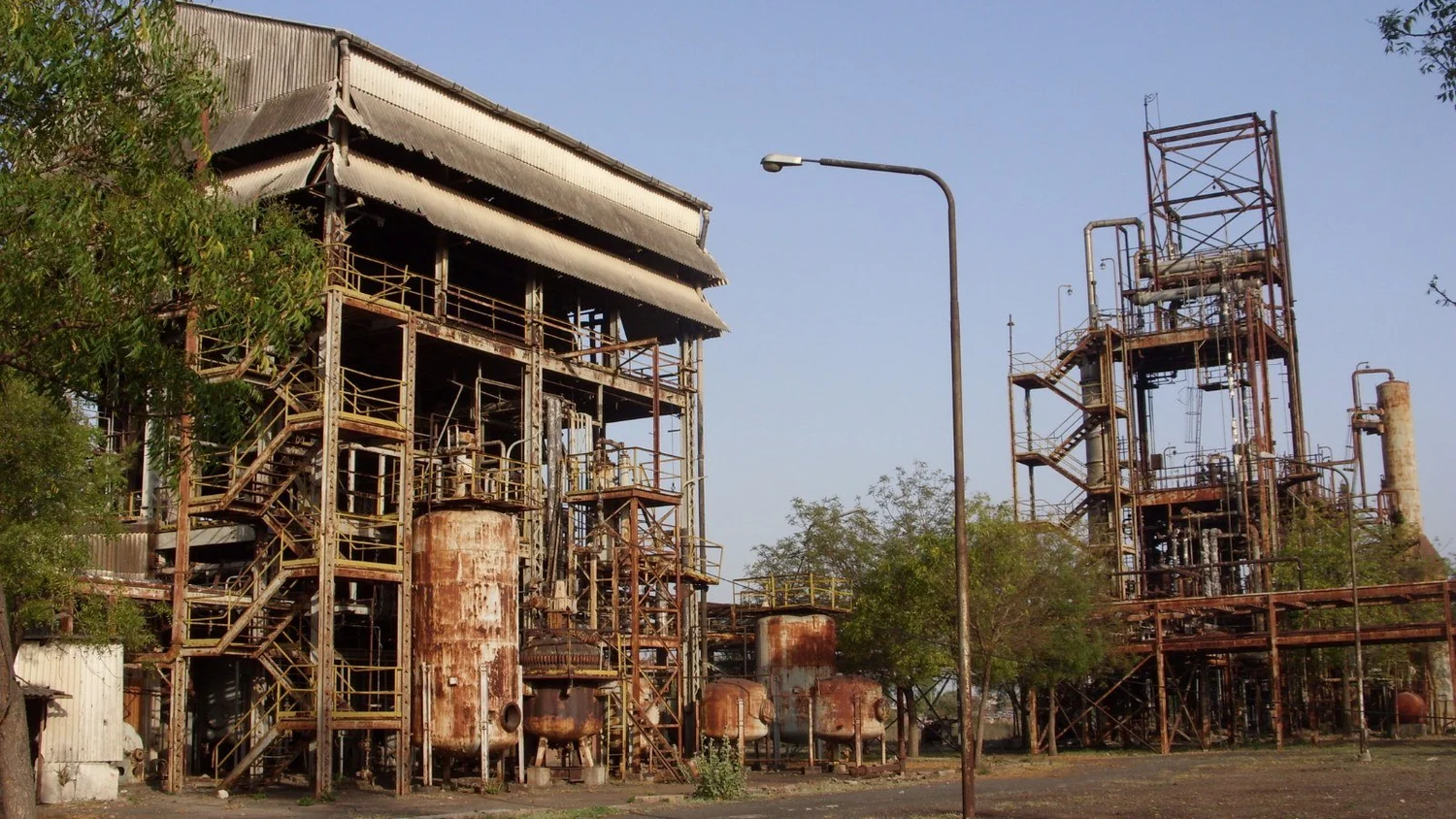
How Did One Leaking Tank Poison Half a Million People in a Single Night?
Shortly after midnight on 3 December 1984, a storage tank at a pesticide factory on the northern edge of Bhopal, in central India, began venting a heavy, toxic gas called methyl isocyanate (MIC). Over the next hour or two, around 40 tonnes of it drifted south-east across the sleeping city. More than 500,000 people were exposed. Thousands were dead by morning, many of them in the crowded informal neighbourhoods that had grown up around the plant's walls.
The factory belonged to Union Carbide India Limited (UCIL), a company majority-owned and controlled by the American Union Carbide Corporation (UCC). The leak happened because water got into a tank holding 42 tonnes of MIC, setting off a runaway chemical reaction, at a plant where almost every safety system meant to contain such a release was switched off, broken or too small. How the water got there is still disputed.
Forty-two years later, the Bhopal gas disaster is still widely described as the world's worst industrial disaster. It is also unfinished business. The death toll has never been agreed, the 1989 compensation settlement is still resented, no one from Union Carbide in the United States ever stood trial in India, and the last of the factory's stored waste was burned only in 2025, leaving hundreds of tonnes of ash that the courts are still deciding what to do with. This explainer sets out what is established, what is contested, and what remains open.
What Was the Union Carbide Plant Making?
UCIL opened its Bhopal factory in 1969 to make Sevin, Union Carbide's brand name for the insecticide carbaryl. In 1979 it added a plant to manufacture methyl isocyanate on site. MIC was an intermediate chemical: methylamine was reacted with phosgene to make MIC, which was then reacted with another chemical, 1-naphthol, to produce carbaryl.
That choice mattered. Other manufacturers made carbaryl by combining the same raw materials in a different order, a route that avoided storing large volumes of MIC, though it cost more. Bhopal's process meant tonnes of one of the most dangerous industrial chemicals in use sat in three underground tanks, labelled E610, E611 and E619, each with a capacity of 68,000 litres. Union Carbide's own safety rules said no tank should be more than half full.
By the early 1980s, demand for pesticides in India had fallen and the plant was losing money. Production carried on, unused MIC accumulated, and spending on the factory was cut.
The Warnings Before December 1984
Bhopal did not come out of nowhere. In 1981 a maintenance worker was splashed with phosgene, pulled off his mask in panic and died 72 hours later. A local journalist, Rajkumar Keswani, began investigating the plant and wrote in his paper: "Wake up, people of Bhopal, you are on the edge of a volcano."
Further leaks followed. In January 1982 a phosgene leak sent 24 workers to hospital. In February 1982 an MIC leak affected 18 workers. Later that year a chemical engineer suffered burns over 30% of his body after contact with liquid MIC, and in October 1982 another MIC leak left a supervisor with severe chemical burns. Leaks of MIC, chlorine, phosgene and other chemicals continued through 1983 and 1984.
Union Carbide's own head office had been told about the risks. A confidential safety audit by UCC in May 1982 identified 61 hazards at Bhopal, 30 of them classed as major, in the phosgene and MIC units. And in September 1984 an internal UCC report on its sister plant at Institute, West Virginia, which used the same basic design, warned that a runaway reaction could occur in the MIC storage tanks and that the planned response would not be quick enough to prevent catastrophic failure. That report was never sent to Bhopal.
What Happened on the Night of 2–3 December
In late October 1984, tank E610 lost the nitrogen pressure used to push MIC out of it. It was holding 42 tonnes, well above the 50% limit. Attempts to re-pressurise it failed, so the MIC simply sat there. MIC production was halted and parts of the plant shut for maintenance, including the flare tower used to burn off escaping gas, which had a corroded pipe removed.
On the evening of 2 December, workers were flushing a clogged pipe with water. Some time that evening, water entered tank E610. MIC reacts violently with water, generating heat and gas. Contaminants, including iron from corroded steel pipework, accelerated the reaction.
The reconstructed timeline ran roughly like this:
- 10.30pm: pressure in E610 is a normal 2 psi.
- 11pm: it reaches 10 psi. Two senior employees assume the gauge is faulty.
- 11.30pm–11.45pm: workers in the MIC area feel the effects of a small leak and find it. The supervisor decides to deal with it after a tea break at 12.15am.
- About 12.40am–12.45am: the reaction runs away within minutes. Temperature goes off the scale; pressure climbs past 40 psi and then 55 psi. The emergency relief valve bursts open and MIC vents straight into the air.
- 12.50am: an employee triggers the alarm. The public siren sounds briefly and is switched off, in line with company practice to avoid alarming residents over minor leaks.
- About 2am: the leak stops. The public siren is sounded properly around 2.15am, roughly an hour and a half after the gas began to escape.
About 30 tonnes of MIC escaped in the first 45 to 60 minutes, rising to around 40 tonnes within two hours. Because MIC is roughly twice as dense as air, the cloud hugged the ground. Children, being shorter, breathed higher concentrations. People who ran inhaled more than those who stayed still or escaped in vehicles. Most residents learned of the leak only when the gas reached them.
The information failures continued into the night. Police calls to the plant between 1.25am and 2.10am were twice told that "everything is OK". Bhopal's main hospital was told at first that the gas was ammonia, then phosgene, and finally "MIC", a name its doctors did not recognise and for which they had no specific treatment.
The Safety Systems That Failed
Three separate safety systems should have stopped or sharply reduced the release. None did.
- Refrigeration: a cooling unit designed to keep the stored MIC cold had been shut down in 1982 and its coolant removed in June 1984. The tank's high-temperature alarm had been disconnected. The MIC was being stored at around 20°C instead of the 4.5°C recommended in the plant manual.
- The vent gas scrubber: meant to neutralise escaping gas with caustic soda, it was on standby and, by most accounts, could not have coped with a release of this size anyway.
- The flare tower: meant to burn escaping gas, it was out of action for maintenance and was in any case sized to handle only a fraction of what leaked.
Water curtains intended to knock gas down could not spray high enough to reach it. A slip-blind plate that would have isolated the pipes being flushed from the tank had not been fitted. Staffing had been cut too: by 1984, only six of the original 12 MIC operators were still working on the unit, supervisors had been halved, and no maintenance supervisor was on the night shift. Union Carbide's own investigation accepted that most of the safety systems were not functioning that night.
There was also no emergency plan for the city. Local authorities had not been told what chemicals were stored at the plant or how dangerous they were.
How Many People Died?
There is no single agreed figure, and the gap between the estimates is itself part of the story.
- 2,259: the official immediate death toll.
- 3,787: deaths related to the gas leak later confirmed by the Madhya Pradesh state government. The environmental magazine Down To Earth uses "around 3,800" for the immediate deaths.
- At least 5,479: the figure used in Press Trust of India reports in 2025.
- Around 8,000 or more: estimates of deaths in the first weeks, cited by clinics working with survivors.
- More than 22,000: Amnesty International's estimate of people who have died prematurely as a direct result of exposure, with deaths continuing.
On injuries, a 2006 Indian government affidavit recorded 558,125, including 38,478 temporary partial injuries and around 3,900 severely and permanently disabling injuries. At least 200,000 children were exposed.
Analysis: The low official counts reflect deaths that were recorded and certified in the chaos of the first days and claims that were later proved to the authorities' satisfaction. The higher figures try to count people who died of exposure-related illness over the following years and decades. Which number you use often says something about where you stand on the question of whether victims were properly recognised.
The Long-Term Health Toll
The first symptoms were coughing, burning eyes and throats, breathlessness, vomiting and a feeling of suffocation. Most early deaths were caused by choking, circulatory collapse and fluid on the lungs. Autopsies also found damage to the brain, kidneys, liver and gut.
Those who survived often lived with long-term harm. Studies over the following decades reported chronic eye damage and early cataracts; lung disease, including fibrosis and worsened tuberculosis; memory and motor problems; post-traumatic stress; and raised rates of stillbirth and newborn death. A government-registered cohort of more than 80,000 exposed people has answered the same health questionnaire almost every year since 1986, and shows excess illness and death compared with an unexposed group, though the study has lost track of most of its original members.
The science was slowed from the start. The Indian Council of Medical Research was barred from publishing its health data until 1994. Researchers and survivor groups say questions about cancer, reproductive health and the children of survivors remain under-studied. Amnesty International says exposure has also harmed reproductive health across generations; how far that extends to children born to survivors remains an active area of research rather than settled fact.
Water or Sabotage? The Unresolved Question of Cause
Everyone accepts that water entered tank E610 and triggered the reaction. The fight is over how.
The negligence account. Indian government investigators and most independent accounts point to the plant's condition. On this view, water used to flush the clogged pipe about 120 metres away travelled through leaking valves and poorly isolated pipework into the tank, in the absence of the slip-blind plate that should have blocked it. Even if the exact route is debated, the argument goes, the scale of the disaster was caused by a plant where cost-cutting had disabled the safety systems.
Union Carbide's account. Union Carbide, now a wholly owned subsidiary of Dow, has long argued that the disaster was caused by sabotage by a disgruntled employee. A report it commissioned from the consultants Arthur D. Little concluded that a worker likely removed a pressure gauge from the tank and connected a water hose directly to it. The company points to testimony that a hose was found next to the tank, to evidence that logs were altered, and to the fact that the water-washing route proposed by investigators could not be reproduced in later tests. It also says its investigators were denied access to the tank and to the operators, because the investigation was controlled by the Indian government.
No employee has ever been charged with sabotage. The sabotage theory was raised again in court in 2017 by the defence of a former production manager. The negligence account, meanwhile, does not depend on proving the exact path the water took: it rests on the condition of the plant, the switched-off safety systems and the decision to store far more MIC than the rules allowed.
Analysis: These explanations are not entirely exclusive. Even if water was introduced deliberately, the refrigeration, scrubber, flare and siren failures determined whether a dangerous incident became a city-wide catastrophe. That is why most safety engineers treat Bhopal as a case study in how multiple safeguards can be allowed to decay at once.
The $470 Million Settlement
In March 1985 India passed the Bhopal Gas Leak Disaster Act, which made the national government the sole legal representative of the victims. Lawsuits were first filed in the United States, but in 1986 a US federal court sent the case to India, ruling that UCIL was a separate Indian company. India claimed $3.3 billion.
In February 1989, with the Supreme Court of India's approval, the government and Union Carbide agreed an out-of-court settlement of $470 million, which the company paid immediately. Amnesty International says survivors were not consulted. In 1991 the Supreme Court upheld the settlement, while ordering the government to take out a group medical insurance policy covering 100,000 people who might develop symptoms later, and to make up any shortfall in the fund.
For most survivors the money was small. The typical award for personal injury was 25,000 rupees, and the average paid to families of the dead was about 62,000 rupees. Claimants were expected to prove that their injury was caused by the gas. Distribution dragged on for years; the remaining funds were released only after a further Supreme Court order in 2004.
In 2010 the Indian government went back to the Supreme Court with a curative petition seeking an extra 7,844 crore rupees from Union Carbide and its successors. On 14 March 2023, a five-judge bench dismissed it. The judges said the settlement had been more than enough to cover actual claims, criticised the government for raising the matter two decades later, and ordered it to use 50 crore rupees held by the Reserve Bank of India to meet any pending claims. They also noted, pointedly, that the medical insurance policy ordered in 1991 had never been taken out: "The Union cannot be negligent on this aspect and then seek a prayer from this court to fix such responsibility on the UCC," the judgment said, as reported by Down To Earth.
Union Carbide's position is that all claims were settled in 1989 and that the Supreme Court upheld the settlement's fairness in 1991, 2007 and 2023. Amnesty International calls the settlement "wholly unfair and inadequate".
Who Was Held Criminally Responsible?
Very few people, and only many years later.
Warren Anderson, Union Carbide's chairman and chief executive, flew to India days after the disaster. He was arrested, released on bail and left the country. Indian prosecutors later charged him with culpable homicide. In 1992 a Bhopal court declared him an absconder after he failed to appear. India sought his extradition; the United States declined, citing insufficient evidence. Anderson died in the United States on 29 September 2014, aged 92, without ever facing trial in India.
On 7 June 2010, a court in Bhopal convicted seven former UCIL executives and managers, all Indian nationals and some by then in their 70s, of causing death by negligence. They included Keshub Mahindra, UCIL's former non-executive chairman. Each was sentenced to two years in prison, the maximum for that offence, and fined 100,000 rupees. All were released on bail shortly afterwards. An eighth defendant had died before the verdict.
The charges had earlier been reduced from culpable homicide to criminal negligence. Campaigners were furious that an offence most often used for road deaths had been applied to Bhopal. The activist Satinath Sarangi called it "the world's worst industrial disaster reduced to a traffic accident", PBS NewsHour reported, citing the New York Times.
Civil cases against Union Carbide in the United States were also unsuccessful. A class action seeking damages and the clean-up of drinking water near the plant was dismissed in 2012, and the appeal was denied.
Who Owns the Problem Now?
Ownership has changed several times, which is one reason accountability is so tangled.
- 1994: Union Carbide sold its stake in UCIL, which became Eveready Industries India.
- 1998: Eveready ended clean-up work, gave up its lease and handed the site to the Madhya Pradesh state government.
- 2001: Dow Chemical bought Union Carbide Corporation.
Union Carbide, now a wholly owned Dow subsidiary, maintains that all claims were settled in 1989. Amnesty International says Dow has consistently distanced itself from any responsibility, and argues that when Dow took over Union Carbide's assets, it should also have absorbed its liabilities, and has urged shareholders to press the company.
The Toxic Waste: Burned in 2025, Still Unresolved
When the factory closed, it left behind chemical residues and contaminated land. Union Carbide's own laboratory tests in 1989 found soil and water samples near and inside the plant were toxic to fish, and later studies reported contamination of soil and groundwater with chemicals including pesticides, organochlorines and heavy metals such as mercury. Amnesty International said in 2024 that thousands of tonnes of toxic waste remained buried in and around the site, causing ongoing and expanding water pollution.
For decades, plans to move and destroy the stored waste were drawn up and abandoned amid protests. Then, on 2 January 2025, under orders from the Madhya Pradesh High Court, 337 tonnes of stored waste were trucked about 250km to a private disposal plant in the Pithampur industrial area of Dhar district. After three trial burns totalling 30 tonnes, the remaining 307 tonnes were incinerated between 5 May and the night of 29–30 June 2025, according to the state pollution control board. Including contaminated soil and packaging, 358 tonnes were burned. Officials said emissions stayed within limits and that the waste contained no MIC.
That did not end it. Burning the waste with lime and other materials produced about 900 tonnes of ash, Press Trust of India reported in December 2025. The state planned to bury it in a landfill cell at the Pithampur plant. On 8 October 2025 the High Court rejected that plan, saying a containment site so close to human habitation was "unacceptable", and ordered the government to identify alternatives. The court referred to an application citing a state pollution board report of 12 August 2025 that found mercury in the ash above permissible limits. As of December 2025, the ash was being kept in a storage shed at the plant. We could not confirm whether a final disposal site has since been agreed.
It is also important to be clear about scale. The waste burned in 2025 was the material stored at the site. Campaigners' concerns about chemicals buried in and around the old plant, and about groundwater in surrounding neighbourhoods, are a separate and larger question.
What Bhopal Changed
Bhopal reshaped chemical safety regulation far beyond India. In the United States, Congressman Henry Waxman called for an inquiry in 1985, and the disaster led to US legislation on the accidental release of toxic chemicals. The chemical industry launched voluntary programmes on process safety and emergency planning; Union Carbide says it helped develop and implement the Responsible Care initiative because of what was learned at Bhopal.
Analysis: The deepest lesson of Bhopal is about how risk is distributed. The chemical was stored in bulk because it was cheaper. Safety systems were turned off to save money. The people who lived closest to the plant were among the city's poorest, and they had the least information and the least power once things went wrong. Amnesty International describes the result as environmental racism; Union Carbide points to the courts' repeated endorsement of the settlement. What both sides agree on is that the world's worst industrial disaster happened at a plant whose dangers had been documented in advance.
What Is Still Disputed or Unknown
- The death toll. Official figures run from 2,259 immediate deaths to 3,787 confirmed; campaigners and Amnesty International estimate more than 22,000 premature deaths over time.
- How the water got into tank E610. Indian investigators and most independent accounts point to negligence and poor maintenance; Union Carbide maintains it was sabotage. No one has been charged with sabotage.
- Long-term and second-generation effects. Some harms are well documented; others, including effects on children born to survivors, remain under-researched.
- The ash and the site. The 2025 incineration created about 900 tonnes of ash whose final disposal was still before the courts at the end of 2025, and contamination at and around the old plant has not been fully cleaned up.
- Dow's liability. Union Carbide says the 1989 settlement resolved all claims; campaigners and Amnesty International say Dow inherited Union Carbide's responsibilities when it bought the company.
Conclusion
The Bhopal gas disaster happened because 42 tonnes of a lethal chemical were stored in a tank that should never have held that much, water reached it, and every safeguard meant to stop the gas reaching the city had been switched off, removed or was too small. Those facts are not seriously disputed. Almost everything that followed is: how many people died, who caused the water to enter the tank, whether $470 million was fair, why no one from Union Carbide in the US was tried, and who should pay for what remains. On the 42nd anniversary, survivors are still living with the consequences, and the last of the factory's stored waste has become a new legal argument in a town 250km away.
Sources
- Wikipedia: Bhopal disaster (citing government affidavits, the Supreme Court settlement orders, UCC's Arthur D. Little report and health studies)
- Union Carbide Corporation: The Bhopal Gas Tragedy (company statement)
- Amnesty International: Environmental racism enabled forty years of injustice for survivors of Bhopal gas tragedy (2 December 2024)
- Down To Earth: SC dismisses Centre's plea for additional compensation from Union Carbide (14 March 2023)
- PBS NewsHour: Seven convicted in deadly 1984 Bhopal gas leak in India (7 June 2010)
- India TV / PTI: All 337 tonnes of Union Carbide waste burnt at disposal unit in Madhya Pradesh (30 June 2025)
- The Week / PTI: 900 tonnes of toxic ash post-incineration of Union Carbide waste causes unease in MP town (2 December 2025)
Next Reads
- Chernobyl Disaster Explained: What Happened, Why the Reactor Exploded and What Happened Afterwards
- The Mount Erebus Disaster Explained: Flight 901, the Changed Coordinates and the 'Orchestrated Litany of Lies'
- The Challenger Disaster Explained: What NASA Knew Before the Shuttle Broke Apart
- The Therac-25 Disaster Explained: How a Software Bug Gave Patients Massive Radiation Overdoses
- The Biggest Cover-Ups Eventually Proven True, Ranked
