How Could a Missing Valve and a Lost Piece of Paper Kill 167 Men?
At about 10pm on Wednesday 6 July 1988, gas leaked from a loosely sealed pipe on the Piper Alpha oil and gas platform, about 120 miles north-east of Aberdeen, and exploded. Over the next two hours the fire spread from module to module, three high-pressure gas pipelines from neighbouring platforms burst, and most of the installation collapsed into the North Sea. Of the 226 people on board, 165 died. Two men from a rescue boat were also killed, bringing the death toll to 167. Sixty-one men survived, almost all of them by jumping into the sea.
It remains the world's deadliest offshore oil and gas disaster. Yet the chain of events that destroyed Piper Alpha began with ordinary maintenance work. A pressure safety valve had been taken off a pump, the open pipe had been covered with a plate that was not properly tightened, and the paperwork that should have warned the night shift never reached the men who restarted the pump.
The public inquiry led by Lord Cullen found that the deeper failures lay in how safety was managed, both by the operator, Occidental, and by the government department that regulated it. His 106 recommendations reshaped offshore safety in Britain and influenced process safety around the world. This explainer sets out what happened that night, why so many men could not escape, what the inquiry found, who was held responsible and what changed. It draws on the parliamentary record, engineering accounts of the inquiry evidence and later reporting, and notes where the sources disagree.
What Was Piper Alpha?
Piper Alpha stood in the Piper oilfield in the UK sector of the North Sea, in about 144 metres (474 feet) of water. The field was discovered in January 1973 and the platform began producing oil in December 1976. It was operated by Occidental Petroleum (Caledonia) Ltd on behalf of a group of companies that also included Texaco, Union Texas Petroleum and Thomson North Sea.
The platform was originally designed to produce oil. In 1978 it was converted to process and export gas as well, as part of gas-conservation work. That conversion matters to the story. It put gas compression equipment in module C, next to the control room, on a platform whose layout and firewalls had been designed around oil.
By 1988 Piper Alpha was producing about 125,000 barrels of oil a day, around a tenth of the UK's North Sea output, according to accounts of the field. It was also a hub. Oil from the nearby Claymore and Tartan platforms fed into Piper's export line, and Piper was connected by high-pressure gas pipelines to Tartan, Claymore and the MCP-01 gas compression platform. Those connections would prove fatal.
Three days before the disaster, Piper had been switched back to a simpler operating mode while equipment used to dry the gas was taken out of service. Accounts of the inquiry evidence say Occidental chose to keep the platform producing during this period rather than shut it down.
What Went Wrong With Pump A?
Piper Alpha had two condensate pumps, A and B, which pumped liquid gas condensate into the oil export line. On 6 July pump A was out of service for maintenance. During the day its pressure safety valve was removed to be checked and recertified, and the open end of the pipe was covered with a blank flange. According to accounts based on the inquiry evidence, the flange was only hand-tight and had not been leak-tested.
Two separate permits to work had been issued: one for the pump's overhaul and one for the removal of the safety valve. The safety valve permit stated that the pump must not be switched on. The work was not finished by the end of the day shift, and the valve permit was put away with other suspended permits. Sources differ on where: some accounts of the evidence say it was left in the control centre, while The Chemical Engineer's account says suspended permits were kept in the safety office, filed by trade rather than by location. Either way, the night shift did not find it.
The restart
At about 9.45pm pump B tripped and could not be restarted. Without a working condensate pump, production would have to stop. The night-shift staff looked for the paperwork on pump A. They found the permit for the overhaul, which had not started, but not the permit showing that its safety valve had been removed. Believing pump A could be used, they started it.
Gas condensate flowed into the pump and leaked at high pressure through the loosely fitted flange. Gas alarms sounded. Shortly afterwards, at about 10pm, the gas cloud ignited. Accounts put the time of the first explosion at between 9.55pm and 10pm. The exact ignition source was never established; hot surfaces, damaged light fittings and an electrostatic spark were all considered.
The Chemical Engineer's account of the inquiry evidence says the most likely cause was the release of as little as 30kg of condensate. It also notes that the inquiry left some uncertainty about the exact cause, and we have reflected that here.
Why Did the Fire Spread So Fast?
The explosion in module C blew through the firewall into the neighbouring modules. Piper's firewalls had been designed to resist fire, not explosions, and the conversion to gas had not led to an effective review of that design. Pipework in module B ruptured, starting a large oil fire, and the control room was put out of action almost at once.
The platform's own firefighting systems did not help. Its diesel fire pumps had been switched to manual start because divers were working in the water nearby. The men who could have started them manually could not reach them. Accounts of the evidence say the deluge system in module C had a history of blockages. The Chemical Engineer's account states bluntly that no water was applied to any of the fires from Piper Alpha itself.
The oil fire produced thick black smoke that quickly covered the platform, including the helideck. No helicopter could land, and the lifeboats could not be reached.
Tartan, Claymore and the gas risers
The decisive escalation came from outside Piper. The neighbouring Tartan and Claymore platforms kept pumping oil and gas through the pipelines connected to Piper for some time after the first explosion. Accounts of the evidence say their managers knew there was a problem but did not shut down production while they waited for instructions from onshore; the Maritime Executive's account links that reluctance to the cost of a shutdown. Oil also flowed back towards Piper through an export valve that appears not to have closed fully.
At about 10.20pm, the high-pressure gas riser from Tartan burst in the heat. It released a vast amount of gas, which ignited in a huge fireball. Wikipedia's account of the disaster describes it as the moment that "doomed Piper". At about 10.50pm the gas riser from MCP-01 ruptured, sending flames more than 90 metres high, and at about 11.20pm the Claymore gas line failed. Sources give slightly different times for these failures, but they agree on the sequence.
From about 11.45pm the platform began to collapse. A crane and the derrick fell, and the module holding the accommodation block slid into the sea.
Why Did So Many Men Wait in the Accommodation Block?
This is the most painful part of the story. By around 10.20pm, roughly 70 to 80 men had gathered in the accommodation block and its galley, which was fire-protected and was where many had been trained to muster. The smoke and flames had cut them off from the lifeboats and the helideck. With the control room abandoned and the public address system damaged, no order to evacuate was given. The men waited for instructions and for helicopters that could not come.
The smoke reached them. The accommodation block was later recovered from the seabed, and the bodies of 87 men were found inside. Most victims of the disaster died from inhaling smoke and gas rather than from burns, according to the pathology evidence summarised in accounts of the inquiry.
Announcing the inquiry's findings in the House of Commons in November 1990, the Energy Secretary, John Wakeham, reported Lord Cullen's view that the death toll among those in the accommodation might have been significantly reduced. The men who survived were mostly those who broke away from the muster point and made their own way down to the sea.
How the survivors escaped
The 61 survivors got off the platform by climbing down ropes and ladders or by jumping. Some jumped from the helideck, about 175 feet (53 metres) above the water. They were picked up by fast rescue craft from the standby vessel Silver Pit and other ships in the area, and later taken to the Tharos, a large firefighting and support vessel that was working near Piper that night.
The Tharos moved alongside and used its water cannon, but its systems had never been tested in conditions like these. Accounts of the evidence say it lost much of its power, its gangway could not be used to take men off, and it had to pull back after the MCP-01 riser failed.
The rescuers took huge risks. A fast rescue craft from the vessel Sandhaven was destroyed by the explosion at about 10.50pm. Two of its three crew were killed. The Chemical Engineer and Maritime Executive accounts say the men they had just pulled from the water, six in all, were killed too. Seven George Medals were among the bravery awards that followed, two of them awarded posthumously to the Sandhaven crewmen.
How Many People Died in Piper Alpha?
The death toll was 167: 165 of the 226 people on the platform and two rescue crew from the Sandhaven. Sixty-one men survived. One source puts the number on board at 229, but most accounts, including The Chemical Engineer and STV, give 226.
The bodies of 30 men were never recovered. Accounts differ slightly on how many bodies were found (135 or 137), but they agree that the great majority died from smoke inhalation.
The fires burned for about three weeks. The wells were finally brought under control in late July 1988 by a team led by the American firefighter Red Adair, working from the Tharos. What remained of the platform was toppled into the sea on 28 March 1989. The process modules that might have shown exactly where the leak occurred were never recovered.
What Did the Cullen Inquiry Find?
The government set up a public inquiry on 13 July 1988, a week after the disaster, and appointed the Scottish judge Lord Cullen to lead it. It sat for 180 days over 13 months and heard evidence from most of the survivors, as well as engineers and safety experts. Its report was published as a Command Paper in November 1990. John Wakeham told MPs on 12 November that he was publishing it that day.
Wakeham told the Commons that "the Piper Alpha disaster was the most serious industrial accident in Britain in over 50 years". He said the inquiry had found that the immediate cause was an explosion in the gas compression module, but that the underlying causes were "failures of communication and weaknesses in management control".
The key findings, as reported to Parliament and in later engineering accounts, were these:
- The permit-to-work system had failed. The Chemical Engineer's account says the inquiry asked four questions about the system: was the procedure adequate, was it complied with, were people trained in it, and was it monitored? The answer to all four was no. Shift handovers did not reliably pass on what had been dismantled.
- Management was complacent. Wakeham quoted Cullen's finding that senior management "were too easily satisfied that safety was being maintained". The report identified significant flaws in the way Occidental managed safety.
- Lessons had not been learned. In September 1987, a contract worker had been killed on Piper Alpha in an accident that also exposed weaknesses in permits and handovers. Occidental was prosecuted and fined over that death, but the practices did not change.
- The platform was not designed for the risks it carried. Gas equipment had been added next to the control room, and firewalls were not designed for blasts.
- The emergency response broke down. There was no effective command once the control room was lost, and men were left waiting for instructions that never came.
- Regulation was too weak. Wakeham told MPs that inspections had "concentrated too much on hardware and not enough on management systems".
What Changed After Piper Alpha?
Lord Cullen made 106 recommendations. Wakeham told Parliament that the government accepted his conclusions and recommendations. The most important changes were structural.
A new regulator
Before Piper Alpha, offshore safety was overseen by the Department of Energy, the same department responsible for promoting oil and gas production. Cullen recommended moving responsibility to the Health and Safety Executive, which set up a dedicated offshore safety division. The change was widely seen as ending a conflict of interest between production and safety.
The safety case
The biggest change was the safety case regime. Under the Offshore Installations (Safety Case) Regulations 1992, every operator had to produce a detailed safety case for each installation, showing how major hazards had been identified and controlled, and have it accepted by the regulator. New installations could not operate without one. The safety case had to include a temporary safe refuge, a protected place where people could shelter long enough to be evacuated, along with arrangements for escape and evacuation. By late 1993, a safety case had to be submitted for every platform and rig in British waters.
The new approach was goal-setting rather than prescriptive. Instead of ticking off a list of rules, operators had to demonstrate that their own safety management systems worked. It became a model for regulators in other countries and in other high-hazard industries.
Engineering changes
Accounts of the regime describe other changes that followed. Emergency shutdown valves on pipelines were moved and strengthened under 1989 regulations so that a fire on one platform could be isolated from the gas lines feeding it. Platforms were fitted with blast walls, fire pumps that could be started remotely, and refuges designed to keep out smoke and gas. Permit-to-work systems and shift handovers were overhauled across the industry.
Was Anyone Prosecuted for Piper Alpha?
No. Wakeham told Parliament that the report had been sent to the Lord Advocate, Scotland's senior law officer, and that any prosecution was a matter for him. No criminal charges were brought against Occidental or any individual over the disaster. For many families that remains a source of anger.
The disaster did produce long civil litigation over who should pay. In 1997, after what has been described as the longest civil trial in Scottish history, Lord Caplan ruled in a case over whether contractors whose staff had worked on the platform should share the cost of compensation. His findings about the role of individual workers who died in the disaster were controversial among families. Appeals were decided in the Court of Session in 1999 and the House of Lords in 2001, both against the contractors.
Occidental and its insurers paid survivors and bereaved families a total reported at about US$220 million in settlements. The overall insured loss has been estimated at around £1.7 billion to £2 billion at the time, making it one of the costliest man-made disasters on record.
What Happened to the Survivors and the Families?
Surviving was not the end of the story. A study of survivors by researchers at Robert Gordon University in Aberdeen found that more than 70% of those who took part reported symptoms of post-traumatic stress, and many had trouble finding work. Wikipedia's account of the study reports that some employers regarded survivors as bad luck.
The families and survivors formed the Piper Alpha Families and Survivors' Association. Disputes about the disaster's legacy have continued for decades, including over the civil court findings and a commemorative Monopoly edition released for the 30th anniversary in 2018, which some families called offensive before it was redesigned.
The memorials
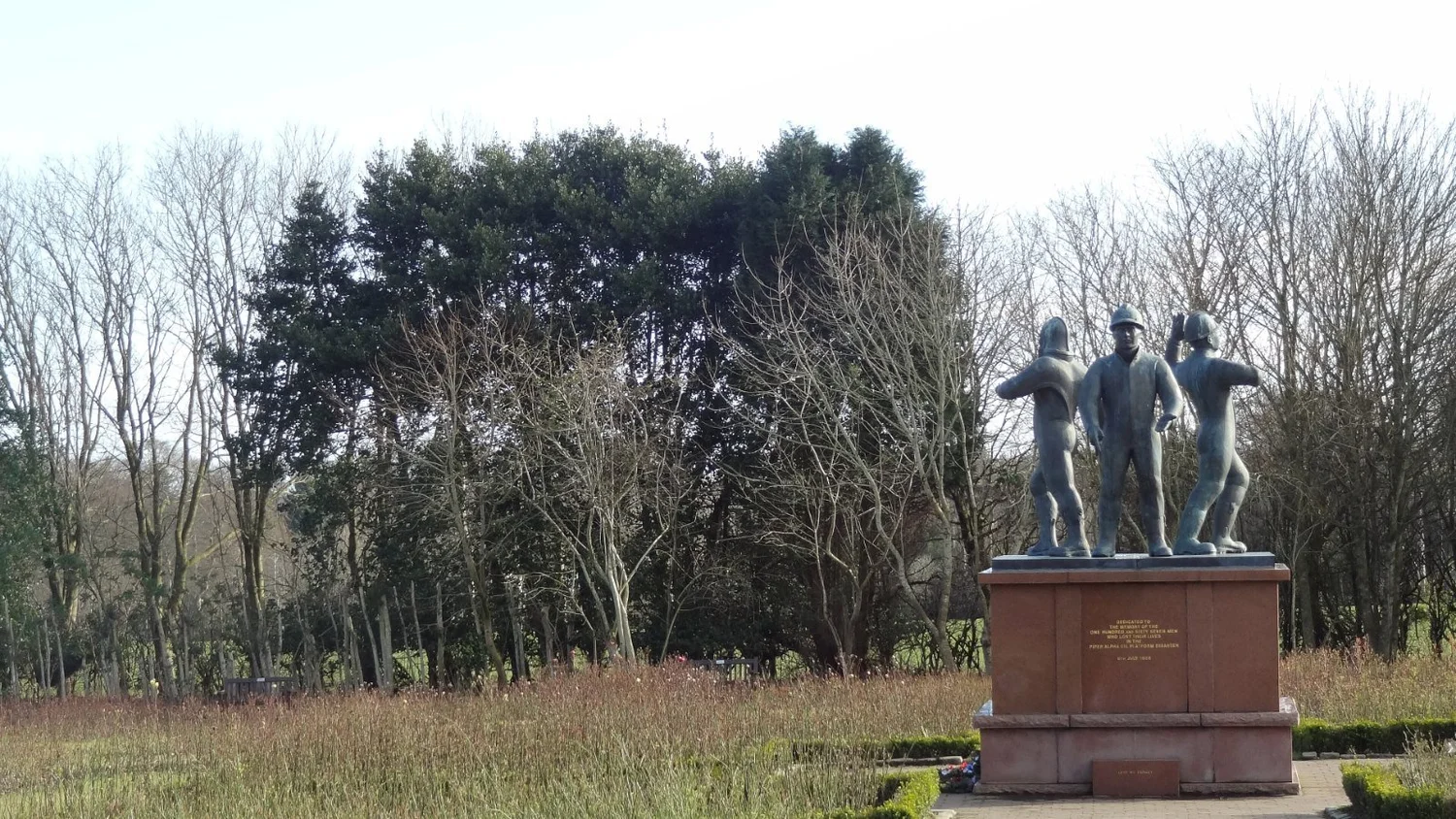
The main memorial is a bronze sculpture of three oil workers by the artist Sue Jane Taylor, in the rose garden at Hazlehead Park in Aberdeen. It was unveiled by the Queen Mother on 6 July 1991, the third anniversary. There are also memorials in Glasgow, at Strathclyde Country Park, and in Aberdeen churches. STV marked the 38th anniversary on 6 July this year.
A replacement platform, Piper Bravo, was installed nearby in 1992 and began production in 1993. A buoy marks the site of the wreck of Piper Alpha.
Why Does Piper Alpha Still Matter?
Analysis: Piper Alpha is still taught to engineers, managers and regulators because almost every failure in it was ordinary. A valve was removed for routine checks. A permit was filed in the wrong place. A night shift was under pressure to keep production running. Neighbouring platforms waited for permission to stop. None of these decisions looked catastrophic on its own, but together they killed 167 people.
The disaster also exposed a confusion that still matters in high-hazard industries: the difference between personal safety and process safety. A company can have a good record on slips, trips and hard hats while the systems that control large amounts of flammable gas are quietly failing. Engineers writing about the disaster's 30th anniversary in the Journal of Petroleum Technology described its "profound impact" on process safety culture and law around the world.
The same pattern has appeared in disasters since, including the Deepwater Horizon blowout in the Gulf of Mexico in 2010: weak controls on routine work, poor communication between shifts and companies, and an emergency response that collapsed when the first barrier failed. That is why the lessons of a fire in 1988 are still repeated in North Sea safety training today.
What Questions Remain?
- The exact ignition point. Because the process modules were never recovered, the inquiry had to reconstruct the leak and ignition from evidence and testimony. The blank flange on pump A is the accepted most likely source, but the ignition source was never identified.
- Whether faster shutdowns would have changed the outcome. Accounts of the evidence suggest earlier shutdowns on Tartan and Claymore might have delayed the riser failures, but it is not clear they would have saved the platform.
- Accountability. No one faced criminal charges, and the civil court findings about individual workers remain disputed by many families.
Conclusion
Piper Alpha was destroyed by a chain of small failures that should have been caught: a safety valve removed and a pipe sealed by hand, a permit that went missing between shifts, firewalls never designed for an explosion, fire pumps on manual, and neighbouring platforms that kept feeding gas to the fire. The men who waited in the accommodation block were following their training, and most of them died there. Lord Cullen's inquiry found that the root cause lay in how safety was managed, and his recommendations created the safety case regime and an independent regulator. They have made the North Sea safer. But no one was ever prosecuted, 30 men were never brought home, and for the families of the 167 the price of those lessons is still felt every 6 July.
Sources
- Hansard: House of Commons statement on the Piper Alpha inquiry report, 12 November 1990
- The Chemical Engineer (IChemE): Piper Alpha, the disaster in detail
- STV News: Piper Alpha, 38 years since the world's worst offshore disaster (6 July 2026)
- The Maritime Executive: July 6, 1988, the Piper Alpha disaster (5 July 2018)
- Journal of Petroleum Technology: Process safety thirty years after the Piper Alpha disaster (2018)
- Wikipedia: Piper Alpha
Next Reads
- The Mount Erebus Disaster Explained: Flight 901, the Changed Coordinates and the 'Orchestrated Litany of Lies'
- Chernobyl Disaster Explained: What Happened, Why the Reactor Exploded and What Happened Afterwards
- The Challenger Disaster Explained: What NASA Knew Before the Shuttle Broke Apart
- The Therac-25 Disaster Explained: How a Software Bug Gave Patients Massive Radiation Overdoses
- The Boeing 737 MAX Disaster Explained: The Crashes, MCAS and What Boeing Knew
