How Did a Dropped Match Kill 31 People in Rush Hour?
At about 7.25pm on Wednesday 18 November 1987, a small fire started underneath a wooden escalator on the Piccadilly line at King's Cross St Pancras, one of the busiest stations on the London Underground. Twenty minutes later it erupted up the escalator shaft into the ticket hall in a sudden burst of flame and thick black smoke. Thirty-one people died, including a London firefighter, Station Officer Colin Townsley. Many more were injured.
The fire began with something as ordinary as a lit match dropped by a passenger. It fell through a gap at the side of the escalator and set light to a thick layer of grease and debris that had built up on the running tracks underneath. What turned that into a disaster was a combination of decades-old wooden escalators, a management culture that treated small fires as routine, untrained staff, and a way that fire behaves on a sloping escalator that no one had understood before.
The public investigation led by Desmond Fennell QC made 157 recommendations, forced the resignations of the two men at the top of London's transport system and transformed fire safety on underground railways. This explainer sets out what happened that evening, why the fire spread as it did, what the investigation found, who the victims were and what changed. It draws on the Fennell report, the parliamentary record, London Fire Brigade and British Transport Police histories and later reporting, and notes where accounts differ.
What Happened at King's Cross on 18 November 1987?
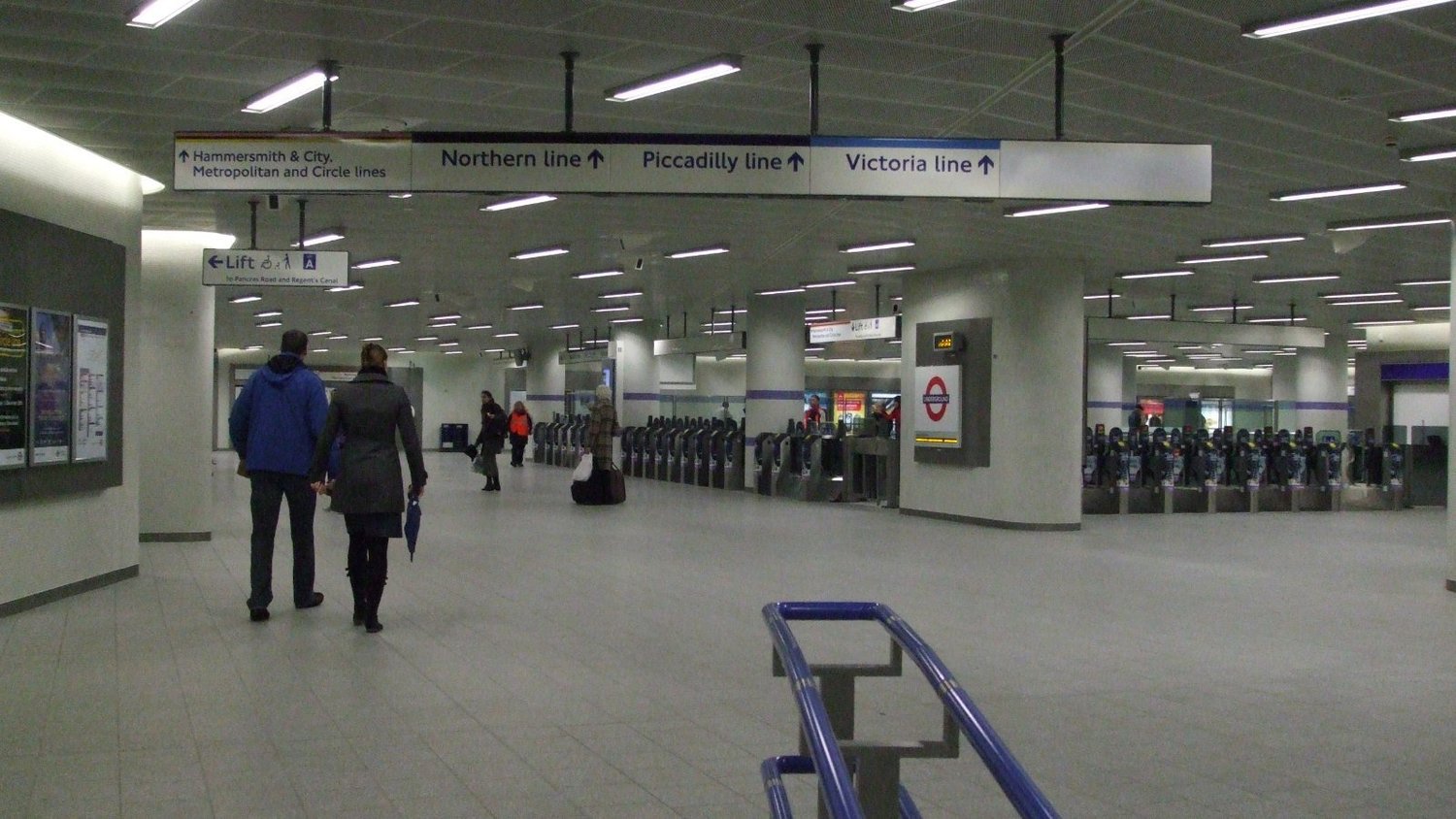
According to the Fennell report, the fire probably started at about 7.25pm, near step 48 of escalator 4, one of the wooden escalators linking the Piccadilly line platforms with the tube lines ticket hall. At about 7.29pm a passenger saw smoke and flames beneath the escalator and told a booking clerk. Fennell's summary says the alarm was raised by a passenger at about 7.30pm.
Underground staff and British Transport Police officers went to look.
A British Transport Police officer went to the surface to call the fire brigade. Fennell records that the brigade "was summoned to King's Cross Underground station at 19:34 and the first fire appliance arrived at 19:42". Firefighters reached the tube lines ticket hall at about 7.43pm.
No one put water on the fire. The Fennell report found that no water was applied between 7.30pm and 7.45pm.
The flashover
At about 7.45pm the fire suddenly flashed over. A jet of flame and superheated smoke burst out of the top of the escalator shaft and filled the ticket hall, where passengers, staff, police officers and the first firefighters were standing. London Fire Brigade notes that the clock above the escalator stopped at 7.45pm when its wiring burned through.
Many of the people who died were in the ticket hall at that moment or on their way up into it.
More than 150 firefighters and 30 fire engines attended, according to London Fire Brigade. The fire was brought under control at 9.48pm and finally declared out at 1.46am on 19 November, about six hours after it started.
Who Died in the King's Cross Fire?
Thirty-one people died. The Fennell report records that 30 died at the station and one more died later in hospital. Accounts of how many were injured vary: Fennell says only that "many more" were hurt, while later accounts say more than 100 people were taken to hospital, about 19 of them seriously injured.
Station Officer Colin Townsley
Colin Townsley was the station officer in charge of the fire engine from Soho, one of the first to arrive. He went down into the station to assess the fire with a colleague from Clerkenwell. When the flashover came, he was in the ticket hall. His body was later found near the Pancras Road exit, beside a badly burned passenger he had been trying to help. Fennell wrote that he had been "trying to help the burned passenger to safety" and that "his was a heroic act".
He was awarded the George Medal posthumously, announced in the London Gazette in May 1989. Fireman Robert Moulton received the Queen's Gallantry Medal for rescuing a woman who had been badly burned. London Fire Brigade says Townsley's place at Soho fire station is still kept for him. In 2021, on the 34th anniversary, the Fire Brigades Union unveiled a red plaque in his memory at King's Cross.
The unknown man
For more than 16 years, one of the 31 had no name. Known to investigators as Body 115, he was a short, older man whom no one reported missing. A post-mortem found a surgical clip in his brain from an earlier operation, and specialists made a reconstruction of his face from his skull, but he could not be identified.
British Transport Police kept working on the case. Around the 10th anniversary, detectives looked again at a man called Alexander Fallon, who had been ruled out earlier because his family had given his height as several inches taller than the victim. Hospital records showed he had had an operation for an aneurysm in 1980 using the same type of clip. In January 2004 police confirmed that Body 115 was Alexander Fallon, a man from Falkirk who had become homeless in London. His daughter told reporters she was "certain" the victim was her father.
What Caused the King's Cross Fire?
Fennell concluded that the fire was started by a lit match dropped by a passenger. It fell through a gap between the escalator treads and the skirting board and landed on the running tracks below, where it ignited a layer of grease mixed with fluff, hair and other debris that had built up over years. Fennell called this layer a "seed bed" for fire. Matches were recovered from the track, and the report found that about 30% of the escalator's fire cleats, the strips designed to stop things falling through the gaps, were missing. British Transport Police has described the cause as probably a discarded cigarette, but the investigation's conclusion was a match.
Smoking had been banned on Underground trains in 1984 and in sub-surface stations from February 1985, after a fire at Oxford Circus. But people still lit up as they rode the escalators out of the station, especially on the way to the street. Fennell found that of 46 serious escalator fires on record, 32 had been attributed to smokers' materials.
The trench effect
The question that puzzled investigators was why a small, slow fire under the escalator suddenly erupted into the ticket hall with such force. In the months after the disaster, experts offered competing theories, including the burning of layers of paint on the ticket hall ceiling and on hoardings.
The answer came from computer modelling. In December 1987 the investigation commissioned the Atomic Energy Research Establishment at Harwell to simulate the fire using a computer program called FLOW-3D. Fennell described the result as a "striking and completely unexpected phenomenon": the hot gases did not rise to the ceiling of the escalator shaft, as everyone had assumed, but stayed low and ran up the trench formed by the steps and the escalator's side panels.
As the fire spread up the escalator, the flames lay along the steps and pre-heated the wood above them. The 30-degree slope of the escalator made the effect much stronger. Eventually the whole escalator caught fire at once and the burning gases were driven out of the top of the shaft into the ticket hall.
Scale-model tests by the Health and Safety Executive at Buxton confirmed the finding. A one-third scale test on 22 July 1988 "clearly substantiated the trench effect", according to the report. One expert witness told the investigation: "This is a newly discovered phenomenon, not previously identified in any previous fire situations or tests." Fennell concluded that the trench effect, not paint, caused the flashover, a finding the Transport Secretary repeated to Parliament.
What Did the Fennell Investigation Find?
The Transport Secretary, Paul Channon, appointed Desmond Fennell QC to lead a formal investigation on 23 November 1987, five days after the fire. It held public hearings at Methodist Central Hall in Westminster from 1 February to 24 June 1988, sitting for 91 days. The report was presented to Parliament on 10 November 1988.
Fennell's findings went well beyond the escalator. He described a culture at London Underground in which fires were treated as an accepted part of running an old railway. Staff, he wrote, insisted that fires should be called "smouldering" and regarded as "an occupational hazard", which gave "a false sense of security". Management believed that "fires were inevitable on the oldest and most extensive underground system in the world".
The report found that London Underground had a "blinkered" approach to fire and a "blind spot" about escalator fires in particular. It found that:
- Staff were not trained. Most station staff had no training in fire or evacuation, and their response on the night was "uncoordinated, haphazard and untrained".
- There was no plan. The station had no evacuation plan, and there was no effective communication with passengers, the police or the fire brigade.
- The fire brigade was called too late. Channon told the Commons that London Underground had previously called the brigade only when a fire had disrupted services for about 30 minutes. It now called the brigade routinely.
- No one was in charge of safety. No single director had responsibility for passenger safety, and the organisation had not learned from earlier escalator fires.
- Funding was not the cause. Channon reported that Fennell found "no evidence that the overall level of subsidy" was inadequate and no evidence that staff cuts had "contributed directly" to the disaster.
The report made 157 recommendations. Channon told MPs that 33 were classed as most important and 59 as important, and that London Underground planned to spend £266 million on safety over three years. "It is essential in the future to have better trained staff," he said.
Who Resigned After King's Cross?
On the day the report was published, Sir Keith Bright, chairman of London Regional Transport, and Dr Tony Ridley, chairman of London Underground, both resigned. Channon told MPs that Sir Neil Shields would become interim chairman. Channon himself did not resign.
No one was prosecuted over the fire.
What Changed After the King's Cross Fire?
King's Cross changed fire safety underground more than any other single event. The main changes were:
Wooden escalators and smoking
Channon told Parliament that the wooden panelling on escalators would be replaced by July 1989, and wooden escalators were phased out across the network over the following years. The ban on smoking was extended to all parts of all Underground stations, including the escalators, within days of the fire.
The section 12 regulations
The Fire Precautions (Sub-surface Railway Stations) Regulations 1989, known in the industry as the section 12 regulations, came into force on 18 September 1989. They require stations below ground to have:
- sprinklers and heat detectors on escalators, and smoke detectors in machine rooms
- fire alarms and public address systems
- fire-resistant materials in station structures and fittings
- staff trained in fire precautions, with regular drills and an emergency plan
- measures to prevent smoking, and records of maintenance and training
Communications and emergency planning
Fennell also recommended that police and fire brigade radios should work together and work underground, that station plans should be kept outside stations for firefighters, and that protective equipment and training should be reviewed. Those recommendations shaped how emergency services plan for incidents on the Underground today.
How Is the King's Cross Fire Remembered?
A memorial below ground at King's Cross St Pancras, paid for by the King's Cross Disaster Fund, reads "In memory of the 31 people who died" and lists 30 names and "an unidentified man". The station also has a memorial plaque and a memorial clock. Anniversaries are marked each 18 November, with a service on the 30th anniversary in 2017 and wreaths laid on the 35th in 2022.
Alexander Fallon was buried in November 1988 before he had been identified. His name was confirmed only in 2004.
Why Does the King's Cross Fire Still Matter?
Analysis: King's Cross is studied for two lessons. The first is scientific. The trench effect was a genuinely new discovery about how fire behaves on a slope, and it is now part of how engineers design escalators, stairways and tunnels. A disaster that looked at first like a simple fire turned out to reveal something nobody in the field had understood.
The second lesson is about culture, and it is the one that recurs. London Underground had seen many small escalator fires and had come to treat them as normal. Its staff called them "smoulderings". Fennell's report is one of the clearest descriptions of how an organisation can normalise danger until a routine event becomes a catastrophe. The same pattern appears in other disasters of the period, from the Piper Alpha platform the following year to the loss of the space shuttle Challenger the year before.
The disaster also showed how much depends on people at the front line. Station staff who had never been trained in fire or evacuation had no plan to follow and did not call the fire brigade themselves. The section 12 regulations made that training a legal requirement.
What Questions Remain?
- Exactly how many were injured. The Fennell report does not give a single figure, and later accounts differ.
- The role of toxic smoke. Some later reports said many victims died from toxic gases including cyanide, but this rests on limited published evidence.
- The precise timings. Fennell's times for the first alarm and the fire brigade's call differ slightly from some later accounts. We have used the report's times.
Conclusion
The King's Cross fire started with a dropped match and a layer of grease and fluff under a wooden escalator that had never been properly cleaned. For 20 minutes it was treated as the kind of minor fire London Underground had seen many times before. Then the trench effect, unknown until investigators modelled it, drove flame and smoke up the escalator into a crowded ticket hall, killing 31 people, among them Station Officer Colin Townsley and a homeless man who would not be named for 16 years. Desmond Fennell's investigation exposed a culture that accepted fire as routine, forced the resignation of London's transport chiefs and led to the section 12 regulations that still govern stations below ground. The wooden escalators have gone, and smoking has long been banned, but the lesson of King's Cross is about what an organisation allows itself to treat as normal.
Sources
- Investigation into the King's Cross Underground Fire (the Fennell report), 1988 (PDF, via JESIP)
- Hansard: House of Commons statement on the King's Cross fire (Fennell report), 10 November 1988
- London Fire Brigade Museum: The King's Cross fire, 1987
- London Fire Brigade: King's Cross fire remembered 30 years on (2017)
- British Transport Police: The unknown man, Alexander Fallon
- British Transport Police: The legacy of the King's Cross fire
- legislation.gov.uk: Fire Precautions (Sub-surface Railway Stations) Regulations 1989, explanatory note
- The London Gazette: Supplement of 25 May 1989 (gallantry awards)
- Irish Examiner: King's Cross fire victim identified (22 January 2004)
- RSSB Right Track: King's Cross fire feature (February 2026)
- Fire Brigades Union: King's Cross fire plaque unveiled for fallen firefighter (18 November 2021)
- London Remembers: King's Cross fire memorial
Next Reads
- The Cocoanut Grove Fire Explained: How 492 People Died in a Boston Nightclub in 1942 and Why Exit Doors Changed for Good
- The Summerland Fire Explained: How 50 People Died at the Isle of Man Leisure Centre in 1973
- The Zeebrugge Ferry Disaster Explained: Why the Herald of Free Enterprise Capsized in 1987 and No One Was Convicted
- The Piper Alpha Disaster Explained: What Went Wrong on the North Sea Platform and What Changed After 167 Died
- The Challenger Disaster Explained: What NASA Knew Before the Shuttle Broke Apart
- The Mount Erebus Disaster Explained: Flight 901, the Changed Coordinates and the 'Orchestrated Litany of Lies'
- Chernobyl Disaster Explained: What Happened, Why the Reactor Exploded and What Happened Afterwards
- The Bhopal Gas Disaster Explained: What Happened, Who Was Blamed and Why It Isn't Over
