How Did a Football Semi-Final Become Britain's Worst Sporting Disaster?
On the afternoon of Saturday 15 April 1989, thousands of Liverpool supporters arrived at Hillsborough, Sheffield Wednesday's ground, for an FA Cup semi-final against Nottingham Forest. Minutes after the 3pm kick-off, a crush in two fenced-in pens behind the goal at the Leppings Lane end was killing people. The referee stopped the match at about 3.06pm. Ninety-four people died that day, and by 1993 the death toll had reached 96. In 2021 a coroner ruled that a 97th supporter, Andrew Devine, who had lived with life-changing injuries for 32 years, had also been unlawfully killed.
Hillsborough is Britain's worst sporting disaster. It is also the story of one of the longest fights for the truth in modern British history. Within days, false claims that drunken, ticketless and violent fans had caused the deaths were circulating in the press. Police statements were altered. The original inquests recorded verdicts of accidental death. It took 27 years, an independent panel and the longest inquests in British legal history before a jury concluded in 2016 that the victims had been unlawfully killed and that the fans had played no part in causing the disaster.
This explainer sets out what happened on the day, what the official inquiries found, how the blame was shifted onto supporters, who was prosecuted and with what result, and why the disaster is still shaping the law through the Hillsborough Law now going through Parliament. It draws on the Hillsborough Independent Panel report, High Court and Crown Court records, government statements, the police watchdog's final report and contemporary reporting, and notes where sources differ.
What Happened at Hillsborough on 15 April 1989?
The match was a neutral-venue FA Cup semi-final. Liverpool supporters were allocated the Leppings Lane end of the ground, where the terrace behind the goal was divided into fenced pens. The central pens, numbered 3 and 4, were reached through a tunnel leading from the entrance area.
As kick-off approached, a large crowd built up outside the Leppings Lane turnstiles, which the 2016 jury later found were too few. According to the jury findings at the 2016 inquests, Sheffield Wednesday knew at about 2.40pm that many fans were still outside and should have asked for the kick-off to be delayed. It was not. With the crush outside becoming dangerous, Superintendent Marshall, the officer in charge outside the ground, asked for the exit gates to be opened. The match commander, Chief Superintendent David Duckenfield, authorised the opening of exit gate C, according to the Hillsborough Independent Panel. Accounts based on Lord Justice Taylor's inquiry put the time at 2.52pm.
Many of those who came through gate C walked straight ahead into the tunnel, which led to the already full central pens. The 2016 jury found that pens 3 and 4 had reached capacity before gate C was opened and that commanding officers should have ordered the closure of the central tunnel before the request to open the gate was made.
The crush
As more people entered from the back, those at the front were pressed against the perimeter fence and the crush barriers inside the pens, with no way out. The referee stopped play at about 3.06pm; one account puts it at 3.05pm and 30 seconds.
The 2016 jury found that both the police and the South Yorkshire Metropolitan Ambulance Service delayed in declaring a major incident, which held up the emergency response.
The victims
Ninety-four people died on the day. Lee Nicol died in hospital on 19 April 1989, and Tony Bland died in March 1993, bringing the toll to 96. Children were among the dead. Hundreds more were injured: a figure of 766 injured, about 300 of them taken to hospital, is widely cited, though it is not given in the official sources we read.
Andrew Devine suffered life-changing injuries in the crush. He died on 27 July 2021, aged 55. The next day the Liverpool coroner, Andre Rebello, ruled that it was "more likely than not that Andrew Devine was unlawfully killed", making him the 97th victim.
What Did the Taylor Report Find?
The government asked Lord Justice Taylor to hold an inquiry. His interim report, published in August 1989, found that the main reason for the disaster was the failure of police control.
His final report, in January 1990, looked at the safety of football grounds generally and made 76 recommendations. The best known was that grounds in the top two divisions in England and Wales should become all-seater, with a deadline of August 1994. The Football Spectators Act 1989 gave the government the power to require all-seater stadiums, overseen by what was then the Football Licensing Authority and is now the Sports Grounds Safety Authority.
Taylor's findings were clear about the police. But they did not end the argument over blame, and they did not stop the story that supporters were responsible.
How Were the Fans Blamed?
Four days after the disaster, on 19 April 1989, The Sun ran a front page under the headline "THE TRUTH". It repeated allegations about the behaviour of Liverpool supporters that were later shown to be false.
The Hillsborough Independent Panel later traced the allegations to a Sheffield news agency, whose sources included several South Yorkshire Police officers, a Police Federation official and a local MP. The panel found no evidence to support claims of exceptional drunkenness, ticketlessness or violence among Liverpool supporters.
Altered statements and blood tests
The panel's most damaging findings concerned what happened inside South Yorkshire Police after the disaster. Of 164 police statements it identified as having been substantially amended, 116 had been changed to remove or alter comments unfavourable to the force.
Blood alcohol levels were taken from every one of the dead, including children. The panel found that using the drink-driving limit as a marker had no justification and that the pattern of drinking among the victims was unremarkable for a day out at football. It also found that police had run checks on the deceased through the Police National Computer. Announcing the findings in the Commons, David Cameron said the checks were made "to impugn the reputations of the deceased".
Why Were the Original Inquests Overturned?
The first inquests, held by the South Yorkshire coroner Stefan Popper, ended in March 1991 with verdicts of accidental death. The coroner had ruled that evidence after 3.15pm on the day was not relevant, on the basis that all the victims had suffered fatal injuries by then. That 3.15pm cut-off meant the emergency response, and whether lives could have been saved, was never properly examined.
Families fought the verdicts for two decades. Anne Williams, whose 15-year-old son Kevin died, challenged the cut-off for years, including at the European Court of Human Rights, which rejected her application in 2009. She died in 2013, months after the verdicts were quashed.
That happened because of the Hillsborough Independent Panel, chaired by the Bishop of Liverpool, the Rt Rev James Jones. Its report, published on 12 September 2012, was built on documents released by the public bodies involved. It found that the 3.15pm cut-off could not be justified. In the panel's analysis of the post-mortem evidence, 28 of the victims had shown no sign of obstructed blood circulation and 31 had hearts and lungs that continued to function after the crush, so some may have been alive for a significant time. At the panel's press conference, its member Dr Bill Kirkup said 41 people had the potential to survive beyond 3.15pm.
The same day, Cameron apologised in the Commons on behalf of the government. He said he was "profoundly sorry that this double injustice has been left uncorrected for so long". On 19 December 2012 the High Court quashed the original inquests. The judges held that the new medical evidence was sufficient on its own to justify fresh inquests, and also cited the weight placed on alcohol and the amendment of police statements.
What Did the 2016 Inquests Conclude?
The new inquests opened in Warrington on 31 March 2014 before Sir John Goldring. They heard 296 days of evidence, the longest inquests in British legal history. On 26 April 2016 the jury delivered its conclusions.
- Unlawful killing. By a majority of 7 to 2, the jury found that the 96 were unlawfully killed.
- The fans were not to blame. It found that no behaviour by supporters caused or contributed to the dangerous situation at the turnstiles.
- Police errors. It found errors in the police planning for the match, in the policing of the turnstiles and in the decisions of commanding officers, including the failure to close the tunnel. It found a delay in declaring a major incident.
- The ambulance service. It found that ambulance officers failed to establish the nature of the problem and to declare a major incident, which delayed the response.
- The stadium and the club. It found defects in the design and safety certification of the ground, including barriers that fell short of the official Green Guide, too few turnstiles and a safety certificate that had not been amended since 1986. It found errors by Sheffield Wednesday and by the club's engineers.
For all but one of the victims, the time bracket the jury gave for death ran past 3.15pm. Theresa May, then Home Secretary, set out the findings to MPs the next day, with an important caveat: the determinations "do not, of course, amount to a finding of criminal liability". That question was for the criminal courts.
Was Anyone Convicted Over Hillsborough?
Only one person was convicted of any offence connected with the disaster, and not for causing the deaths.
David Duckenfield
The match commander was charged with the gross negligence manslaughter of 95 of the victims. Tony Bland's death could not be included because of the "year and a day" rule that applied when he died. Duckenfield's first trial, in January 2019, ended when the jury could not reach a verdict. At a retrial at Preston Crown Court later that year, after seven weeks of evidence, he was found not guilty. He has therefore been cleared of manslaughter, and nothing in this article suggests otherwise.
Graham Mackrell
Sheffield Wednesday's former club secretary and safety officer, Graham Mackrell, was convicted in 2019 of a health and safety offence for failing to take reasonable care over the turnstile arrangements at Leppings Lane. He was acquitted of a separate charge, fined £6,500 and ordered to pay £5,000 towards the prosecution's costs.
The cover-up trial
In 2021, two retired South Yorkshire Police officers and a solicitor who had acted for the force went on trial accused of perverting the course of justice over the amended statements. On 26 May 2021 the judge ruled that there was no case to answer and the trial collapsed. The legal reason was technical: the Taylor inquiry was a non-statutory departmental inquiry rather than a "course of justice", and the prosecution had not shown the amendments were intended to affect the original inquests or the separate West Midlands Police investigation. A case against Sir Norman Bettison, a former chief constable, for misconduct in public office had already been dropped in August 2018. All of these men are presumed innocent of the charges that did not proceed or ended in acquittal.
The police watchdog's verdict
The Independent Office for Police Conduct (IOPC) finally published its findings from Operation Resolve, its long-running Hillsborough investigation, on 2 December 2025. It said 12 officers, including the then chief constable of South Yorkshire Police, would have faced gross misconduct proceedings had they still been serving. It upheld or found a case to answer in 92 of the complaints and conduct matters it examined, found that 327 police statements had been amended, more than 100 more than previously known, and again found no evidence that supporters caused or contributed to the disaster. Its director general, Kathie Cashell, called the failures "a source of national shame". Because the officers had retired, no disciplinary action could follow.
Why Did It Take So Long?
Analysis: Several things combined to delay the truth. The original inquiry was not a court, so the altered statements it relied on carried no criminal risk for those who changed them. The original inquests drew their 3.15pm line before the response to the disaster could be examined. The documents that eventually exposed the cover-up sat in the files of police, councils, the ambulance service and government departments until the independent panel persuaded them to release everything. And at almost every stage, families had to fund their own lawyers while public bodies used public money to defend their positions.
The bereaved were also fighting a narrative. The idea that drunken fans were to blame, launched in the first week, survived in parts of the press and public opinion long after Taylor's report contradicted it. Campaigners including the Hillsborough Family Support Group, chaired by Margaret Aspinall, whose 18-year-old son James died, kept the issue alive through annual memorial services and repeated legal challenges. Without them, the panel, the new inquests and the apologies that followed would probably not have happened.
What Did Bishop James Jones Recommend?
After the inquests, the government asked Bishop Jones to report on the families' experience. His report, published on 1 November 2017, was titled "The patronising disposition of unaccountable power". It set out 25 points of learning for public bodies about how bereaved families had been treated.
The government did not respond fully until 6 December 2023. It signed the Hillsborough Charter for families bereaved through public tragedy, made the Independent Public Advocate permanent and committed to a statutory duty of candour for policing. Rishi Sunak, then Prime Minister, said "there can never be too many apologies for what they have been through". But the government rejected a wider duty of candour across all public bodies as unnecessary, and campaigners said it had stopped short of what they had asked for.
What Is the Hillsborough Law and Has It Passed?
The Labour government introduced the Public Office (Accountability) Bill, known as the Hillsborough Law, on 16 September 2025. It would:
- place a legal duty of candour and assistance on public authorities and officials during inquiries, inquests and investigations;
- require public bodies to adopt ethical codes of conduct;
- create a criminal offence of misleading the public, and replace the old common-law offence of misconduct in public office with statutory offences;
- provide for parity of legal representation for bereaved families where public bodies are involved.
Its passage has not been smooth. In January 2026 the final Commons debate was shelved after a dispute over how the duty of candour would apply to the intelligence services. The bill was amended to cover them, with a secure process for information affecting national security, and it passed its Commons third reading unanimously on 14 July 2026, according to the Independent Public Advocate. The House of Lords debated it at second reading on 1 September 2026 and has completed its committee stage.
As of 27 November 2026, the bill has not received Royal Assent. It is due to return to the Lords in December for its remaining stages, and the government has said it hopes to have the law in force by April 2027. A live dispute remains over legal aid: campaigners say families can be left without early help because funding is triggered only when a public body is formally an interested person, and an amendment on the point is due in the Lords. Margaret Aspinall has put the families' complaint bluntly: "In the past, they have had a Rolls Royce and we haven't." The Ministry of Justice says the bill represents the biggest expansion of legal aid in a decade.
How Is Hillsborough Remembered?
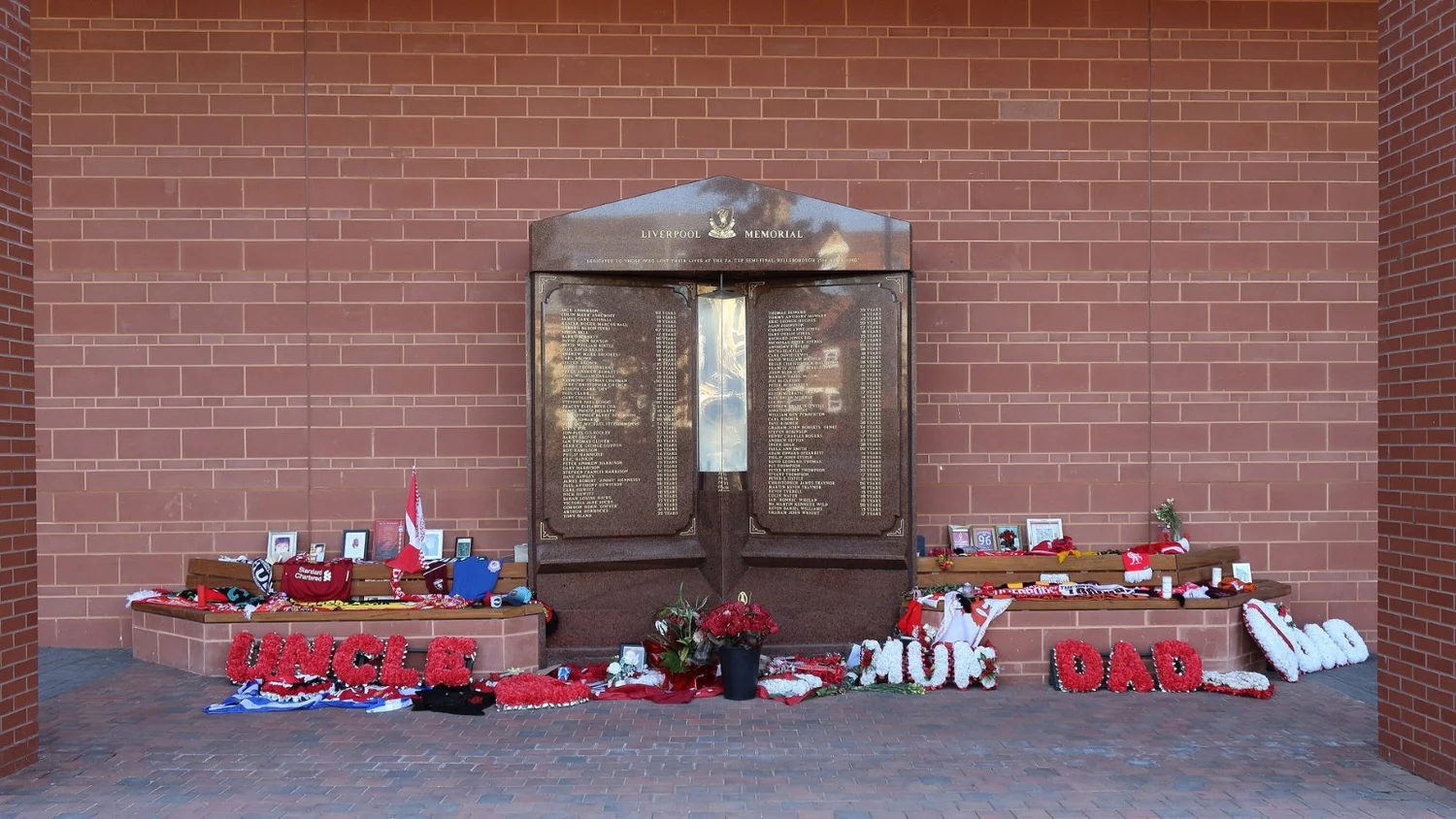
Memorials stand at Hillsborough stadium in Sheffield, unveiled on the 10th anniversary in 1999, and at Anfield, where the memorial was moved from beside the Shankly Gates in 2016 and later updated with Andrew Devine's name. There is also a memorial at Old Haymarket in Liverpool city centre and others across Merseyside.
The disaster also changed football grounds permanently. The all-seater rule that followed Taylor's report transformed the top divisions of English football, and the Sports Grounds Safety Authority still oversees safety at grounds today.
What Questions Remain?
- Accountability. A jury has found the victims were unlawfully killed, but no one has been convicted over their deaths, and the officers the IOPC says would have faced gross misconduct proceedings had retired.
- The final shape of the Hillsborough Law. The legal aid provisions and the treatment of national security are still being settled in the Lords, and the duty of candour will only matter once it is in force and tested.
- Whether the lessons have been learned. Bishop Jones has since been asked to chair a Hillsborough-style panel for nuclear test veterans, a sign that the model the panel created is still in demand.
Conclusion
Ninety-seven people went to a football match and did not come home because a crowd was allowed to flow into pens that were already full, behind fences they could not escape. That was established by the first inquiry within months. What took 27 years was getting the state to accept it. Police statements were changed, the dead were tested for alcohol and checked for criminal records, a newspaper printed lies as "the truth" and the first inquests closed the questions that mattered at 3.15pm. The families, and the independent panel that finally opened the files, overturned all of it. The 2016 jury found the victims were unlawfully killed and the fans blameless. Yet no one has been convicted for their deaths, and the law named after Hillsborough, intended to stop public bodies from closing ranks again, is still not on the statute book.
Sources
- GOV.UK: The report of the Hillsborough Independent Panel (HC 581, 12 September 2012)
- Hansard via Parallel Parliament: David Cameron's statement on Hillsborough, 12 September 2012
- National Archives Find Case Law: High Court judgment quashing the original inquests, [2012] EWHC 3783 (Admin)
- GOV.UK: Home Secretary's statement on the determinations of the Hillsborough inquests, 27 April 2016
- ITV News: Hillsborough inquests, how the jury reached their verdicts (26 April 2016)
- Judiciary of England and Wales: Sentencing remarks, R v Graham Mackrell (2019)
- Liverpool FC: Hillsborough retrial concludes (November 2019)
- IOPC: Hillsborough criminal trials
- IOPC: Hillsborough investigation, summary of findings (2 December 2025)
- ITV Granada: Andrew Devine ruled 97th victim of Hillsborough (28 July 2021)
- GOV.UK: Government pledges never to repeat the injustices of Hillsborough (6 December 2023)
- ITV Granada: Government stops short on implementing Hillsborough Law (6 December 2023)
- Independent Public Advocate: Public Office (Accountability) Bill passes through the House of Commons (July 2026)
- Brit Brief: Hillsborough Law row over legal aid funding (November 2026)
- Wikipedia: Hillsborough disaster
- Wikipedia: Taylor Report
Next Reads
- The Heysel Disaster Explained: What Happened in Brussels in 1985, Before You Watch Heysel 85
- The Aberfan Disaster Explained: What Happened in 1966, Who Was to Blame and Why It Still Matters
- The King's Cross Fire Explained: How a Dropped Match Killed 31 People on the London Underground in 1987
- The Piper Alpha Disaster Explained: What Went Wrong on the North Sea Platform and What Changed After 167 Died
- Nuclear Test Veterans Panel: What Burnham's Hillsborough-Style Inquiry Means
