How Could a Football Stand Burn Down in Four Minutes?
On the afternoon of Saturday 11 May 1985, Bradford City were playing Lincoln City at Valley Parade in the last match of the season. Shortly before half-time, a small fire was noticed under the floor at one end of the old wooden main stand. Within about four minutes, according to the Football Association's account, the stand was a burnt-out shell. Fifty-six people died: 54 Bradford City supporters and two Lincoln City supporters. Eleven of them were children. More than 200 people were injured.
The fire was not an act of nature and it did not come out of nowhere. Rubbish had been allowed to build up for years in the space beneath the wooden floor of the stand, under a roof covered in bitumen and felt. The club had been warned about it in writing the previous summer. When the fire took hold, many of the exits at the back of the stand were locked, and the people who held the keys were somewhere else.
This explainer sets out what happened at Valley Parade, why the fire spread so fast, what the official inquiry and the courts found, how the disaster changed the law on sports grounds, and how Bradford remembers the 56. It draws on Parliamentary records, the 1987 High Court judgment on liability, official statements and anniversary reporting, and notes where accounts differ.
What Happened at Valley Parade on 11 May 1985?
About 3,000 people were in the main stand that afternoon, according to the Home Secretary's statement to the Commons two days later. The stand was built largely of timber, with a wooden floor raised over a void, and a roof of bitumen and felt.
The Home Secretary, Leon Brittan, told MPs that the fire started "just before half-time, at about 3.35 pm". Other accounts put the first sighting a few minutes later, at about 3.40pm. It began under the floor at one end of the stand.
How fast it spread
At first it looked small. Then, in Brittan's words to the Commons, "the fire spread extremely rapidly". The FA has described the stand as "a burnt-out shell within four minutes". In the 1987 civil case, the judge, Sir Joseph Cantley, found that the fire had spread through the whole stand in about five minutes. Either way, people had only minutes to get out.
Some people who tried to escape through the back of the stand were trapped in a narrow passageway behind it.
The dead and injured
Two days after the fire, Brittan told the Commons that 51 people had died at the ground, two more had died in hospital and four were still missing. The final toll was 56. Hansard records more than 200 people injured that day, 60 of them still in hospital on 13 May, as well as 22 police officers and three firefighters.
According to IBTimes UK's anniversary report, the oldest victim was 86-year-old Samuel Firth, described as a founder of the club's supporters' club, and the youngest were 11 years old.
Why Did the Fire Spread So Fast?
The official inquiry, led by Mr Justice Popplewell, and the High Court judge who later decided who should pay compensation agreed on the basic sequence. A lighted match, cigarette or tobacco fell through a gap in the wooden floor of the stand and onto rubbish that had built up in the void underneath.
The 1987 judgment located the spot near seats 141 to 143. Popplewell's interim report said the fire was probably caused by "the accidental dropping of a lighted match or cigarette or tobacco on to accumulated rubbish below the stand".
The rubbish under the floor
The void beneath the floor had collected years of litter, which provided the fuel. Once the fire broke through the floor, it found a dry timber structure and a roof of bitumen and felt to carry it along the length of the stand.
Locked exits
The second factor was the exits. On 13 May 1985, Brittan told MPs that a number of people had been trapped in a narrow alley behind the stand where exit gates had been locked, in line with long-standing practice at the ground. The 1987 judgment went further. It found that many of the exits were padlocked, bolted or boarded up, that none of them was manned, that the stewards who held the keys were stationed near the players' entrance, and that there was no evacuation procedure.
No fire extinguishers
Reports at the time of the 30th anniversary said there were no fire extinguishers in the stand, reportedly for fear of vandalism. Witnesses told the judge in 1987 that extinguishers were likely to be stolen or vandalised. He concluded that, given how fast the fire spread, extinguishers would not have stopped it, though readily available ones might have slowed it.
Was the Club Warned?
Yes. The most damaging evidence in the 1987 judgment concerned warnings given in 1984, nearly a year before the fire.
- July 1984: on 4 July, an engineer from West Yorkshire Metropolitan County Council, inspecting the roof, saw debris in the voids under the stand.
- The letter: a council letter dated 18 July 1984 warned the club that "a build-up of combustible materials in the voids beneath the seats" was a fire hazard. The club passed it to its vice-chairman, and no action was taken.
- The fire service: a copy of the letter went to the fire service, which filed it without following it up.
- Safety inspectors: Health and Safety Executive inspectors visited the ground in April and August 1984. Neither visit recorded the litter under the floor.
Popplewell's interim report, as the government summarised it to Parliament, concluded that if the official safety guidance for sports grounds, known as the Green Guide, had been followed, "the tragedy would not have occurred".
What Did the Popplewell Inquiry Find?
On 13 May 1985, two days after the fire, the government appointed Mr Justice Popplewell to inquire into the events at Bradford and the events at Birmingham City's match the same day, and into how the Safety of Sports Grounds Act 1975 was working.
The interim report
The interim report was published in July 1985. It found the fire had probably been started accidentally by a dropped match, cigarette or tobacco, and made 32 recommendations, eight of them provisional. The government told Parliament on 24 July 1985 that it was acting immediately on one of the biggest gaps the report exposed.
Until then, the 1975 Act's safety-certificate regime applied only to the larger grounds. Valley Parade, in the Third Division, was outside it. The government designated the grounds of clubs in the Football League's Third and Fourth Divisions, and of the top two divisions of rugby league, under the Act. The orders were laid on 19 July 1985 and took effect on 9 August.
The final report
Popplewell's final report followed in January 1986, with 15 further recommendations. On 16 January 1986 the Home Secretary, Douglas Hurd, told the Commons that sports grounds with a capacity of more than 10,000 would be designated. The government accepted in principle that controls should be extended to stands holding more than 500 people, and said fire legislation "may well prove necessary".
Who Was Held Responsible?
The inquest recorded a verdict of misadventure, as West Yorkshire Police later noted. The question of who was responsible was settled in the civil courts.
In Fletcher and others v Bradford City AFC (1983) Ltd and others, decided on 23 February 1987, Sir Joseph Cantley, sitting as a deputy High Court judge, found both the club and the county council liable to the victims and their families. He apportioned the blame "two-thirds on the first defendant", the club, and "one-third on the third defendant", West Yorkshire Metropolitan County Council. The claim against the Health and Safety Executive failed.
Analysis: The judgment captures the pattern behind many disasters of the period. The hazard was known, it was written down, and the letter went to the right people. But nobody treated it as urgent, and the bodies that might have checked each assumed someone else would act.
How Did Bradford Change the Law?
The Popplewell recommendations led directly to legislation. The Fire Safety and Safety of Places of Sport Act 1987 extended safety controls to stands at grounds that had previously fallen outside the 1975 regime. Part III of the Act deals specifically with the "Safety of Stands at Sports Grounds".
That closed the gap the government had promised in January 1986 to deal with: stands at grounds that were too small to need a safety certificate. Bradford was followed by Heysel later in May 1985 and Hillsborough in 1989, and together the three disasters reshaped how British football grounds are built and run.
Who Saw It Happen?
Yorkshire Television had cameras at Valley Parade to record the match for highlights, with John Helm as commentator. When the fire broke out, the pictures were shown live on ITV's World of Sport, according to the Sports Journalists' Association. Helm's words, "That is a catastrophic sight", became part of how the country remembered the day.
What Was the Bradford Burns Unit?
The injured were treated at Bradford Royal Infirmary, where the consultant plastic surgeon David Sharp led the response. According to the University of Bradford, he treated 258 burns patients after the fire.
The fire led to the founding of the Plastic Surgery and Burns Research Unit, a partnership between the hospital's plastic surgery department and the University of Bradford, often called the Bradford Burns Unit. Its work on hand injuries after the fire helped lead to a treatment device known as the Bradford Sling. Professor Sharp OBE retired in 2014.
Why Was the Cause Questioned in 2015?
In 2015, the 30th anniversary year, Martin Fletcher, who lost his father, brother, uncle and grandfather in the fire, published a book, Fifty-Six: The Story of the Bradford Fire. According to the Guardian's report, republished by the Irish Times, the book set out a history of earlier fires at businesses linked to the club's then chairman, who died in 1995. The report said the book made no direct allegations, but Fletcher argued that this history warranted further investigation.
The response was firm. Sir Oliver Popplewell, who led the original inquiry, said the fire was "undoubtedly" accidental, and described the claims as "nonsense". The chairman's son dismissed them. A fire investigator, Nigel Adams, called for a fresh investigation.
West Yorkshire Police noted that the inquest had returned a verdict of misadventure and said that if evidence emerged that had not been available to the coroner, it would consider its significance and take appropriate action. That was a conditional statement, not a reopening. The force also referred Fletcher's concerns about the original police handling to the Independent Police Complaints Commission, which declined to investigate, finding no indication of potential misconduct by individual officers. It recommended that the force consider releasing more of its records.
The official findings stand: the inquiry and the court both concluded that the fire was started accidentally. Nothing in this article suggests otherwise.
How Is Bradford Remembered?
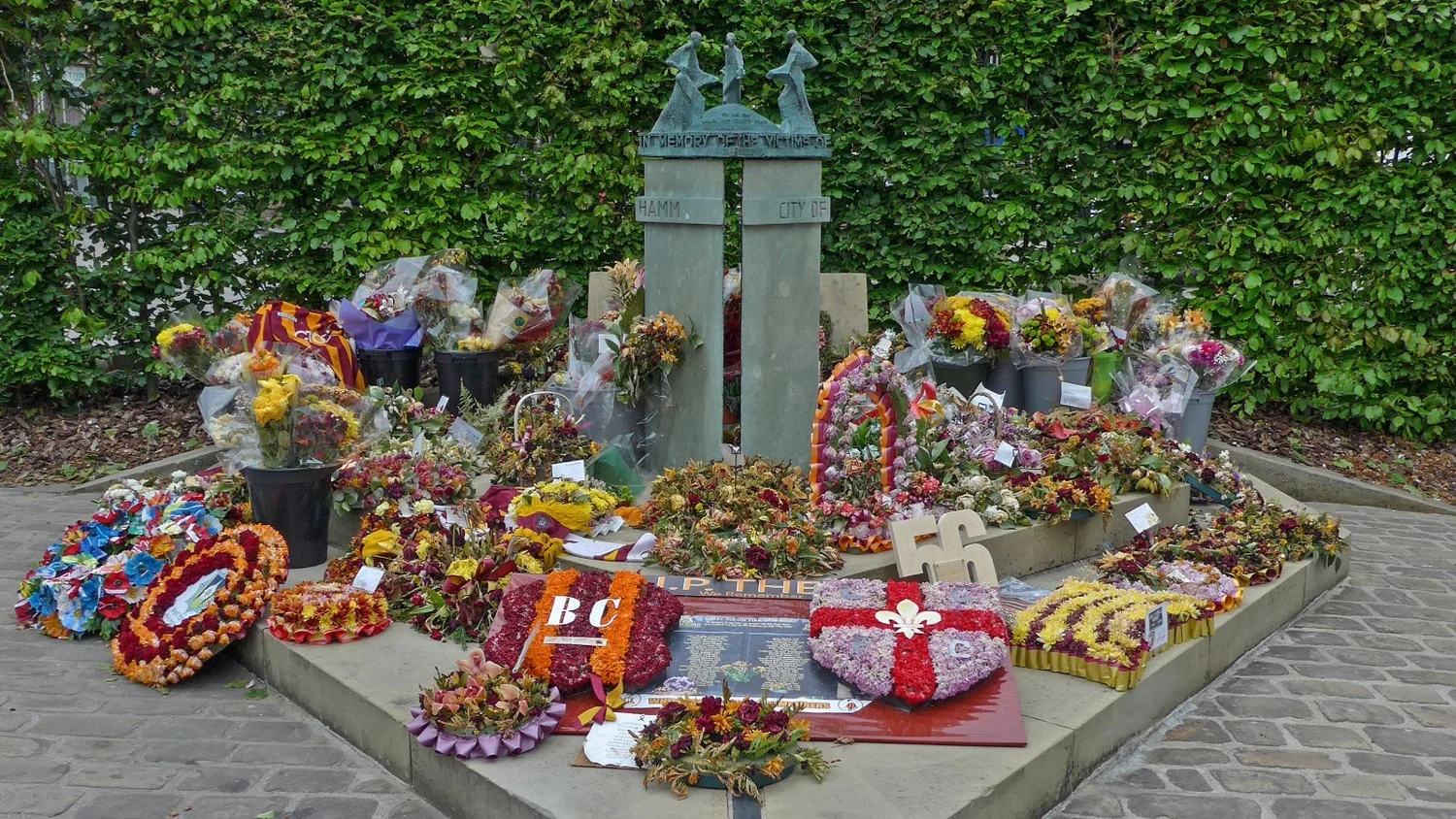
A memorial sculpture to the 56 stands in Centenary Square in Bradford city centre, where the main anniversary services are held.
At the 30th anniversary in 2015, more than 1,000 people gathered in the square. The names of the 56 were read aloud as the City Hall bell tolled, by readers including John Helm, Phil Parkinson and Stephen Darby.
On Sunday 11 May 2025, the 40th anniversary, a service was held at the memorial at about 11am. A bell tolled 56 times, a brass band played "You'll Never Walk Alone", wreaths were laid, including by firefighters from West Yorkshire Fire and Rescue Service, and the mayor, Beverley Mullaney, spoke. That evening BBC Two broadcast the documentary Unforgotten: The Bradford City Fire.
What Questions Remain?
- Why the warning was ignored. The 1984 letter named the exact hazard that caused the disaster. The court found the club took no action, and the fire service filed its copy without follow-up.
- The 2015 doubts. The book raised questions, but the inquiry judge rejected them and police said only that they would consider genuinely new evidence. No new investigation has been opened.
- Whether the lessons last. Analysis: the 1987 Act and the certificate system it extended exist to stop a stand in that condition from being filled again. Their value depends on continued inspection and enforcement.
Conclusion
The Bradford City fire took about four minutes to destroy an old wooden stand, and it killed 56 people who had gone to watch the last game of the season. A dropped match or cigarette was the spark, but the disaster was built in advance: years of rubbish under a timber floor, a roof of bitumen and felt, a written warning in July 1984 that produced no action, and exits that were locked while the keys were elsewhere. The Popplewell inquiry and the 1987 judgment set that out clearly, holding the club and the county council liable. The law that followed brought smaller grounds and individual stands into a safety regime that should have covered them already. In Centenary Square, and every May, Bradford still reads the 56 names.
Sources
- Hansard: Football Grounds, House of Commons, 13 May 1985
- Hansard: Sports Grounds (Safety and Control), House of Commons, 24 July 1985
- Hansard: Sports Grounds (Popplewell Report), House of Commons, 16 January 1986
- Hansard: Football Grounds (Deaths), written answer, 7 November 1989
- legislation.gov.uk: Fire Safety and Safety of Places of Sport Act 1987
- Court transcript: Fletcher and others v Bradford City AFC (1983) Ltd and others, 23 February 1987 (hosted by bradfordcityfire.co.uk)
- The FA: The FA remembers the Bradford City fire disaster (11 May 2025)
- West Yorkshire Fire and Rescue Service: WYFRS honours 56
- University of Bradford: Burns Unit marks anniversary (2021)
- Sports Journalists' Association: Sports broadcasting, May 1985
- Irish Times (Guardian): Bradford fire judge dismisses new claims about disaster (16 April 2015)
- Irish Times: Expert calls for new investigation into Bradford fire (22 April 2015)
- Ahram Online (AFP): Police will consider fresh evidence into 1985 Bradford fire (2015)
- Huddersfield Examiner: No Independent Police Complaints Commission investigation into Bradford fire
- Irish Times: More than 1,000 people gather to mark 30th anniversary of Bradford fire (2015)
- LBC: Hundreds gather to mark 40 years since Bradford City fire (12 May 2025)
- IBTimes UK: Bradford City stadium fire 30th anniversary, remembering the 56 (2015)
- Wikipedia: Bradford City stadium fire
Next Reads
- The Heysel Disaster Explained: What Happened in Brussels in 1985, Before You Watch Heysel 85
- The Hillsborough Disaster Explained: What Happened in 1989, the Cover-Up and the 27-Year Fight for the Truth
- The King's Cross Fire Explained: How a Dropped Match Killed 31 People on the London Underground in 1987
- The Zeebrugge Ferry Disaster Explained: Why the Herald of Free Enterprise Capsized in 1987 and No One Was Convicted
- The Aberfan Disaster Explained: What Happened in 1966, Who Was to Blame and Why It Still Matters
